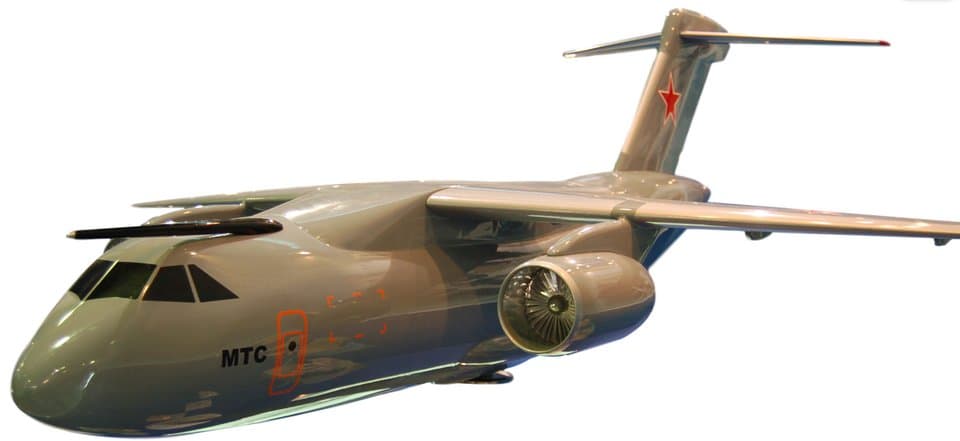


Credit
Allocer · CC BY-SA 3.0 · Resized · CC BY-SA 3.0 · Source ↗ · Modified


Preparing your view.

At a glance
Measured figures
Length
Single source37.7 m (123 ft 8 in)[source]
Kawasaki C-1 · Length
Single sourceConfiguration
| Specification | Ilyushin Il-276 | Kawasaki C-1 |
|---|---|---|
| Type | Military transport aircraft[source] | Military transport aircraft[source] |
| Manufacturer | United Aircraft Corporation[source] | Kawasaki Heavy Industries[source] |
| Status | Under development[source] | Retired[source] |
| Primary user | Russian Aerospace Forces[source] | Japan Air Self-Defense Force |
29 m (95 ft 2 in)[source]
Cruise; Cruise speed
Single sourceMaximum; Maximum speed
Single source870 km/h (540 mph, 470 kn)[source]
800 km/h (500 mph, 430 kn)[source]
Cruise; Kawasaki C-1 · at 10,670 m (35,010 ft) at 35,450 kg (78,150 lb)
Single sourceMaximum; Kawasaki C-1 · at 7,620 m (25,000 ft) at 35,450 kg (78,150 lb)
Single sourceFerry; Ferry range
Single sourcewith payload of 20,000 kilograms (44,000 lb)
Single source2,000 km (1,200 mi, 1,100 nmi) with payload of 20,000 kilograms (44,000 lb)[source]
7,300 km (4,500 mi, 3,900 nmi)[source]
Kawasaki C-1 · with max fuel & 2,300 kg (5,100 lb) payload
Single source3,353 km (2,083 mi, 1,810 nmi) with max fuel & 2,300 kg (5,100 lb) payload[source]
2 × Aviadvigatel PD-14M turbofan engines thrust each
Single source2 × Aviadvigatel PD-14M turbofan engines, 152.98 kN (34,392 lbf) thrust each[source]
Kawasaki C-1 · 2 × Pratt & Whitney JT8D -M-9 ( Mitsubishi -built) low-bypass turbofans thrust each
Single source2 × Pratt & Whitney JT8D -M-9 ( Mitsubishi -built) low-bypass turbofans , 64 kN (14,500 lbf) thrust each[source]
Payload
Single source20,000 kilograms (44,000 lb)[source]
Kawasaki C-1 · (3,494 ft/min) at sea level
Single source17.75 m/s (3,494 ft/min) at sea level[source]
Bars compare reported quantities only. A larger figure does not make a system better; configurations and test conditions differ.
| Introduction date | Under development[source] | December 1974[source] |
|---|
| First flight | Sometime in 2026[source] | 12 November 1970[source] |
|---|
| Capacity | 70 to 150 passengers[source] | 8,000 kg (18,000 lb) normal payload[source] |
|---|
| Fuel capacity | 30,700 kilograms (67,700 lb)[source] | 15,200 L (4,000 US gal; 3,300 imp gal) in 4 integral tanks in the wings[source] |
|---|
| Takeoff run | 1,050 metres (3,440 ft)[source] | — |
|---|
| Landing run | 1,050 metres (3,440 ft)[source] | — |
|---|
| Country of origin | Russia, India[source] | Japan[source]Inventory Origin column; table 2, row 41, cell 2; revision 1359403478 |
|---|
| National origin | — | Japan[source] |
|---|
| Number built | — | 31[source] |
|---|
| Retired | — | 15 March 2025[source] |
|---|
| Aspect ratio | — | 7.8[source] |
|---|
| Wing loading | — | 321.2 kg/m 2 (65.8 lb/sq ft)[source] |
|---|
| Thrust/weight | — | 0.003 kN/kg (0.34 lbf/lb)[source] |
|---|
| Role | — | twin-engined short-range military transport aircraft[source] |
|---|
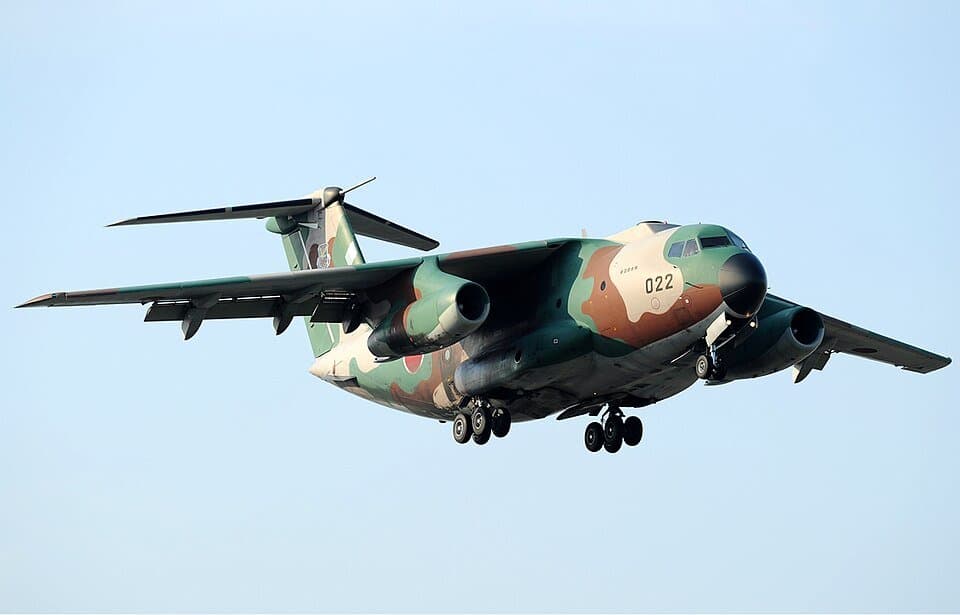
| Source measurement | — | Development of the C-1 commenced in 1966 in response to a requirement from the JASDF, which sought an indigenous jet-powered replacement for its aging Second World War –era Curtiss C-46 Commando transport fleet. First flown on 12 November 1970, quantity production of the type commenced during the following year. The C-1 has formed the backbone of the JASDF's transport capability throughout the latter half of the twentieth century and the initial years of the twenty-first century as well. During the 2010s, Kawasaki developed a newer, larger, and longer-range airlifter, the Kawasaki C-2 , which will eventually replace the JASDF's C-1 fleet entirely.[source]Kawasaki C-1 · Lead; only the objects and conditions stated in this passage In terms of its basic configuration, the C-1 is a twin-engine medium-range airlifter, somewhat resembling the larger Lockheed C-141 Starlifter . It is powered by a pair of Pratt & Whitney JT8D -M-9 low-bypass turbofan engines, which were locally manufactured under license by Mitsubishi, each capable of generating up to 64 kN (14,500 lbf) of thrust. In terms of payload capacity, a single C-1 could carry up to 80 fully-equipped troops, 45 paratroopers , or 36 stretcher-bound personnel, in addition to bulky cargo, including a whole truck or a pair of jeeps , which would be loaded via a ramp deployed at the airlifter's rear. It was designed to be typically operated by a crew of five, comprising two pilots, a flight engineer , a navigator , and a loadmaster. The C-1 incorporates a high-lift system, which includes aerodynamic features such as a leading edge slat and a four-stage Fowler flap , facilitates a high level of short takeoff and landing (STOL) performance, while day-and-night all-weather operations are achieved via the application of numerous electronic navigation systems.[source]Kawasaki C-1 · Design and development; only the objects and conditions stated in this passage The maximum range of C-1 caused a problem after the island of Okinawa was returned to Japan from the United States; the airlifter was unable to fly directly to Okinawa from most parts of the Japanese home islands. This may have been a factor in the decision to reduce the planned procurement of the C-1 in favour of the American-built C-130H Hercules utility transport aircraft instead, which entered service with the JASDF's 401st Tactical Airlift Squadron in 1989. Another reason for the curtailment was the enactment of general cutbacks upon various military programmes and procurement initiatives during the 1970s.[source]Kawasaki C-1 · Design and development; only the objects and conditions stated in this passage The last five C-1s ordered were fitted with an additional 4,730-litre fuel tank.[source]Kawasaki C-1 · Variants; only the objects and conditions stated in this passage Two C-1s of the 401st Tactical Airlift Squadron crashed near Toba, Mie when the lead two airplanes of a formation of 5 en route from Komaki Air Base to Iruma Air Base flew into a hill while flying in low visibility at low altitude. A third airplane narrowly avoided also crashing and struck trees, but was able to return to Komaki Air Base. Fourteen personnel were killed in these two aircraft, six personnel in airplane 68-1015 and eight in aircraft 58–1009.[source]Kawasaki C-1 · Accidents; only the objects and conditions stated in this passage A C-1 crashed into the sea of Japan's west coast during a test flight with five personnel on board. There were no survivors.[source]Kawasaki C-1 · Accidents; only the objects and conditions stated in this passage Capacity: 8,000 kg (18,000 lb) normal payload[source]Kawasaki C-1 · Specifications (Kawasaki C-1); only the objects and conditions stated in this passage Length: 29 m (95 ft 2 in)[source]Kawasaki C-1 · Specifications (Kawasaki C-1); only the objects and conditions stated in this passage Wingspan: 30.6 m (100 ft 5 in)[source]Kawasaki C-1 · Specifications (Kawasaki C-1); only the objects and conditions stated in this passage Height: 9.99 m (32 ft 9 in)[source]Kawasaki C-1 · Specifications (Kawasaki C-1); only the objects and conditions stated in this passage Wing area: 120.5 m 2 (1,297 sq ft)[source]Kawasaki C-1 · Specifications (Kawasaki C-1); only the objects and conditions stated in this passage Empty weight: 23,220 kg (51,191 lb)[source]Kawasaki C-1 · Specifications (Kawasaki C-1); only the objects and conditions stated in this passage Max takeoff weight: 38,700 kg (85,319 lb)[source]Kawasaki C-1 · Specifications (Kawasaki C-1); only the objects and conditions stated in this passage Powerplant: 2 × Pratt & Whitney JT8D -M-9 ( Mitsubishi -built) low-bypass turbofans , 64 kN (14,500 lbf) thrust each[source]Kawasaki C-1 · Specifications (Kawasaki C-1); only the objects and conditions stated in this passage Maximum speed: 806 km/h (501 mph, 435 kn) at 7,620 m (25,000 ft) at 35,450 kg (78,150 lb)[source]Kawasaki C-1 · Specifications (Kawasaki C-1); only the objects and conditions stated in this passage Cruise speed: 657 km/h (408 mph, 355 kn) at 10,670 m (35,010 ft) at 35,450 kg (78,150 lb)[source]Kawasaki C-1 · Specifications (Kawasaki C-1); only the objects and conditions stated in this passage Range: 3,353 km (2,083 mi, 1,810 nmi) with max fuel & 2,300 kg (5,100 lb) payload[source]Kawasaki C-1 · Specifications (Kawasaki C-1); only the objects and conditions stated in this passage Service ceiling: 11,580 m (37,990 ft)[source]Kawasaki C-1 · Specifications (Kawasaki C-1); only the objects and conditions stated in this passage Rate of climb: 17.75 m/s (3,494 ft/min) at sea level[source]Kawasaki C-1 · Specifications (Kawasaki C-1); only the objects and conditions stated in this passage |
|---|