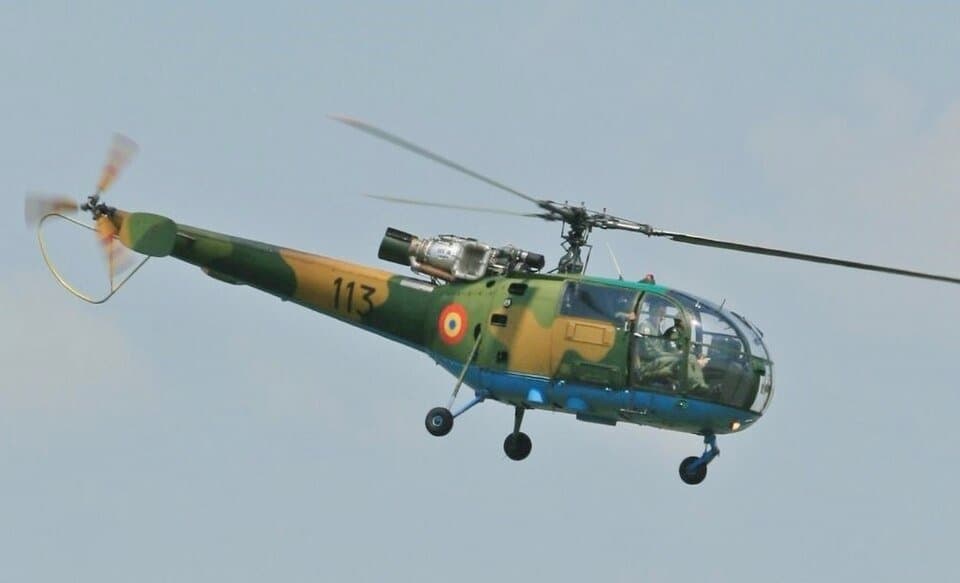

Credit
Adrian Sultănoiu · CC BY-SA 3.0 · Resized · CC BY-SA 3.0 · Source ↗ · Modified


Preparing your view.

BHelicopters
British helicopter operator, specialising in providing offshore helicopter transportation services to North Sea offshore platforms
Measured figures
IAR 316 · Length
Single source12.82 m (42 ft 1 in)[source]
Configuration
| Specification | IAR 316 | Offshore Helicopter Services |
|---|---|---|
| Type | Light utility /training helicopter[source] | — |
| Manufacturer | Industria Aeronautică Română[source] | — |
| Status | operational for training purposes[source] | — |
| Primary user | Romanian Air Force[source] | — |
| Number built | 250[source] | — |
| Manufactured | 1971-1987[source] |
IAR 316 · 3 ×
Single source3 × 11.02 m (36 ft 2 in)[source]
IAR 316 · Height
Single source2.97 m (9 ft 9 in)[source]
IAR 316 · Range
Single source540 km (340 mi, 290 nmi)[source]
IAR 316 · 1 × Turbomeca Artouste IIIB turboshaft
Single source1 × Turbomeca Artouste IIIB turboshaft, 425 kW (570 hp)[source]
IAR 316 · Service ceiling
Single source3,200 m (10,500 ft)[source]
IAR 316 · 852 ft/min
Single source4.33 m/s (852 ft/min)[source]
Bars compare reported quantities only. A larger figure does not make a system better; configurations and test conditions differ.
| — |
| Introduction date | 1971[source] | — |
|---|
| Developed from | Aérospatiale Alouette III[source] | — |
|---|
| Capacity | 5 passengers[source] | — |
|---|
| Fuel capacity | 550 kg (1,210 lb) maximum[source] | — |
|---|
| Fuselage width | 2.6 m (8 ft 6 in)[source] | — |
|---|
| Main rotor area | 95.4 m 2 (1,027 sq ft)[source] | — |
|---|
| Hardpoints | 2 hardpoints for anti-tank guided missiles[source] | — |
|---|
| National origin | Romania[source] | United Kingdom[source] |
|---|
| Country of origin | Romania[source] | — |
|---|
| Role | — | British helicopter operator, specialising in providing offshore helicopter transportation services to North Sea offshore platforms[source] |
|---|
| Source measurement | — | OHS operates a mixed fleet of helicopters on behalf of a small number of energy industry customers. Annually they transport around 200,000 passengers to and from offshore oil and gas platforms from bases at Aberdeen and Sumburgh airports. OHS also operates two specialist Search and Rescue (SAR) aircraft to support the Oil and Gas industry. These two AW139 helicopters are based at Aberdeen airport and equipped with specialist search and rescue equipment and provide 24-hour SAR coverage for the central North Sea.[source]Offshore Helicopter Services · Lead; only the objects and conditions stated in this passage Mission Critical Services Offshore is based in Aberdeen , Scotland with additional operations located in Sumburgh. The company opened a new terminal – Terminal 2 – in Aberdeen in 2014, initially serving Nexen passengers. In 2015, the company opened a major new hangar at Aberdeen airport to accommodate its fleet. The 21,000 square feet (2,000 m 2 ) hangar at the east side of the airport is used as both a maintenance and storage facility for S-92, H175, AW139 and AS365N3 helicopters.[source]Offshore Helicopter Services · History / Offices; only the objects and conditions stated in this passage 18 February 2009 – G-REDU, an EC225 LP. During a night visual approach to the Eastern Trough Area Project platform, the helicopter descended and impacted the surface of the sea. The crew's perception of the position and orientation of the helicopter relative to the platform during the final approach was erroneous. All 18 people on board survived the controlled flight into terrain (water) .[source]Offshore Helicopter Services · Accidents and incidents; only the objects and conditions stated in this passage 1 April 2009 – G-REDL, a Eurocopter AS332 L2 Super Puma Mk 2, returning from the Miller oilfield went down in the North Sea, 40 miles northeast of Aberdeen, killing all sixteen on board. Preliminary cause was attributed to a catastrophic failure in the main gearbox.[source]Offshore Helicopter Services · Accidents and incidents; only the objects and conditions stated in this passage 10 May 2012 – G-REDW, a Bond Eurocopter EC225 Super Puma , travelling to the Conocophillips operated Joanne and Judy fields made a controlled ditching into the North Sea following a radio report of a low oil pressure light. All 14 people were rescued from the helicopter liferaft, 9 were airlifted to Aberdeen Royal Infirmary while the remaining five were brought to Aberdeen by lifeboat. On 15 June 2012 helicopter manufacturer Eurocopter cleared Bond Offshore Helicopters of any blame for the ditching of G-REDW. On 17 October 2012 AAIB concluded in their S5/2012 report that a faulty design of the Emergency Lubrication System was the most likely cause of the warnings that led to the ditching of G-REDW and recommended "Eurocopter to review the design of the main gearbox emergency lubrication system on the EC225 LP Super Puma to ensure that the system will provide the crew with an accurate indication of its status when activated".[source]Offshore Helicopter Services · Accidents and incidents; only the objects and conditions stated in this passage 17 February 2023 – G-MCSH, an Airbus Helicopters H175 , flew 130 miles (210 km) to the Elgin-Franklin complex east of Aberdeen. The aircraft landed safely but an illuminated tail rotor chip light prevented it from departing for its return journey. While the helicopter was parked on the helipad, gusts from Storm Otto , which reached over 100 mph (160 km/h), snapped off three of its five blades close to the root. Industry sources advise that the rotor brake failed to hold the main blades from windmilling before they had been tied down, resulting in the loss of two of the broken blades into the north sea, while another hit the cockpit.[source]Offshore Helicopter Services · Accidents and incidents; only the objects and conditions stated in this passage |
|---|