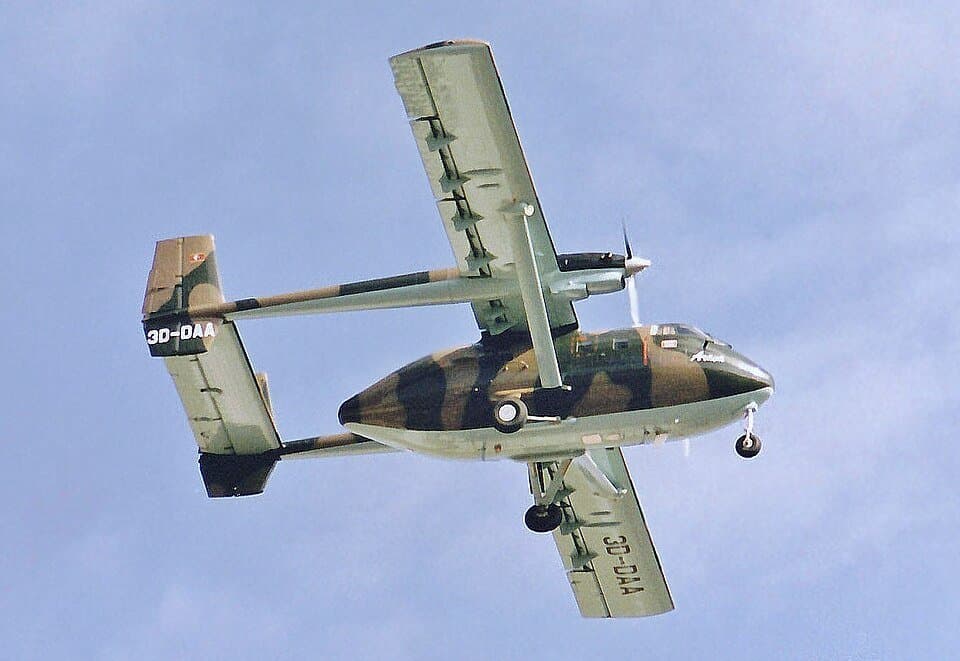

Credit
Bob Adams from George, South Africa · CC BY-SA 2.0 · Resized · CC BY-SA 2.0 · Source ↗ · Modified


Preparing your view.

At a glance
True scale
Side by side. From every angle. A human reference for perspective.
3.25 MB · Loads when you open it| Model | Length | Width / span | Height |
|---|---|---|---|
| IAI Arava | ≈ 13.03 m | ≈ 20.96 m (Width) | ≈ 5.21 m |
| Short 330 | ≈ 17.69 m | ≈ 22.76 m (Width) | ≈ 4.95 m |
Scaled uniformly to the sourced length of 13.03 m. The shape was turned square to the axes; the height was fitted to the sourced 5.21 m; the width was fitted to the sourced 20.96 m. Not an official model or a measured survey.
ForceTally · All rights reserved
Scaled uniformly to the sourced length of 17.69 m. The shape was turned square to the axes; the height was fitted to the sourced 4.95 m; the width was fitted to the sourced 22.76 m. Not an official model or a measured survey.
ForceTally · All rights reserved
The human reference is a generic 1.75 m figure. Models describe external size, not combat performance.
Measured figures
IAI 201 · Length
Single source13.03 m (42 ft 9 in)[source]
330-200 · Length
Single sourceConfiguration
| Specification | IAI Arava | Short 330 |
|---|---|---|
| Type | Light STOL Transport aircraft[source] | Transport aircraft[source] |
| Manufacturer | Israeli Aircraft Industries[source] | Short Brothers[source] |
| Status | Out of production, limited use[source] | In limited cargo service[source] |
| Primary users | Israeli Air Force (IAF) 14 other militaries[source] | Air Cargo Carriers Corporate Air |
17.69 m (58 ft 0 in)[source]
Cruise; IAI 201 · at 3,050 m (10,000 ft) (econ. cruise)
Single sourceMaximum; IAI 201 · at 3,050 m (10,000 ft)
Single source326 km/h (203 mph, 176 kn) at 3,050 m (10,000 ft)[source]
311 km/h (193 mph, 168 kn) at 3,050 m (10,000 ft) (econ. cruise)[source]
Cruise; 330-200 · (econ cruise at 3,000 m (10,000 ft))
Single sourceMaximum; 330-200 · (max cruise at 3,000 m (10,000 ft))
Single sourceIAI 201 · 2 × Pratt & Whitney Canada PT6A-34 turboprops (750 shp) each
Single source2 × Pratt & Whitney Canada PT6A-34 turboprops , 560 kW (750 shp) each[source]
330-200 · 2 × Pratt & Whitney Canada PT6 A-45-R turboprop (1,198 shp) each
Single source2 × Pratt & Whitney Canada PT6 A-45-R turboprop , 893 kW (1,198 shp) each[source]
Bars compare reported quantities only. A larger figure does not make a system better; configurations and test conditions differ.
| Number built | 103[source] | 330-100: 68 330-200: 73[source] |
|---|
| Manufactured | 1972–1988[source] | 1974–1992[source] |
|---|
| First flight | 27 November 1969[source] | 22 August 1974[source] |
|---|
| Capacity | 24 fully equipped troops or 16 paratroopers or 2,351 kg (5,183 lb) payload[source] | — |
|---|
| Aspect ratio | 10:1[source] | — |
|---|
| Airfoil | NACA 63(215)A 417[source] | NACA 63A series (modified)[source] |
|---|
| Fuel capacity | 1,663 L (439 US gal; 366 imp gal) (normal)[source] | 2,546 L (560 imp gal; 673 US gal)[source] |
|---|
| Propellers | 3-bladed Hartzell HC-B3TN fully-feathering reversible pitch propellers[source] | 5-bladed Hartzell constant-speed[source] |
|---|
| Stall speed | 115 km/h (71 mph, 62 kn) (54% flaps)[source] | 135 km/h (84 mph, 73 kn) (landing gear and flaps down)[source] |
|---|
| Never exceed speed | 397 km/h (247 mph, 214 kn)[source] | — |
|---|
| Takeoff distance to 15 m (50 ft) | 463 m (1,520 ft)[source] | — |
|---|
| Landing run from 15 m (50 ft) | 469 m (1,540 ft)[source] | — |
|---|
| Role | light STOL utility transport aircraft[source] | — |
|---|
| Source measurement | According to aviation journalist and ex-IAI engineer Danny Shalom, substantial work on the development of what would become the Arava commenced right after the Six-Day War between Israel and several neighbouring nations. Prior to this point, Israel Aerospace Industries (IAI) had largely confined its aircraft manufacturing efforts to producing copies of existing French and American designs, such as the IAI Nesher . However, many of the company's engineers were keen to develop beyond imitation and reverse engineering effort, for IAI and Israel to produce its own unique and indigenously produced aircraft. Around this time, the company foresaw a requirement for a new generation of transport aircraft that would suit operations from runways only 400 meters in length. IAI had forecast the international market demand for such an aircraft to be massive and that, by obtaining only a 20% market share, the company would sell between 400 and 600 aircraft throughout the life of the programme.[source]IAI Arava · Design and development / Origins; only the objects and conditions stated in this passage As the design took shape, key performance objectives included Short-Takeoff and Landing (STOL) capability, the ability to operate the type from unprepared/rough airstrips, as well as the carriage of up to 20 passengers or bulky payloads. The Arava featured a barrel -like fuselage , being relatively short but wide, while the rear of the fuselage was hinged and could swing open for easy and rapid loading and unloading. Its wingspan was long and the twin tails were mounted on booms that ran from the engine nacelles . It was fitted with a fixed nosewheel undercarriage to save weight, while the chosen powerplant was a pair of 715 eshp (533 kW) Pratt & Whitney Canada PT6 A-27 turboprop engines. The design configuration bore considerable similarity to the French Nord Noratlas transport plane, which was already being used at that time by the Israeli Air Force (IAF).[source]IAI Arava · Design and development / Origins; only the objects and conditions stated in this passage Civil passenger aircraft for up to 20 people in airline-standard configuration or up to 12 passengers in VIP configuration[source]IAI Arava · Variants; only the objects and conditions stated in this passage The military version could also be equipped with a range of weapons, in order to act in anti-submarine- or gunship roles. The weapon configuration could include two machine guns in fuselage side packs (usually 0.5" Browning), plus a third gun on the rear fuselage, and two pods containing 6 x 82 mm rocket pods or torpedoes or sonar buoys on the fuselage sides.[source]IAI Arava · Variants; only the objects and conditions stated in this passage Bolivian Air Force – Six purchased 1975–76. One seized by Nicaragua during delivery, one in use 1987.[source]IAI Arava · Operators; only the objects and conditions stated in this passage Ecuadorian Army – 2 in use as of December 2018. One other aircraft E-206 was written off due to a crash[source]IAI Arava · Operators; only the objects and conditions stated in this passage Salvadoran Air Force – 3 in use as of December 2015, variant IAI Arava 202 since 2008.[source]IAI Arava · Operators; only the objects and conditions stated in this passage Guatemalan Air Force – 1 in use as of December 2015.[source]IAI Arava · Operators; only the objects and conditions stated in this passage Honduran Air Force – 1 in use as of December 2018.[source]IAI Arava · Operators; only the objects and conditions stated in this passage Papua New Guinea Defence Force – 3 in use as of December 2015 but since retired.[source]IAI Arava · Operators; only the objects and conditions stated in this passage Army of Venezuela – 11 in use as of December 2015, reducing to 4 by December 2018.[source]IAI Arava · Operators; only the objects and conditions stated in this passage Capacity: 24 fully equipped troops or 16 paratroopers or 2,351 kg (5,183 lb) payload[source]IAI Arava · Specifications (IAI 201); only the objects and conditions stated in this passage Length: 13.03 m (42 ft 9 in)[source]IAI Arava · Specifications (IAI 201); only the objects and conditions stated in this passage Wingspan: 20.96 m (68 ft 9 in)[source]IAI Arava · Specifications (IAI 201); only the objects and conditions stated in this passage Height: 5.21 m (17 ft 1 in)[source]IAI Arava · Specifications (IAI 201); only the objects and conditions stated in this passage Wing area: 43.68 m 2 (470.2 sq ft)[source]IAI Arava · Specifications (IAI 201); only the objects and conditions stated in this passage Empty weight: 3,999 kg (8,816 lb)[source]IAI Arava · Specifications (IAI 201); only the objects and conditions stated in this passage Max takeoff weight: 6,804 kg (15,000 lb)[source]IAI Arava · Specifications (IAI 201); only the objects and conditions stated in this passage Powerplant: 2 × Pratt & Whitney Canada PT6A-34 turboprops , 560 kW (750 shp) each[source]IAI Arava · Specifications (IAI 201); only the objects and conditions stated in this passage Maximum speed: 326 km/h (203 mph, 176 kn) at 3,050 m (10,000 ft)[source]IAI Arava · Specifications (IAI 201); only the objects and conditions stated in this passage Cruise speed: 311 km/h (193 mph, 168 kn) at 3,050 m (10,000 ft) (econ. cruise)[source]IAI Arava · Specifications (IAI 201); only the objects and conditions stated in this passage Stall speed: 115 km/h (71 mph, 62 kn) (54% flaps)[source]IAI Arava · Specifications (IAI 201); only the objects and conditions stated in this passage Never exceed speed : 397 km/h (247 mph, 214 kn)[source]IAI Arava · Specifications (IAI 201); only the objects and conditions stated in this passage Range: 1,056 km (656 mi, 570 nmi) with maximum fuel[source]IAI Arava · Specifications (IAI 201); only the objects and conditions stated in this passage Service ceiling: 7,620 m (25,000 ft)[source]IAI Arava · Specifications (IAI 201); only the objects and conditions stated in this passage Rate of climb: 6.6 m/s (1,290 ft/min)[source]IAI Arava · Specifications (IAI 201); only the objects and conditions stated in this passage Takeoff distance to 15 m (50 ft): 463 m (1,520 ft)[source]IAI Arava · Specifications (IAI 201); only the objects and conditions stated in this passage Landing run from 15 m (50 ft): 469 m (1,540 ft)[source]IAI Arava · Specifications (IAI 201); only the objects and conditions stated in this passage | — |
|---|
| Country of origin | Israel[source] | — |
|---|
| National origin | — | United Kingdom[source] |
|---|
| Introduction date | — | 1976[source] |
|---|
| Developed from | — | Short Skyvan[source] |
|---|
| Variant | — | C-23A Sherpa[source] |
|---|
| Developed into | — | Short 360[source] |
|---|