
FORCETALLY
Loading the evidence…
Preparing your view.


Preparing your view.

At a glance
Hwasong-11Elarger figure on 1 of 3
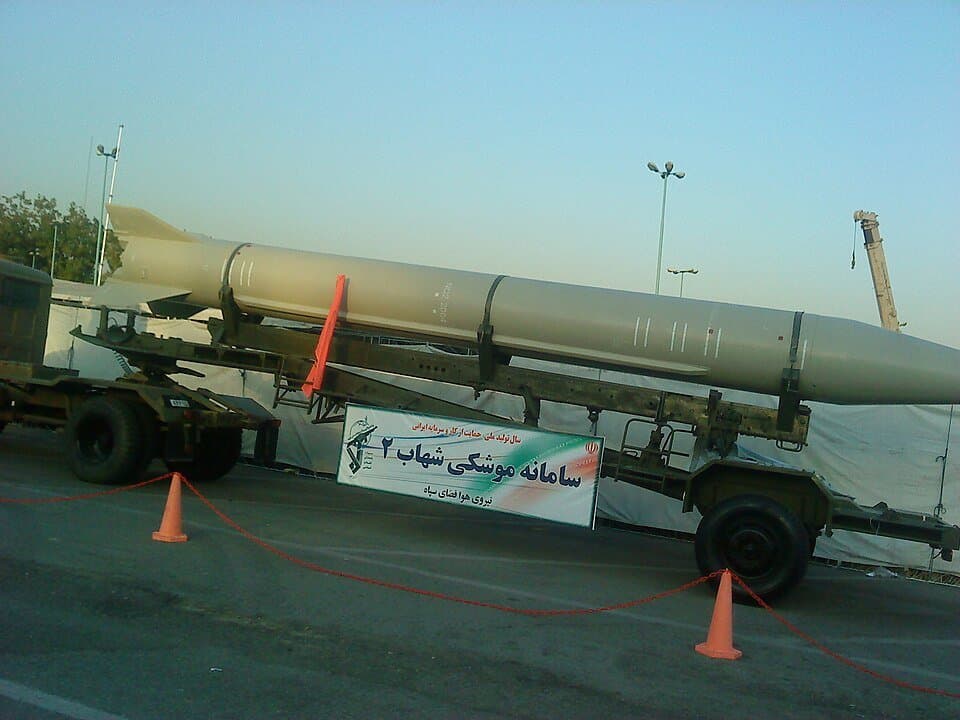
Shahab-2larger figure on 2 of 3
Counts only measures both sources give with the same scope. A larger figure is not a better system.
Measured figures
Length
Single source7.3–9.8 m (24–32 ft)[source]
Length
Single sourceConfiguration
| Specification | Hwasong-11E | Shahab-2 |
|---|---|---|
| Type | Short-range or medium-range ballistic missile[source] | Tactical SRBM[source] |
| Place of origin | North Korea[source] | — |
| In service | 2026–present[source] | 1990–2016 (in Iran); present (in Syria)[source] |
| Designed | 2025[source] | — |
| Manufacturer | North Korea[source] |
11.37–12.29 m[source]
Maximum; Estimated: Mach 5 – Mach 8 (
Single sourceMaximum; Maximum speed · source measurement 3
Single sourceMaximum; Maximum speed · source measurement 4
Single sourceMaximum; ) (terminal phase) Tested: Mach 8 (
Single sourceEstimated: Mach 5 – Mach 8 (6,100–9,800 km/h; 3,800–6,100 mph) (terminal phase) Tested: Mach 8 (9,800 km/h; 6,100 mph)[source]
Bars compare reported quantities only. A larger figure does not make a system better; configurations and test conditions differ.
Iran[source] |
| Developed from | Hwasong-11A , Hwasong-11C[source] | — |
|---|
| Developed into | Hwasong-11E-1[source] | — |
|---|
| Warhead | Hypersonic glide vehicle[source] | 770kg[source] |
|---|
| Engine | Solid-fueled engine[source] | Liquid[source] |
|---|
| Launch platform | 5-axle TEL[source] | — |
|---|
| Source measurement | The Hwasong-11E is the sixth member of the Hwasong-11 missile family. It uses the same booster and engine as Hwasong-11C , the larger variant of Hwasong-11A . The TEL of Hwasong-11E is a 5-axle chassis that can carry two missiles, like other road-mobile variants of Hwasong-11A. Open-source assessments indicate the Hwasong-11E's length and diameter are estimated to be 7.3–9.8 m (24–32 ft) and 0.9 m (2 ft 11 in) respectively, while its launch mass is also judged to be 3,400 kg (7,500 lb).[source]Hwasong-11E · Description; only the objects and conditions stated in this passage The missile features a hypersonic glide vehicle , using the design not seen in other systems, with four fins (two aerodynamic and two guidance) located near its base. It has the capability of conducting unexpected and complicated maneuvers, including S-turn and rapid altitude changes. Estimation indicates a range of 800–1,500 km (500–930 mi), which is longer than other Hwasong-11 variants due to the lengthened flight trajectory and duration.[source]Hwasong-11E · Description; only the objects and conditions stated in this passage The Hwasong-11E may bring North Korea additional hypersonic-speed strike capability for use against South Korea 's better-protected targets, including airfields, command centers and weapons storage facilities. According to South Korean media, as the Hwasong-11E can reach hypersonic speed and fly at low altitude, it's capable of evading the air defense systems of the United States and South Korea. The missile's estimated maximum speed at terminal phase is Mach 5 – Mach 8 (6,100–9,800 km/h; 3,800–6,100 mph). According to North Korea, Hwasong-11E can execute "ultraprecision" strikes against targets located at hundreds of kilometers away with high destructive power and defense evading capability.[source]Hwasong-11E · Description; only the objects and conditions stated in this passage Images from North Korean state media indicate Hwasong-11E-1 has a red-white livery. The TEL is a 6-axle chassis, with two launch canisters and modified retractable hatches to cover the warhead. It is equipped with what appears to be hypersonic glide vehicle (HGV). The "-1" designation suggests it is the upgraded version of Hwasong-11E. According to Janes Information Services , the missile is roughly 9.6 m (31 ft) long, 1.1 m (3 ft 7 in) wide and has a mass of 9,800 kg (21,600 lb).[source]Hwasong-11E · Hwasong-11E-1 / Description; only the objects and conditions stated in this passage Estimates quoted by France's Agence France-Presse and South Korea's The Dong-A Ilbo indicate a tested range of from 450–600 km (280–370 mi) to a higher end of 1,000 km (620 mi) in the maiden test flight.[source]Hwasong-11E · Hwasong-11E-1 / Description; only the objects and conditions stated in this passage | On November 2, 2006, Iran fired unarmed missiles to begin 10 days of military simulations . Iranian state television reported "dozens of missiles were fired, including Shahab-2 and Shahab-3 missiles. The missiles ranged from 300 km to up to 2,000 km. Iranian experts have made some changes to Shahab-3 missiles, installing cluster warheads in them with the capacity to carry 1,400 bombs."[source]Shahab-2 · History; only the objects and conditions stated in this passage |
|---|
| Used by | — | See § Operators[source] |
|---|
| Guidance system | — | inertial[source] |
|---|
| Accuracy | — | 500m CEP[source] |
|---|
| Role | — | tactical short-range ballistic missile[source] |
|---|
| Country of origin | — | Iran[source] Iran[source] |
|---|
| Reported operators | — |
|
|---|