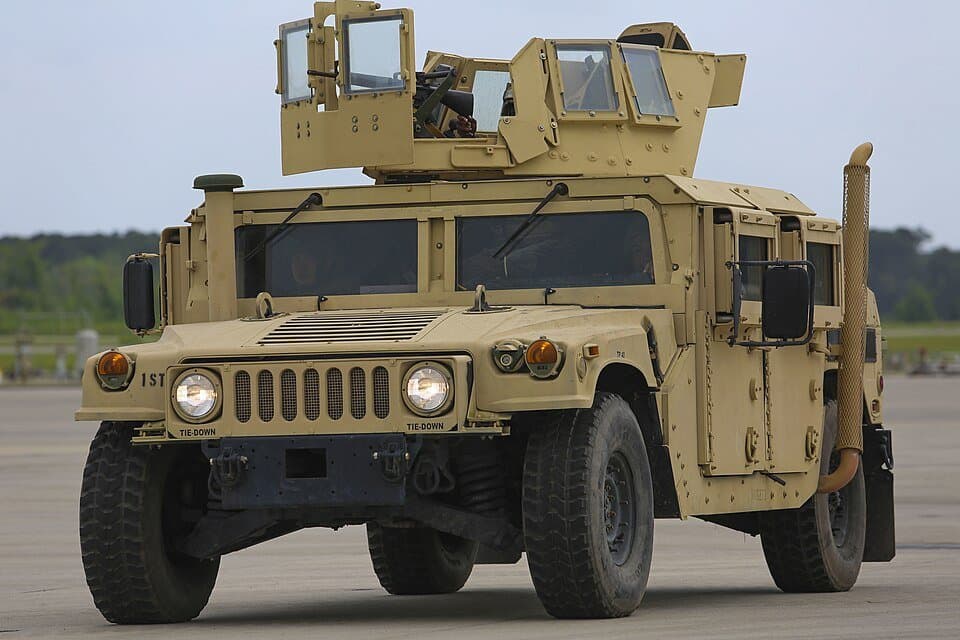

AMilitary transport & logistics
Humvee
family of light , four-wheel drive military trucks and utility vehicles
Credit
U.S. Marine Corps photo by Lance Cpl. Olivia G. Ortiz/Released · Public domain · Resized · Public domain · Source ↗ · Modified


Preparing your view.
AMilitary transport & logistics
family of light , four-wheel drive military trucks and utility vehicles
BMilitary transport & logistics
Measured figures
Length
Single sourcewheelbase
Single sourceConfiguration
| Specification | Humvee | Mercedes-Benz short-bonnet trucks |
|---|---|---|
| Type | 2- or 4-door truck Unarmored: Light utility vehicle Armored: Infantry mobility vehicle[source] | — |
| Place of origin | United States[source] | — |
| In service | 1985–present[source] | — |
| Wars | Cold War Invasion of Panama Persian Gulf War Somali Civil War Operation Gothic Serpent Battle of Mogadishu Global War on Terrorism 2001 insurgency in North Macedonia Iraq War War in Afghanistan Syrian Civil War Moro War Zamboanga City crisis War in Iraq Yemeni Civil War Saudi Arabian-led intervention in Yemen Mexican drug war Djiboutian-Eritrean border conflict Arab–Israeli conflict Russo-Ukrainian War War in Donbas Russian invasion of Ukraine 2025 Cambodian–Thai clashes[source] | — |
| Manufacturer |
15 ft (4.57 m), wheelbase 10 ft 10 in (3.30 m)[source]
Height
Single sourcereducible to
Single source6 ft (1.83 m), reducible to 4 ft 6 in (1.37 m)[source]
curb weight
Single sourcegross weight
Single source5,200 to 5,900 lb (2,359 to 2,676 kg) curb weight, 7,700 to 8,500 lb (3,493 to 3,856 kg) gross weight[source]
Maximum; at max gross weight Over
Single sourceMaximum; top speed
Single source55 mph (89 km/h) at max gross weight Over 70 mph (113 km/h) top speed[source]
Operational; Operational range
Single source250–350 miles (400–560 km)[source]
Bars compare reported quantities only. A larger figure does not make a system better; configurations and test conditions differ.
AM General , assembled in Mishawaka, Indiana[source] |
Daimler-Benz (1959–1995) Freightliner (1975–1991) Iran Khodro Diesel Company (1979–present)[source] |
| Unit cost | $220,000 (2011) (up-armored) (equivalent to $301,767 in 2024)[source] | — |
|---|
| Produced | 2 January 1985 – present[source] | — |
|---|
| No. built | 281,000[source] | — |
|---|
| Main armament | Multiple, see design features[source] | — |
|---|
| Engine | 6.2 L GM Detroit Diesel V8 6.5 L GM Detroit Diesel V8 6.5 L GEP Optimizer 6500 V8[source] 6.5-liter diesel engine[source]HMMWV A2 | — |
|---|
| Transmission | GM TH400 / 3L80 3-speed automatic GM 4L80-E 4-speed automatic[source] | — |
|---|
| Suspension | Independent 4×4[source] | — |
|---|
| Fuel capacity | 25 U.S. gal (95 L)[source] | — |
|---|
| Former operator · Afghanistan | Afghanistan[source] | — |
|---|
| Role | family of light , four-wheel drive military trucks and utility vehicles[source] | — |
|---|
| Source measurement | Since World War II , the " Willys MB 1 ⁄ 4 -ton Truck, Command and Reconnaissance", and its evolutions, were used for mass-deployment, and became known as "jeeps". The United States military had continued to rely heavily on jeeps as general utility vehicles and as a mass-transport for soldiers in small groups. Although the U.S. Army had let Ford redesign the jeep from the ground up during the 1950s, and the resulting 1960 Ford M151 jeep incorporated significant innovations, it firmly adhered to the original concept: a very compact, light enough to manhandle, low profile vehicle, with a folding windshield, that a layman could barely distinguish from the preceding Willys jeeps . The jeeps were more than two feet shorter than a Volkswagen Beetle and weighed just over one metric ton, seating three to four, with a 800 lb (360 kg) off-road payload rating. During and after the war, the very light, 1 ⁄ 4 -ton jeeps were complemented by the 3 ⁄ 4 -ton Dodge WC and Korean War Dodge M37 models.[source]Humvee · History; only the objects and conditions stated in this passage Army tactical vehicles in the 1/4-ton to 5/4-ton range, as well as select vehicles in the U.S.[source]Humvee · History; only the objects and conditions stated in this passage Compared to the jeep, it was larger and had a much wider track, with a 16 in (410 mm) ground clearance, double that of most sport-utility vehicles .[source]Humvee · History; only the objects and conditions stated in this passage The new truck was to climb a 60 percent incline and traverse a 40 percent slope and ford 5 ft (1.5 m) of water and electronics waterproofed to drive through 2.5 ft (0.76 m) of water were specified.[source]Humvee · History; only the objects and conditions stated in this passage The vehicles were subjected to over 600,000 miles in trials which included off-road courses in desert and arctic conditions.[source]Humvee · History; only the objects and conditions stated in this passage In June 1983, a Pentagon report noted the vehicle's "very low" reliability, averaging 370 miles between failures.[source]Humvee · History; only the objects and conditions stated in this passage In December 2004, Secretary of Defense Donald Rumsfeld came under criticism from U.S. troops and their families for not providing better-equipped HMMWVs. Rumsfeld pointed out that, before the war, armor kits were produced only in small numbers per year. As the role of American forces in Iraq changed from fighting the Iraqi Army to suppressing the insurgency, more armor kits were being manufactured, though perhaps not as fast as production facilities were capable. Even more advanced kits were also being developed. While these kits are much more effective against all types of attacks, they weigh from 1,500 to 2,200 lb (680 to 1,000 kg) and have some of the same drawbacks as the improvised armor. Unlike similar-sized civilian cargo and tow trucks, which typically have dual rear wheels to reduce sway, the HMMWV has single rear wheels because of its independent rear suspension coupled with the body design.[source]Humvee · History / Modifications; only the objects and conditions stated in this passage The armor kits fielded include the Armor Survivability Kit (ASK), FRAG 5 , FRAG 6 , as well as upgrade kits to the M1151 . The ASK was the first fielded in October 2003, adding about 1,000 pounds (450 kg) to the weight of the vehicle. Armor Holdings fielded an even lighter kit, adding only 750 pounds (340 kg) to the vehicle's weight. The Marine Armor Kit (MAK), fielded in January 2005, offers more protection than the M1114 but also increases weight. The FRAG 5 offered even more protection but was still inadequate to stop EFP attacks. The FRAG 6 kit is designed to do just that, however its increased protection adds over 1,000 lb (450 kg) the vehicle over the FRAG 5 kit, and the width is increased by 2 feet (61 cm). The doors may also require a mechanical assist device to open and close.[source]Humvee · History / Modifications; only the objects and conditions stated in this passage The soldier manning the exposed crew-served weapon on top of the vehicle is extremely vulnerable. In response, many HMMWVs have been fitted with basic gun shields or turrets , as was the case with M113 APCs after they were first deployed in Vietnam. The U.S. military is currently evaluating a new form of protection, developed by BAE Systems as well as systems designed by the Army, which are already in theater. The new gunner's seat is protected by 1.5 to 2 feet (46 to 61 cm) high steel plates with bulletproof glass windows. Additionally, some HMMWVs have been fitted with a remotely operated CROWS weapon station, which slaves the machine gun to controls in the back seat so it can be fired without exposing the crew. The Boomerang anti- sniper system was also fielded by some HMMWVs in Iraq to immediately give troops the location of insurgents firing on them.[source]Humvee · History / Modifications; only the objects and conditions stated in this passage Another weakness for the HMMWV has proven to be its size, which limited its deployment in Afghanistan because it is too wide for the smallest roads and too large for many forms of air transport compared to jeeps or Land Rover-sized vehicles (which are, respectively, 24 and 15 inches narrower). This size also limits the ability of the vehicle to be manhandled out of situations.[source]Humvee · History / Modifications; only the objects and conditions stated in this passage The Humvee seats four people with an available fully enclosed aluminum cabin with a vertical windshield. It has all-wheel drive with an independent suspension and helical gear-reduction hubs similar to portal axles which attach towards the top rather than the center of each wheel to allow the drivetrain shafts to be raised for 16 in (410 mm) ground clearance. The body is mounted on a narrow steel frame with boxed rails and five cross members for rigidity. The rails act as sliders to protect the drivetrain which is nestled between and above the rails. Raising the drivetrain into the cabin area and lowering the seats into the frame creates a chest-high transmission hump which separates passengers on each side and lowers the overall center of gravity compared to most trucks where the body and passengers are above the frame.[source]Humvee · Design features; only the objects and conditions stated in this passage The Humvee uses V8 powertrains from General Motors and General Engine Products (GEP), a wholly owned subsidiary of AM General. Early iterations were issued with General Motors' 6.2-liter Detroit Diesel V8. Later iterations were fitted with the larger and improved 6.5-liter Detroit Diesel V8. Power output for the naturally-aspirated version of this engine is 160–170 hp (119–127 kW; 162–172 PS) and 290 lb⋅ft (393 N⋅m) of torque, while the turbocharged version produces 190–205 hp (142–153 kW; 193–208 PS) and 385–440 lb⋅ft (522–597 N⋅m). GEP uses a modified version of the 6.5-liter Detroit Diesel V8 called the Optimizer 6500 . This engine features improvements for better long-term reliability and has a power output of 205 hp (153 kW; 208 PS) and 440 lb⋅ft (597 N⋅m) of torque.[source]Humvee · Design features; only the objects and conditions stated in this passage The vehicle has double wishbone suspension with portal gear hubs on all 4 wheels and inboard disc brakes . The brake discs are not mounted at the wheels, as on conventional cars, but are inboard of the half-shafts, attached outboard of the differentials. The front and rear differentials are Torsen type, and the center differential is of the lockable type. Torque-biasing differentials allows forward movement as long as at least one wheel has traction. It runs on specialized 37 × 12.5 radial tires with low-profile runflat devices. Newer HMMWV versions can be equipped with a central tire inflation system (CTIS) kit in the field. While it is optimized for off-road mobility, it can achieve 55 mph (89 km/h) at maximum weight with a top speed of 70 mph (110 km/h).[source]Humvee · Design features; only the objects and conditions stated in this passage There are at least 17 variants of the HMMWV in service with the U.S. military. HMMWVs serve as cargo/troop carriers, automatic weapons platforms, ambulances (four litter patients or eight ambulatory patients), M220 TOW missile carriers, M119 howitzer prime movers, M1097 Avenger Pedestal Mounted Stinger platforms, MRQ-12 direct air support vehicles, S250 shelter carriers, and other roles. The HMMWV is capable of fording 2.5 feet (0.76 m) normally, or 5 feet (1.5 m) with the deep-water fording kits installed.[source]Humvee · Design features; only the objects and conditions stated in this passage Optional equipment includes a winch (maximum load capacity 6,000 lb (2,700 kg) and supplemental armor. The M1025/M1026 and M1043/M1044 armament carriers provide mounting and firing capabilities for the M134 Minigun , the Mk 19 grenade launcher , the M2 heavy machine gun , the GAU-19A/B gatling gun, the M240G/B machine gun and M249 SAW .[source]Humvee · Design features; only the objects and conditions stated in this passage The latest iteration of the Humvee series can be seen in the M1151A1 and later up-armored A1-versions. It has a stronger suspension and larger 6.5 liter turbo-diesel engine to accommodate the weight of up to 680 kg (1,500 lb) of additional armor. The armor protection can be installed or taken off depending on the operating environment, so the vehicles can move more efficiently without armor when there is no threat of attack. There is some underbody armor that moderately protects against mines and roadside bombs. Other improvements include Vehicle Emergency Escape (VEE) windows that can be quickly removed so troops inside can escape in the event of a rollover, jammed door, or the vehicle catching fire, and a blast chimney that vents the force of a bomb blast upwards and away from the occupants. The M1151A1 has a crew of four, can carry 2,000 lb (910 kg) of payload, and can tow a 4,000 lb (1,800 kg) load. On roads, it has a top speed of 80 km/h (50 mph) and a range of 480 km (300 mi).[source]Humvee · Design features; only the objects and conditions stated in this passage M1069 tractor for M119 105 mm gun[source]Humvee · Variants / Major HMMWV A0/A1/A2 versions; only the objects and conditions stated in this passage Scorpion – single unit version, fitted with 2B9 Vasilek 82 mm automatic mortar . This is a heavy chassis HMMWV developed in 2004 by engineers at the U.S. Army's Picatinny Arsenal . The mortar itself can fire on single shots or automatic using four-round clips. The range for direct fire is 1000 m and the indirect fire is 4000 m. It is also intended to provide another means of destroying roadside bombs but at a safer standoff range. Only one has been produced.[source]Humvee · Variants / Major HMMWV A0/A1/A2 versions; only the objects and conditions stated in this passage In late 1995, the production of the M1114 based on the improved ECV chassis began. The M1114 meets Army requirements for a scout, military police, and explosive ordnance disposal vehicle with improved ballistic protection levels. The M1114 provides protection against 7.62 mm armor-piercing projectiles, 155 mm artillery air bursts and 12 lb (5.4 kg) anti-tank mine blasts.[source]Humvee · Variants / M1113 expanded capacity vehicle (ECV); only the objects and conditions stated in this passage The extended capacity HMMWVs, such as the M1165 can drive over an 18 in (460 mm) vertical wall and carry a 6,820 lb (3,090 kg) payload.[source]Humvee · Variants / M1113 expanded capacity vehicle (ECV); only the objects and conditions stated in this passage Composite HMMWV – a prototype developed by TPI Composites of Rhode Island and AM General. The purpose of the concept vehicle is to reduce the vehicle's weight so that it may more easily carry an up-armor kit. TPI's all-composite HMMWV saves approximately 900 pounds (410 kg) when compared to a current steel and aluminum HMMWV.[source]Humvee · Variants / M1113 expanded capacity vehicle (ECV); only the objects and conditions stated in this passage A prototype XM1124 hybrid-electric Humvee on an M1113 Humvee chassis powered by a diesel-series hybrid featuring an all-electric drive train has been developed by RDECOM/TARDEC . The vehicle has a 6 mi (9.7 km) full-electric range for silent operations. It may have less emissions and save fuel in the battlefield, and it can increase the survival rate in emergencies such as if one of the engines is destroyed or fails.[source]Humvee · Variants / M1113 expanded capacity vehicle (ECV); only the objects and conditions stated in this passage HUMVEE 2-CT Hawkeye 105mm Mobile Howitzer System: Variant of the HMMWV designed by AM General, it is a redesigned M1152 chassis carrying a mounted version of the M119 howitzer . Sent to be tested by the Ukrainian armed forces.[source]Humvee · Variants / M1113 expanded capacity vehicle (ECV); only the objects and conditions stated in this passage Poland – Polish Land Forces operate 222 HMMWVs (5 unknown variants are operated by Polish Special Forces ). Over 200 are used by the 18th Airborne Battalion which is a part of the 6th Airborne Brigade. The used variants are designated as follows: Tumak-2 – M1043A2, Tumak-3 – M1025A2, Tumak-4 – M1097A2, Tumak-5 – M1045A2, Tumak-6 – M1097A2 (variant used for transport of special containers), Tumak-7 – M1035A2. All vehicles are modified to meet Polish road regulations and are equipped with Polish communication devices. 140 HMMWVs are equipped with a Fonet digital internal communication device. 120 Tumak-2s and Tumak-3s have a rotatable mount which can be fitted with either the UKM-2000P 7.62 mm general-purpose machine gun or the NSW-B 12.7 mm heavy machine gun . Tumak-5s are used by anti-tank subunits and are armed with a dismountable Spike missile . Additionally Polish forces of ISAF operated 120 HMMWVs on loan from the U.S. forces.[source]Humvee · Variants / International versions; only the objects and conditions stated in this passage It has greater engine power, replacing the 6.5-liter diesel engine with a Cummins 6.7-liter diesel and Allison 6-speed transmission, as well as a stronger suspension, improved brakes, higher ground clearance, and new onboard instrumentation.[source]Humvee · Variants / Survivable Combat Tactical Vehicle; only the objects and conditions stated in this passage Work began on the SCTV in 2008 in anticipation of U.S. military upgrades, but it was shelved once they made the JLTV a priority. Textron then focused on selling the SCTV upgrade package to up to 25 countries operating the global fleet, a potential market of up to 10,000 vehicles. The upgrade can enhance the survivability of previously soft-skinned versions, sometimes sold by the U.S. as Excess Defense Articles, while costing and weighing less than a comparable MRAP. By 2015, Colombia had installed the SCTV into three Humvees for testing, and Ukraine had shown interest in upgrading their old-model Humvees recently supplied by the U.S. Ukraine ordered three SCTVs in February 2016.[source]Humvee · Variants / Survivable Combat Tactical Vehicle; only the objects and conditions stated in this passage | — |
|---|
| Origin reported by inventory | United States Greece[source]Inventory Origin column; table 5, row 20, cell 4; revision 1376489443; retrieved 2026-10-02 | — |
|---|
| Country of origin | United States[source]Inventory Origin column; table 8, row 16, cell 5; revision 1370185263; retrieved 2026-10-01 | West Germany[source]Inventory Origin column; table 9, row 8, cell 4; revision 1375919249; retrieved 2026-10-01 |
|---|
| Production | — | 1959–present[source] |
|---|
| Assembly | — | West Germany: Mannheim (medium-weight trucks) West Germany: Gaggenau (heavy trucks) Brazil: São Bernardo do Campo Iran: Tehran South Africa: East London[source] |
|---|
| Class | — | Truck[source] |
|---|
| Layout | — | FR layout[source] |
|---|
| Successor | — | Freightliner FL-Series (in-direct)[source] |
|---|
| Reported operators |
| — |
|---|