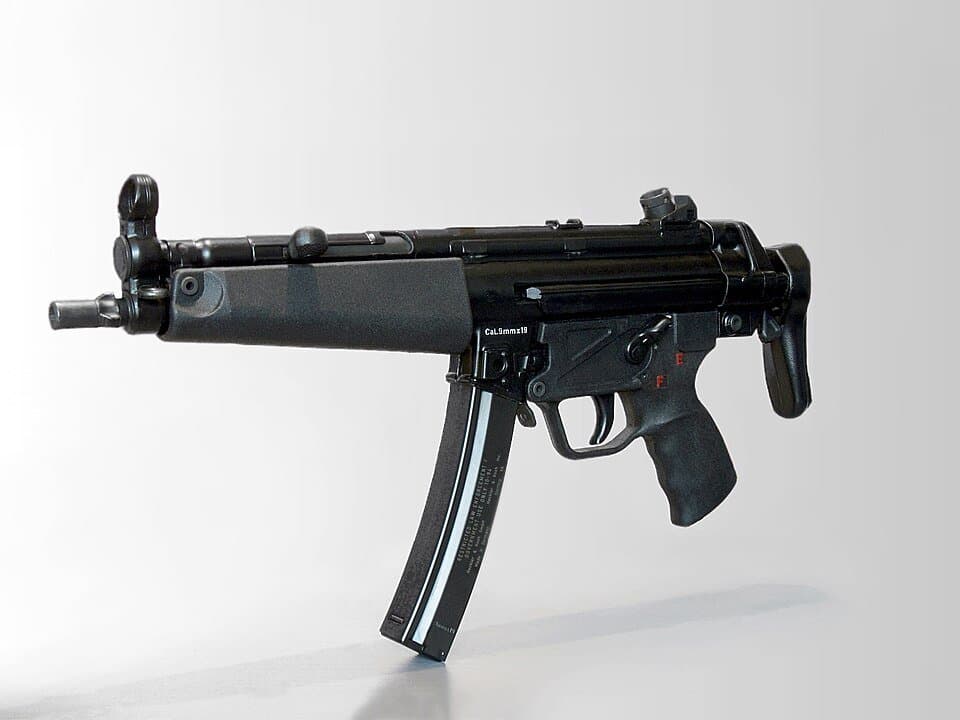
Heckler & Koch, encouraged by the success of the G3 Rifle in 1959, developed a family of small arms consisting of four types of firearms all based on a common G3 design layout and operating principle. The first type was chambered for 7.62×51mm NATO , the second for 7.62×39mm M43 , the third for 5.56×45mm NATO and the fourth for 9×19mm Parabellum . The MP5 was created for the fourth type as the HK54 ; under the HK naming system , this categorizes it as a selective fire carbine chambered in a handgun cartridge .[source]Heckler & Koch MP5 · History; only the objects and conditions stated in this passage The primary version of the MP5 family is the MP5A2 , which is a selective fire delayed blowback -operated 9×19mm Parabellum weapon. It fires from a closed bolt (bolt forward) position.[source]Heckler & Koch MP5 · Design; only the objects and conditions stated in this passage The fixed, free-floating , cold hammer forged barrel has six right hand grooves with a 1 in 250 mm (1:10 in) rifling twist rate and is pressed and pinned into the receiver.[source]Heckler & Koch MP5 · Design; only the objects and conditions stated in this passage The first MP5 models used a double column straight box magazine , but since 1977, slightly curved steel magazines have been used with a 15-round capacity (weighing 0.12 kg) or a 30-round capacity (0.17 kg empty).[source]Heckler & Koch MP5 · Design / Features; only the objects and conditions stated in this passage The adjustable iron sights (closed type) consist of a rotating rear diopter drum and a front post installed in a hooded ring. The rear sight is mechanically adjustable for both windage and elevation with the use of a special tool, being adjusted at the factory for firing at 25 metres (27 yd) with standard 8 grams (123 gr) FMJ 9×19mm NATO ammunition. The rear sight drum provides four apertures of varying diameters used to adjust the diopter system, according to the user's preference and tactical situation. Changing between apertures does not change the point of impact down range.[source]Heckler & Koch MP5 · Design / Features; only the objects and conditions stated in this passage The non-reciprocating cocking handle is located above the handguard and protrudes from the cocking handle tube at approximately a 45° angle. This rigid control is attached to a tubular piece within the cocking lever housing called the cocking lever support, which in turn makes contact with the forward extension of the bolt group. It is not however connected to the bolt carrier and therefore cannot be used as a forward assist to fully seat the bolt group. The cocking handle is held in a forward position by a spring detent located in the front end of the cocking lever support which engages in the cocking lever housing. The lever is locked back by pulling it fully to the rear and rotating it slightly clockwise where it can be hooked into an indent in the cocking lever tube.[source]Heckler & Koch MP5 · Design / Features; only the objects and conditions stated in this passage The delay results from the amount of time it takes for enough recoil energy to be transferred through to the bolt carrier in a sufficient quantity for it to be driven to the rear against the force of inertia of the bolt carrier and the forward pressure exerted against the bolt by the recoil spring. As the rollers are forced inward they displace the locking piece and propel the bolt carrier to the rear. The bolt carrier's rearward velocity is four times that of the bolt head since the cartridge remains in the chamber for a short period of time during the initial recoil impulse. After the bolt carrier has travelled rearward 4 mm, the locking piece is withdrawn fully from the bolt head and the rollers are compressed into the bolt head. Only once the locking rollers are fully cammed into the bolt head can the entire bolt group continue its rearward movement in the receiver, breaking the seal in the chamber and continuing the feeding cycle.[source]Heckler & Koch MP5 · Design / Operating mechanism; only the objects and conditions stated in this passage Since the 9×19mm Parabellum cartridge is relatively low powered, the bolt does not have an anti-bounce device like the G3, but instead the bolt carrier contains 32.5 g (1.15 oz) of tungsten granules that prevent the bolt group from bouncing back after impacting the barrel extension. The weapon has a fluted chamber that enhances extraction reliability by bleeding gases backwards into the shallow flutes running along the length of the chamber to prevent the cartridge case from expanding and sticking to the chamber walls (since the bolt is opened under relatively high barrel pressure). A spring extractor is installed inside the bolt head and holds the case securely until it strikes the ejector arm and is thrown out of the ejection port to the right of the receiver. The lever-type ejector is located inside the trigger housing (activated by the movement of the recoiling bolt).[source]Heckler & Koch MP5 · Design / Operating mechanism; only the objects and conditions stated in this passage Threading is provided at the muzzle to work with certain muzzle devices made by Heckler & Koch, including a slotted flash suppressor , a blank-firing adapter (marked with a red painted band denoting use with blank ammunition only), a rifle grenade adapter (for use with rifle style grenades with an inside diameter of 22 mm using a special grenade launching cartridge) and cup-type tear gas rifle grenade adapter. An optional "3-Lug" barrel is also available on some variants for mounting a quick-detachable suppressor .[source]Heckler & Koch MP5 · Design / Accessories / Barrel accessories; only the objects and conditions stated in this passage The MP5SD's 146 mm (5.7 in) barrel has 30 2.5 mm (0.1 in) ports drilled forward of the chamber through which escaping gases are diverted to the surrounding sealed tubular casing that is screwed onto threading on the barrel's external surface just prior to the ported segment.[source]Heckler & Koch MP5 · Design / Accessories / Barrel accessories / MP5SD suppressor; only the objects and conditions stated in this passage The basic MP5, based on a modified and improved HK54, introduced in 1966. When first released, it had a gray phosphated finish, "Slimline" handguard , 8.9-inch barrel with "3-Lug" muzzle, and straight waffle magazines. Modernized improvements were introduced in the 1970s: Proprietary "claw mount" rails for scope, laser and flashlight attachments were introduced in 1973, un-ribbed curved magazines with chrome followers were introduced in 1977, the matte black lacquered finish was introduced for export models also in 1977 and the polymer "Tropical" handguard was introduced in 1978.[source]Heckler & Koch MP5 · Variants / MP5; only the objects and conditions stated in this passage Semi-automatic variant of the MP5 intended for the law enforcement and military markets, introduced in 1986 to meet a Federal Bureau of Investigation request for a "9mm semi-automatic carbine". Unlike the HK94, the semi-automatic MP5 variant for the civilian market, the MP5SF retains its standard 8.9-inch barrel. It has two variants: the MP5SFA2 with a fixed stock, and the MP5SFA3 with a retractable stock. It uses the "0-1" trigger group, but since 1991, it has been delivered with select-fire bolt carriers that make it capable of automatic fire if paired with an appropriate trigger group.[source]Heckler & Koch MP5 · Variants / MP5; only the objects and conditions stated in this passage Training variants of the MP5A4 and MP5A5. They are designed to use a plastic 9×19mm round developed by Dynamit Nobel .[source]Heckler & Koch MP5 · Variants / MP5; only the objects and conditions stated in this passage The MP5SD ("SD" meaning Schalldämpfer , German for "sound suppressor") is a variant of the MP5 with an integral suppressor , introduced in 1974. The integral suppressor, built around its 5.7-inch barrel, uses a unique two-stage design that allows it to operate silently in most environments, including when wet, while still remaining reliable. The distinctive size of the integral suppressor gives it a unique handguard design, with a modified charging handle to account for it. The MP5SD has a rate of fire of approximately 800 rounds per minute, and is intended for use with both standard and subsonic ammunition.[source]Heckler & Koch MP5 · Variants / MP5SD; only the objects and conditions stated in this passage The MP5K ("K" meaning Kurz , German for "short") is a redesigned compact variant of the MP5, introduced in 1976. Developed from the stockless MP5A1, it features a 4.5-inch barrel incompatible with muzzle attachments, an endcap with sling mount instead of a stock, and a unique handguard with a built-in foregrip. Most components of the MP5K are shortened on account of its compact design, including its bolt, receiver, charging handle, cover and trigger group frame. The lighter bolt gives it a higher rate of fire, at approximately 900 rounds per minute (as opposed to 800 rounds per minute with the regular MP5). Different variants of the MP5K use either unique open iron sights or redesigned fixed iron sights.[source]Heckler & Koch MP5 · Variants / MP5K; only the objects and conditions stated in this passage "Full-size" variant of the MP5K, introduced in 1991. It is designed to provide the benefits of the MP5K with the size and handling of a regular MP5 and is essentially a regular MP5K with a custom folding stock, "Navy" trigger group, and 5.5-inch barrel with a custom "3-Lug" muzzle similar to that of the MP5N but for a Qual-A-Tec suppressor. Its name is derived from its intended use as a self-defense firearm for vehicle and aircraft crews.[source]Heckler & Koch MP5 · Variants / MP5K; only the objects and conditions stated in this passage Though the MP5 is normally chambered in 9×19mm Parabellum, two variants and an unreleased kit existed that used different ammunition.[source]Heckler & Koch MP5 · Variants / Rechambered variants; only the objects and conditions stated in this passage MP5 chambered in 10mm Auto , introduced in 1992. It features either a fixed or retractable stock, the "Navy 2-Round Burst" trigger group, and the MP5N's custom "3-Lug" muzzle derivative and tritium illuminated sights. It includes a bolt hold-open device, which catches the bolt in its rear position when empty, and is released by pressing a lever on the left side of the receiver. It is fed by custom 30-round translucent straight magazines. The MP5/10 was discontinued in 2000, but HK still offers support and spare parts.[source]Heckler & Koch MP5 · Variants / Rechambered variants; only the objects and conditions stated in this passage MP5 chambered in .22 Long Rifle , introduced around 2021. It comes in two variants: the MP5 .22 LR Rifle, which resembles an MP5SD3 with a 16.1-inch barrel hidden by a faux "integral suppressor" barrel shroud; and the MP5 .22 LR Pistol, which resembles an MP5A1 or MP5A3 with an 8.5-inch barrel. Both variants use the "Tropical" handguard and the "0-1" trigger group. Like all civilian market MP5 variants, it is semi-automatic only.[source]Heckler & Koch MP5 · Variants / Rechambered variants; only the objects and conditions stated in this passage Rechambering kit to convert an MP5 to .22 Long Rifle, introduced in the early 1970s and discontinued at an indeterminate point. The kit consisted of a barrel insert, a bolt group, two 20-round magazines and was mostly sold to law enforcement agencies for training purposes by easing trainees inexperienced with the MP5 into learning handling techniques and firing practice without the high recoil and cost of 9×19mm rounds. The conversion reduced the MP5's rate of fire to 650 rounds per minute. It was ultimately replaced by the MP5 .22 LR in 2021.[source]Heckler & Koch MP5 · Variants / Rechambered variants; only the objects and conditions stated in this passage MP5 6.5×25mm Rechambering Kit[source]Heckler & Koch MP5 · Variants / Rechambered variants; only the objects and conditions stated in this passage Rechambering kit to convert an MP5 to 6.5×25mm CBJ , which was proposed in the 2000s but never released. It would have allowed an MP5 to be rechambered simply by switching its barrel.[source]Heckler & Koch MP5 · Variants / Rechambered variants; only the objects and conditions stated in this passage Civilian market variant of the MP5, imported to the United States civilian market from 1983 to 1989 (with a one-off final order for the California Department of Corrections and Rehabilitation delivered in 1991). It has a 16.54-inch barrel, "0-1" trigger group, push-button magazine release (as opposed to the paddle magazine release on regular MP5s), and a straight pistol grip similar to that on the MP5A4 and MP5A5. It has two variants: the HK94A2 with a fixed stock, and the HK94A3 with a retractable stock. Optional accessories included a handguard-mounted foregrip and a ventilated barrel shroud. The HK94 was particularly popular as a prop in film and television productions of the era, and blank -firing HK94s with "chopped" 8.9-inch barrels and fake automatic conversions were often used as cost effective MP5 stand-ins well into the 2010s.[source]Heckler & Koch MP5 · Variants / Civilian variants; only the objects and conditions stated in this passage Accurized sharpshooting variant of the HK94, introduced in 1985. It was designed and intended for marksman fire in situations and environments where precise handgun cartridge fire may be needed, such as dense urban areas and indoor environments like prisons. It has a fixed match stock with a rubber buttpad and an adjustable cheekpiece, a folding bipod , a flash hider and a Leupold 6x telescopic sight . A PSG1 -inspired aftermarket trigger pack was also produced, featuring a target pistol grip and match trigger. The HK94/SG-1 did not sell very well due to its niche role and poor performance—it had poor range, penetration, stopping power and its Leupold scope was calibrated for .223 Remington ; not 9×19mm. Only 50 units were imported to the U.S., primarily to target shooters and firearm collectors.[source]Heckler & Koch MP5 · Variants / Civilian variants; only the objects and conditions stated in this passage Modernized civilian market variant of the MP5 introduced in 2019, replacing the HK94. It resembles an MP5A2 with an 8.8-inch barrel, MP5K-style threaded adaptor, "Tropical" handguard, "0-1" trigger group, paddle magazine release, fluted chamber and the buyer's choice of fixed stock, retractable stock or endcap.[source]Heckler & Koch MP5 · Variants / Civilian variants; only the objects and conditions stated in this passage Prototype derived from the HK54A1, first developed for the JSSAP between 1982 and 1983. It was intended to spawn a "family" of modular all purpose submachine guns. Unique for HK, the SMG I used a simple blowback operation with separate lower and upper receivers and an easy-to-remove 5.8-inch barrel with an integral suppressor. It had a boxy body with a retractable stock and a diagonal foregrip. A mechanical and hydraulic buffer in the backplate and a timing device in the stock reduced its rate of fire to a manageable 500 rounds per minute, roughly half that of the HK54A1. The rear iron sight, resembling that of the HK21E , allowed for adjustments based on wind, ammunition type, sight elevation and also featured indents to assist with close-range point shooting . The trigger included an add-on to be used with bulkier cold weather gloves. Only 20 handmade examples were produced. The SMG I was tested by NWSC Crane in 1984 and proved promising but several minor issues prompted the development of the SMG II.[source]Heckler & Koch MP5 · Variants / Prototypes; only the objects and conditions stated in this passage In the United States , PTR Industries, Zenith Firearms, Dakota Tactical, and Century International Arms manufacture semi-automatic clones of the MP5 that are legally classified as pistols. In 2007, Professional Arms demonstrated the MK5, an MP5 clone that could be rechambered between 9×19mm, .45 ACP, and .40 S&W.[source]Heckler & Koch MP5 · Other manufacturers / Manufactured without license; only the objects and conditions stated in this passage |