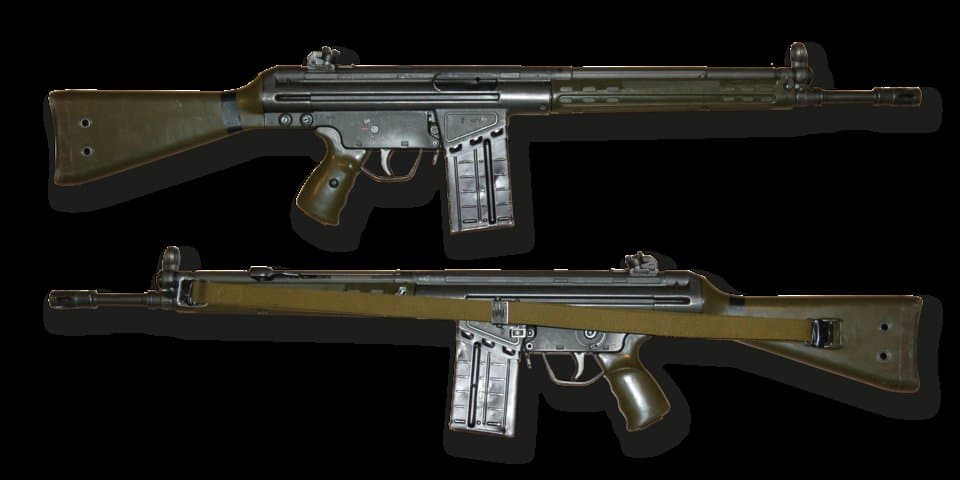
Credit
https://commons.wikimedia.org/wiki/User:Harald_Hansen · CC BY-SA 4.0 · Resized · CC BY-SA 4.0 · Source ↗ · Modified


Preparing your view.

BSmall arms
At a glance
Heckler & Koch G3larger figure on 0 of 2
Mk 13 riflelarger figure on 2 of 2
Counts only measures both sources give with the same scope. A larger figure is not a better system.
Measured figures
Length
Single source1,025 mm (40.4 in)[source]
Length
Single sourceConfiguration
| Specification | Heckler & Koch G3 | Mk 13 rifle |
|---|---|---|
| Type | Battle rifle[source] | — |
| Place of origin | West Germany[source] | — |
| In service | 1959–present[source] | 2001–present[source] |
| Used by | See Users[source] | United States[source] |
| Wars | See Conflicts[source] |
1207 mm (47.5")[source]
with inserted magazine
Single source220 mm (8.7 in) with inserted magazine[source]
Rate of fire
Single source500–600 rounds/min[source]
Muzzle velocity
Single source800 m/s (2,625 ft/s)[source]
Bars compare reported quantities only. A larger figure does not make a system better; configurations and test conditions differ.
War in Afghanistan Iraq War[source] |
| Designer | CETME Mauser Heckler & Koch[source] | Accuracy International / Remington Arms[source] |
|---|
| Designed | 1950s[source] | — |
|---|
| Manufacturer | Heckler & Koch (original) Rheinmetall MIC SEDENA Kongsberg Gruppen Pakistan Ordnance Factories and others[source] | Accuracy International[source] |
|---|
| Produced | 1958–present[source] | — |
|---|
| No. built | 8,000,000[source] | — |
|---|
| Variants | See Variants[source] | Mk 13 MOD 5 Mk 13 MOD 7[source] |
|---|
| Cartridge | 7.62×51mm NATO[source] | .300 Winchester Magnum[source] |
|---|
| Action | Roller-delayed blowback[source] | Bolt action[source] |
|---|
| Feed system | 5-, 10-, 20-, 30-, or 40-round detachable box, and 50-round and 100-round drum magazine[source] | 5-round magazine (MOD 5)[source] |
|---|
| Sights | Rear: rotary diopter; front: hooded post[source] | Nightforce Advanced Tactical Riflescope[source] |
|---|
| Role | select-fire battle rifle chambered in 7.62×51mm NATO[source] | — |
|---|
| Status | The BA63 is still in service with Myanmar Police Force, People's Militia and ethnic Border Guard Forces.[source]BA63 · source-literal variant status | — |
|---|
| Source measurement | The Heckler & Koch G3 ( German : Gewehr 3 ) is a select-fire battle rifle chambered in 7.62×51mm NATO developed in the 1950s by the West German firearms manufacturer Heckler & Koch , in collaboration with the Spanish state-owned firearms manufacturer CETME . The G3 was the service rifle of the West German Bundeswehr until it was replaced by the Heckler & Koch G36 in the 1990s after German reunification, and was adopted into service with numerous other countries.[source]Heckler & Koch G3 · Lead; only the objects and conditions stated in this passage The origin of the G3 can be traced back to the final years of World War II when Mauser engineers at the Light Weapon Development Group ( Abteilung 37 ) at Oberndorf am Neckar designed the Maschinenkarabiner Gerät 06 (MKb Gerät 06, "machine carbine device 06") prototype assault rifle chambered for the intermediate 7.92×33mm Kurz cartridge, first with the Gerät 06 model using a roller-locked short recoil mechanism originally adapted from the MG 42 machine gun but with a fixed barrel and conventional gas-actuated piston rod. With careful attention to the mechanical ratios, the gas system could be omitted. The resultant weapon, Gerät 06H (the "H" suffix is an abbreviation for halbverriegelt - "half-locked") is known today as StG 45(M) ( Sturmgewehr 45(M) , assault rifle 45). However, there is no evidence that the term was ever officially used in the German Reich. The weapon was not produced in significant numbers and the war ended before the first production rifles were completed.[source]Heckler & Koch G3 · History; only the objects and conditions stated in this passage The German technicians involved in developing the StG 45(M) were taken to work in France at Centre d'Etudes et d'Armement de Mulhouse (CEAM). The StG 45(M) mechanism was modified by Ludwig Vorgrimler and Theodor Löffler at the Mulhouse facility between 1946 and 1949. Three versions were made, chambered in .30 Carbine , 7.92×33mm Kurz , and the experimental 7.65×35mm French short cartridge developed by Cartoucherie de Valence in 1948. A 7.5×38mm cartridge using a partial aluminium bullet was abandoned in 1947. Löffler's design, designated Carabine Mitrailleuse Modèle 1950 , was retained for trials among 12 different prototypes designed by CEAM, MAC , and MAS . Engaged in the Indochina War and being the second NATO contributor, France canceled the adoption of these new weapons for financial reasons.[source]Heckler & Koch G3 · History; only the objects and conditions stated in this passage In 1950, Vorgrimler moved to Spain where he created the LV-50 rifle chambered for the Kurz cartridge and later, the proprietary 7.92×40mm CETME M53 round.[source]Heckler & Koch G3 · History; only the objects and conditions stated in this passage Not willing to accept a cartridge outside of the NATO specification, the West Germans asked CETME to develop a 7.62×51mm version of the rifle.[source]Heckler & Koch G3 · History; only the objects and conditions stated in this passage The resulting CETME Model A was chambered for the 7.62×51mm CETME cartridge which was identical in chamber dimensions but had a reduced-power load compared to the 7.62×51mm NATO round.[source]Heckler & Koch G3 · History; only the objects and conditions stated in this passage Further development of the rifle with input from H&K produced the CETME Model B which received several modifications, including the ability to fire from a closed bolt in both semi-automatic and automatic firing modes, a new perforated sheet metal handguard (the folding bipod had been the foregrip in previous models), improved ergonomics and a slightly longer barrel with a 22 mm rifle grenade launcher guide.[source]Heckler & Koch G3 · History; only the objects and conditions stated in this passage In 1958, this rifle was accepted into service with the Spanish Army as the Modelo 58 , using the 7.62×51mm CETME round.[source]Heckler & Koch G3 · History; only the objects and conditions stated in this passage However, the newly formed West German military ( Bundeswehr ) now showed interest and soon purchased a number of CETME rifles (7.62×51mm NATO chambering) for further testing.[source]Heckler & Koch G3 · History; only the objects and conditions stated in this passage To acquire production rights, the West German government offered NWM contracts to supply the West German air force (Luftwaffe) with 20mm ammunition.[source]Heckler & Koch G3 · History; only the objects and conditions stated in this passage The latter company already had ties to CETME, and had worked to further optimize the CETME rifle for use with the full-power 7.62×51mm NATO cartridge (as opposed to the downgraded CETME variant).[source]Heckler & Koch G3 · History; only the objects and conditions stated in this passage In the process, five shots were fired at a target at 100 metres (109 yd) with particularly accurate sighting-in ammunition.[source]Heckler & Koch G3 · History; only the objects and conditions stated in this passage The 5-shot group could not exceed 120 mm (4.7 in) (1.2 mil /4.13 MOA ) diameter.[source]Heckler & Koch G3 · History; only the objects and conditions stated in this passage Based on the geometric relationship arising from the angles of the roller contact surfaces of the locking piece and the barrel extension recesses, the recoil of the bolt head is delayed by a ratio of 4:1 for the 7.62×51mm NATO chambering. Thus during the same period of time, the bolt head carrier moves 4 times faster than the bolt head. This ratio is continued until the locking rollers have been withdrawn from the barrel extension recesses.[source]Heckler & Koch G3 · Design details / Operating mechanism; only the objects and conditions stated in this passage The rifle is hammer fired and has a trigger mechanism with a 3-position fire selector switch that is also the manual safety toggle that secures the weapon from accidentally discharging (fire selector in the "E" or "1" position – single fire mode ( Einzelfeuer ), "F" or "20" – automatic fire ( Feuerstoß ), "S" or "0" – weapon is safe ( Sicher ), trigger disabled mechanically). The weapon can be fitted with an optional four-position safety/fire selector group illustrated with pictograms with an ambidextrous selector lever. The additional, fourth selector setting enables a three-round burst mode of fire. The rifle has a relatively high trigger pull of 50–55 N (11.2–12.4 lb f ) due to a drop safety requirement. An interchangeable set-trigger pack assembly featuring a trigger stop and less trigger pull is available for the G3SG/1 and other sniping orientated variants.[source]Heckler & Koch G3 · Design details / Features / Trigger; only the objects and conditions stated in this passage The rotary drum features an open V-notch (numbered 1) for rapid target acquisition, close range, low light and impaired visibility use and three apertures (numbered 2, 3 and 4) used for: 200–400 metres (219–437 yd) in 100 metres (109 yd) increments for more precise aiming.[source]Heckler & Koch G3 · Design details / Features / Sights; only the objects and conditions stated in this passage The 1 V-notch and 2 or 200 metres (219 yd) aperture settings have an identical point of aim.[source]Heckler & Koch G3 · Design details / Features / Sights; only the objects and conditions stated in this passage The V-notch and apertures are calibrated for US M80 / German DM111 series or other equivalent 9.5 grams (147 gr) 7.62×51mm NATO ball ammunition.[source]Heckler & Koch G3 · Design details / Features / Sights; only the objects and conditions stated in this passage The rifled barrel – four right-hand grooves with a 305 mm (12.0 in) twist rate to adequately stabilize the military 7.62×51mm NATO ammunition of the era – terminates with a slotted flash suppressor which can also be used to attach a bayonet or serve as an adapter for launching rifle grenades . From the G3A3 the barrel was free floated from the stock and had polygonal rifling . The barrel chamber is fluted with twelve flutes, which assists in the initial extraction of a spent cartridge casing (since the breech is opened under very high barrel in internal cartridge case pressure).[source]Heckler & Koch G3 · Design details / Features / Barrel; only the objects and conditions stated in this passage The G3A3 (A4) uses either steel (260 g) or aluminium (140 g) 20-round double-stacked straight box magazines , or a 50-round drum magazine. H&K developed a prototype plastic disposable magazine in the early 1960s, but it was not adopted as aluminum magazines were just as light and proved more durable, as well as easier to produce.[source]Heckler & Koch G3 · Design details / Features / Feeding; only the objects and conditions stated in this passage Standard accessories supplied with the rifle include: a detachable bipod (not included with rifles that have a perforated plastic handguard), sling, cleaning kit and a speed-loading device. Several types of bayonet are available for the G3, but with few exceptions they require an adapter to be inserted into the end of the cocking tube. The most common type features a 6 3 ⁄ 4 inch spear-point blade nearly identical with the M7 bayonet , but with a different grip because of its mounting above the barrel. The weapon can also mount a 40 mm HK79 under-barrel grenade launcher , blank firing adapter , a straight blowback bolt (called a "PT" bolt, lacks rollers) used for firing 7.62×51mm ammunition with plastic bullets, a conversion kit used for training with .22 Long Rifle ammunition and a sound suppressor (that uses standard ammunition).[source]Heckler & Koch G3 · Design details / Features / Accessories; only the objects and conditions stated in this passage BA63 (Burma Army): Licensed produced G3 by Myanmar stated owned KaPaSa factories in partnership with Fritz Werner Industry Ausrustungen-Gmbh (FRG) and the German Technical Corporation Agency with licensing rights sold by 1960 with the first 10,000 G3s bought from West Germany (through Rheinmetall) before Burmese factories went operational due to fears that it could align with East Germany. It was the main battle rifle for Myanmar armed forces until they were replaced by MA series 5.56mm assault rifles in 1995. The BA63 is still in service with Myanmar Police Force, People's Militia and ethnic Border Guard Forces.[source]Heckler & Koch G3 · Variants / Other military variants and derivatives / Myanmar; only the objects and conditions stated in this passage AG-3 : Norwegian G3A5 variant produced by Kongsberg Våpenfabrikk , with the given name Automatgevær 3 . A total of 253,497 units were produced for the Norwegian Armed Forces from 1967 to 1974. The Norwegian AG-3 differs from the original G3; it has a buttstock that is approx. 2 cm longer, the bolt carrier has a serrated thumb groove to aid in silent bolt closure, it features an all-metal cocking handle and a different bayonet mount. Throughout Autumn 2020, the Norwegian home guard began to replace the AG-3 with the Heckler & Koch HK416 and MP7 , a transition which is planned to see completion by the end of the year.[source]Heckler & Koch G3 · Variants / Other military variants and derivatives / Norway; only the objects and conditions stated in this passage AG-3F1 : An AG-3 with a retractable stock as on G3A4. Produced by Kongsberg Våpenfabrikk. A retractable stock was required by certain groups of soldiers within the Norwegian Armed Forces, primarily vehicle crews with limited space inside, particularly where a quick disembarkment from such a vehicle is required. All versions of the AG-3 have the ability to attach a 40 mm HK79 grenade launcher.[source]Heckler & Koch G3 · Variants / Other military variants and derivatives / Norway; only the objects and conditions stated in this passage Ak 4 : Swedish-made version of the G3A3, with a buttstock that is 2 cm longer, the bolt carrier has a serrated thumb groove to aid in silent bolt closure and fitted with a heavy buffer for higher number of rounds fired before failure. The iron sights feature extended 200–500 metres (219–547 yd) sight adjustments in 100 metres (109 yd) increments, because the 500 metres (547 yd) hit probability met Swedish military doctrine. The rifles were manufactured from 1965 to 1970 by both Carl Gustafs stads gevärsfaktori and Husqvarna Vapenfabriks and from 1970 until the end of production in 1985 – exclusively by Carl Gustaf in Eskilstuna . All Ak 4s are adapted to mount the M203 grenade launcher . Sweden has supplied unmodified Ak 4s to Estonia, Latvia and Lithuania.[source]Heckler & Koch G3 · Variants / Other military variants and derivatives / Sweden; only the objects and conditions stated in this passage F.R. Ordnance MC51 Machine Carbine : Produced by the United Kingdom firm F.R. Ordnance International Ltd. The MC51 weighs 3.1 kg (6.8 lb), has a folded overall length of 625 mm (24.6 in), a barrel length of only 230 mm (9.1 in), which produces a muzzle velocity of approx. 690 m/s (2,263.8 ft/s) and a muzzle energy of 2215 J . Another UK-based company called Imperial Defence Services Ltd. absorbed FR Ordnance and continues to market the MC51 standard variant.[source]Heckler & Koch G3 · Variants / Other military variants and derivatives / United Kingdom; only the objects and conditions stated in this passage G3TGS : This is simply a G3 with a 40 mm HK79 under-barrel grenade launcher. TGS stands for Tragbares Granat System ("portable grenade system").[source]Heckler & Koch G3 · Variants / Specialized G3 types; only the objects and conditions stated in this passage G3A3ZF : This is a rifle issued with a STANAG claw-and rail scope bracket and a Hensoldt Fero Z24 4×24 telescopic sight to be mounted and zeroed by the user. The ZF stands for Zielfernrohr ("Telescopic Sight"). The Hensoldt Fero Z24 4×24 telescope sight for G3 rifle and claw mount assembly were developed for designated marksman use. The Fero Z24 elevation knob features Bullet Drop Compensation (BDC) settings for 100–600 metres (109–656 yd) in 100 metres (109 yd) increments calibrated for 7.62×51mm NATO ball ammunition. The G3A3ZF is otherwise a standard G3A3 that during factory test shooting printed a 5-shot group of 80 millimetres (3.1 in) (0.8 mil /2.75 MOA ) diameter or less.[source]Heckler & Koch G3 · Variants / Specialized G3 types; only the objects and conditions stated in this passage The standard trigger was exchanged for an adjustable set-trigger pack assembly with a 25 N (5.6 lb f ) trigger pull and 12.5 N (2.8 lb f ) in the set operation mode, the buttstock has a slightly adjustable auxiliary cheek riser, and the lengthened handguard has an integrated bipod.[source]Heckler & Koch G3 · Variants / Specialized G3 types; only the objects and conditions stated in this passage The Zeiss Diavari-DA 1.5-6×36 was windage adjustable and had an elevation knob featuring Bullet Drop Compensation (BDC) settings for 10–600 metres (11–656 yd).[source]Heckler & Koch G3 · Variants / Specialized G3 types; only the objects and conditions stated in this passage For the sub 100 metres (109 yd) ranges the BDC numbers are yellow.[source]Heckler & Koch G3 · Variants / Specialized G3 types; only the objects and conditions stated in this passage The BDC numbers for the longer ranges are white and in 100 metres (109 yd) increments.[source]Heckler & Koch G3 · Variants / Specialized G3 types; only the objects and conditions stated in this passage MSG3 : A variant introduced in 1988 featuring a 600 millimetres (23.6 in) long barrel, a newer telescopic sight mount that is found on only a few of the Heckler & Koch rifles, as compared to the more conventional claw mounts, though the claw mounting points remain on the receiver. This newer telescopic sight mount does not allow the use of the open sights with the mount in place, as is the case with the more conventional claw mount. The receiver is not strengthened. In addition to the G3SG/1 the buttstock has an auxiliary cheek riser and its length is adjustable and features the PSG1 semi-automatic only trigger pack. MSG stands for Militärisches Scharfschützen Gewehr ("Military Sniper Rifle").[source]Heckler & Koch G3 · Variants / Specialized G3 types; only the objects and conditions stated in this passage MSG90 : A somewhat cheaper and lighter 600 millimetres (23.6 in) long barrel version of the PSG1 modified for military sniping/designated marksman applications. The MSG90 and PSG1 have different trigger packs.[source]Heckler & Koch G3 · Variants / Specialized G3 types; only the objects and conditions stated in this passage PSG1 : A free-floating 650 millimetres (25.6 in) long barrel semi-automatic only version of the G3 introduced in 1985 with a strengthened receiver with rails welded over the channels where a retractable buttstock would slide and numerous other upgrades and such to meet the necessities of police sniper units. This rifle is famous for its accuracy and comfort, but infamous for its price and inability to be deployed by military units because some upgrades made the rifle too fragile. PSG stands for Präzisionsscharfschützengewehr ("Precision Sniper Rifle").[source]Heckler & Koch G3 · Variants / Specialized G3 types; only the objects and conditions stated in this passage HK32 : An experimental variant of the rifle chambered for the Soviet 7.62×39mm M43 cartridge. It was never wholly adopted by any country.[source]Heckler & Koch G3 · Variants / Specialized G3 types; only the objects and conditions stated in this passage Fleming Arms HK51 : Contrary to popular belief, the HK51 is not made by H&K, being a creation of the American Class II manufacturing after-market. The HK51 has no real standards, but is usually a cut down and modified G3A3, or its semi-automatic clones the HK41 and HK91, modified to take MP5 stock and accessories. It is usually fitted with a collapsible stock; with a 211 mm (8.31-inch) long barrel; it is relatively small at 589 mm (23.17 inches) with the stock retracted and 780 mm (30.72 inches) with the stock extended. The first commercial version was by Bill Fleming of Fleming Arms and existed before Heckler & Koch made the HK53.[source]Heckler & Koch G3 · Variants / Law enforcement and civilian models; only the objects and conditions stated in this passage | — |
|---|
| Calibre | — | .308[source] |
|---|
| Country of origin | — | United Kingdom[source] |
|---|
| Reported operators |
| — |
|---|