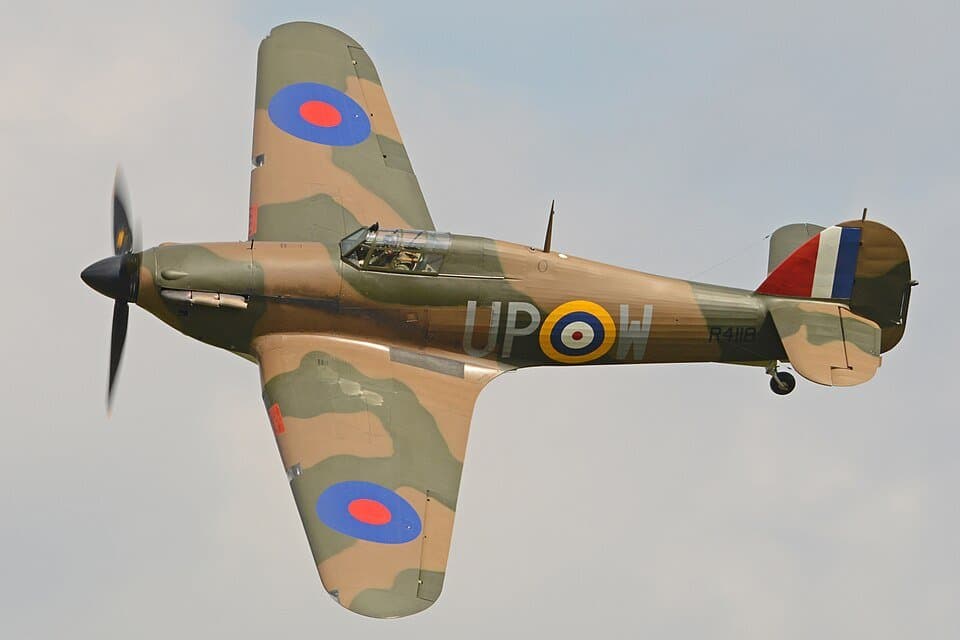

Credit
Alan Wilson from Stilton, Peterborough, Cambs, UK · CC BY-SA 2.0 · Resized · CC BY-SA 2.0 · Source ↗ · Modified


Preparing your view.
At a glance
Measured figures
Hurricane Mk.IIC · Length
Single source32 ft 3 in (9.83 m)[source]
Configuration
| Specification | Hawker Hurricane | Mikoyan-Gurevich MiG-23 |
|---|---|---|
| Type | Fighter aircraft[source] | Fighter aircraft (M series) Fighter-bomber (B series)[source] |
| National origin | United Kingdom[source] | Soviet Union[source] |
| Manufacturer | Hawker Aircraft[source] | Mikoyan-Gurevich / Mikoyan[source] |
| Designer | Sydney Camm[source] |
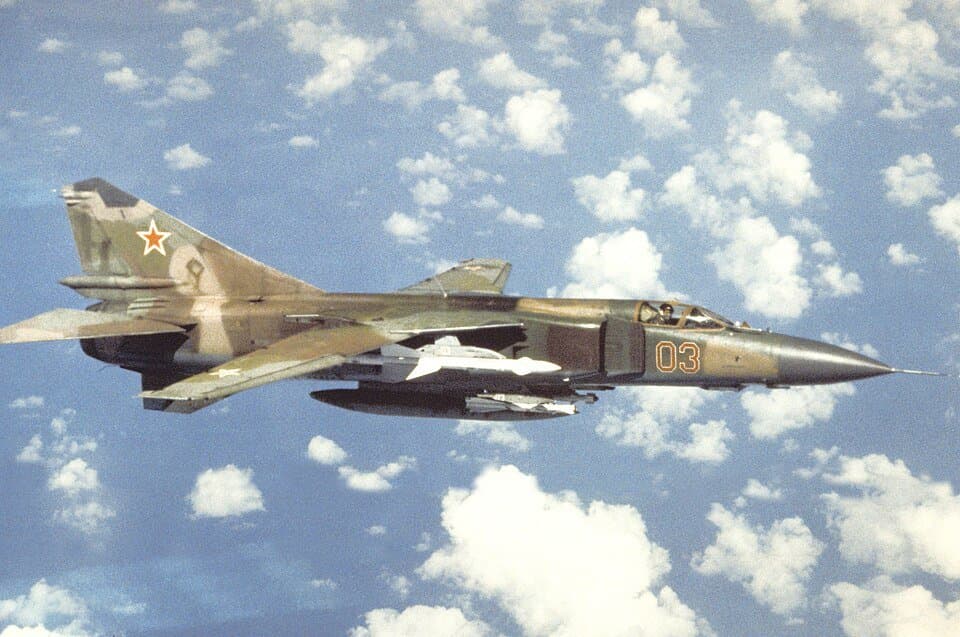
MiG-23MLD · Length
16.7 m (54 ft 9 in)[source]
Empty; Hurricane Mk.IIC · Empty weight
Single sourceGross; Hurricane Mk.IIC · Gross weight
Single sourceMaximum take-off; Hurricane Mk.IIC · Max takeoff weight
Single source5,745 lb (2,606 kg)[source]
7,670 lb (3,479 kg)[source]
8,710 lb (3,951 kg)[source]
Gross; MiG-23MLD · Gross weight
Single sourceMaximum take-off; MiG-23MLD · Max takeoff weight
Single sourceHurricane Mk.IIC · Range
Single source600 mi (970 km, 520 nmi)[source]
MiG-23MLD · with standard armament, no drop-tanks
Single source1,450 km (900 mi, 780 nmi) with standard armament, no drop-tanks[source]
Hurricane Mk.IIC · 1 × Rolls-Royce Merlin XX V-12 liquid-cooled piston engine at 21,000 ft (6,400 m)
Single source1 × Rolls-Royce Merlin XX V-12 liquid-cooled piston engine, 1,185 hp (884 kW) at 21,000 ft (6,400 m)[source]
MiG-23MLD · 1 × Khatchaturov R-35-300 afterburning turbojet thrust with variable-geometry nozzles dry
Single sourceMiG-23MLD · with afterburner
Single source1 × Khatchaturov R-35-300 afterburning turbojet , 83.6 kN (18,800 lbf) thrust with variable-geometry nozzles dry, 127.49 kN (28,660 lbf) with afterburner[source]
Bars compare reported quantities only. A larger figure does not make a system better; configurations and test conditions differ.
| — |
| Built by | Austin Motor Company Avions Fairey Canadian Car and Foundry Gloster Aircraft Company Rogožarski Zmaj Aircraft[source] | — |
|---|
| Primary users | Royal Air Force Royal Canadian Air Force Royal Navy Soviet Air Forces[source] | Soviet Air Force (historical) Syrian Air Force (historical) Indian Air Force (historical) North Korean Air Force[source] |
|---|
| Number built | 14,487 (UK and Canada)[source] | 5,047[source] |
|---|
| Manufactured | 1937–1944[source] | 1967–1985[source] |
|---|
| Introduction date | December 1937[source] | 1970[source] |
|---|
| First flight | 6 November 1935[source] | 10 June 1967[source] |
|---|
| Airfoil | root: Clark YH (19%); tip: Clark YH (12.2%)[source] | root: TsAGI SR-12S (6.5%); tip: TsAGI SR-12S (5.5%)[source] |
|---|
| Propellers | 3-bladed[source] | — |
|---|
| Wing loading | 29.8 lb/sq ft (145 kg/m 2 )[source] | 370 kg/m 2 (76 lb/sq ft)[source] |
|---|
| Power/mass | 0.15 hp/lb (0.25 kW/kg)[source] | — |
|---|
| Guns | 4 × 20 mm (0.79 in) Hispano Mk II cannon[source] | 1 × 23 mm Gryazev-Shipunov GSh-23 L autocannon with 200 rounds[source] |
|---|
| Bombs | 2 × 250 or 500 lb (110 or 230 kg) bombs[source] | Up to 500 kg (1,100 lb) bombs per hardpoint[source] |
|---|
| Role | British single-seat fighter aircraft of the 1930s–40s[source] | single-engined, supersonic , variable-sweep wing fighter aircraft ,[source] |
|---|
| Source measurement | In 1934, the British Air Ministry issued Specification F.5/34 in response to demands within the RAF for a new generation of fighter aircraft. During 1933, British aircraft designer Sydney Camm had conducted discussions with Major John Buchanan of the Directorate of Technical Development on a monoplane based on the existing Fury. Mason attributes Camm's discussions with figures within the RAF, such as Squadron Leader Ralph Sorley , as having provoked the specification and some of its details, such as the preference for armaments being installed within the wings instead of within the aircraft's nose.[source]Hawker Hurricane · Development / Background; only the objects and conditions stated in this passage An outline of the "Fury Monoplane" armed with two guns in the wings and two in the nose and powered by the Goshawk engine was prepared and discussed with Roger Liptrot of the Air Ministry in December 1933. The design was reworked with the PV.12, following detailed work working drawings of the "Interceptor Monoplane" were begun in May 1934. The complete design was presented to the Air Ministry on 4 September.[source]Hawker Hurricane · Development / Background; only the objects and conditions stated in this passage Camm's initial submission in response to the earlier fighter specification F.7/30 was a development of the Fury, the Hawker P.V.3 , However, the P.V.3 was not among the proposals which the Air Ministry selected to be built as prototype to official contract. After the rejection of the P.V.3 proposal, Camm started work on a new design involving a cantilever monoplane arrangement with a fixed undercarriage, armed with four machine guns and powered by the Rolls-Royce Goshawk engine. The original 1934 armament specifications for what evolved into the Hurricane were for a similar armament fitment to the Gloster Gladiator - four machine guns, two in the wings and two in the fuselage, synchronised to fire through the propeller arc. By January 1934, the proposal's detail drawings had been finished, but these failed to impress the Air Ministry enough for a prototype to be ordered.[source]Hawker Hurricane · Development / Background; only the objects and conditions stated in this passage "Gunner" Hill presented his calculation showing that future fighters must carry no fewer than eight machine guns, each capable of firing 1,000 rounds per minute. / Hill's assistant in making his calculations was his 13-year-old daughter Hazel Hill .[source]Hawker Hurricane · Development / Background; only the objects and conditions stated in this passage In the course of RAF trials, despite the problems with the Merlin engine, which had suffered numerous failures necessitating several changes, enthusiastic reports were produced on the aircraft and its performance. The trials had proved the aircraft to possess a maximum level speed of 315 mph (507 km/h) at an altitude of 16,200 ft (4,900 m), climb to 15,000 ft (4,600 m) in 5.7 minutes, and a stall speed of 57 mph (92 km/h) (only marginally higher than the Gladiator biplane), the last achieved using its flaps .[source]Hawker Hurricane · Development / Prototype and trials; only the objects and conditions stated in this passage In 1939, production of 100 Hurricanes was initiated in Yugoslavia by Zmaj and Rogožarski . Of these, 20 were built by Zmaj by April 1941. Recognising that the supply of British-made Merlin engines might not be guaranteed, one of the Yugoslavian Hurricanes was fitted with a Daimler-Benz DB 601 engine, instead. This aircraft was flown in 1941. In 1938, a contract for 80 Hurricanes was placed with Fairey's Belgian subsidiary Avions Fairey SA for the Belgian Air Force , and it was intended to arm these aircraft with four 13.2 mm (0.52 in) Browning machine guns . Three were built and two flown with this armament by the time of the German invasion of Belgium in May 1940, with at least 12 more constructed by Avions Fairey armed with the conventional eight rifle-calibre machine-gun armament.[source]Hawker Hurricane · Development / Production; only the objects and conditions stated in this passage An all-metal, stressed-skin wing of duraluminium (a DERD specification similar to AA2024) was introduced in April 1939 and was used for all of the later marks. "The metal-skinned wings allowed a diving speed that was 80 mph (130 km/h) higher than the fabric-covered ones. They were very different in construction but were interchangeable with the fabric-covered wings; one trials Hurricane, L1877 , was even flown with a fabric-covered port wing and metal-covered starboard wing. The great advantage of the metal-covered wings over the fabric ones was that the metal ones could carry far greater stress loads without needing as much structure." Several fabric-wing Hurricanes were still in service during the Battle of Britain, although a good number had had their wings replaced during servicing or after repair. Changing the wings required only three hours' work per aircraft.[source]Hawker Hurricane · Design; only the objects and conditions stated in this passage The prototype and early production Hurricanes were fitted with a Watts two-bladed, fixed-pitch, wooden propeller. Flight commented of this arrangement: "Many have expressed surprise that the Hurricane is not fitted with variable-pitch airscrews". The original two-bladed propeller was found to be inefficient at low airspeeds, and the aircraft required a long ground run to get airborne, which caused concern at Fighter Command. Accordingly, trials with a de Havilland variable-pitch propeller demonstrated a reduction in the Hurricane's take-off run from 1,230 to 750 ft (370 to 230 m). Deliveries of these began in April 1939; this was later replaced by the hydraulically operated, constant-speed Rotol propeller, which came into service in time for the Battle of Britain.[source]Hawker Hurricane · Design; only the objects and conditions stated in this passage Throughout the bad days of 1940, 87 Squadron had maintained a proficient formation aerobatic team, the precise flying controls and responsive engines permitting precision formation through loops, barrel rolls, 1 g semistall turns and rolls off half-loops ... My Hurricane was never hit in the Battles of France and Britain, and in over 700 hr on type I never experienced an engine failure.[source]Hawker Hurricane · Operational history / Phoney War; only the objects and conditions stated in this passage While the opening months of the war were characterised by little air activity in general, sporadic engagements and aerial skirmishes happened between the two sides. On 30 October 1939 Hurricanes saw action over France. That day, Pilot Officer P. W. O. "Boy" Mould of 1 Squadron, flying Hurricane L1842, shot down a Dornier Do 17 P from 2(F)/123. The German aircraft, sent to photograph Allied airfields close to the border, fell in flames about 10 mi (16 km) west of Toul . Mould was the first RAF pilot to down an enemy aircraft on the European continent in the Second World War. According to Mason, the experiences gained in these early engagements proved invaluable in developing tactics that became tried and tested and rapidly spread throughout Fighter Command.[source]Hawker Hurricane · Operational history / Phoney War; only the objects and conditions stated in this passage Initial engagements with the Luftwaffe showed the Hurricane to be a tight-turning and steady platform, but the Watts two-bladed propeller was clearly unsuitable. At least one pilot complained of how a Heinkel 111 was able to pull away from him in a chase, yet by this time, the Heinkel was obsolete. At the start of the war, the engine ran on standard 87 octane aviation spirit . From early 1940, increasing quantities of 100 octane fuel imported from the U.S. became available. In February 1940, Hurricanes with the Merlin II and III engines began to receive modifications to allow for an additional 6 psi (41 kPa) of supercharger boost for five minutes (although accounts were made of its use for 30 minutes continuously).[source]Hawker Hurricane · Operational history / Operation Dynamo; only the objects and conditions stated in this passage The extra supercharger boost, which increased engine output by nearly 250 hp (190 kW), gave the Hurricane an approximate increase in speed of 25 to 35 mph (40 to 56 km/h), under 15,000 ft (4,600 m) altitude and greatly increased the aircraft's climb rate. "Overboost" or "pulling the plug", a form of war emergency power as it was called in later Second World War aircraft, was an important wartime modification that allowed the Hurricane to be more competitive against the Bf 109E and to increase its margin of superiority over the Bf 110C , especially at low altitude. With the +12 psi (83 kPa) "emergency boost", the Merlin III was able to generate 1,310 hp (980 kW) at 9,000 ft (2,700 m).[source]Hawker Hurricane · Operational history / Operation Dynamo; only the objects and conditions stated in this passage Flight Lieutenant Ian Gleed of 87 Squadron wrote about the effect of using the extra boost on the Hurricane while chasing a Bf 109 at low altitude on 19 May 1940: "Damn! We're flat out as it is. Here goes with the tit. A jerk – boost's shot up to 12 pounds; speed's increased by 30 mph. I'm gaining ground – 700, 600, 500 yards. Give him a burst. No, hold your fire you fool! He hasn't seen you yet..." Gleed ran out of ammunition before he could shoot the 109 down, although he left it heavily damaged and flying at about 50 ft (15 m).[source]Hawker Hurricane · Operational history / Operation Dynamo; only the objects and conditions stated in this passage This version was capable of a maximum speed of 342 mph (550 km/h).[source]Hawker Hurricane · Operational history / Battle of Britain; only the objects and conditions stated in this passage Hurricanes served with several British Commonwealth squadrons in the Desert Air Force . They suffered heavy losses over North Africa after the arrival of Bf 109E and -F variants and were progressively replaced in the air-superiority role from June 1941 by Curtiss Tomahawks/Kittyhawks . However, fighter-bomber variants ("Hurribombers") retained an edge in the ground attack role, due to their impressive armament of four 20 mm (0.79 in) cannon and a 500 lb (230 kg) bomb load.[source]Hawker Hurricane · Operational history / North Africa; only the objects and conditions stated in this passage During and following the five-day Second Battle of El Alamein artillery barrage that commenced on the night of 23 October 1942, six squadrons of Hurricanes, including the 40 mm (1.57 in) cannon -armed Hurricane Mk.IID version, claimed to have destroyed 39 tanks, 212 lorries and armoured troop-carriers, 26 bowsers , 42 guns, 200 various other vehicles, and four small fuel and ammunition dumps, flying 842 sorties with the loss of 11 pilots. Whilst performing in a ground-support role, Hurricanes based at RAF Castel Benito , Tripoli , knocked out six tanks, 13 armoured vehicles, 10 lorries, five half-tracks , a gun and trailer, and a wireless van on 10 March 1943, with no losses to themselves.[source]Hawker Hurricane · Operational history / North Africa; only the objects and conditions stated in this passage The "Soviet" IIB Hurricane as a multirole fighter-bomber had quite a few drawbacks. First, it was 25–31 mph (40–50 km/h) slower than its main opponent, the Bf 109E interceptor, at low and medium altitudes, and had a slower rate of climb. The Messerschmitt could outdive the Hurricane because of the thicker wing profile of the British fighter, but the main source of complaints was the Hurricane's armament. On occasion, the eight- or 12-rifle-calibre machine guns did not damage the sturdy and heavily armoured German aircraft; consequently, Soviet ground crews started to remove the Brownings. Retaining only four or six of the 12 machine guns, two 12.7 mm (0.50 in) Berezin UBs or two or even four 20 mm (0.79 in) ShVAK cannons were substituted, but overall performance deteriorated as a result.[source]Hawker Hurricane · Operational history / Air defence in the Soviet Union; only the objects and conditions stated in this passage Thanks to the efforts of No. 151 Maintenance Unit RAF, the 51 Hurricanes were assembled and ready for testing within 48 hours, and of these, 21 were ready for operational service within three days. The Hurricanes, originally intended for the Middle East theatre, were fitted with bulky Vokes dust filters under the nose and were armed with 12, rather than eight, machine guns. The additional weight and drag made them slow to climb and unwieldy to manoeuvre at altitude, although they were more effective bomber killers.[source]Hawker Hurricane · Operational history / Southeast Asia; only the objects and conditions stated in this passage First production version, with fabric-covered wings, a wooden two-bladed, fixed- pitch propeller (first 435) or three blade two - pitch propeller , powered by the 1,030 hp (770 kW) Rolls-Royce Merlin Mk.II (first 364) or III engines and armed with eight .303 in (7.7 mm) Browning machine guns . Produced between 1937 and 1939.[source]Hawker Hurricane · Variants; only the objects and conditions stated in this passage Hurricane Mk.I powered by the improved Merlin XX engine with two-speed supercharger. This new engine used a coolant mix of 30% glycol and 70% water. Pure glycol is flammable, so not only was the new mix safer, but the engine also ran approximately 21 °C (38 °F) cooler, which gave longer engine life and greater reliability. The new engine was longer than the earlier Merlin and so the Hurricane gained a 4.5 in "plug" in front of the cockpit, which made the aircraft slightly more stable due to the slight forward shift in centre of gravity. First flew on 11 June 1940 and went into squadron service in September 1940. Hawker built 418 and Gloster Aircraft Company 33. The series 1 may refer to the first production batch which did not have all the proposed changes incorporated, becoming series 2 when the changes were made. 33 Mk. IIA built by Gloster, 418 by Hawker.[source]Hawker Hurricane · Variants; only the objects and conditions stated in this passage Carrying four additional wing-mounted .303 in (7.7 mm) Browning machine guns; for a total of 12 guns, 230 were factory fitted with racks allowing them to carry two 250 lb (110 kg) or two 500 lb (230 kg) bombs. This lowered the top speed of the Hurricane to 301 mph (484 km/h), but by this point mixed sweeps of Hurricanes carrying bombs, protected by a screen of fighter Hurricanes were not uncommon. The same racks allowed the Hurricane to carry two 45 imp gal (200 L) drop tanks instead of the bombs, nearly doubling the Hurricane's fuel load.[source]Hawker Hurricane · Variants; only the objects and conditions stated in this passage Replaced the machine-gun armament with four 20 mm (0.79 in) Hispano Mk.II cannons, two per wing. The new wings later included a hardpoint for a 500 or 250 lb (230 or 110 kg) bomb and, later again, fuel tanks. By then performance was inferior to the latest German fighters, and the Hurricane changed to the ground-attack role, sometimes referred to as the Hurribomber . The Mk. IIC also served as a night fighter and intruder with about three quarters converted to fighter bombers. There were 4,751 IICs built by Hawker between February 1941 and July 1944.[source]Hawker Hurricane · Variants; only the objects and conditions stated in this passage Armed with two 40 mm (1.57 in) anti-tank autocannon in a gondola-style pod , one under each wing and a single Browning machine gun in each wing loaded with tracers for aiming purposes. The first aircraft flew on 18 September 1941 and deliveries started in 1942. Had additional armour for the pilot, radiator and engine, and were armed with a Rolls-Royce gun with 12 rounds, later changed to the 40 mm (1.57 in) Vickers S gun with 15 rounds. The outer wing attachments were strengthened so that 4G could be pulled at a weight of 8,540 lb (3,870 kg). The weight of guns and armour protection marginally impaired the aircraft's performance. These Hurricanes were nicknamed "Flying Can Openers", perhaps a play on the logo of No. 6 Squadron, which flew the Hurricane starting in 1942. A total of 296 built by Hawker from January 1942 to February 1943.[source]Hawker Hurricane · Variants; only the objects and conditions stated in this passage The last major change to the Hurricane was the introduction of the "universal wing", a single design able to mount two 250 or 500 lb (110 or 230 kg) bombs, or two 40 mm (1.57 in) Vickers S guns, or two 40 mm (1.57 in) Rolls-Royce B.H. type guns, two SBC (small bomb containers) or SCI (smoke curtain installation), or two 45 or 90 gallon drop tanks or eight "60 pounder" RP-3 rockets. Two .303 in (7.7 mm) Brownings were fitted to aid aiming of the heavier armament. Despite persistent reports, Mk.IVs were actually fitted with the same Merlin XX as the Mk.II. All Merlin 27s were modified to Merlin 25 and used in Mosquitoes, there were only 16 production Merlin 24s by the time over 300 Mk.IV had been delivered. The individual aircraft cards held by the RAF museum reports the final Mk.IV had a Merlin XX. The radiator was deeper and armoured. Additional armour was also fitted around the engine. 524 built by Hawker between December 1942 and March 1944.[source]Hawker Hurricane · Variants; only the objects and conditions stated in this passage The final variant to be produced. Only one was purpose built and two Mk.IV converted, though the variant never reached full-scale production. This was planned to be powered by a Merlin 27 but also tested with a Merlin 32 boosted engine to give 1,700 hp (1,300 kW) at low level and was intended as a dedicated ground-attack aircraft to use in Burma . All three prototypes had four-bladed propellers. The Mk. V replaced the twin 7.7mm machine guns on the Mk. IV with two 20mm cannons, only completed on the third prototype. Speed was 326 mph (525 km/h) at 500 ft (150 m)[source]Hawker Hurricane · Variants; only the objects and conditions stated in this passage Canadian-built variant. On 19 August 1941, the Canadian government placed an order with Canadian Car and Foundry for 400 Hurricanes, with 100 meant for the Netherlands and 300 for China, the Netherlands order was amended to 72, the Chinese decided to buy American, which resulted in 328 being offered to the USSR, to be shipped across the Pacific. Amended to all 400 for the RCAF. Originally designated the Mk.IIB (Can), designation changed to Mk.XII in April 1943. Single-seat fighter and fighter-bomber, powered by a 1,300 hp (970 kW) Packard Merlin 29, armed with twelve 0.303 in (7.7 mm) machine guns, production starting in June 1942, 250 served with the RCAF and 150 were sent to Britain in 1943 either without an engine or fitted with a Merlin 28 which was replaced by a Merlin XX on arrival and they became Mk.IIs[source]Hawker Hurricane · Variants; only the objects and conditions stated in this passage Canadian-built variant. The survivors of a batch of 30 RAF order Mk.I airframes retained in Canada in late 1941 that were fitted with Merlin III and propellers from Fairey Battles, became Mk. XIIA when fitted with Merlin 29. Armed with eight 0.303 in (7.7 mm) machine guns[source]Hawker Hurricane · Variants; only the objects and conditions stated in this passage The Sea Hurricane I used during Operation Pedestal had their Merlin III engines modified to accept 16 psi (110 kPa) boost, and could generate more than 1,400 hp (1,000 kW) at low altitude. Lt. R. J. Cork was credited with five kills while flying a Sea Hurricane I during Operation Pedestal .[source]Hawker Hurricane · Variants; only the objects and conditions stated in this passage 60 built by Hawker between November 1942 and May 1943, version equipped with naval radio gear; other standard Mk.IICs were converted and used on fleet carriers. The Merlin XX engine on the Sea Hurricane generated 1,460 hp (1,090 kW) at 6,250 ft (1,900 m) and 1,435 hp (1,070 kW) at 11,000 ft (3,400 m). Top speed was 322 mph (518 km/h) at 13,500 ft (4,100 m) and 342 mph (550 km/h) at 22,000 ft (6,700 m). Another 47 mark IIB converted to Sea mark II, with 45 of them given C wings as part of the conversion.[source]Hawker Hurricane · Variants; only the objects and conditions stated in this passage The Service Depot at Heliopolis in Egypt converted several Hurricanes Is for photo reconnaissance. The first three were converted in January 1941. Two carried a pair of F24 cameras with 8-inch focal length lenses. The third carried one vertical and two oblique F24s with 14-inch focal length lenses mounted in the rear fuselage, close to the trailing edge of the wing, and a fairing was built up over the lenses aft of the radiator housing. A further five Hurricanes were modified in March 1941, and two were converted in a similar manner in Malta during April 1941. During October 1941 a batch of six Hurricane Mk.IIs were converted to PR Mk.II status and a final batch, thought to be of 12 aircraft, was converted in late 1941. The PR Mk.II was said to be capable of slightly over 350 mph (560 km/h) and was able to reach 38,000 ft (12,000 m).[source]Hawker Hurricane · Variants; only the objects and conditions stated in this passage Length: 32 ft 3 in (9.83 m)[source]Hawker Hurricane · Specifications (Hurricane Mk.IIC); only the objects and conditions stated in this passage Wingspan: 40 ft 0 in (12.19 m)[source]Hawker Hurricane · Specifications (Hurricane Mk.IIC); only the objects and conditions stated in this passage Height: 13 ft 1.5 in (4.001 m)[source]Hawker Hurricane · Specifications (Hurricane Mk.IIC); only the objects and conditions stated in this passage Wing area: 257.5 sq ft (23.92 m 2 )[source]Hawker Hurricane · Specifications (Hurricane Mk.IIC); only the objects and conditions stated in this passage Empty weight: 5,745 lb (2,606 kg)[source]Hawker Hurricane · Specifications (Hurricane Mk.IIC); only the objects and conditions stated in this passage Gross weight: 7,670 lb (3,479 kg)[source]Hawker Hurricane · Specifications (Hurricane Mk.IIC); only the objects and conditions stated in this passage Max takeoff weight: 8,710 lb (3,951 kg)[source]Hawker Hurricane · Specifications (Hurricane Mk.IIC); only the objects and conditions stated in this passage Powerplant: 1 × Rolls-Royce Merlin XX V-12 liquid-cooled piston engine, 1,185 hp (884 kW) at 21,000 ft (6,400 m)[source]Hawker Hurricane · Specifications (Hurricane Mk.IIC); only the objects and conditions stated in this passage Maximum speed: 340 mph (550 km/h, 300 kn) at 21,000 ft (6,400 m)[source]Hawker Hurricane · Specifications (Hurricane Mk.IIC); only the objects and conditions stated in this passage Range: 600 mi (970 km, 520 nmi)[source]Hawker Hurricane · Specifications (Hurricane Mk.IIC); only the objects and conditions stated in this passage Service ceiling: 36,000 ft (11,000 m)[source]Hawker Hurricane · Specifications (Hurricane Mk.IIC); only the objects and conditions stated in this passage Rate of climb: 2,780 ft/min (14.1 m/s)[source]Hawker Hurricane · Specifications (Hurricane Mk.IIC); only the objects and conditions stated in this passage Guns: 4 × 20 mm (0.79 in) Hispano Mk II cannon[source]Hawker Hurricane · Specifications (Hurricane Mk.IIC); only the objects and conditions stated in this passage Bombs: 2 × 250 or 500 lb (110 or 230 kg) bombs[source]Hawker Hurricane · Specifications (Hurricane Mk.IIC); only the objects and conditions stated in this passage In May 1940 a Messerschmitt Bf 109E3 captured by French forces was tested against a Hurricane, both flown by British pilots. The pilots reported that the Messerschmitt was faster than the Hurricane, and could out-climb and out-dive it, but could not turn as well. In climbing and diving turns at high speed, although the Bf 109 was placed line astern to start with, it could not keep the Hurricane in its gunsights and the latter was able to get onto its tail in only four turns. However, these trials were restricted to below 15,000 feet owing to lack of oxygen equipment.[source]Hawker Hurricane · Turn performance / Turning radius of Hurricane and other Battle of Britain fighters; only the objects and conditions stated in this passage Much has been written of the relative manouevrability of the four principal Battle of Britain fighters. Published here for the first time are comparative turning radii attainable, resolved to a combat altitude of 10,000 feet—the most common area of combat chosen by the Hurricane pilots in 1940 ... if and when the choice was theirs. True airspeed, 300 m.p.h.[source]Hawker Hurricane · Turn performance / Turning radius of Hurricane and other Battle of Britain fighters; only the objects and conditions stated in this passage C L 1 ⁄ 2 ρ v 2 Wing loading at half-fuel weight "Available g" Turning Radius Hurricane I 1.0 170 22 lb./sq. ft. 7.5 800 feet Spitfire I 1.0 170 24 lb./sq. ft. 7.0 880 feet Bf 109E 1.0 170 25 lb./sq. ft. 8.1 750 feet Bf 110C 1.0 170 32 lb./sq. ft. 5.2 1,210 feet[source]Hawker Hurricane · Turn performance / Turning radius of Hurricane and other Battle of Britain fighters; only the objects and conditions stated in this passage According to them, to arrive at those values Mason had assumed the aircraft were flown at 300 m.p.h. while in a sustained angle of bank so steep - about 80° - that the g forces would have been "beyond the limits of any pilot at that time and most probably beyond the structural limits of the aircraft". Further, none of the aircraft engines could have delivered the required thrust, since far more power is required to overcome aircraft drag in a very steep turn.[source]Hawker Hurricane · Turn performance / Turning radius of Hurricane and other Battle of Britain fighters; only the objects and conditions stated in this passage Recalculating for thrusts actually achievable with those engines, and assuming the aircraft were flown at maximum power as near to the stall as possible, again at 10,000 feet, Ackroyd and Lamont arrived at the following among other parameter values:[source]Hawker Hurricane · Turn performance / Turning radius of Hurricane and other Battle of Britain fighters; only the objects and conditions stated in this passage | Work began on a replacement for the MiG-21 in the early 1960s.[source]Mikoyan-Gurevich MiG-23 · Development; only the objects and conditions stated in this passage The 23-11 featured variable-geometry wings which could be set to angles of 16, 45 and 72 degrees, and it was clearly more promising. The maiden flight of 23–11 took place on 10 June 1967, flown by the famous MiG test pilot Aleksandr Vasilyevich Fedotov . Six more flight prototypes and two static-test prototypes were prepared for further flight and system testing. All featured the Tumansky R-27-300 turbojet engine with a thrust of 77 kN (17,300 lbf ). The order to start series production of the MiG-23 was given in December 1967. The first production " MiG-23S " (NATO reporting name 'Flogger-A') took to the air on 21 May 1969, with Fedotov at the controls.[source]Mikoyan-Gurevich MiG-23 · Development; only the objects and conditions stated in this passage The armament carried by the MiG-23 changed as new models underwent development. The initial production variant, the MiG-23S, was fitted with the S-21 fire control system borrowed from the MiG-21S/SM. Based on the RP-22SM Sapfir-21 radar with an ASP-PFD-21 lead computing gunsight, it could carry only four R-3/K-13 (AA-2 "Atoll") air-to-air missiles (typically two SARH R-3Rs and two IR R-3Ss) in addition to a Gryazev-Shipunov GSh-23 L autocannon . In the ground-attack role, the MiG-23S could carry two Kh-23 (AS-7 "Kerry") radio guidance air-to-surface missiles , two to four UB-16 rocket pods with S-5 rockets , S-24 rockets or up to 2,000 kg (4,400 lb) of various bomb types. The MiG-23 Edition 1971, equipped with the Sapfir-23L radar and TP-23 infrared search and track (IRST), could fire the new BVR R-23 (AA-7 "Apex") missile, although only the R-23R SARH variant. However, the Sapfir-23L was considered unreliable and lacked look-down/shoot-down capability.[source]Mikoyan-Gurevich MiG-23 · Design / Armament; only the objects and conditions stated in this passage The MiG-23M, the definitive first-generation variant of the fighter, was equipped with the improved Sapfir-23D look-down/shoot-down radar and could carry a pair of R-23 missiles (either the R-23R SARH or R-23T IR variants) and a pair of R-60 (AA-8 "Aphid") missiles. Starting with aircraft number 3201, the APU-60-2 double-rail launcher was introduced, allowing the MiG-23M to carry six R-60 missiles. The MiG-23 could carry up to 3,000 kg (6,600 lb) in bombs and rockets, and from aircraft number 3701 onward it could fire the Kh-23 and Kh-23M air-to-surface missiles. Lastly, all VVS MiG-23Ms had the ability to mount a single nuclear bomb via a special adapter under the fuselage, either the 10- kiloton RN-24 or the 30-kiloton RN-40 . |
|---|
| Country of origin | United Kingdom[source]Inventory Origin column; table 3, row 5, cell 2; revision 1376452447 | — |
|---|
| Status | — | In limited service[source] |
|---|
| Variant | — | Mikoyan MiG-27[source] |
|---|
| Fuel capacity | — | 4,260 L (1,130 US gal; 940 imp gal) internal with provision for up to 3x 800 L (210 US gal; 180 imp gal) drop-tanks[source] |
|---|
| Hardpoints | — | 2 × fuselage, 2 × wing glove and 2 × wing pylons with a capacity of up to 2,000 kg (4,400 lb) of stores, with provisions to carry combinations of: Rockets: S-5 S-8M S-24B Missiles: Air-to-air missiles : 8 × R-60 or 4 x R-73 2 × R-23 or R-24 2 × R-13M or R-13M1 4 × R-3S Air-to-surface missiles : Kh-23 Grom Bombs: Up to 500 kg (1,100 lb) bombs per hardpoint[source] |
|---|
| g limits | — | +8.5[source] |
|---|
| Thrust/weight | — | 0.91[source] |
|---|
| Take-off distance | — | 450 m (1,480 ft)[source] |
|---|
| Landing distance | — | 690 m (2,260 ft)[source] |
|---|
| Rockets | — | S-5 S-8M S-24B[source] |
|---|
| Missiles | — | Air-to-air missiles : 8 × R-60 or 4 x R-73 2 × R-23 or R-24 2 × R-13M or R-13M1 4 × R-3S Air-to-surface missiles : Kh-23 Grom[source] |
|---|
| Former operator · Democratic Republic of Afghanistan | — | Democratic Republic of Afghanistan[source] |
|---|
| Former operator · People's Republic of Angola | — | People's Republic of Angola[source] |
|---|
| Former operator · Algeria | — | Algeria[source] |
|---|
| Former operator · Republic of Belarus | — | Republic of Belarus[source] |
|---|
| Former operator · People's Republic of Bulgaria | — | People's Republic of Bulgaria[source] |
|---|
| Former operator · Cote d'Ivoire | — | Cote d'Ivoire[source] |
|---|
| Former operator · Czech Republic | — | Czech Republic[source] |
|---|
| Former operator · Czechoslovakia | — | Czechoslovakia[source] |
|---|
| Former operator · Democratic Republic of the Congo | — | Democratic Republic of the Congo[source] |
|---|
| Former operator · East Germany | — | East Germany[source] |
|---|
| Former operator · Egypt | — | Egypt[source] |
|---|
| Former operator · Germany | — | Germany[source] |
|---|
| Former operator · Federation of Arab Republics | — | Federation of Arab Republics[source] |
|---|
| Former operator · Hungarian People's Republic | — | Hungarian People's Republic[source] |
|---|
| Former operator · India | — | India[source] |
|---|
| Former operator · Ba'athist Iraq | — | Ba'athist Iraq[source] |
|---|
| Former operator · Kazakhstan | — | Kazakhstan[source] |
|---|
| Former operator · Libyan Arab Jamahiriya | — | Libyan Arab Jamahiriya[source] |
|---|
| Former operator · Namibia | — | Namibia[source] |
|---|
| Former operator · Polish People's Republic | — | Polish People's Republic[source] |
|---|
| Former operator · Socialist Republic of Romania | — | Socialist Republic of Romania[source] |
|---|
| Former operator · Russia | — | Russia[source] |
|---|
| Former operator · Soviet Union | — | Soviet Union[source] |
|---|
| Former operator · Sri Lanka | — | Sri Lanka[source] |
|---|
| Former operator · Ba'athist Syria | — | Ba'athist Syria[source] |
|---|
| Former operator · Turkmenistan | — | Turkmenistan[source] |
|---|
| Former operator · Second Republic of Uganda | — | Second Republic of Uganda[source] |
|---|
| Former operator · Ukraine | — | Ukraine[source] |
|---|
| Former operator · Uzbekistan | — | Uzbekistan[source] |
|---|
| Former operator · Zambia | — | Zambia[source] |
|---|
| Former operator · Zimbabwe | — | Zimbabwe[source] |
|---|
| Reported operators |
|---|
14,840 kg (32,717 lb)[source]
17,800 kg (39,242 lb)[source]
10 550[source]МиГ-23МЛ · exact own native article specification table column 2; not another MiG-23 modification · source row header unit кг (kilograms)
10 700[source]МиГ-23УБ · exact own native article specification table column 3; not another MiG-23 modification · source row header unit кг (kilograms)
In the second-generation MiG-23ML, a new SUV-2ML weapons system allowed the aircraft to carry both types of R-23 missiles simultaneously. The typical loadout was an R-23R on the starboard wing pylon and an R-23T on the port wing pylon. Besides other ordnance (including a single nuclear bomb), the MiG-23ML could also carry two UPK-23-250 23 mm gun pods on the underwing pylons. Starting in 1981, the MiG-23MLA could carry the improved Vympel R-24R/T missiles. The final fighter variant, the MiG-23MLD, could also carry the improved R-24R/T missiles in addition to a pair of B8M1 20-round rocket pods firing S-8 rockets, the Kh-23 /Kh-23M air-to-surface missile, or a single RN-24 or RN-40 nuclear bomb. The MiG-23MLD's maximum bomb load was 2,000 kg (4,400 lb), with a standard loadout comprising four FAB-500 500 kg (1,100 lb) general-purpose bombs (GP) or ZAB-500 napalm bombs. Other configurations included sixteen FAB-100 100 kg (220 lb) GP bombs carried on four ejector racks, four FAB-250 250 kg (550 lb) GP bombs, or two RBK-500 cluster bombs .[source]Mikoyan-Gurevich MiG-23 · Design / Armament; only the objects and conditions stated in this passage
The MiG-23 cockpit was considered an improvement over previous Soviet fighters as it was more ergonomic in its layout. However the pilot still had a high workload, having to manipulate switches and monitor gauges, compared to more modern aircraft with HOTAS controls. The instrument panel featured a white stripe to serve as a visual aid for centering the control column during an out-of-control situation. To prevent the pilot from exceeding a 17° angle of attack , the control column incorporated a "knuckle rapper" which would strike the pilot's knuckles as the limit was approached.[source]Mikoyan-Gurevich MiG-23 · Design / Cockpit; only the objects and conditions stated in this passage
The MiG-23's ejection seat , the KM-1, was built with extreme altitude and speed in mind: leg stirrups, shoulder harness, pelvic D-ring , and a 3-parachute system. Engaging the ejection seat could take a long time, as the pilots had to place their feet in the stirrups, let go of the control column, grab the two trigger handles, squeeze and lift them. The first parachute, the size of a large handkerchief, was deployed out of a telescoping rod which would pop out of the top back of the seat as it started to clear the windscreen windbreak area. It was supposed to help rotate the seat into the windblast and stabilize into a flight path that would take it above and behind the vertical stabilizer . As the first chute and rod separated from the seat, a larger drogue parachute deployed to slow down the seat, allowing the deployment of the main parachute. If engaged at low altitudes, the seat included a barometric element that allowed the drogue chute to separate more quickly. One deficiency of the KM-1 was that it was not a zero-zero ejection seat – it required a minimum speed of 90 knots .[source]Mikoyan-Gurevich MiG-23 · Design / Cockpit; only the objects and conditions stated in this passage
The MiG-23 was among the first Soviet aircraft to feature variable-geometry wings . These were hydraulically controlled by means of a small lever set beneath the throttle in the cockpit. There were three main sweep angles that were set by the pilot for different levels of flying. The first, with the wings fully spread at 16°, was used when cruising at or below Mach 0.7 or when taking off and landing. Putting the wings at mid-spread of 45° was used for basic fighter maneuvering, as well as cruising at high speeds or making low-altitude intercepts. Moving the wings to fully swept at 72° was reserved for making high-altitude intercepts or high-speed dashes at low altitudes.[source]Mikoyan-Gurevich MiG-23 · Design / Control surfaces; only the objects and conditions stated in this passage
The wings were not fitted with ailerons but used spoilers to control rolling when the wings were at 16° and 45° angles. In addition to the spoilers, the wings were fitted with trailing edge flaps and leading edge slats to try to give the fighter a short take-off and landing performance. Although there was a gauge in the cockpit showing the position of the wings, when they were in motion, and the Mach limit for each position, there was none to indicate what was the optimum wing position for the prevailing flight condition.[source]Mikoyan-Gurevich MiG-23 · Design / Control surfaces; only the objects and conditions stated in this passage
Starting with the Edition 1971 model, the MiG-23's wings (known as Edition 2) had their surface area increased by 20%, necessitating the positions be changed to 18°, 47° 40', and 74° 40' (though for convenience the cockpit indicators and manuals retained the original labeling). A dogtooth extension was added but the leading-edge slats were removed to simplify manufacturing. However this proved to exacerbate the MiG-23's stability issues at high AoA and made take-off and landings more difficult. The definitive Edition 3 wing design, introduced with the MiG-23M, retained the dimensions of the Edition 2 but added back in the leading-edge slats.[source]Mikoyan-Gurevich MiG-23 · Design / Control surfaces; only the objects and conditions stated in this passage
A strengthening of the wing pivot in the MiG-23MLD allowed the addition of a fourth wing sweep position of 33°, which was intended to reduce turn radius and allow for rapid deceleration during dogfights. However, with the wings at the 33° position, the MiG-23MLD was much more difficult to handle and suffered from poor acceleration. Moving the wings to this position was primarily reserved for experienced MiG-23 pilots, while combat manuals continued to emphasize the 45° position.[source]Mikoyan-Gurevich MiG-23 · Design / Control surfaces; only the objects and conditions stated in this passage
The MiG-23's original engine was a 122 kN (12,500 kgf; 27,500 lbf) thrust Tumansky R-29 -300 with thrust to spare at the aircraft top speed of Mach 2.4. It also had a fast acceleration time, taking 3–4 seconds to go from idle to full power, and took less than a second to ignite the afterburner . The aircraft's placarded top speed was set by cockpit canopy structural strength. The engine intake had louvers which supplied the environmental control system with air to keep the avionics and pilot cool.[source]Mikoyan-Gurevich MiG-23 · Design / Engine; only the objects and conditions stated in this passage
Similar to early examples of the F-4 Phantom 's J-79 engine, the R-29 would generate smoke when operating without the afterburner. The engine outer cases ran very hot, which sometimes triggered false fire alarms. Moreover, the engine was good for only a couple of hundred sorties at most before requiring replacement. This was partly because Russian engines were designed to last about 150 hours before being replaced. It was also a way to generate income from export customers by selling them new engines in exchange for hard currency . Changing an engine was difficult because the aircraft had to be separated in the middle.[source]Mikoyan-Gurevich MiG-23 · Design / Engine; only the objects and conditions stated in this passage
The prototype version of the MiG-23 carried three fuel tanks in the fuselage, with capacities of 1,920, 820 and 710 litres (510, 220 and 190 US gal) respectively.[source]Mikoyan-Gurevich MiG-23 · Design / Fuel; only the objects and conditions stated in this passage
Additionally, each wing carried three integral fuel tanks of 62.5, 137.5 and 200 litres (16.5, 36.3 and 52.8 US gal).[source]Mikoyan-Gurevich MiG-23 · Design / Fuel; only the objects and conditions stated in this passage
The MiG-23 Edition 1971 redesign allowed for a fourth tank carrying 470 litres (120 US gal) to be fitted in the rear of the fuselage.[source]Mikoyan-Gurevich MiG-23 · Design / Fuel; only the objects and conditions stated in this passage
This fuel capacity gave the MiG-23 better endurance than a "clean" F-4 (carrying no drop tanks ); if traveling at the MiG-23's endurance speed of 230 knots an individual sortie could be stretched out to an hour, though if the afterburner was used that could fall down to around 45 minutes or less.[source]Mikoyan-Gurevich MiG-23 · Design / Fuel; only the objects and conditions stated in this passage
Introduced with the MiG-23M were plumbed pylons under the movable wing panels which could be fitted with 800-litre (210 US gal) drop tanks, though these could only be carried with the wings at full spread and had to be jettisoned otherwise, and a third 800-liter (210 US gal) drop tank could be carried under the fuselage on the MiG-23ML.[source]Mikoyan-Gurevich MiG-23 · Design / Fuel; only the objects and conditions stated in this passage
Initially, American intelligence on the MiG-23 assumed that the fighter could turn well and had reasonable acceleration capability, but testing during HAVE PAD proved this assumption to be incorrect. While its turning capability was comparable to an original F-4E Phantom , newer American fighters like the F-15 Eagle or F-4E upgraded with slats could easily out-turn the MiG-23 in a dogfight. In fact, whenever the MiG-23 approached high angle of attack it became very unstable and liable to depart controlled flight . Conversely, the MiG-23's acceleration capability was tremendous, particularly at low altitudes (below 10,000 ft or 3,000 m) and crossing the sound barrier , where it could out-accelerate any American fighter. The fighter's small profile gave it the advantage of being hard to spot visually as well. Overall, HAVE PAD testing determined that the MiG-23 - while a poor dogfighter - made for a good interceptor capable of performing hit-and-run attacks. Despite its limitations, in the hands of a very capable pilot the MiG-23 represented a serious threat in air combat.[source]Mikoyan-Gurevich MiG-23 · Design / Performance tests; only the objects and conditions stated in this passage
Among the nicknames the Constant Peg pilots had for the MiG-23 was the "Looping Hog" because it flew like a pig and one of the few basic fighter maneuvers (BFM) it could pull off in a dogfight was a massive loop . If going fast enough, a MiG-23 could easily perform a loop 6.4 kilometres (4 mi) high that other planes would struggle to follow, at the bottom of which it would cut back inside them and proceed to fly off until outside their visual range so it could come back in again. The only other BFM the MiG-23 could perform, according to Col (ret.) John "Sax" Saxman, was the "no circle fight": as the two aircraft approached and passed close by each other the MiG-23, instead of trying to turn one way or the other with the enemy aircraft (as in a one-circle or two-circle fight), would speed on ahead until it could come back into the fight from a different angle.[source]Mikoyan-Gurevich MiG-23 · Design / Performance tests; only the objects and conditions stated in this passage
One of the MiG-23s would retreat while the other guy would come in behind you. In the training environment the Blue Air pilots would do their intercepts at 350 to 400 knots , so when they all of a sudden get this Flogger coming at Mach 1.5, it really changes the geometry of things. It blows your mind because you are not used to seeing that kind of speed.[source]Mikoyan-Gurevich MiG-23 · Design / Performance tests; only the objects and conditions stated in this passage
The early MiG-23M series was also used to test the American Northrop F-5s captured by the North Vietnamese and sent to the former USSR for evaluation. The Soviets acknowledged the F-5 was a very agile aircraft, and at some speeds and altitudes better than the MiG-23M, one of the main reasons the MiG-23MLD and MiG-29 developments were started. These tests allowed the Russians to make modifications to several of their fourth-generation aircraft. The MiG-23, however, was not designed to combat F-5s, a weakness reflected by early MiG-23 variants.[source]Mikoyan-Gurevich MiG-23 · Design / Performance tests; only the objects and conditions stated in this passage
According to the MiG-23ML technical manual, the MiG-23ML has an instantaneous turn rate of 16.7 deg/s and a sustained of 14.1 deg/s at 1 km (3,300 ft) of altitude and at a speed of 490 kn (900 km/h); and at maximum 7g load factor. It will take to the MiG-23ML around 25 seconds to complete the horizontal turn.[source]Mikoyan-Gurevich MiG-23 · Design / Performance tests; only the objects and conditions stated in this passage
In general, with this sweep wing angle of 45 degrees are significantly inferior to the wing 16 degrees of wing swept. Maximum sustained turn rate near the ground: 13.35 deg/s for MiG-23 model 71, 14.5 deg/s for MiG-23M and 15.4 deg/s for MiG-23ML.[source]Mikoyan-Gurevich MiG-23 · Design / Performance tests; only the objects and conditions stated in this passage
The maximum climb rate for the MiG-23 variant 1971 and the MiG-23M, especially at low altitudes shows a big difference gap. The difference between the MiG-23M and MiG-23ML is much smaller, but also noticeable. The maximum calculated climb rate on the MiG-23 sub variant 1971 is 174 m/s (34,300 ft/min), which is not a very large indicator for a fighter of this class. In the MiG-23M, due to a much more powerful engine, the rate of climb increased to 222 m/s (43,700 ft/min), almost 50 m/s (10,000 ft/min) more. This figure is already consistent with the "status" of a powerful fighter aircraft. On the MiG-23ML, mainly due to weight reduction, the climb rate reached 242 m/s (47,600 ft/min), which corresponds to the most powerful aircraft of the 2-3rd generation, as well as some 4th generation fighters.[source]Mikoyan-Gurevich MiG-23 · Design / Performance tests; only the objects and conditions stated in this passage
Although many MiG-23 pilots were disappointed to discover their fighter would lose in a turning engagement with the MiG-21, the MiG-23 gave the VVS capabilities which the MiG-21 simply lacked, particularly as a high-energy fighter with BVR missiles. However, throughout the 1970s and early 1980s Soviet pilots continued to train and operate the MiG-23 in the same inflexible manner as the MiG-21: a high-speed point defense interceptor closely guided by GCI . It was not until the widespread introduction of the MiG-23MLD that Soviet pilots began to use the MiG-23 as a true air-superiority fighter.[source]Mikoyan-Gurevich MiG-23 · Operational history / Soviet and Warsaw Pact; only the objects and conditions stated in this passage
By 1990, over 1,500 MiG-23s of different models were in service with the VVS and the V-PVO . With the dissolution of the Soviet Union, the new Russian Air Force began to cut back its fighter force, and it was decided that the single-engine MiG-23s and MiG-27s were to be retired to operational storage. The last model to serve was the MiG-23P air-defense variant: it was retired on 1 May 1998. The last kill claim for the MiG-23 in the service of any Warsaw Pact Nation would come in April 1992, when a MiG-23MLD of the Russian Airforce (Still the V-PVO then) allegedly destroyed a Georgian Airforce Su-25 using an R-24 missile.[source]Mikoyan-Gurevich MiG-23 · Operational history / Soviet and Warsaw Pact; only the objects and conditions stated in this passage
The MiG-23 was the Soviet Air Force's " Top Gun "-equivalent aggressor aircraft from the late 1970s to the late 1980s. It proved a difficult opponent for early MiG-29 variants flown by inexperienced pilots. Exercises showed when well-flown, a MiG-23MLD could achieve favorable kill ratios against the MiG-29 in mock combat by using hit-and-run tactics and not engaging the MiG-29s in dogfights. Usually the aggressor MiG-23MLDs had a shark mouth painted on the nose just aft of the radome, and many were piloted by Soviet–Afghan War veterans. In the late 1980s, these aggressor MiG-23s were replaced by MiG-29s, also featuring shark mouths.[source]Mikoyan-Gurevich MiG-23 · Operational history / Soviet and Warsaw Pact; only the objects and conditions stated in this passage
The earliest use of the MiG-23 in Afghanistan occurred in April 1982, when aircraft of the 152nd IAP escorted a large air raid against Rabat-e-Jali in Nimruz province. This developed into a disaster when the MiG-23s failed to provide adequate air cover and the strike force accidentally crossed into Iran, losing several helicopters to Iranian F-4 Phantoms.[source]Mikoyan-Gurevich MiG-23 · Operational history / Soviet and Warsaw Pact; only the objects and conditions stated in this passage
In 1988, Soviet MiG-23MLDs using R-23s (NATO: AA-7 "Apex") downed two Iranian AH-1J Cobras that had intruded into Afghan airspace. In a similar incident a decade earlier , on 21 June 1978, a PVO MiG-23M flown by Pilot Captain V. Shkinder shot down two Iranian Boeing CH-47 Chinook helicopters that had trespassed into Soviet airspace, one helicopter being dispatched by two R-60 missiles and the other by cannon fire.[source]Mikoyan-Gurevich MiG-23 · Operational history / Soviet and Warsaw Pact; only the objects and conditions stated in this passage
Air-to-air encounters, however, were not particularly frequent, with close air support accounting for most missions flown in Afghanistan while combat air patrol and air-to-air escort missions comprised 15% of the total. Sorties with dumb bombs and cluster munitions were flown against a wide range of targets, while more sophisticated weaponry was not often employed because of the difficult terrain and threat of MANPADs and AA. Attacks were made in pairs, with both MiGs diving at a 45-degree angle before releasing their bombs. After heavy losses in 1984–5, tactics were re-evaluated and a minimum altitude of 3,500 m (11,480 ft) was introduced. This was later increased to 4,500 m (14,760 ft). The accuracy of attacks was lowered and it became impossible to use unguided rockets at all. However, this was effective at reducing losses; there were none during 1986.[source]Mikoyan-Gurevich MiG-23 · Operational history / Soviet and Warsaw Pact; only the objects and conditions stated in this passage
On 23 March 2014, one Syrian MiG-23 was shot down after being hit by an AIM-9 Sidewinder fired by a Turkish F-16 in the vicinity of the Syrian town of Kessab. The pilot ejected safely and was recovered by friendly forces. Turkish sources said the fighter violated Turkish airspace and it was downed after several radio warnings while approaching the border. Another Syrian MiG-23 returned to Syria after trespassing into Turkish airspace.[source]Mikoyan-Gurevich MiG-23 · Operational history / Syria / Syrian Civil War; only the objects and conditions stated in this passage
On 28 February 2016, a MiG-23MLA serial 6453 was restored to flying status after several years, becoming the only MiG-23 in service with the Libyan Air Force as of March 2016, performing missions against enemy positions and vehicles since March 2016.[source]Mikoyan-Gurevich MiG-23 · Operational history / Libya; only the objects and conditions stated in this passage
On 6 December 2019, a Libyan National Army (LNA) MiG-23MLD was shot down by forces loyal to the Government of National Accord (GNA). In the ongoing Libyan Civil War both parties are pushing back to service stored airframes after repairs with foreign assistance. The jet, serial 26144, was restored using the wings of two different airframes and became flyable again in August 2019, after around 20 years of storage. The jet was hit over the Yarmouk frontline in southern Tripoli and crashed in Al Zawiya city and the pilot, Amer Jagem was detained after ejecting. A video emerged showing the aircraft diving for attack with soldiers on the ground firing a Strela-2M MANPADS in response. The LNA reported they lost a MiG-23 due to technical fault, denying it crashed due to enemy fire.[source]Mikoyan-Gurevich MiG-23 · Operational history / Libya; only the objects and conditions stated in this passage
UNITA rebels, opposing Cuban/MPLA forces, shot down a number of MiG-23s with American-supplied FIM-92 Stinger MANPADS missiles. South African ground forces shot down a MiG-23, which was prosecuting a raid on the Calueque Dam, by using the Ystervark (porcupine) 20 mm AA gun.[source]Mikoyan-Gurevich MiG-23 · Operational history / Cuba; only the objects and conditions stated in this passage
On 29 November 2020, an Ethiopian Air Force MiG-23 reportedly crashed during the Tigray conflict near Abiy Addi , 50 kilometers west of Mekelle . Unreliable images of the pilot were circulating after being captured by the Tigray People's Liberation Front who claimed they shot it down, showing the pilot with his Zsh-7 flying helmet (originally intended for Su-27 and MiG-29), a flight suit, a MiG-23 English manual and the crash site with charred metal parts.[source]Mikoyan-Gurevich MiG-23 · Operational history / Ethiopia; only the objects and conditions stated in this passage
The Indian Air Force first evaluated the MiG-23 in 1979, though the IAF was initially disappointed with the aircraft's air-defence models but it was pleased with its strike variants. India first acquired MiG-23s in 1980, with the Indian Air Force inducting 46 MiG-23MFs and 95 MiG-23BNs. MiG-23MFs were acquired from the Soviet Union as part of a larger modernization drive in the 1980s to keep up with increasing regional threats. They were commissioned into service on 24 January 1981 with the role of being Tactical Air Strike Aircraft first and Local Air Defence aircraft as second. Forty MF variants were acquired in September 1981 and equipped two squadrons to counteract the Pakistani acquisition of F-16s , prior to being succeeded and replaced in both roles by the arrival of more modern Mirage 2000s and MiG-29s by the end of the decade. IAF pilots were trained at Lugovoya airfield in the USSR.[source]Mikoyan-Gurevich MiG-23 · Operational history / India; only the objects and conditions stated in this passage
On 26 May 1999, the Indian Air Force started airstrikes during the Kargil War . Ground attack aircraft including MiG-21 , MiG-23, MiG-27 , and Mirage 2000 were used to bombard Pakistani positions in Kargil and Drass during Operation Safed Sagar . IAF MiG-23's flew over 155 missions and flew at the Battle of Tiger Hill utilising their heavy cannons, 57 mm rockets and 500 kg bombs to neutralise enemy targets. MiG-23's claimed the highest bombing rates of any IAF aircraft as they were being the only aircraft type capable of deploying their maximum weapon load at that altitude. 12 aircraft from the No.9 and No.221 squadrons were deployed during this conflict. The MiG-23BNs and MiG-27s made vital contributions towards softening high-value targets in the areas of Muntho Dhalo, Batalik, Drass, Kargil and Mashkoh.[source]Mikoyan-Gurevich MiG-23 · Operational history / India; only the objects and conditions stated in this passage
The BNs served in No.10 Squadron , No.221 Squadron and No. 220 Squadron from January 1981 to March 2011 with the final sortie of the BNs taking place officially on 6th of March 2011. Cumulatively the aircraft type had flown over 154000 hours in IAF service. 15 MiG-23UB trainers were retained in service to train IAF pilots to fly MiG-27s. An IAF MiG-23 crashed in Jodhpur during these training flights with both pilots ejecting safely. They were retired from active service in 2019 . Despite being retired, around 40 IAF MiG-23s have been stored at the IAF's maintenance command as reserve aircraft and have been sighted occasionally conducting Target towing duties.[source]Mikoyan-Gurevich MiG-23 · Operational history / India; only the objects and conditions stated in this passage
("Flogger-A") was the initial production variant. An interim variant, it was externally similar to the prototype but as the Sapfir-23 had been delayed it was equipped with the RP-22SM Sapfir radar and lacked an IRST . The first MiG-23Ss were powered by an R-27F-300 turbojet with a dry thrust of 67.62 kN (15,200 lb f ) and 78.5 kN (17,600 lb f ) on afterburner; later version used the uprated R-27F2M-300 with a dry thrust of 64.53 kN (14,510 lb f ) and 98 kN (22,000 lb f ) on afterburner.[source]Mikoyan-Gurevich MiG-23 · Variants / First-generation; only the objects and conditions stated in this passage
("Flogger-A") was another interim variant which replaced the MiG-23S starting in late 1970; while known simply as the MiG-23, it was also called the MiG-23 Edition 1971. It was the first to feature the Sapfir-23 radar (albeit the unreliable Sapfir-23L model which lacked look-down/shoot-down ) allowing it to fire the R-23R SARH missile, along with a TP-23 IRST and ASP-23D gunsight/HUD. A redesigned fuselage moved the tail surfaces back 86 cm (34 in), added ribbed air brakes, and inserted another fuel tank with 470 L (100 imp gal; 120 US gal) capacity. The new wing design, known as Edition 2 wings, increased surface area by 20 percent to improved wing loading but resulted in a change in sweep settings; it also added a pronounced leading-edge dogtooth but removed the leading-edge slats, making them easier to manufacture but increasing the already dangerous control and stability issues. The MiG-23 Edition 1971 was powered by a R-27F2-300 turbojet rated at 67.62 kN (15,200 lb f ) dry and 98 kN (22,000 lb f ) with afterburners.[source]Mikoyan-Gurevich MiG-23 · Variants / First-generation; only the objects and conditions stated in this passage
("Flogger-B") The most produced variant of the first-generation MiG-23s, the MiG-23M first flew in June 1972 and became the VVS' chief air superiority fighter, giving it a true look-down/shoot-down capability. While the first fighters were equipped with the Sapfir-23L, it was quickly succeeded by the improved Sapfir-23D (and in 1975 the Sapfir-23D-III), allowing the MiG-23M to carry a pair of R-23 missiles and R-60 missiles. Other updates to the electronics included the SAU-23A three-axis automatic flight control system/autopilot and Polyot-11-23 navigation system. An updated wing design, the definitive Edition 3 wing, retained the Edition 2's design but added leading-edge slats back to improve handling characteristics. The variant was powered by an uprated R-27 turbojet, the Tumansky R-29-300 ( izdeliye 55a ), which had a dry thrust of 81.35 kN (18,290 lb f ) and 122.5 kN (27,500 lb f ) with afterburners. Plumbed pylons were also introduced to allow the MiG-23M to carry 800-litre (211 US gal) drop tanks when the wings were at full spread.[source]Mikoyan-Gurevich MiG-23 · Variants / First-generation; only the objects and conditions stated in this passage
Production began at the Znamya Truda factory in 1972, and by 1974 it reached an impressive thirty-plus airframes a month, with peaks of up to forty a month. The first MiG-23Ms entered service with the 4th TsBPiPLS in 1973, soon followed by frontline VVS regiments stationed in East Germany ; by the mid-1970s a small number of PVO regiments had also converted to the MiG-23M. However, problems with the airframe's structural elements and wing sweep mechanism failures resulted in a self-imposed 5- G restriction until 1977, when quality controls and strengthening measures addressed the problem and allowed for MiG-23M squadrons to conduct basic fighter maneuvers . Around 1,300 MiG-23Ms were produced for the VVS and PVO from 1972 to 1978.[source]Mikoyan-Gurevich MiG-23 · Variants / First-generation; only the objects and conditions stated in this passage
("Flogger-B") This was an export derivative of the MiG-23M produced from 1978 to 1983 at Znamya Truda. One version ( izdeliye 2A or 23-11A), intended for sale to the Warsaw Pact , was practically the same as the MiG-23M with small differences in communication and IFF equipment. The other ( izdeliya 2B or 23-11B) was designed for sale for certain Third World client states. Like the 23-11A it featured the Sapfir-23D-III radar (redesignated Sapfir-23E), but lacked electronic counter-countermeasure (ECCM) features and had lower overall performance. Their communication equipment was also less powerful, with the Lazur-SMA datalink removed from some aircraft. Until 1981, these were delivered to customers with the R-13M missile instead of the R-60.[source]Mikoyan-Gurevich MiG-23 · Variants / First-generation; only the objects and conditions stated in this passage
("Flogger-E") Another export variant, the MiG-23MS was a downgrade version of the MiG-23M designed for Third World customers who couldn't be trusted with the advanced technology of the MiG-23MF. While using the same airframe and engine as the MiG-23M, the MiG-23MS was equipped with the same weapons and equipment as the MiG-21S/SM. A downgraded export version of the RP-22SM radar gave the MiG-23MS its distinctively short nose radome, while the undernose IRST was removed. The only missiles it was capable of firing were up to four R-3S and R-3R air-to-air missiles, though the improved R-13M was added later. This variant was produced at Znamya Truda between 1973 and 1978, with fifty-four sent to Syria , eighteen to Iraq , eight to Egypt , and fifty-four to Libya . Egypt handed over several of their MiG-23MSs to China and the United States for technical evaluation.[source]Mikoyan-Gurevich MiG-23 · Variants / First-generation; only the objects and conditions stated in this passage
("Flogger-C") The MiG-23U was a twin-seat training variant based on the MiG-23S, first appearing six months after the single-seater's introduction. Its only major design difference was the addition of a second cockpit where the equipment bay was located, necessitating its movement into the redesigned nose. It retained the MiG-23S' GSh-23L gun with 200 rounds and could carry up to 3,000 kg (6,600 lb) of bombs. Equipped with the S-21 weapon control system centered on the Sapfir-21M radar, the MiG-23U could fire the R-3S and R-13M missiles. Also like the MiG-23 Edition 1971 and MiG-23M, a fourth fuel tank was added with a capacity of 470 litres. Production of the MiG-23U began at Irkutsk in 1971 and eventually converted to the MiG-23UB.[source]Mikoyan-Gurevich MiG-23 · Variants / First-generation; only the objects and conditions stated in this passage
("Flogger-C") Another two-seat trainer, the MiG-23UB made its maiden flight on 10 April 1970, with production starting later that year at the Irkutsk Aviation Plant. It was equipped with the SAU-23UB flight control system and Polyot-11-23 navigation system, consisting of a RSBN-6S tactical aid to navigation, a SKV-2N2 reference gyro and a DV-30 and DV-10 air data system. While early production aircraft did feature the Sapfir-21M radar, it was soon replaced with ballast blocks under a conical metal fairing. Additionally, starting in 1971 production MiG-23UBs received the Edition 3 wing, and from 1979 onward those delivered to MiG-23M/ML regiments received the SOUA limiter to constrain AoA to within 28 degrees. Production of the MiG-23UB for the VVS and PVO continued until 1978, and until 1985 for export customers. More than 1,000 MiG-23UBs were produced, with 760 of these for the VVS and PVO.[source]Mikoyan-Gurevich MiG-23 · Variants / First-generation; only the objects and conditions stated in this passage
("Flogger-C") A modified version of 251 MiG-23UBs. Work began in 1984 at Aircraft Factory No. 39 in Russia. They were then provided to exporting countries already operating the MiG-23U/UB.[source]Mikoyan-Gurevich MiG-23 · Variants / First-generation; only the objects and conditions stated in this passage
("Flogger-G", Model 23-12, Izdyelie 3) The early MiG-23 variants had a number of design shortcomings, including airframe strength and reliability, engine performance, maneuverability and radar performance. A considerable redesign of the airframe was conducted, resulting in the MiG-23ML (L - Lyogkiy or lightweight), which was given the NATO designation "Flogger-G". Empty weight was reduced 1,250 kg (2,760 lb) by removing the No. 4 fuselage fuel tank. Aerodynamics were refined for less drag, with the dorsal fin extension removed. The lighter weight of the airframe and a redesign of the main undercarriage units resulted in a different sit on the ground, with the aircraft's nose at a lower attitude compared to the nose-high appearance of earlier variants. Structural weaknesses, in particular the wing pivot mechanism, were strengthened so that the airframe was now rated for a G -limit of 8.5 at speeds below Mach 0.85 and 7.5-G at faster speeds. This also allowed the angle of attack (AoA) limiter to be set to 20-22° with the wings fully swept back, and 28-30° otherwise.[source]Mikoyan-Gurevich MiG-23 · Variants / Second-generation; only the objects and conditions stated in this passage
A new engine model, the R-35F-300, now provided a maximum dry thrust of 83.82 kN (18,840 lb f ), and 128.08 kN (28,790 lb f ) with afterburner. This led to a considerably improved thrust-to-weight ratio of 0.83 (versus 0.77 for the MiG-23M), though in real-world conditions the ratio would be lower due to engine 'detuning', and a lower specific fuel consumption of 1.96 kg/kgf.h at maximum afterburn (versus 2.09 in the earlier R-27F2M-300). After initial issues of reliability, the time between overhauls was also extended to 450 hours, though like earlier engines it was limited to only ten hours at full military power or afterburner.[source]Mikoyan-Gurevich MiG-23 · Variants / Second-generation; only the objects and conditions stated in this passage
The avionics set was considerably improved as well. The S-23ML standard included Sapfir-23ML radar and TP-23M IRST. The Polyot-21-23 navigation suite, Lazur-23SML datalink, SAU-23AM flight control system, and RV-5R Reper-M radar altimeter were all improvements on previous systems. Thanks to the new SUV-2ML weapons system, the MiG-23ML could carry both types of R-23 BVR missiles, and the underwing pylons could accommodate UPK-23-250 23mm gun pods.[source]Mikoyan-Gurevich MiG-23 · Variants / Second-generation; only the objects and conditions stated in this passage
Overall the MiG-23ML's combat effectiveness was about 20 per cent better than the MiG-23M according to Mikoyan OKB. Instantaneous turn rate was 16.7° per second at a corner speed of 780 km/h (480 mph) and 27° AoA; average rate of turn was 14.1° per second. Completing a 360° turn at an altitude of 1,000 m (3,300 ft) took 27 seconds at an average of 6.5-G, with an entry speed of 900 km/h (560 mph) and final speed of 540 km/h (340 mph). At the same altitude, accelerating from 600 km/h (370 mph) to 1,000 km/h (620 mph) at full afterburn took 12 seconds, while the rate of climb was 215 m/s (710 ft/s), though this fell off as altitude increased. In total, the time it took a MiG-23ML to take off and reach 15,000 m (49,000 ft) while accelerating to Mach 2.1 on full afterburner was 4.3 minutes.[source]Mikoyan-Gurevich MiG-23 · Variants / Second-generation; only the objects and conditions stated in this passage
A TP-23M IRST was included, which had a maximum detection range of 15 km (9.3 mi) for a high-altitude fighter-sized target operating at full power, or 45 km (28 mi) for a bomber-sized target.[source]Mikoyan-Gurevich MiG-23 · Variants / Second-generation; only the objects and conditions stated in this passage
However its field of scanning was restricted compared to the radar: only 60° in azimuth and 15° in elevation.[source]Mikoyan-Gurevich MiG-23 · Variants / Second-generation; only the objects and conditions stated in this passage
("Flogger-K", Model 23-18) The MiG-23MLD was the ultimate fighter variant of the MiG-23. The main focus of the upgrade was to improve maneuverability, especially during high AoA, which was identified as the MiG-23M/ML's chief shortcoming. The pitot boom was equipped with vortex generators , and the wing's notched leading edge roots were 'saw-toothed' to act as vortex generators as well. The flight-control system incorporated the SOS-3-4 synthetic stick-stop device/signals limiter being used on the MiG-29 to improve handling and safety in high-AoA maneuvers. A strengthening of the wing pivot allowed the addition of a fourth wing sweep position of 33°, which was intended to reduce turn radius and allow for rapid deceleration during dogfights. However, with the wings at the 33° position, the MiG-23MLD was much more difficult to handle and suffered from poor acceleration. Moving the wings to this position was primarily reserved for experienced MiG-23 pilots, while combat manuals continued to emphasize the 45° position.[source]Mikoyan-Gurevich MiG-23 · Variants / Second-generation; only the objects and conditions stated in this passage
Significant improvements were made in avionics, with the incorporation of the Sapfir-23MLA-II (N008) radar which featured greater range, reliability, ECM resistance and improved modes for look-down/shoot-down over rough terrain. The radar also featured a close-in fighting mode with vertical-scan capability covering a narrow sector in front of the fighter. Against a bomber-sized target operating at medium to high altitudes, the Sapfire-23MLA-II had a maximum detection range of 70 km (43 mi). Other improvements included the SPO-15L Beryoza radar warning receiver , A-321 Klystron digital tactical radio navigation/automatic landing system, SAU-23-18 automatic flight control system, and SARP-12-24 crash-resistant flight recorder . Survivability was improved with a pair of six-round downward-firing chaff / flare dispensers mounted in the underfuselage centerline pylon, complemented by the two thirty-round upward-firing BVP-50-60 chaff/flare dispenser.[source]Mikoyan-Gurevich MiG-23 · Variants / Second-generation; only the objects and conditions stated in this passage
("Flogger-F") Created to meet the need for a new fighter-bomber, the MiG-23B was similar to the MiG-23S but with a redesigned forward fuselage and a dielectric head just above the pylon. In the flat-bottomed, tapered-down nose was a PrNK Sokol-23 ground attack sight system in place of the radar. The system included an analogue computer , a laser rangefinder and a PBK-3 bomb sight . The navigation suite and autopilot were updated to provide more accurate bombing, while the pylons were strengthened to increase the maximum bomb payload to 3,000 kg. To improve the fighter's survivability, the Flogger-F was fitted with an electronic warfare (EW) suite, and an inert gas system was placed in the fuel tanks to prevent fires. The pilot's survivability and visibility was also enhanced by raising their seat and armoring the cockpit windscreen. Instead of the R-29 engine, the MiG-23B was fitted with the Lyulka AL-21 turbojet.[source]Mikoyan-Gurevich MiG-23 · Variants / Ground-attack variants; only the objects and conditions stated in this passage
("Flogger-D") Introduced in 1975, simplified ground-attack version with simple pitot air intakes, no radar and a simplified engine with two position afterburner nozzle. An upgrade of the MiG-23BK, the MiG-23BM replaced the original PrNK-23 with the PrNK-23M and the analog computer with a digital computer. Introduced into service as the MiG-27 .[source]Mikoyan-Gurevich MiG-23 · Variants / Ground-attack variants; only the objects and conditions stated in this passage
A modification of the MiG-23M which would have been equipped with a Saphir-23MLA-2 radar.[source]Mikoyan-Gurevich MiG-23 · Variants / Proposed variants and upgrades; only the objects and conditions stated in this passage
MiG-23s were obtained from Egypt, and an attempt to incorporate its variable wing design into their Nanchang Q-6 . The program did not go ahead and the Q-6 was not built, but some features from the MiG-23 features were incorporated into the J-8II . China currently displays the MiG-23 in several air museums.[source]Mikoyan-Gurevich MiG-23 · Operators / Evaluation only users; only the objects and conditions stated in this passage
Samples obtained from Egypt and were mostly stationed in Nellis Air Force Base . The U.S. Air Force operated a small number of MiG-23s, officially designated YF-113 , as both test and evaluation aircraft and in an aggressor role for fighter pilot training, from 1977 through 1988 in a program codenamed " Constant Peg ".[source]Mikoyan-Gurevich MiG-23 · Operators / Evaluation only users; only the objects and conditions stated in this passage
18 July 1980 ( 1980-07-18 ) : three weeks after the loss of Itavia Flight 870 , the wreckage of a Libyan MiG-23 and the remains of its pilot were discovered on the Sila Mountains at Castelsilano , southern Italy, around 300 km (190 mi) from Flight 870's crash site.[source]Mikoyan-Gurevich MiG-23 · Accidents and incidents; only the objects and conditions stated in this passage
4 July 1989 ( 1989-07-04 ) : a stray Soviet MiG-23M flew 900 km (600 mi) with no one at the controls after the pilot had ejected shortly after takeoff, eventually crashing into a house in Belgium killing one person.[source]Mikoyan-Gurevich MiG-23 · Accidents and incidents; only the objects and conditions stated in this passage
22 December 1992 ( 1992-12-22 ) : a Libyan Boeing 727 collided with a Libyan Air Force MiG-23 near Tripoli, causing the death of all 157 people on board the jetliner.[source]Mikoyan-Gurevich MiG-23 · Accidents and incidents; only the objects and conditions stated in this passage
Crew: 1 sat on a Mikoyan KM-1M ejection seat[source]Mikoyan-Gurevich MiG-23 · Specifications (MiG-23MLD); only the objects and conditions stated in this passage
Length: 16.7 m (54 ft 9 in)[source]Mikoyan-Gurevich MiG-23 · Specifications (MiG-23MLD); only the objects and conditions stated in this passage
Wingspan: 13.965 m (45 ft 10 in) fully spread[source]Mikoyan-Gurevich MiG-23 · Specifications (MiG-23MLD); only the objects and conditions stated in this passage
7.779 m (25.52 ft) fully-swept[source]Mikoyan-Gurevich MiG-23 · Specifications (MiG-23MLD); only the objects and conditions stated in this passage
Height: 4.82 m (15 ft 10 in)[source]Mikoyan-Gurevich MiG-23 · Specifications (MiG-23MLD); only the objects and conditions stated in this passage
Wing area: 37.35 m 2 (402.0 sq ft) fully-spread[source]Mikoyan-Gurevich MiG-23 · Specifications (MiG-23MLD); only the objects and conditions stated in this passage
34.16 m 2 (367.7 sq ft) fully-swept[source]Mikoyan-Gurevich MiG-23 · Specifications (MiG-23MLD); only the objects and conditions stated in this passage
Gross weight: 14,840 kg (32,717 lb)[source]Mikoyan-Gurevich MiG-23 · Specifications (MiG-23MLD); only the objects and conditions stated in this passage
Max takeoff weight: 17,800 kg (39,242 lb)[source]Mikoyan-Gurevich MiG-23 · Specifications (MiG-23MLD); only the objects and conditions stated in this passage
Powerplant: 1 × Khatchaturov R-35-300 afterburning turbojet , 83.6 kN (18,800 lbf) thrust with variable-geometry nozzles dry, 127.49 kN (28,660 lbf) with afterburner[source]Mikoyan-Gurevich MiG-23 · Specifications (MiG-23MLD); only the objects and conditions stated in this passage
Maximum speed: 2,500 km/h (1,600 mph, 1,300 kn) / M2.35 at altitude[source]Mikoyan-Gurevich MiG-23 · Specifications (MiG-23MLD); only the objects and conditions stated in this passage
1,400 km/h (870 mph; 760 kn) / M1.14 at sea level[source]Mikoyan-Gurevich MiG-23 · Specifications (MiG-23MLD); only the objects and conditions stated in this passage
Range: 1,900 km (1,200 mi, 1,000 nmi) clean[source]Mikoyan-Gurevich MiG-23 · Specifications (MiG-23MLD); only the objects and conditions stated in this passage
Combat range: 1,450 km (900 mi, 780 nmi) with standard armament, no drop-tanks[source]Mikoyan-Gurevich MiG-23 · Specifications (MiG-23MLD); only the objects and conditions stated in this passage
2,360 km (1,470 mi; 1,270 nmi) with standard armament and 3x 800 L (210 US gal; 180 imp gal) drop-tanks[source]Mikoyan-Gurevich MiG-23 · Specifications (MiG-23MLD); only the objects and conditions stated in this passage
Ferry range: 2,360 km (1,470 mi, 1,270 nmi) with 3x 800 L (210 US gal; 180 imp gal) drop-tanks[source]Mikoyan-Gurevich MiG-23 · Specifications (MiG-23MLD); only the objects and conditions stated in this passage
Service ceiling: 18,500 m (60,700 ft)[source]Mikoyan-Gurevich MiG-23 · Specifications (MiG-23MLD); only the objects and conditions stated in this passage
Rate of climb: 230 m/s (45,000 ft/min) at sea level[source]Mikoyan-Gurevich MiG-23 · Specifications (MiG-23MLD); only the objects and conditions stated in this passage
Take-off distance: 450 m (1,480 ft)[source]Mikoyan-Gurevich MiG-23 · Specifications (MiG-23MLD); only the objects and conditions stated in this passage
Landing distance: 690 m (2,260 ft)[source]Mikoyan-Gurevich MiG-23 · Specifications (MiG-23MLD); only the objects and conditions stated in this passage
Guns: 1 × 23 mm Gryazev-Shipunov GSh-23 L autocannon with 200 rounds[source]Mikoyan-Gurevich MiG-23 · Specifications (MiG-23MLD); only the objects and conditions stated in this passage
Hardpoints: 2 × fuselage, 2 × wing glove and 2 × wing pylons with a capacity of up to 2,000 kg (4,400 lb) of stores, with provisions to carry combinations of: Rockets: S-5 S-8M S-24B Missiles: Air-to-air missiles : 8 × R-60 or 4 x R-73 2 × R-23 or R-24 2 × R-13M or R-13M1 4 × R-3S Air-to-surface missiles : Kh-23 Grom Bombs: Up to 500 kg (1,100 lb) bombs per hardpoint[source]Mikoyan-Gurevich MiG-23 · Specifications (MiG-23MLD); only the objects and conditions stated in this passage