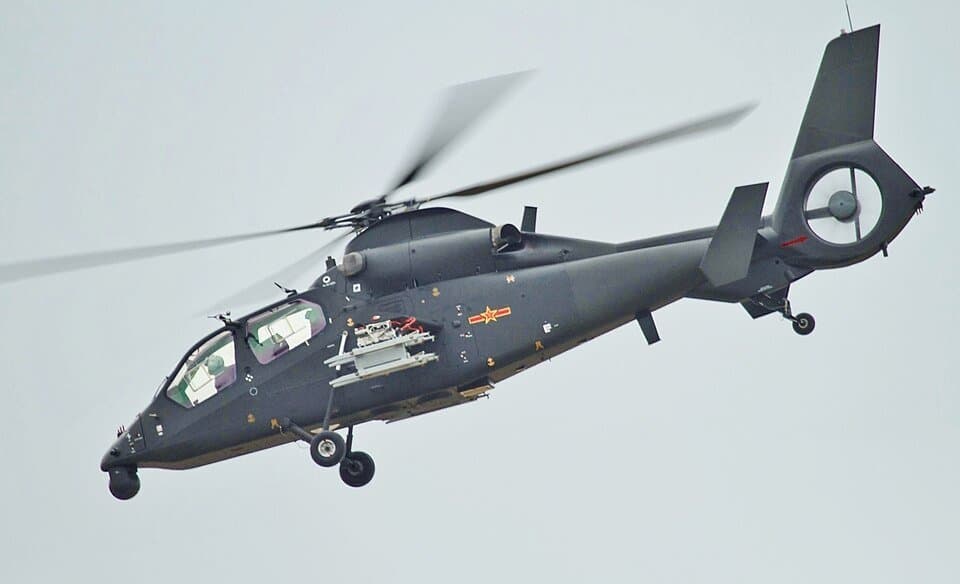

Credit
Alert5 · CC BY-SA 4.0 · Resized · CC BY-SA 4.0 · Source ↗ · Modified


Preparing your view.

At a glance
Measured figures
Z-19 · Length
Single source12 m (39 ft 4 in)[source]
Length
Single sourceConfiguration
| Specification | Harbin Z-19 | Sikorsky S-97 Raider |
|---|---|---|
| Crew | Two, pilot and observer[source] | 0–2 pilots[source] |
| Type | Reconnaissance and attack helicopter[source] | Reconnaissance and attack compound helicopter[source] |
| Manufacturer | Harbin Aircraft Manufacturing Corporation[source] | Sikorsky Aircraft[source] |
| Status | In service[source] | Under development |
35 ft (11 m)[source]
Z-19 · Height
Single source4.01 m (13 ft 2 in)[source]
Z-19 · 1,800 ft/min
Single source9 m/s (1,800 ft/min)[source]
Bars compare reported quantities only. A larger figure does not make a system better; configurations and test conditions differ.
| Primary user | People's Liberation Army Ground Force[source] | — |
|---|
| Number built | 186+[source] |
|---|
| Manufactured | 2011-Present[source] | — |
|---|
| Introduction date | 2012[source] | — |
|---|
| First flight | 2011[source] | 22 May 2015[source] |
|---|
| Developed from | Harbin Z-9W[source] | Sikorsky X2[source] |
|---|
| Main rotor area | 111.79 m 2 (1,203.3 sq ft)[source] | — |
|---|
| National origin | China[source] | United States[source] |
|---|
| Developed into | — | Sikorsky Raider X[source] |
|---|
| Capacity | — | 6 troops[source] |
|---|
| Guns | — | .50 cal gun with 500 rounds[source] |
|---|
| Propellers | — | 1 x 6-bladed variable-pitch , clutchable pusher propeller (7 ft (2.1 m) diameter)[source] |
|---|
| Never exceed speed | — | 280 mph (440 km/h, 240 kn)[source] |
|---|
| Rockets | — | 7-shot rocket pod(s)[source] |
|---|
| Role | — | high-speed scout and attack compound helicopter[source] |
|---|
| Source measurement | — | Sikorsky's earliest attempt at a fast compound helicopter with stiff coaxial rotors was the Sikorsky S-69 (XH-59A) flown in the 1970s. Its top speed was over 260 knots but its excessive fuel consumption, vibration and complexity requiring the full-time attention of two pilots led to the program's cancellation. These problems were largely solved on another attempt by the Sikorsky X2 technology demonstrator in 2010. First proposed in response to a Request for Information for the Armed Aerial Scout (AAS) program in March 2010, the S-97 was formally launched on 20 October 2010. It was intended as a contender for a United States Army's requirement to replace the Bell OH-58D Kiowa Warrior . Other military roles are possible, the U.S. Special Operations Command having expressed interest in the S-97 as a replacement for the MH-6 Little Bird , and the possibility of adapting it for civilian applications also exists.[source]Sikorsky S-97 Raider · Development / Background; only the objects and conditions stated in this passage Sikorsky plans to build two prototypes of the S-97 as demonstrators. One prototype (P1) will be used for flight testing, while the second (P2) is planned for use as a demonstrator. The first prototype was planned to fly in late 2013 or early 2014. Sikorsky started construction of the two prototypes in October 2012. In September 2013, Sikorsky began final assembly of the first S-97 following delivery of the single-piece, all-composite fuselage by Aurora Flight Sciences . In February 2014, construction of the first S-97 prototype was one-quarter complete. Simulated bird strikes testing had been conducted on the fuselage at speeds of up to 235 kn (435 km/h; 270 mph), the S-97's expected maximum flight speed. Drop tests were also performed to ensure the fuel tanks' safety in the event of a crash. Sikorsky is exploring civil applications for the S-97, such as transporting personnel between offshore oil platforms.[source]Sikorsky S-97 Raider · Development / S-97; only the objects and conditions stated in this passage On 5 May 2014, Sikorsky opened the S-97 production hangar during the rollout of the CH-53K King Stallion . At that point, the mostly-composite airframe was almost assembled, including some of the electrical wiring and avionics, missing elements were the transmission, drive train, engine, coaxial rotor, and pusher propeller. The S-97's first military customer is aimed to be the U.S. Special Operations Command to replace the MH-6M Little Bird. Unspecified foreign militaries have shown interest in the S-97; it may be difficult to get approval for export for a next-generation helicopter if the US military does not yet have it. The Raider is a prototype, so the first customer would need to finance a production development program. Its avionics were powered on in June 2014, with rollout on 2 October 2014.[source]Sikorsky S-97 Raider · Development / S-97; only the objects and conditions stated in this passage The S-97 will be capable of carrying up to six passengers, in addition to a flight crew of two in a side-by-side cockpit. However, the production S-97 is projected to be capable of flying with either one or two pilots, or autonomously . Space for a targeting sensor has been reserved, however it will not be installed in the prototype aircraft.[source]Sikorsky S-97 Raider · Design; only the objects and conditions stated in this passage Based on the technology from the Sikorsky X2 demonstrator, the prototype S-97s will be powered by a General Electric YT706 turboshaft (the same engine used on the MH-60M Black Hawk ). A more powerful engine, developed under the Improved Turbine Engine Program , is expected to become available. Compared to the OH-58D Kiowa, the S-97 has significantly increased performance goals, such as cruising speeds upwards of 200 knots while carrying weapons, turning at three times the force of gravity at 220kt, and a high hover efficiency (Figure of merit) . Sikorsky also aims for an operating cost of $1,400 per flight hour.[source]Sikorsky S-97 Raider · Design; only the objects and conditions stated in this passage The first flight of the S-97 occurred on 22 May 2015. It flew for 1 hour instead of the planned 30 minutes, completing three takeoffs and landings; forward, rearward and sideward. For this initial flight, the Raider was flown with its triplex fly-by-wire flight control system in backup degraded mode so as to focus on basic airworthiness in the low-speed regime. This begins a year-long flight test program of about 100 flight-hours to expand the flight envelope to meet Sikorsky's key targets of 220-knot cruise speed carrying weapons, hover at 6,000 feet on a 95F day and 3g maneuverability at speed. Toward the end of Phase 1 testing, software will be upgraded to Block 2, bringing in the propulsor and articulating tail to increase speed and enable the full flight envelope. The second prototype (P2) was displayed to the public in October 2015. After two flight hours and a few months of testbench validation of the propulsion drivetrain, P1 is scheduled for higher speed some time in 2016.[source]Sikorsky S-97 Raider · Operational history; only the objects and conditions stated in this passage On 2 August 2017, an S-97 prototype suffered what Sikorsky described as a hard landing at their flight test facility in West Palm Beach, Florida; both airline transport pilots received minor injuries. The NTSB factual report on the incident stated that the helicopter lifted into a low hover and immediately experienced excessive roll oscillations which lead to intermeshing of the counter-rotating coaxial rotor system, and a hard landing. Damage to the helicopter included collapsed landing gear, structural cabin damage, and dynamic component damage, including rotor blade tip separation of all rotor blades. Video of the accident sequence showed aircraft roll oscillations exceeding 60–degree angle of bank during the course of 5 seconds, during which the upper and lower rotors collided at the 1 o'clock position.[source]Sikorsky S-97 Raider · Operational history; only the objects and conditions stated in this passage On 25 June 2019, the S-97 returned to flight testing and reached a speed of 190 knots (350 km/h).[source]Sikorsky S-97 Raider · Operational history; only the objects and conditions stated in this passage Capacity: 6 troops[source]Sikorsky S-97 Raider · Specifications; only the objects and conditions stated in this passage Length: 35 ft (11 m)[source]Sikorsky S-97 Raider · Specifications; only the objects and conditions stated in this passage Gross weight: 8,945 lb (4,057 kg)[source]Sikorsky S-97 Raider · Specifications; only the objects and conditions stated in this passage Max takeoff weight: 11,000 lb (4,990 kg)[source]Sikorsky S-97 Raider · Specifications; only the objects and conditions stated in this passage Powerplant: 1 × General Electric YT706 , 2,600 shp (1,900 kW)[source]Sikorsky S-97 Raider · Specifications; only the objects and conditions stated in this passage Main rotor diameter: 1 (2 coaxial) × 34 ft (10 m)[source]Sikorsky S-97 Raider · Specifications; only the objects and conditions stated in this passage Propellers: 1 x 6-bladed variable-pitch , clutchable pusher propeller (7 ft (2.1 m) diameter)[source]Sikorsky S-97 Raider · Specifications; only the objects and conditions stated in this passage Cruise speed: 250 mph (410 km/h, 220 kn) (with external weapons)[source]Sikorsky S-97 Raider · Specifications; only the objects and conditions stated in this passage Never exceed speed : 280 mph (440 km/h, 240 kn)[source]Sikorsky S-97 Raider · Specifications; only the objects and conditions stated in this passage Range: 350 mi (570 km, 310 nmi)[source]Sikorsky S-97 Raider · Specifications; only the objects and conditions stated in this passage Endurance: 2 h 40 min[source]Sikorsky S-97 Raider · Specifications; only the objects and conditions stated in this passage Service ceiling: 10,000 ft (3,000 m) at 95 °F (35 °C)[source]Sikorsky S-97 Raider · Specifications; only the objects and conditions stated in this passage |
|---|