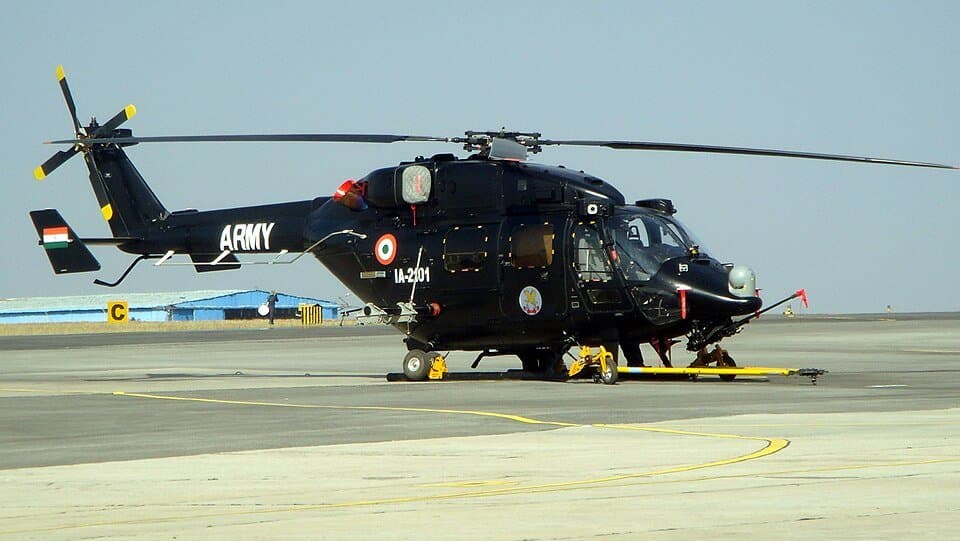

Credit
Pritishp333 · CC BY-SA 3.0 · Resized · CC BY-SA 3.0 · Source ↗ · Modified


Preparing your view.

At a glance
HAL Rudralarger figure on 5 of 6
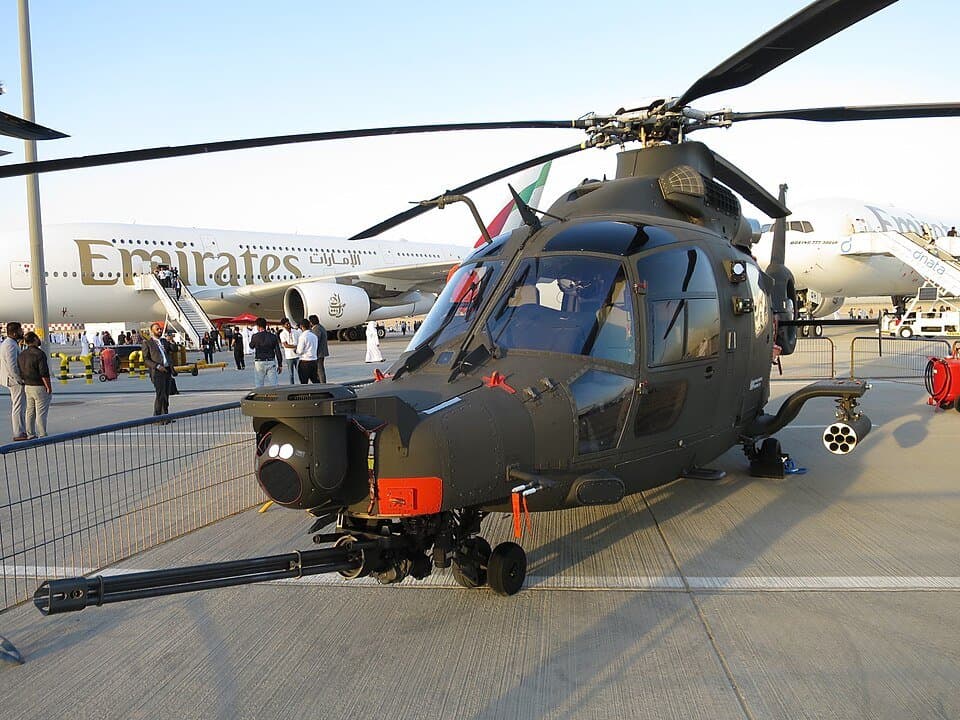
KAI LAH-1 Mironlarger figure on 1 of 6
True scale
Side by side. From every angle. A human reference for perspective.
3.06 MB · Loads when you open it| Model | Length | Width / span | Height |
|---|---|---|---|
| HAL Rudra | ≈ 15.87 m | ≈ 10.45 m (Width) | ≈ 5.26 m |
| KAI LAH-1 Miron | ≈ 11.16 m | ≈ 10.99 m (Width) | ≈ 4.05 m |
Scaled uniformly to the sourced length of 15.87 m. Not an official model or a measured survey.
ForceTally · All rights reserved
Scaled uniformly so that the main rotor matches the sourced 12.6 m rotor diameter. Not an official model or a measured survey.
ForceTally · All rights reserved
The human reference is a generic 1.75 m figure. Models describe external size, not combat performance.
Measured figures
Length
Single source15.87 m (52 ft 1 in)[source]
Length
Single sourceConfiguration
| Specification | HAL Rudra | KAI LAH-1 Miron |
|---|---|---|
| Type | Armed helicopter[source] | Armed helicopter[source] |
| National origin | India[source] | South Korea[source] |
| Manufacturer | Hindustan Aeronautics Limited[source] | Korea Aerospace Industries Airbus Helicopters[source] |
| Designer | Rotary Wing Research and Design Centre[source] | Agency for Defense Development |
Counts only measures both sources give with the same scope. A larger figure is not a better system.
14.3 m (46 ft 11 in)[source]
2 × HAL/Turbomeca Shakti -1H turboshaft (1,432 shp) each
Single source2 × HAL/Turbomeca Shakti -1H turboshaft , 1,068 kW (1,432 shp) each[source]
2 × HAS-Arriel 2L2 turboshaft engines, Take-off Power each
Single source2 × HAS-Arriel 2L2 turboshaft engines, Take-off Power, 770 kW (1,030 hp) each[source]
Bars compare reported quantities only. A larger figure does not make a system better; configurations and test conditions differ.
| Status | In service[source] | In service[source] |
|---|
| Primary users | Indian Army Indian Air Force[source] | — |
|---|
| Number built | 91[source] |
|---|
| Manufactured | 2007–present[source] | — |
|---|
| Introduction date | 2012[source] | — |
|---|
| First flight | 16 August 2007[source] | 4 July 2019[source] |
|---|
| Developed from | HAL Dhruv[source] | Airbus Helicopters H155[source] |
|---|
| Capacity | 12 passengers (14 passengers in high density seating)[source] | 2 x 20mm Magazines (Cabin)[source] |
|---|
| Fuel capacity | 1,055 kg (2,326 lb)[source] | — |
|---|
| Main rotor area | 136.85 m 2 (1,473.0 sq ft)[source] | 124.7 m 2 (1,342 sq ft)[source] |
|---|
| Never exceed speed | 292 km/h (182 mph, 157 kn)[source] | — |
|---|
| Disk loading | 40.19 kg/m 2 (8.23 lb/sq ft)[source] | — |
|---|
| Primary user | — | Republic of Korea Army[source] |
|---|
| Guns | — | 1× 20mm M197 electric cannon three-barreled electric Gatling-type rotary cannon[source] |
|---|
| Hardpoints | — | 4 , with provisions to carry combinations of: Rockets: 2 × seven-shot rocket launcher Hydra 70 (1 launcher on each side) Missiles: Air-to-surface missiles: 4 × TAipers Air-to-surface missile (2 on each side)[source] |
|---|
| Rockets | — | 2 × seven-shot rocket launcher Hydra 70 (1 launcher on each side)[source] |
|---|
| Missiles | — | Air-to-surface missiles: 4 × TAipers Air-to-surface missile (2 on each side)[source] |
|---|
| Air-to-surface missiles | — | 4 × TAipers Air-to-surface missile (2 on each side)[source] |
|---|
| Reported operators |
| — |
|---|
Empty; Empty weight
Single source