
Credit
Government of India · GODL-India · Resized · GODL-India · Source ↗ · Modified


Preparing your view.

At a glance
True scale
Side by side. From every angle. A human reference for perspective.
3.43 MB · Loads when you open it| Model | Length | Width / span | Height |
|---|---|---|---|
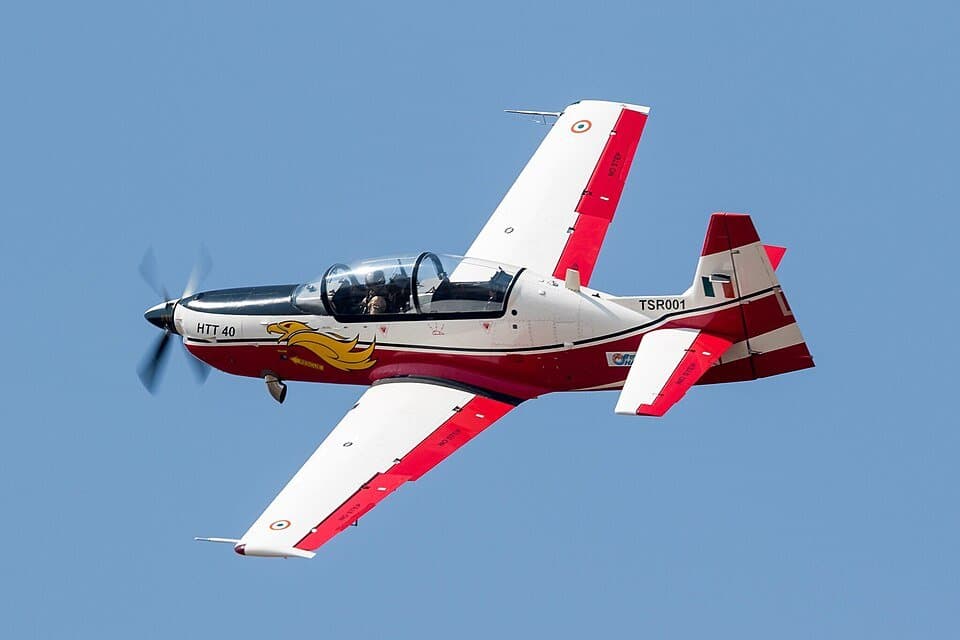
| HAL HTT-40 | ≈ 10.06 m | ≈ 11 m (Wingspan) | ≈ 3.58 m |
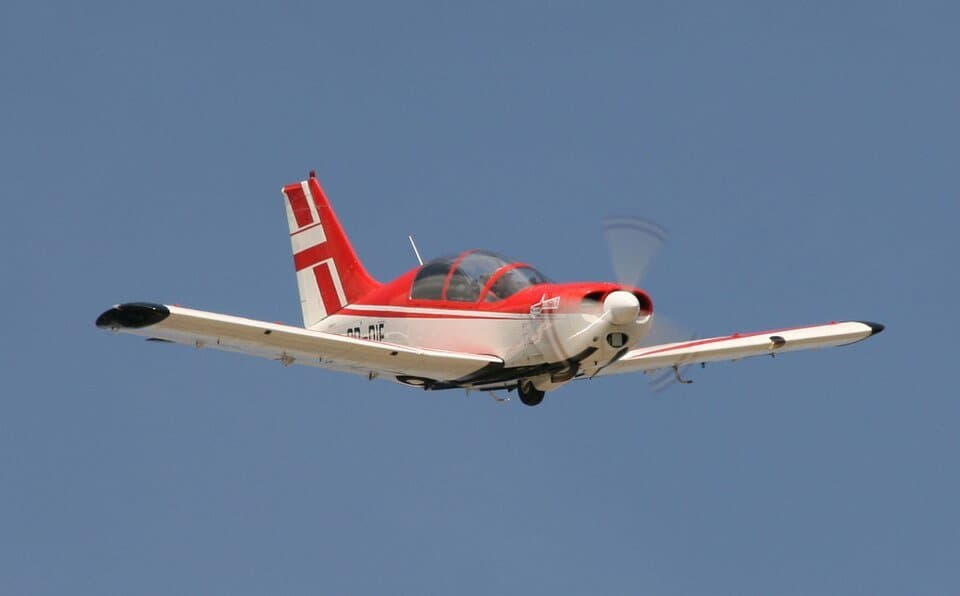
| PZL M26 Iskierka | ≈ 8.3 m | ≈ 8.6 m (Wingspan) | ≈ 2.96 m |
Scaled uniformly to the sourced length of 10.061 m. The shape was turned square to the axes; the height was fitted to the sourced 3.583 m; the width was fitted to the sourced 11 m wingspan. Not an official model or a measured survey.
ForceTally · All rights reserved
Scaled uniformly to the sourced length of 8.295 m. The shape was turned square to the axes; the height was fitted to the sourced 2.96 m; the width was fitted to the sourced 8.6 m wingspan. Not an official model or a measured survey.
ForceTally · All rights reserved
The human reference is a generic 1.75 m figure. Models describe external size, not combat performance.
Measured figures
HTT-40 · Length
DisputedConfiguration
| Specification | HAL HTT-40 | PZL M26 Iskierka |
|---|---|---|
| Type | Basic training aircraft[source] | Trainer aircraft[source] |
| National origin | India[source] | Poland[source] |
| Manufacturer | Hindustan Aeronautics Limited[source] Hindustan Aeronautics Limited (HAL)[source]HTT-40 | PZL Mielec[source] |
| Designer | Aircraft Research and Design Centre |
HTT-40 · Length
M26 01 · Length
Single source8.295 m (27 ft 3 in)[source]
Empty; HTT-40 / Basic Empty Mass · Empty mass
Single sourceGross; HTT-40 · Gross weight
Single sourceGross; HTT-40 / Normal Training Configuration Mass · Gross weight
Single sourceMaximum take-off; HTT-40 / Maximum Take-off Mass · Max takeoff weight
Single source2,800 kg (6,173 lb)[source]
2414 kg[source]HTT-40 / Basic Empty Mass
3040 kg[source]HTT-40 / Maximum Take-off Mass
2960 kg[source]HTT-40 / Normal Training Configuration Mass
Empty; M26 01 · Empty weight
Single sourceMaximum take-off; M26 01 · Aerobatic mission
Single sourceMaximum; HTT-40 · Maximum speed
DisputedMaximum; HTT-40 / Max level Speed · Maximum speed
Manufacturer claimMaximum; HTT-40 / Max permissible Speed · @ 6g
Manufacturer claimMaximum; HTT-40 · Maximum speed
Disputed400 km/h (249 mph, 216 kn)[source]
450 kmph @ 6g[source]HTT-40 / Max permissible Speed
407 kmph[source]HTT-40 / Max level Speed
450 km/h[source]HTT-40
Maximum; M26 01 · Aerobatic mission
Single sourceMaximum; M26 01 · Utility mission
Single sourceHTT-40 · 1 × Honeywell Garrett TPE331-12B turboprop (1,100 shp) derated to
Single sourceHTT-40 · 950 shp
Single source1 × Honeywell Garrett TPE331-12B turboprop, 834 kW (1,100 shp) derated to 708 kW (950 shp)[source]
1100 Shp[source]HTT-40 / Max Power
M26 01 · 1 × Textron Lycoming AEIO-540-L1B5 6-cylinder horizontally-opposed air-cooled piston engine
Single source1 × Textron Lycoming AEIO-540-L1B5 6-cylinder horizontally-opposed air-cooled piston engine, 224 kW (300 hp)[source]
HTT-40 · Endurance
Manufacturer claim3.09 hrs[source]HTT-40
M26 01 · Wing area
Single source14 m 2 (150 sq ft)[source]
M26 01 · (1,480 ft/min) Aerobatic mission
Single sourceM26 01 · Utility mission
Single source7.5 m/s (1,480 ft/min) Aerobatic mission; 6 m/s (20 ft/s) Utility mission[source]
Bars compare reported quantities only. A larger figure does not make a system better; configurations and test conditions differ.
| — |
| Status | In service[source] | in production[source] |
|---|
| Primary user | Indian Air Force[source] | — |
|---|
| Number built | 3 (excluding 2 prototypes)[source] |
|---|
| Introduction date | 2026 (planned)[source] | — |
|---|
| First flight | 31 May 2016[source] | July 15, 1986[source] |
|---|
| Developed from | HPT-32 Deepak[source] | — |
|---|
| Fuel capacity | 450 kg[source] | 369 L (97 US gal; 81 imp gal) in four wing tanks; Oil capacity 18 L (4.8 US gal; 4.0 imp gal)[source] |
|---|
| Propellers | 4-bladed[source] | 3-bladed Hoffman HO-V123K-V/200AH-10 OR Hartzell HC-C3YR-4BF, 1.9 m (6 ft 3 in) diameter constant-speed propeller[source] |
|---|
| Never exceed speed | 450 km/h (279 mph, 243 kn)[source] | 395 km/h (245 mph, 213 kn) Aerobatic mission; 371 km/h (231 mph; 200 kn) Utility mission[source] |
|---|
| g limits | +6/-3[source] | +6 / -3 Aerobatic mission; +4.4 / -1.76 Utility mission at Max take-off weight[source] |
|---|
| Internal fuel mass | 460 kg[source]HTT-40 / Internal fuel mass | — |
|---|
| Take-off Distance | 785 meter[source]HTT-40 | — |
|---|
| Landing Distance | 987 meter[source]HTT-40 | — |
|---|
| Time to Climb 3 km | 7.05 min[source]HTT-40 | — |
|---|
| Engine | Honeywell TPE331-12B Turboprop engine[source]HTT-40 | — |
|---|
| Primary users | — | US civilian aviation Poland Venezuela[source] |
|---|
| Aspect ratio | — | 5.3[source] |
|---|
| Airfoil | — | NACA65 2 -415[source] |
|---|
| Wing loading | — | 93.9 kg/m 2 (19.2 lb/sq ft) Aerobatic mission; 100 kg/m 2 (20 lb/sq ft) Utility mission[source] |
|---|
| Power/mass | — | 5.88 kg/kW (9.66 lb/hp) Aerobatic mission; 6.26 kg/kW (10.29 lb/hp) Utility mission[source] |
|---|
| Reported operators | — |
|---|
Maximum take-off; M26 01 · Utility mission
Single source1,040 kg (2,293 lb)[source]
1,315 kg (2,899 lb) Aerobatic mission; 1,400 kg (3,100 lb) Utility mission[source]
330 km/h (210 mph, 180 kn) Aerobatic mission; 321 km/h (199 mph; 173 kn) Utility mission[source]