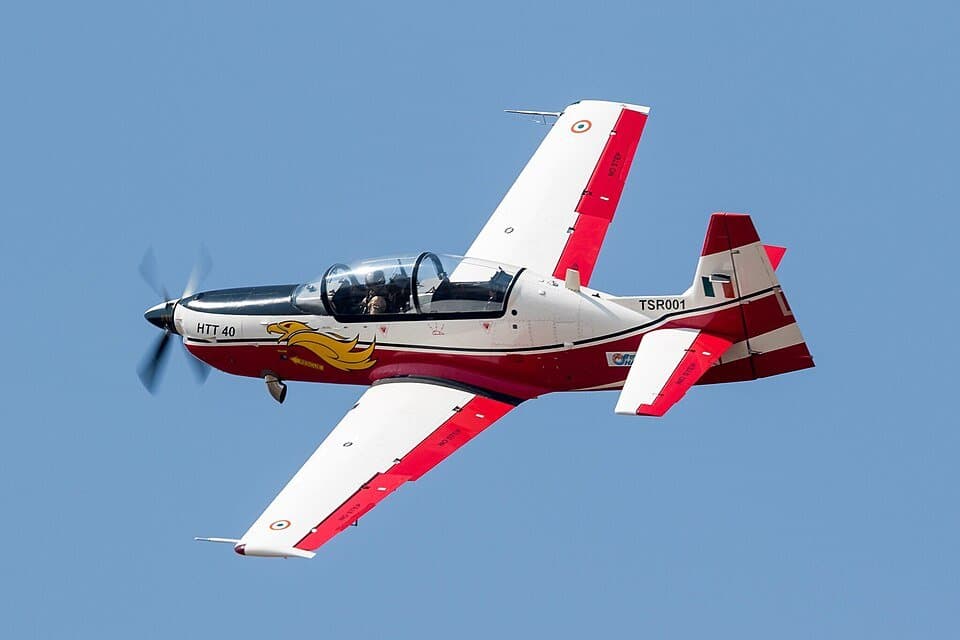

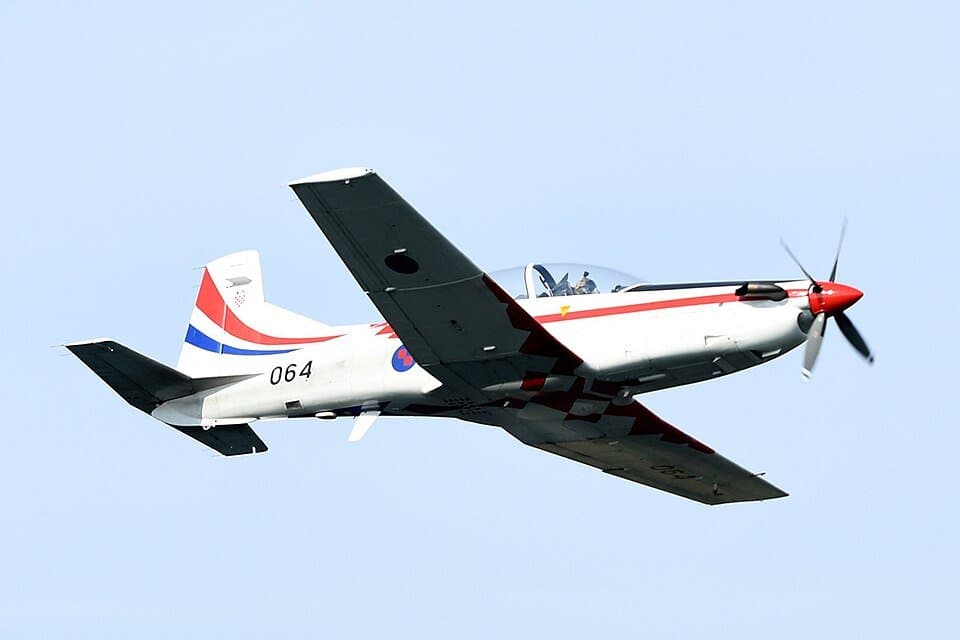
Credit
Government of India · GODL-India · Resized · GODL-India · Source ↗ · Modified


Preparing your view.

At a glance
True scale
Side by side. From every angle. A human reference for perspective.
3.44 MB · Loads when you open it| Model | Length | Width / span | Height |
|---|---|---|---|
| HAL HTT-40 | ≈ 10.06 m | ≈ 11 m (Wingspan) | ≈ 3.58 m |
| Pilatus PC-9 | ≈ 10.14 m | ≈ 10.12 m (Wingspan) | ≈ 3.26 m |
Scaled uniformly to the sourced length of 10.061 m. The shape was turned square to the axes; the height was fitted to the sourced 3.583 m; the width was fitted to the sourced 11 m wingspan. Not an official model or a measured survey.
ForceTally · All rights reserved
Scaled uniformly to the sourced length of 10.14 m. The shape was turned square to the axes; the height was fitted to the sourced 3.26 m; the width was fitted to the sourced 10.125 m wingspan. Not an official model or a measured survey.
ForceTally · All rights reserved
The human reference is a generic 1.75 m figure. Models describe external size, not combat performance.
Measured figures
HTT-40 · Length
DisputedConfiguration
| Specification | HAL HTT-40 | Pilatus PC-9 |
|---|---|---|
| Type | Basic training aircraft[source] | Basic/advanced trainer aircraft[source] |
| National origin | India[source] | Switzerland[source] |
| Manufacturer | Hindustan Aeronautics Limited[source] Hindustan Aeronautics Limited (HAL)[source]HTT-40 | Pilatus Aircraft[source] |
| Designer | Aircraft Research and Design Centre |
HTT-40 · Length
PC-9M · Length
Single source10.14 m (33 ft 3 in)[source]
Empty; HTT-40 / Basic Empty Mass · Empty mass
Single sourceGross; HTT-40 · Gross weight
Single sourceGross; HTT-40 / Normal Training Configuration Mass · Gross weight
Single sourceMaximum take-off; HTT-40 / Maximum Take-off Mass · Max takeoff weight
Single source2,800 kg (6,173 lb)[source]
2414 kg[source]HTT-40 / Basic Empty Mass
3040 kg[source]HTT-40 / Maximum Take-off Mass
2960 kg[source]HTT-40 / Normal Training Configuration Mass
Empty; PC-9M · Empty weight
Single sourceGross; PC-9M · Gross weight
Single sourceMaximum; HTT-40 · Maximum speed
DisputedMaximum; HTT-40 / Max level Speed · Maximum speed
Manufacturer claimMaximum; HTT-40 / Max permissible Speed · @ 6g
Manufacturer claimMaximum; HTT-40 · Maximum speed
Disputed400 km/h (249 mph, 216 kn)[source]
450 kmph @ 6g[source]HTT-40 / Max permissible Speed
407 kmph[source]HTT-40 / Max level Speed
450 km/h[source]HTT-40
Cruise; PC-9M · at 7,620 m (25,000 ft)
Single sourceMaximum; PC-9M · Maximum speed
Single sourceHTT-40 · 1 × Honeywell Garrett TPE331-12B turboprop (1,100 shp) derated to
Single sourceHTT-40 · 950 shp
Single source1 × Honeywell Garrett TPE331-12B turboprop, 834 kW (1,100 shp) derated to 708 kW (950 shp)[source]
1100 Shp[source]HTT-40 / Max Power
PC-9M · 1 × Pratt & Whitney Canada PT6A -62 turboprop flat-rated at
Single sourcePC-9M · 950 shp
Single sourcePC-9M · Wing area
Single source16.29 m 2 (175.3 sq ft)[source]
PC-9M · 4,090 ft/min
Single source20.8 m/s (4,090 ft/min)[source]
Bars compare reported quantities only. A larger figure does not make a system better; configurations and test conditions differ.
| — |
| Status | In service[source] | Active service[source] |
|---|
| Primary user | Indian Air Force[source] | — |
|---|
| Number built | 3 (excluding 2 prototypes)[source] | 265[source] |
|---|
| Introduction date | 2026 (planned)[source] | — |
|---|
| First flight | 31 May 2016[source] | 7 May 1984[source] |
|---|
| Developed from | HPT-32 Deepak[source] | Pilatus PC-7[source] |
|---|
| Fuel capacity | 450 kg[source] | — |
|---|
| Propellers | 4-bladed[source] | — |
|---|
| Never exceed speed | 450 km/h (279 mph, 243 kn)[source] | — |
|---|
| g limits | +6/-3[source] | + 7.0 g to −3.5 g[source] |
|---|
| Internal fuel mass | 460 kg[source]HTT-40 / Internal fuel mass | — |
|---|
| Take-off Distance | 785 meter[source]HTT-40 | — |
|---|
| Landing Distance | 987 meter[source]HTT-40 | — |
|---|
| Time to Climb 3 km | 7.05 min[source]HTT-40 | — |
|---|
| Engine | Honeywell TPE331-12B Turboprop engine[source]HTT-40 | — |
|---|
| Primary users | — | Swiss Air Force Slovenian Air Force and Air Defence Royal Saudi Air Force Royal Thai Air Force Irish Air Corps[source] |
|---|
| Manufactured | — | 1984–present[source] |
|---|
| Developed into | — | T-6 Texan II[source] |
|---|
| Stall speed | — | 143 km/h (89 mph, 77 kn) EAS flaps and gear up, 128 km/h (80 mph; 69 kn) flaps and gear down[source] |
|---|
| Take-off distance over 50 ft (15 m) obstacle at sea level | — | 1,280 ft (391 m)[source] |
|---|
| Landing distance over 50 ft (15 m) obstacle at sea level | — | 2,295 ft (700 m)[source] |
|---|
| Hardpoints | — | seven hardpoints, 3 under each wing, inner two rated at 250 kg (550 lb), outer rated at 110 kg (240 lb)[source] |
|---|
Maximum take-off; PC-9M · A view of the interior of the cockpit of a Pilatus PC-9 aircraft
Single source1,725 kg (3,803 lb)[source]
2,350 kg (5,181 lb)[source]
3,200 kg (7,055 lb) A view of the interior of the cockpit of a Pilatus PC-9 aircraft.[source]
1 × Pratt & Whitney Canada PT6A -62 turboprop, 857 kW (1,149 hp) flat-rated at 708 kW (950 shp)[source]