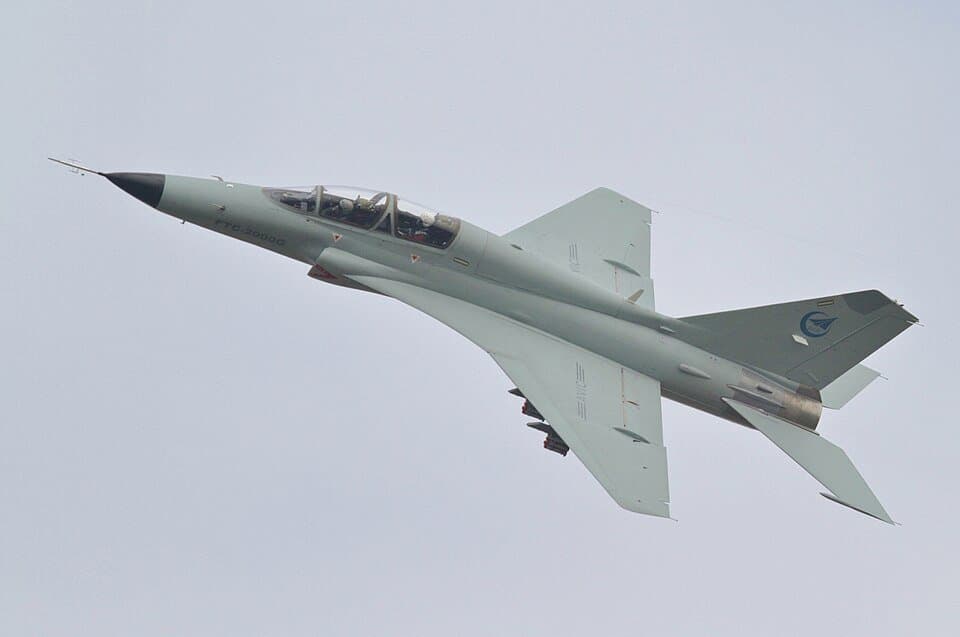

Credit
Alert5 · CC BY-SA 4.0 · Resized · CC BY-SA 4.0 · Source ↗ · Modified


Preparing your view.
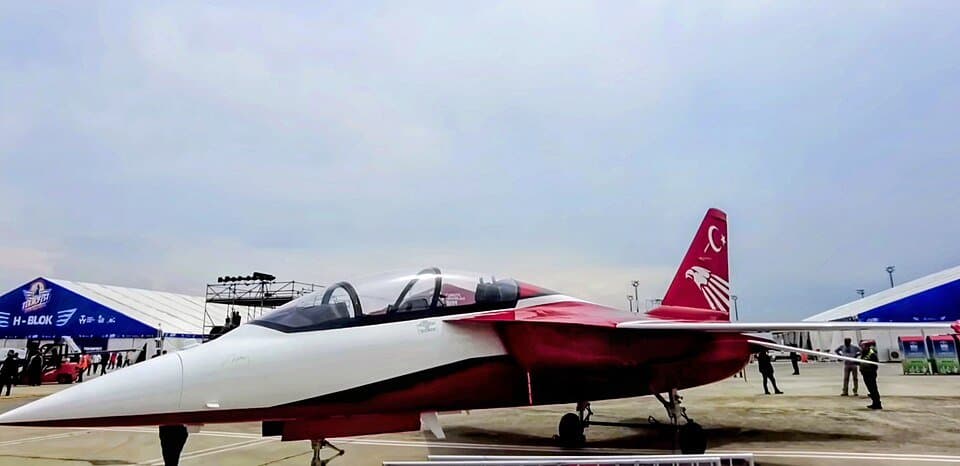

BTrainer aircraft
Advanced jet trainer ( lead-in fighter trainer ) and Light combat aircraft
At a glance
Measured figures
FTC-2000 · excluding nose-probe
Single source14.555 m (47 ft 9 in) excluding nose-probe[source]
Configuration
| Specification | Guizhou JL-9 | TAI Hürjet |
|---|---|---|
| Type | Advanced jet trainer Light combat aircraft[source] | Advanced jet trainer ( lead-in fighter trainer ) and Light combat aircraft[source] |
| Manufacturer | Guizhou Aviation Industry Import/Export Company (GAIEC)[source] | Turkish Aerospace Industries[source] |
| Designer | Aero Engine Research Institute of Guizhou Aviation Industry Corporation[source] | — |
| Status | In service[source] | Scheduled to enter operational service[source] |
Length
13.6 m (44 ft 9 in)[source]
Ferry; FTC-2000 · with maximum internal and external fuel
Single sourceFTC-2000 · on internal fuel
Single source863 km (536 mi, 466 nmi) on internal fuel[source]
2,400 km (1,500 mi, 1,300 nmi) with maximum internal and external fuel[source]
Range
Single source1,960 km (1,220 mi, 1,060 nmi)[source]
FTC-2000 · 1 × Guizhou Liyang WP-13F (C) afterburning turbojet thrust dry
Single sourceFTC-2000 · thrust dry and
Single sourceFTC-2000 · with afterburner
Single sourceFTC-2000 · with afterburner (1 × WP-14C Kunlun-3 for FTC-2000G
Single source1 × Guizhou Liyang WP-13F (C) afterburning turbojet, 43.15 kN (9,700 lbf) thrust dry, 63.25 kN (14,220 lbf) with afterburner (1 × WP-14C Kunlun-3 for FTC-2000G, 53.89 kN (12,110 lbf) thrust dry and 76.53 kN (17,200 lbf) with afterburner.)[source]
1 × General Electric F404 -GE-104 afterburning turbofan engine thrust dry
Single sourcewith afterburner
Single sourceFTC-2000 · Endurance
Single source3 hours[source]
Bars compare reported quantities only. A larger figure does not make a system better; configurations and test conditions differ.
| Primary users | People's Liberation Army Air Force People's Liberation Army Navy Air Force Myanmar Air Force Sudanese Air Force[source] | — |
|---|
| First flight | 13 December 2003[source] | 25 April 2023[source] |
|---|
| Developed from | Chengdu JJ-7[source] | — |
|---|
| Fuel capacity | 2,000 kg (4,409 lb) internal + up to 1,302 kg (2,870 lb) in external tanks[source] | — |
|---|
| Guns | 1 × 23 mm cannon[source] | — |
|---|
| Hardpoints | 5 with a capacity of 2,000 kg (4,409 lb) maximum, with provisions to carry combinations of: Other: up to 3 x fuel tanks[source] | Provision for a total of seven pylon stations (one × under-fuselage, four × under-wing plus two × wingtip)[source] |
|---|
| Unstick and touchdown speed | 260 km/h (160 mph; 140 kn)[source] | — |
|---|
| Minimum flying speed | 210 km/h (130 mph; 110 kn)[source] | — |
|---|
| Stall speed | 125 km/h (78 mph, 67 kn)[source] | — |
|---|
| g limits | + 8 - 3[source] | + 8 − 3[source] |
|---|
| Wing loading | 374.8 kg/m 2 (76.8 lb/sq ft)[source] | — |
|---|
| Thrust/weight | 0.00645 kN/kg (0.658 lb f /lb)[source] | — |
|---|
| Take-off run | 400–500 m (1,300–1,600 ft)[source] | — |
|---|
| Landing run | 700 m (2,300 ft)[source] | — |
|---|
| Other | up to 3 x fuel tanks[source] | — |
|---|
| Missiles | ** Short range air-to-air missile 2 × PL-8 AAMs (on inboard pylons) 2 × PL-9 AAMs (on outboard pylons) Beyond-visual-range air-to-air missiles SD-10 (Only on FTC-2000G) Anti-radiation missiles CM-102 (Only on FTC-2000G)[source] | — |
|---|
| Beyond-visual-range air-to-air missiles | SD-10 (Only on FTC-2000G)[source] | — |
|---|
| Anti-radiation missiles | CM-102 (Only on FTC-2000G)[source] | — |
|---|
| Country of origin | Volksrepublik China[source]Country of design · Entwurfsland | — |
|---|
| National origin | — | Türkiye[source] |
|---|
| Prototypes | — | 3 prototypes[source] |
|---|
| Number built | — |
|---|
| Introduction date | — | 2026[source] |
|---|
| Role | — | single-engine, tandem seat , supersonic advanced jet trainer and light combat aircraft ,[source] |
|---|
| Source measurement | — | The Turkish Air Force intends to use the design to replace the Northrop T-38M Talon in the trainer role and also to supplement the General Dynamics F-16C Fighting Falcon for close air support . The aircraft is also planned to replace the Northrop F-5A/2000 Freedom Fighter used by the Turkish Stars aerobatic team. A naval version of the aircraft may also be developed. The company also plans to pursue export orders to countries looking to replace older trainer and ground attack aircraft.[source]TAI Hürjet · Lead; only the objects and conditions stated in this passage On September 3, 2023, the Hürjet prototype successfully conducted a formation flight with the Turkish Stars aerobatic team, completing a total of 17 flights, accumulating a total of 9 hours and 8 minutes of flight time.[source]TAI Hürjet · Development and design; only the objects and conditions stated in this passage On July 11, 2024, the Hürjet prototype successfully conducted a transonic flight test, reaching a speed of Mach 0.9 at an altitude of 30,000 feet, completing a total of 79 flights.[source]TAI Hürjet · Development and design; only the objects and conditions stated in this passage On August 16, 2024, the Hürjet prototype successfully conducted its 100th flight piloted by TAI test pilots Ercan Çelik and Orhan Boran, accumulating a total of 118 hours of flight time.[source]TAI Hürjet · Development and design; only the objects and conditions stated in this passage On 12 November the second prototype of Hürjet successfully completed its first flight. The second Hürjet prototype (PT-2, TUS-A003), remained airborne for 26 minutes on its first flight, reaching a speed of 260 knots and an altitude of 10,000 feet, with an F-16D flying ‘chase’.[source]TAI Hürjet · Development and design; only the objects and conditions stated in this passage Length: 13.6 m (44 ft 9 in)[source]TAI Hürjet · Specifications; only the objects and conditions stated in this passage Wingspan: 9.5 m (31 ft 2 in)[source]TAI Hürjet · Specifications; only the objects and conditions stated in this passage Height: 4.1 m (13 ft 5 in)[source]TAI Hürjet · Specifications; only the objects and conditions stated in this passage Wing area: 25 m 2 (270 sq ft)[source]TAI Hürjet · Specifications; only the objects and conditions stated in this passage Payload : 3,402 kg (7,500 lb)[source]TAI Hürjet · Specifications; only the objects and conditions stated in this passage Powerplant: 1 × General Electric F404 -GE-104 afterburning turbofan engine, 53.07 kN (11,930 lbf) thrust dry, 78.7 kN (17,700 lbf) with afterburner[source]TAI Hürjet · Specifications; only the objects and conditions stated in this passage Range: 1,960 km (1,220 mi, 1,060 nmi)[source]TAI Hürjet · Specifications; only the objects and conditions stated in this passage Service ceiling: 14,000 m (45,000 ft)[source]TAI Hürjet · Specifications; only the objects and conditions stated in this passage Rate of climb: 246 m/s (48,500 ft/min)[source]TAI Hürjet · Specifications; only the objects and conditions stated in this passage |
|---|
| Reported operators | — |
|---|
1 × General Electric F404 -GE-104 afterburning turbofan engine, 53.07 kN (11,930 lbf) thrust dry, 78.7 kN (17,700 lbf) with afterburner[source]