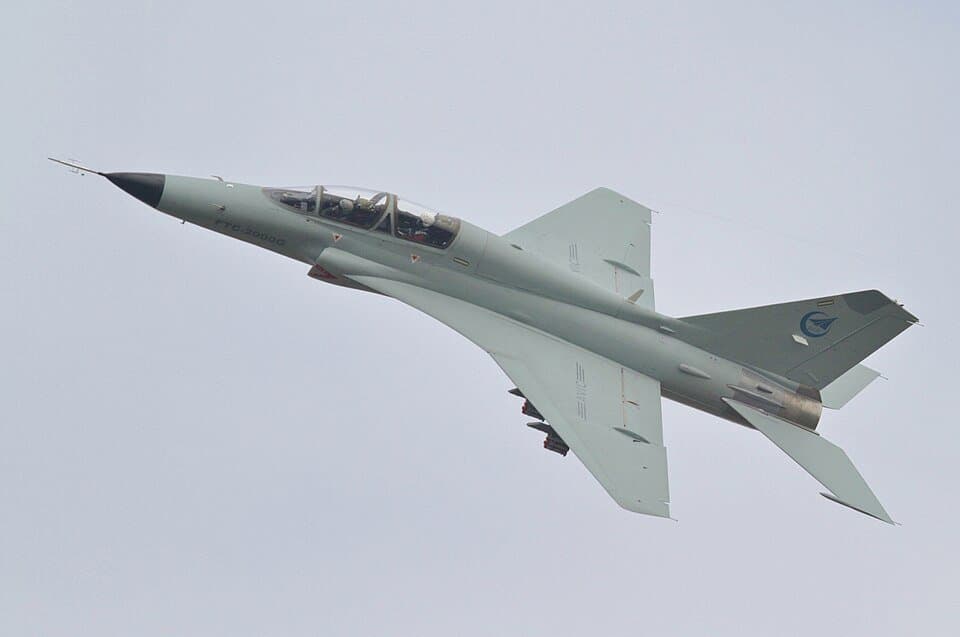

Credit
Alert5 · CC BY-SA 4.0 · Resized · CC BY-SA 4.0 · Source ↗ · Modified


Preparing your view.

At a glance
Measured figures
FTC-2000 · excluding nose-probe
Single source14.555 m (47 ft 9 in) excluding nose-probe[source]
PC-9M · Length
Configuration
| Specification | Guizhou JL-9 | Pilatus PC-9 |
|---|---|---|
| Type | Advanced jet trainer Light combat aircraft[source] | Basic/advanced trainer aircraft[source] |
| Manufacturer | Guizhou Aviation Industry Import/Export Company (GAIEC)[source] | Pilatus Aircraft[source] |
| Designer | Aero Engine Research Institute of Guizhou Aviation Industry Corporation[source] | — |
| Status | In service[source] | Active service[source] |
10.14 m (33 ft 3 in)[source]
Ferry; FTC-2000 · with maximum internal and external fuel
Single sourceFTC-2000 · on internal fuel
Single source863 km (536 mi, 466 nmi) on internal fuel[source]
2,400 km (1,500 mi, 1,300 nmi) with maximum internal and external fuel[source]
PC-9M · Range
Single source1,537 km (955 mi, 830 nmi)[source]
PC-9M · 1 × Pratt & Whitney Canada PT6A -62 turboprop flat-rated at
Single sourcePC-9M · 950 shp
Single source1 × Pratt & Whitney Canada PT6A -62 turboprop, 857 kW (1,149 hp) flat-rated at 708 kW (950 shp)[source]
FTC-2000 · 1 × Guizhou Liyang WP-13F (C) afterburning turbojet thrust dry
Single sourceFTC-2000 · thrust dry and
Single sourceFTC-2000 · with afterburner
Single sourceFTC-2000 · with afterburner (1 × WP-14C Kunlun-3 for FTC-2000G
Single source1 × Guizhou Liyang WP-13F (C) afterburning turbojet, 43.15 kN (9,700 lbf) thrust dry, 63.25 kN (14,220 lbf) with afterburner (1 × WP-14C Kunlun-3 for FTC-2000G, 53.89 kN (12,110 lbf) thrust dry and 76.53 kN (17,200 lbf) with afterburner.)[source]
Bars compare reported quantities only. A larger figure does not make a system better; configurations and test conditions differ.
| Primary users |
|---|
People's Liberation Army Air Force People's Liberation Army Navy Air Force Myanmar Air Force Sudanese Air Force[source] |
Swiss Air Force Slovenian Air Force and Air Defence Royal Saudi Air Force Royal Thai Air Force Irish Air Corps[source] |
| First flight | 13 December 2003[source] | 7 May 1984[source] |
|---|
| Developed from | Chengdu JJ-7[source] | Pilatus PC-7[source] |
|---|
| Fuel capacity | 2,000 kg (4,409 lb) internal + up to 1,302 kg (2,870 lb) in external tanks[source] | — |
|---|
| Guns | 1 × 23 mm cannon[source] | — |
|---|
| Hardpoints | 5 with a capacity of 2,000 kg (4,409 lb) maximum, with provisions to carry combinations of: Other: up to 3 x fuel tanks[source] | seven hardpoints, 3 under each wing, inner two rated at 250 kg (550 lb), outer rated at 110 kg (240 lb)[source] |
|---|
| Unstick and touchdown speed | 260 km/h (160 mph; 140 kn)[source] | — |
|---|
| Minimum flying speed | 210 km/h (130 mph; 110 kn)[source] | — |
|---|
| Stall speed | 125 km/h (78 mph, 67 kn)[source] | 143 km/h (89 mph, 77 kn) EAS flaps and gear up, 128 km/h (80 mph; 69 kn) flaps and gear down[source] |
|---|
| g limits | + 8 - 3[source] | + 7.0 g to −3.5 g[source] |
|---|
| Wing loading | 374.8 kg/m 2 (76.8 lb/sq ft)[source] | — |
|---|
| Thrust/weight | 0.00645 kN/kg (0.658 lb f /lb)[source] | — |
|---|
| Take-off run | 400–500 m (1,300–1,600 ft)[source] | — |
|---|
| Landing run | 700 m (2,300 ft)[source] | — |
|---|
| Other | up to 3 x fuel tanks[source] | — |
|---|
| Missiles | ** Short range air-to-air missile 2 × PL-8 AAMs (on inboard pylons) 2 × PL-9 AAMs (on outboard pylons) Beyond-visual-range air-to-air missiles SD-10 (Only on FTC-2000G) Anti-radiation missiles CM-102 (Only on FTC-2000G)[source] | — |
|---|
| Beyond-visual-range air-to-air missiles | SD-10 (Only on FTC-2000G)[source] | — |
|---|
| Anti-radiation missiles | CM-102 (Only on FTC-2000G)[source] | — |
|---|
| Country of origin | Volksrepublik China[source]Country of design · Entwurfsland | — |
|---|
| National origin | — | Switzerland[source] |
|---|
| Number built | — | 265[source] |
|---|
| Manufactured | — | 1984–present[source] |
|---|
| Developed into | — | T-6 Texan II[source] |
|---|
| Take-off distance over 50 ft (15 m) obstacle at sea level | — | 1,280 ft (391 m)[source] |
|---|
| Landing distance over 50 ft (15 m) obstacle at sea level | — | 2,295 ft (700 m)[source] |
|---|
| Reported operators |
| — |
|---|
Maximum take-off; PC-9M · A view of the interior of the cockpit of a Pilatus PC-9 aircraft
Single source