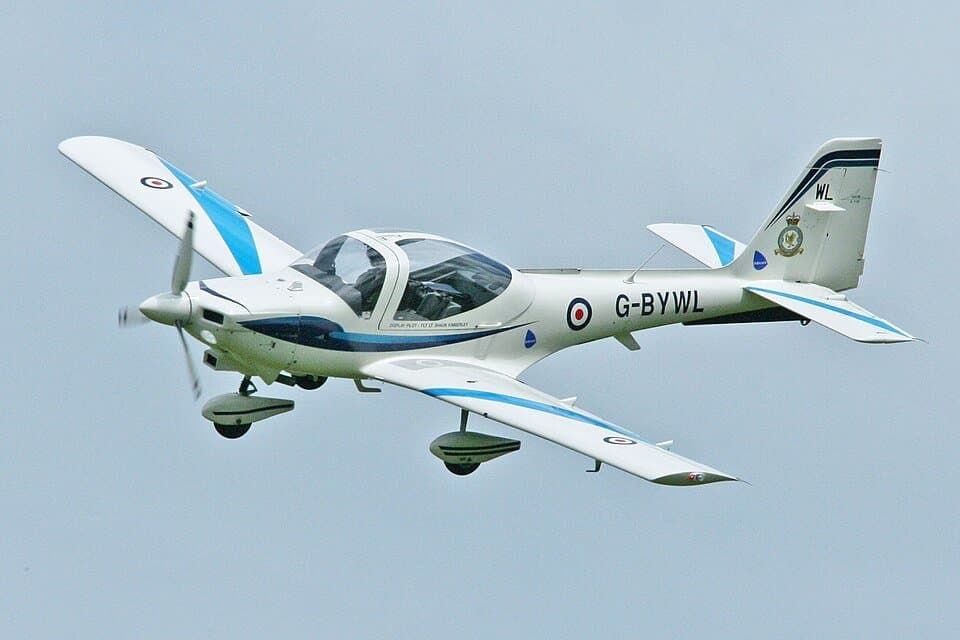

Credit
Alan Wilson · CC BY-SA 2.0 · Resized · CC BY-SA 2.0 · Source ↗ · Modified


Preparing your view.

At a glance
Measured figures
G 115E · Length
Single source7.79 m (25 ft 7 in)[source]
PC-9M · Length
Single sourceConfiguration
| Specification | Grob G 115 | Pilatus PC-9 |
|---|---|---|
| Type | Basic trainer[source] | Basic/advanced trainer aircraft[source] |
| Manufacturer | Grob Aircraft[source] | Pilatus Aircraft[source] |
| Status | active[source] | Active service[source] |
| Primary users | Royal Air Force Egyptian Air Force Finnish Air Force Royal Navy Army Air Corps (UK)[source] | Swiss Air Force Slovenian Air Force and Air Defence Royal Saudi Air Force Royal Thai Air Force Irish Air Corps |
10.14 m (33 ft 3 in)[source]
Cruise; G 115E · long range cruising speed
Single sourceMaximum; G 115E · Maximum speed
Single source250 km/h (160 mph, 130 kn)[source]
178 km/h (111 mph, 96 kn) (long range cruising speed)[source]
Cruise; PC-9M · at 7,620 m (25,000 ft)
Single sourceMaximum; PC-9M · Maximum speed
Single sourceG 115E · 1 × Lycoming AEIO-360-B1F/B 4-cylinder air-cooled horizontally-opposed piston engine
Single source1 × Lycoming AEIO-360-B1F/B 4-cylinder air-cooled horizontally-opposed piston engine, 130 kW (180 hp)[source]
PC-9M · 1 × Pratt & Whitney Canada PT6A -62 turboprop flat-rated at
Single sourcePC-9M · 950 shp
Single source1 × Pratt & Whitney Canada PT6A -62 turboprop, 857 kW (1,149 hp) flat-rated at 708 kW (950 shp)[source]
PC-9M · four hours and
Single sourcefour hours and 30 minutes[source]
Bars compare reported quantities only. A larger figure does not make a system better; configurations and test conditions differ.
| Manufactured | 1985–present[source] | 1984–present[source] |
|---|
| Introduction date | 1999[source] | — |
|---|
| First flight | November 1985[source] | 7 May 1984[source] |
|---|
| Fuel capacity | 143 L (31 imp gal; 38 US gal) usable[source] | — |
|---|
| Aspect ratio | 8.2:1[source] | — |
|---|
| Airfoil | Eppler 696[source] | — |
|---|
| Propellers | 3-bladed Hoffmann HO-V343K-V/183GY Constant-speed propeller , 1.83 m (6 ft 0 in) diameter[source] | — |
|---|
| Stall speed | 91 km/h (57 mph, 49 kn) (60 degree flap)[source] | 143 km/h (89 mph, 77 kn) EAS flaps and gear up, 128 km/h (80 mph; 69 kn) flaps and gear down[source] |
|---|
| Never exceed speed | 341 km/h (212 mph, 184 kn)[source] | — |
|---|
| g limits | + 6.0/ - 3.0[source] | + 7.0 g to −3.5 g[source] |
|---|
| Country of origin | Deutschland[source]Country of design · Entwurfsland | — |
|---|
| National origin | — | Switzerland[source] |
|---|
| Number built | — | 265[source] |
|---|
| Developed from | — | Pilatus PC-7[source] |
|---|
| Developed into | — | T-6 Texan II[source] |
|---|
| Take-off distance over 50 ft (15 m) obstacle at sea level | — | 1,280 ft (391 m)[source] |
|---|
| Landing distance over 50 ft (15 m) obstacle at sea level | — | 2,295 ft (700 m)[source] |
|---|
| Hardpoints | — | seven hardpoints, 3 under each wing, inner two rated at 250 kg (550 lb), outer rated at 110 kg (240 lb)[source] |
|---|
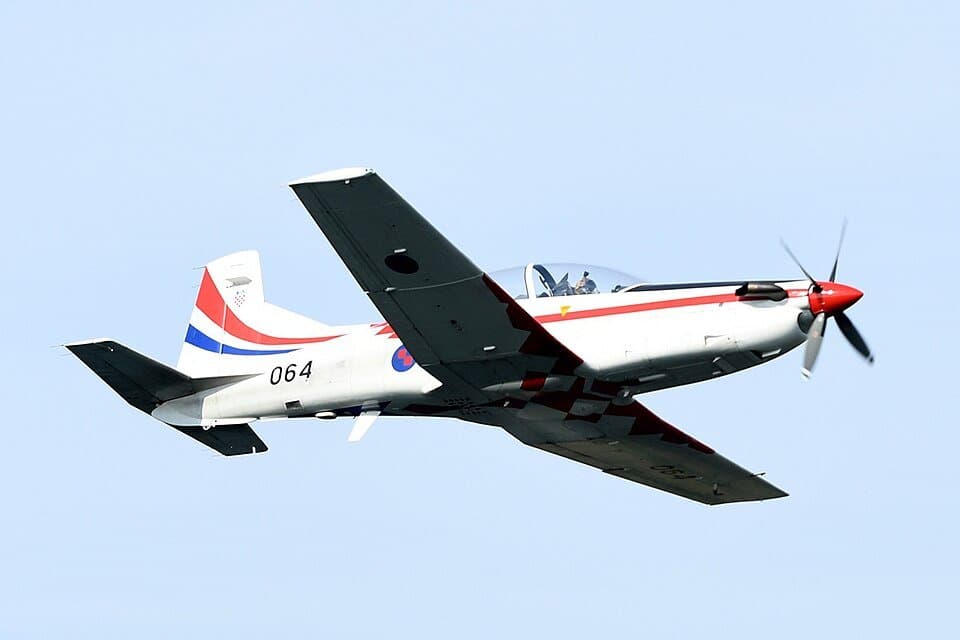
Maximum take-off; PC-9M · A view of the interior of the cockpit of a Pilatus PC-9 aircraft
Single source