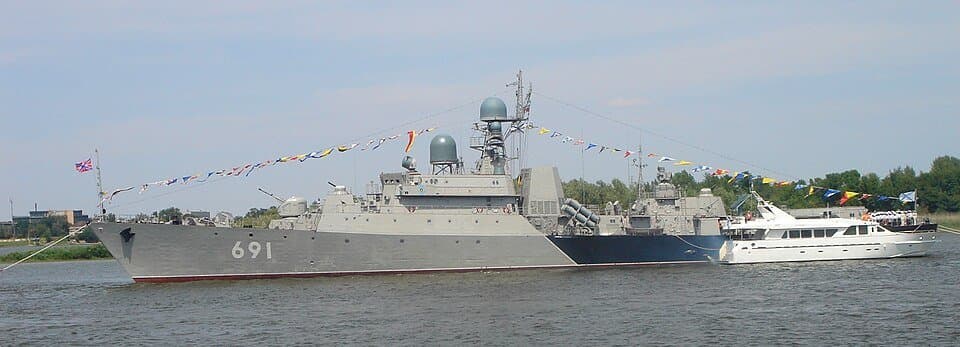

Credit
Vissarion · Public domain · Resized · Public domain · Source ↗ · Modified


Preparing your view.
At a glance
Gepard-class frigatelarger figure on 2 of 2
Measured figures
Approx Gepard 3.9 batch II
Single sourceApprox 102.4 m (336 ft) (Gepard 3.9 batch II)[source]
Length
Single sourceConfiguration
| Specification | Gepard-class frigate | Russian research vessel Yantar |
|---|---|---|
| Displacement | 1,500 tons (standard) 2,500 tons (Gepard 3.9)[source] | 5,736 tons (full load)[source] |
| Name | Gepard class (Project 1166.1)[source] | Yantar[source] |
| Builders | Zelenodolsk Plant Gorky[source] | — |
| Operators | Russian Navy Vietnam People's Navy[source] | — |
| Preceded by | Koni class Grisha class |
Russian research vessel Yantarlarger figure on 0 of 2
Counts only measures both sources give with the same scope. A larger figure is not a better system.
107.8 m (353 ft 8 in)[source]
2 × electric motors 4 ×
Single sourcediesel generators
Single sourcediesel generators 2 ×
Single source2 × 3400 hp electric motors 4 × 1600 kW diesel generators 2 × 1080 kW diesel generators[source]
Bars compare reported quantities only. A larger figure does not make a system better; configurations and test conditions differ.
| — |
| Subclasses | Project 11661 Tatarstan Project 11661K Dagestan Project 11661E Gepard: Gepard 3.9: Batch I; Batch II Gepard 5.1 Gepard 5.3[source] | — |
|---|
| Cost | 11661E (Gepard 3.9 batch I): US$175 million per ship 11661E (Gepard 3.9 batch II): US$350 million per ship (price included ammunition, maintenance packages signed between Vietnam and Russia )[source] | — |
|---|
| Built | 1991–2016[source] | — |
|---|
| Planned | 10[source] | — |
|---|
| Completed | — |
|---|
| Cancelled | — |
|---|
| Active | — |
|---|
| Type | Frigate[source] | — |
|---|
| Propulsion | Twin-shaft CODOG , FPP, 2 × 14,300 + 1 × 6,000 (kW)[source] | 2 azipods with fixed pitch propellers 2 bow thrusters[source] |
|---|
| Endurance | 20 days[source] | 60 days[source] |
|---|
| Sensors & processing systems | MR-231-1 Pal navigation radar Mineral-ME shipborne multifunctional radar system (including guidance and target designation functions for cruise missiles ) 5P-26/MR-352 Pozitiv-ME1/-ME1.2 3D active shipborne radars 5P-10E-03E Laska fire control radar for naval gun and CIWS Sonar : MGK-335EM-03 with under-keel antenna[source] | — |
|---|
| Electronic warfare & decoys | EW Suite : 2 × Bell Shroud passive intercept, 2 × Bell Squat jammers, Countermeasures : 4 × 16-barreled Pk-16 decoy launchers[source] | — |
|---|
| Armament | Artillery: 1 × 76.2mm AK-176M/MA naval gun 2 × AK-630M CIWS ( Tatarstan and VPN configuration) Cruise missiles : 8 × UKSK VLS cells for Kalibr missiles ( Dagestan ) (up to 16x cells in configurations offered to the export market; options for Club-N , Yakhont and BrahMos missile systems are available) 2 × quadruple launchers (2×4) Kh-35 anti-ship missiles ( Tatarstan and VPN 's Batch I & II configuration) Anti-submarine warfare : 2 × 533mm DTA-53 twin-tube (2×2) torpedo launchers (not featured on VPN 's Batch I) Naval mines Anti-air warfare : 1 × Palash/Palma-SU CIWS featured with 8x Sosna-R short range air defense missiles ( Dagestan and VPN configuration) 1 × Osa-M twin-launcher for 20x 9M33M short range air defense missiles ( Tatarstan ) 12 × Shtil-1 VLS cells for 9M317ME medium-range surface-to-air missiles (offered configuration for the export market)[source] | — |
|---|
| Notes | [1][source] | — |
|---|
| National origin | Russia[source] | — |
|---|
| Builder | — | Yantar Shipyard[source] |
|---|
| Yard number | — | 01602[source] |
|---|
| Laid down | — | 8 July 2010[source] |
|---|
| Launched | — | 5 December 2012[source] |
|---|
| Commissioned | — | 23 May 2015[source] |
|---|
| Home port | — | Severomorsk[source] |
|---|
| Identification | — | Call sign : RMM91 MMSI number : 273546520[source] |
|---|
| Status | — | In service[source] |
|---|
| Class & type | — | Project 22010-class intelligence ship[source] |
|---|
| Boats & landing craft carried | — | 2 deep-diving autonomous underwater vehicles 1 Rus class (Project 16810) 1 Konsul class (Project 16811)[source] |
|---|
| Aviation facilities | — | Helipad for 1 helicopter[source] |
|---|
| Source measurement | — | Yantar was designed by the CMDB Almaz Design Bureau in Saint Petersburg , and the hull was laid down on 8 July 2010. It was launched in December 2012, and concluded its sea trials in May 2015. The ship has a length of 108 metres (354 ft) and a full displacement of 5,736 tons. It uses diesel-electric propulsion for a top speed of approximately 15 knots (28 km/h; 17 mph). It officially has a complement of 60. The ship was built at the Yantar Shipyard in Kaliningrad .[source]Russian research vessel Yantar · Design and construction; only the objects and conditions stated in this passage Yantar can act as a mothership to mini-subs . The United States Navy has stated that the submersibles are able to sever cables miles beneath the ocean's surface. The submersibles are reportedly capable of operating at depths of up to 6,000 metres (20,000 ft). The submersibles are reportedly the project 16810 Rus -class submersible and the project 16811 Konsul -class submersible.[source]Russian research vessel Yantar · Roles; only the objects and conditions stated in this passage On 11 and 12 September 2023, while being followed by the Norwegian Coast Guard vessel NoCGV Barentshav in the Fram Strait , Yantar closely followed Kronprins Haakon for 16.5 hours. The Russian ship was operating without AIS and would overtly copy all of the research vessel's stops and movements, at one point closing to a distance of 200–370 metres. While the Norwegian Polar Institute characterised the incident as " harassment ", and the Royal Norwegian Navy reportedly keeps a close eye on the Russian intelligence vessel, all relevant Norwegian authorities assessed that Yantar acted in accordance with international maritime law .[source]Russian research vessel Yantar · Activities; only the objects and conditions stated in this passage On 19 November 2025, British Defence Secretary John Healey , stated that the intelligence-gathering Yantar had entered the United Kingdom’s wider waters north of Scotland during the previous weeks, and was allegedly engaging in espionage and the mapping of UK's undersea cables . The vessel came within 45 miles of the British coast. In response, the UK deployed a Royal Navy frigate and RAF P-8 Poseidon maritime patrol aircraft to monitor and track the ship, during which Yantar reportedly directed Dazzler lasers at the pilots. Healey described the Russian actions as "deeply dangerous", noting that this was the second visit of Yantar to UK waters in the same year, and warning that Britain was prepared to respond if the vessel attempted to travel further south.[source]Russian research vessel Yantar · Activities; only the objects and conditions stated in this passage |
|---|