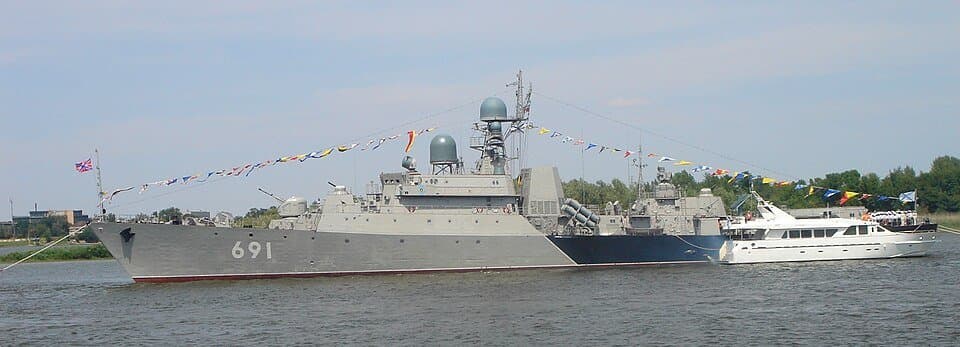

Credit
Vissarion · Public domain · Resized · Public domain · Source ↗ · Modified


Preparing your view.
At a glance
Gepard-class frigatelarger figure on 0 of 2
Measured figures
Approx Gepard 3.9 batch II
Single sourceApprox 102.4 m (336 ft) (Gepard 3.9 batch II)[source]
Length
Single sourceConfiguration
| Specification | Gepard-class frigate | INS Anvesh |
|---|---|---|
| Mass | — | weight of approximately 3,900 tons[source]INS Anvesh · Design · It has a length of 118.4 m, 20 m width and 7.1 m draft and having a steel weight of approximately 3,900 tons. |
| Power | — | 3 x 4320 ekW (Main Gen Set) 1 x 1350 ekW (Aux Gen Set)[source] Integrated Electric Propulsion 2 × 5,000 kW (6,705 hp) prop motor 2 x 4,200 mm (165 in) CPP-Contra-Rotaing Pod Propeller 1 × 1,000 kW (1,341 hp) Forward Tunnel Thruster[source] |
| Name | Gepard class (Project 1166.1)[source] | Anvesh[source] |
| Builders | Zelenodolsk Plant Gorky[source] |
INS Anveshlarger figure on 2 of 2
Counts only measures both sources give with the same scope. A larger figure is not a better system.
length of
Single source118.40 m (388 ft 5 in)[source]
length of 118.4 m[source]INS Anvesh · Design · It has a length of 118.4 m, 20 m width and 7.1 m draft and having a steel weight of approximately 3,900 tons.
at 10 knots (19 km/h)
Single source4,000 nmi (7,000 km) at 10 knots (19 km/h)[source]
Bars compare reported quantities only. A larger figure does not make a system better; configurations and test conditions differ.
| Operators | Russian Navy Vietnam People's Navy[source] | — |
|---|
| Preceded by | Koni class Grisha class[source] | — |
|---|
| Subclasses | Project 11661 Tatarstan Project 11661K Dagestan Project 11661E Gepard: Gepard 3.9: Batch I; Batch II Gepard 5.1 Gepard 5.3[source] | — |
|---|
| Cost | 11661E (Gepard 3.9 batch I): US$175 million per ship 11661E (Gepard 3.9 batch II): US$350 million per ship (price included ammunition, maintenance packages signed between Vietnam and Russia )[source] | ₹425 crore[source] |
|---|
| Built | 1991–2016[source] | — |
|---|
| Planned | 10[source] | — |
|---|
| Completed | — |
|---|
| Cancelled | — |
|---|
| Active | — |
|---|
| Type | Frigate[source] | Missile range instrumentation vessel and Floating Test Range (FTR)[source] |
|---|
| Propulsion | Twin-shaft CODOG , FPP, 2 × 14,300 + 1 × 6,000 (kW)[source] | — |
|---|
| Endurance | 20 days[source] | 45 days[source] |
|---|
| Sensors & processing systems | MR-231-1 Pal navigation radar Mineral-ME shipborne multifunctional radar system (including guidance and target designation functions for cruise missiles ) 5P-26/MR-352 Pozitiv-ME1/-ME1.2 3D active shipborne radars 5P-10E-03E Laska fire control radar for naval gun and CIWS Sonar : MGK-335EM-03 with under-keel antenna[source] | LRDE Long-Range Multi Function Radar[source] |
|---|
| Electronic warfare & decoys | EW Suite : 2 × Bell Shroud passive intercept, 2 × Bell Squat jammers, Countermeasures : 4 × 16-barreled Pk-16 decoy launchers[source] | — |
|---|
| Armament | Artillery: 1 × 76.2mm AK-176M/MA naval gun 2 × AK-630M CIWS ( Tatarstan and VPN configuration) Cruise missiles : 8 × UKSK VLS cells for Kalibr missiles ( Dagestan ) (up to 16x cells in configurations offered to the export market; options for Club-N , Yakhont and BrahMos missile systems are available) 2 × quadruple launchers (2×4) Kh-35 anti-ship missiles ( Tatarstan and VPN 's Batch I & II configuration) Anti-submarine warfare : 2 × 533mm DTA-53 twin-tube (2×2) torpedo launchers (not featured on VPN 's Batch I) Naval mines Anti-air warfare : 1 × Palash/Palma-SU CIWS featured with 8x Sosna-R short range air defense missiles ( Dagestan and VPN configuration) 1 × Osa-M twin-launcher for 20x 9M33M short range air defense missiles ( Tatarstan ) 12 × Shtil-1 VLS cells for 9M317ME medium-range surface-to-air missiles (offered configuration for the export market)[source] | 4 x Ship Launch Systems for BMD test missiles[source] |
|---|
| Notes | [1][source] | — |
|---|
| National origin | Russia[source] | — |
|---|
| Operator | — | Indian Navy Defence Research and Development Organisation[source] |
|---|
| Builder | — | Cochin Shipyard Limited[source] |
|---|
| Laid down | — | 27 January 2016[source] |
|---|
| Commissioned | — | 11 March 2022[source] |
|---|
| Identification | — | Pennant number : A41[source] |
|---|
| Status | — | Active[source] |
|---|
| Depth | — | 10.40 m (34 ft 1 in)[source] |
|---|
| Source measurement | — | The ship was conceived to serve as a sea-based platform for India's ballistic missile defence program and consists of 4 Ship Launch System (SLS) VLS for the same purpose. The Phase II of the BMD envisages intercepting and destroying enemy missile up to range of 5,000 kilometers by kinetic force with the FTR allowing live testing of the interdictor missiles and not computer simulations.[source]INS Anvesh · Lead; only the objects and conditions stated in this passage INS Anvesh was designed by Vik-Sandvik Design India Pvt Ltd ("VSDI"). It has a length of 118.4 m, 20 m width and 7.1 m draft and having a steel weight of approximately 3,900 tons.[source]INS Anvesh · Design; only the objects and conditions stated in this passage The ship incorporates LRDE Long-Range Multi Function Radar (LRMFR) which will be used by Indian naval ships in future as Fire control radars for Ballistic Missile Defence. The 6 metre Active Antenna Array Unit (AAAU) for the radar was built by Astra Microwave Products Ltd. the first of which would be delivered in latter half of 2023. The LRMFR is an S-band radar system which is intended to replace the EL/M-2248 MF-STAR radar used by the Indian Navy as the primary naval radar of the next generation of naval ships. The functions of LRMFR includes acting as Fire Control Radar (FCR) for surface-to-air missile systems onboard ships and to track ballistic missiles .[source]INS Anvesh · Design; only the objects and conditions stated in this passage The vessel equipped with electro-optical missile tracking, S-band radar tracking, telemetry devices apart from a launch pad, control and mission control center, for testing its Phase II of Ballistic Missile Defence (BMD) interceptor missiles. The Phase II of the BMD envisages intercepting and destroying enemy missile up to range of 5,000 kilometers by kinetic force with the FTR allowing live testing of the interdictor missiles and not computer simulations.[source]INS Anvesh · Design; only the objects and conditions stated in this passage The missile launch system consists of 4 Ship Launching Systems (SLS) in the aft section which rests at 0° when not in used but the alignment is changed to 90° during test launches. The SLS was developed by Electropneumatics & Hydraulics Pvt Ltd. The ship has other specialised systems like damping tanks, missile integration and checkout bay, data processing room and mission control center. It is also equipped with a 15 ton crane and A-frame for cargo handling in the aft section.[source]INS Anvesh · Design; only the objects and conditions stated in this passage It is also designed to test radars, sonars, telemetry equipment and propulsion. The configuration of the installed power generation is Integrated Full Electric Propulsion (IFEP). The output is 14 MW which is produced by diesel generators powering steerable contra-rotating propulsion thrusters.[source]INS Anvesh · Design; only the objects and conditions stated in this passage |
|---|