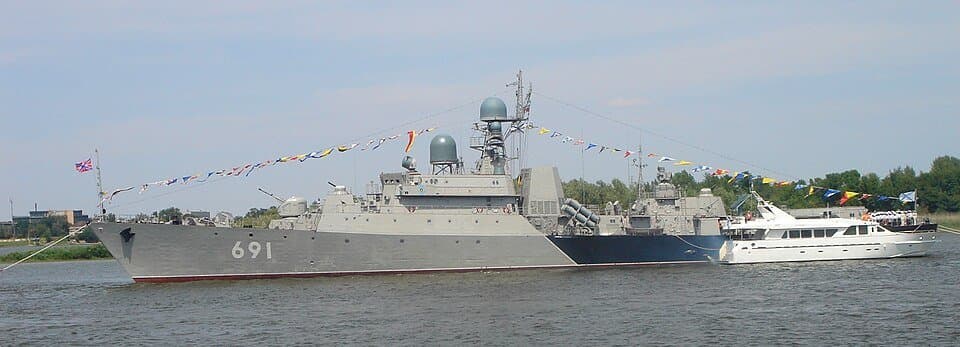

Credit
Vissarion · Public domain · Resized · Public domain · Source ↗ · Modified


Preparing your view.
At a glance
Gepard-class frigatelarger figure on 1 of 1
Hobart-class destroyerlarger figure on 0 of 1
Counts only measures both sources give with the same scope. A larger figure is not a better system.
Measured figures
Approx Gepard 3.9 batch II
Single sourceApprox 102.4 m (336 ft) (Gepard 3.9 batch II)[source]
Length
Single sourceConfiguration
| Specification | Gepard-class frigate | Hobart-class destroyer |
|---|---|---|
| Power | — | Combined diesel or gas (CODOG) arrangement 2 × General Electric Marine model 7LM2500-SA-MLG38 gas turbines, 17,500 kilowatts (23,500 hp) each 2 × Caterpillar Bravo 16 V Bravo diesel engines, 5,650 kilowatts (7,580 hp) each 2 × controllable pitch propellers[source] |
| Name | Gepard class (Project 1166.1)[source] | Hobart class[source] |
| Builders | Zelenodolsk Plant Gorky[source] | Navantia (designer) AWD Alliance (project coordinator) ASC (primary shipbuilder) Forgacs Group and BAE Systems Australia (module builders)[source] |
| Operators | Russian Navy Vietnam People's Navy[source] |
147.2 metres (483 ft)[source]
Bars compare reported quantities only. A larger figure does not make a system better; configurations and test conditions differ.
Royal Australian Navy[source] |
| Preceded by | Koni class Grisha class[source] | Perth -class destroyer and Adelaide -class frigate[source] |
|---|
| Subclasses | Project 11661 Tatarstan Project 11661K Dagestan Project 11661E Gepard: Gepard 3.9: Batch I; Batch II Gepard 5.1 Gepard 5.3[source] | Álvaro de Bazán -class frigate (parent)[source] |
|---|
| Cost | 11661E (Gepard 3.9 batch I): US$175 million per ship 11661E (Gepard 3.9 batch II): US$350 million per ship (price included ammunition, maintenance packages signed between Vietnam and Russia )[source] | A$ 9.1 billion (2020) for 3 units + ToT (est.) A$ 3.03 billion (2020) per unit (est.)[source] |
|---|
| Built | 1991–2016[source] | 2009–2020[source] |
|---|
| Planned | 10[source] | — |
|---|
| Completed |
|---|
| Cancelled | — |
|---|
| Active |
|---|
| Type | Frigate[source] | Guided-missile destroyer[source] |
|---|
| Propulsion | Twin-shaft CODOG , FPP, 2 × 14,300 + 1 × 6,000 (kW)[source] | — |
|---|
| Endurance | 20 days[source] | — |
|---|
| Sensors & processing systems | MR-231-1 Pal navigation radar Mineral-ME shipborne multifunctional radar system (including guidance and target designation functions for cruise missiles ) 5P-26/MR-352 Pozitiv-ME1/-ME1.2 3D active shipborne radars 5P-10E-03E Laska fire control radar for naval gun and CIWS Sonar : MGK-335EM-03 with under-keel antenna[source] | Aegis combat system Lockheed Martin AN/SPY-1 D(V) S-band radar Northrop Grumman AN/SPQ-9 B X-band pulse Doppler horizon search radar Raytheon Mark 99 fire-control system with two AN/SPG-62 continuous wave illuminating radars 2 × L-3 Communications SAM Electronics X-band navigation radars Ultra Electronics Sonar Systems, hull mounted sonar and towed sonar Ultra Electronics Series 2500 electro-optical director Sagem VAMPIR IR search and track system Rafael Toplite stabilised target acquisition sights[source] |
|---|
| Electronic warfare & decoys | EW Suite : 2 × Bell Shroud passive intercept, 2 × Bell Squat jammers, Countermeasures : 4 × 16-barreled Pk-16 decoy launchers[source] | ITT EDO Reconnaissance and Surveillance Systems ES-3701 ESM radar SwRI MBS-567A communications ESM system Ultra Electronics Avalon Systems multipurpose digital receiver Jenkins Engineering Defence Systems low-band receiver 4 × quad Nulka decoy launchers 4 × Mk36 SRBOC 6-tube 130mm multipurpose decoy launchers[source] |
|---|
| Armament | Artillery: 1 × 76.2mm AK-176M/MA naval gun 2 × AK-630M CIWS ( Tatarstan and VPN configuration) Cruise missiles : 8 × UKSK VLS cells for Kalibr missiles ( Dagestan ) (up to 16x cells in configurations offered to the export market; options for Club-N , Yakhont and BrahMos missile systems are available) 2 × quadruple launchers (2×4) Kh-35 anti-ship missiles ( Tatarstan and VPN 's Batch I & II configuration) Anti-submarine warfare : 2 × 533mm DTA-53 twin-tube (2×2) torpedo launchers (not featured on VPN 's Batch I) Naval mines Anti-air warfare : 1 × Palash/Palma-SU CIWS featured with 8x Sosna-R short range air defense missiles ( Dagestan and VPN configuration) 1 × Osa-M twin-launcher for 20x 9M33M short range air defense missiles ( Tatarstan ) 12 × Shtil-1 VLS cells for 9M317ME medium-range surface-to-air missiles (offered configuration for the export market)[source] | Missiles: 48-cell Mark 41 Vertical Launch System firing: SM-2 Standard missile RIM-162 Evolved Sea Sparrow missile SM-6 missile Tomahawk cruise missile 2 x 4-canister Naval Strike Missile launchers Torpedoes: 2 × 2-tube Mark 32 Mod 9 torpedo launchers firing MU90 Impact torpedoes Guns: 1 × 5"/62 calibre Mark 45 mod 4 main gun 2 × 25mm M242 Bushmaster Mk 38 mod 2 Typhoon RWS 1 × 20mm Phalanx CIWS[source] |
|---|
| Notes | [1][source] | — |
|---|
| National origin | Russia[source] | — |
|---|
| In commission | — | 2017– present[source] |
|---|
| Boats & landing craft carried | — | 2 x 7.2m RHIBs[source] |
|---|
| Aircraft carried | — | 1 × MH-60R Seahawk[source] |
|---|
| Role | — | ship class of three air warfare destroyers (AWDs)[source] |
|---|
| Source measurement | — | The two ship designs were equivalent in many areas, including length, speed and weapons outfit, although the Arleigh Burke class was larger with a displacement 2,200 tons greater than the Spanish frigate, and had superior capabilities in regards to range (700 nautical miles (1,300 km; 810 mi) greater), helicopter operations (two embarked helicopters instead of one), primary armament is rather comparable (2 x 32-cell (64 total cells) Mark 41 Vertical Launch System compared to a 48-cell launcher), and close-defence (with a second close-in weapons system ).[source]Hobart-class destroyer · Planning; only the objects and conditions stated in this passage Each destroyer will have a length overall of 147.2 metres (483 ft), a maximum beam of 18.6 metres (61 ft), and a draught of 5.17 metres (17.0 ft). At launch, the ships will have a full-load displacement of 6,250 tonnes (6,150 long tons; 6,890 short tons). The Hobart s have been designed to allow for upgrades and installation of new equipment, with a theoretical maximum displacement of 7,000 tonnes (6,900 long tons; 7,700 short tons).[source]Hobart-class destroyer · Design; only the objects and conditions stated in this passage The Hobart s use a more powerful propulsion system than their Spanish predecessors. The combined diesel or gas turbine (CODOG) propulsion arrangement consists of two General Electric Marine model 7LM2500-SA-MLG38 gas turbines, each generating 17,500 kilowatts (23,500 hp), and two Caterpillar Bravo 16 V Bravo diesel engines, each providing 5,650 kilowatts (7,580 hp). These drive two propeller shafts, fitted with Wärtsilä controllable pitch propellers . The ships' maximum speed is over 28 knots (52 km/h; 32 mph), with a range of over 5,000 nautical miles (9,300 km; 5,800 mi) at 18 knots (33 km/h; 21 mph); although not fast enough to keep pace with an American carrier battle group , the RAN is happy with the speed/range tradeoff, as endurance is more important for Australian operating conditions. For in-harbour manoeuvring, each destroyer is fitted with a bow thruster.[source]Hobart-class destroyer · Design; only the objects and conditions stated in this passage The missiles are supplemented by two four-canister launchers for Harpoon anti-ship missiles , and a BAE Systems Mark 45 (Mod 4) 5-inch gun with a 62-calibre barrel. The 5-inch gun has a maximum range of 23.6 kilometres (14.7 mi). Two Babcock Mark 32 Mod 9 two-tube torpedo launchers will be carried, and used to fire Eurotorp MU90 torpedoes at submarines. For close-in defence, the ships will carry an aft-facing Phalanx CIWS system, plus two M242 Bushmasters in Typhoon mounts sited on the bridge wings.[source]Hobart-class destroyer · Design / Armament; only the objects and conditions stated in this passage In 2021, the government announced that the Hobart s would be armed with Tomahawk cruise missiles to enable them to strike land targets at greater distances up to 2,500 km (1,553.43 mi). In December 2024, HMAS Brisbane became the first of the Hobart s to fire a Tomahawk cruise missile.[source]Hobart-class destroyer · Design / Armament; only the objects and conditions stated in this passage The Hobart s are built around the Aegis combat system , specifically the Aegis Baseline 7.1 Refresh 2 version. The system has been 'Australianised' to be more capable in regard to non-aviation threats. The system feeds into the Australian Tactical Interface; six multi-function consoles that are capable of handling the destroyer's sonar, electronic warfare, and close-defence functions in addition to Aegis. The main radar system is the Lockheed Martin AN/SPY-1 D(V) S-band radar. The combination of the AN/SPY-1D(V) radar, Aegis system, and Standard 2 missile will allow each destroyer to fire on enemy aircraft or missiles over 150 kilometres (93 mi) away.[source]Hobart-class destroyer · Design / Sensors and systems; only the objects and conditions stated in this passage Each ship is assembled from 31 pre-fabricated modules or 'blocks', averaging 200 tonnes (200 long tons; 220 short tons) in weight and 15 by 12 by 9 metres (49 by 39 by 30 ft) in size. The nine blocks making up the forward superstructure of each destroyer, containing the most sensitive or classified equipment, are manufactured by ASC's shipyard at Osborne, South Australia , where the final assembly of each destroyer will occur. The other 22 blocks for each ship were subcontracted out. On 9 May 2009, two companies were selected to fabricate the additional blocks: NQEA (building the twelve blocks of each ship's hull) and Forgacs Group (building the ten aft superstructure blocks per ship). However, during June, NQEA advised the AWD Alliance that the shipbuilder was undergoing restructuring and may have difficulty in meeting its contracted obligations. The Department of Defence went into negotiations with NQEA and BAE Systems Australia (which had been shortlisted during the initial subcontractor selection process), and at the end of June, transferred all of NQEA's work to BAE.[source]Hobart-class destroyer · Construction; only the objects and conditions stated in this passage In October 2010, the 20-by-17-metre (66 by 56 ft) central keel block manufactured by BAE for Hobart was found to be distorted and incompatible with other hull sections.[source]Hobart-class destroyer · Construction; only the objects and conditions stated in this passage |
|---|