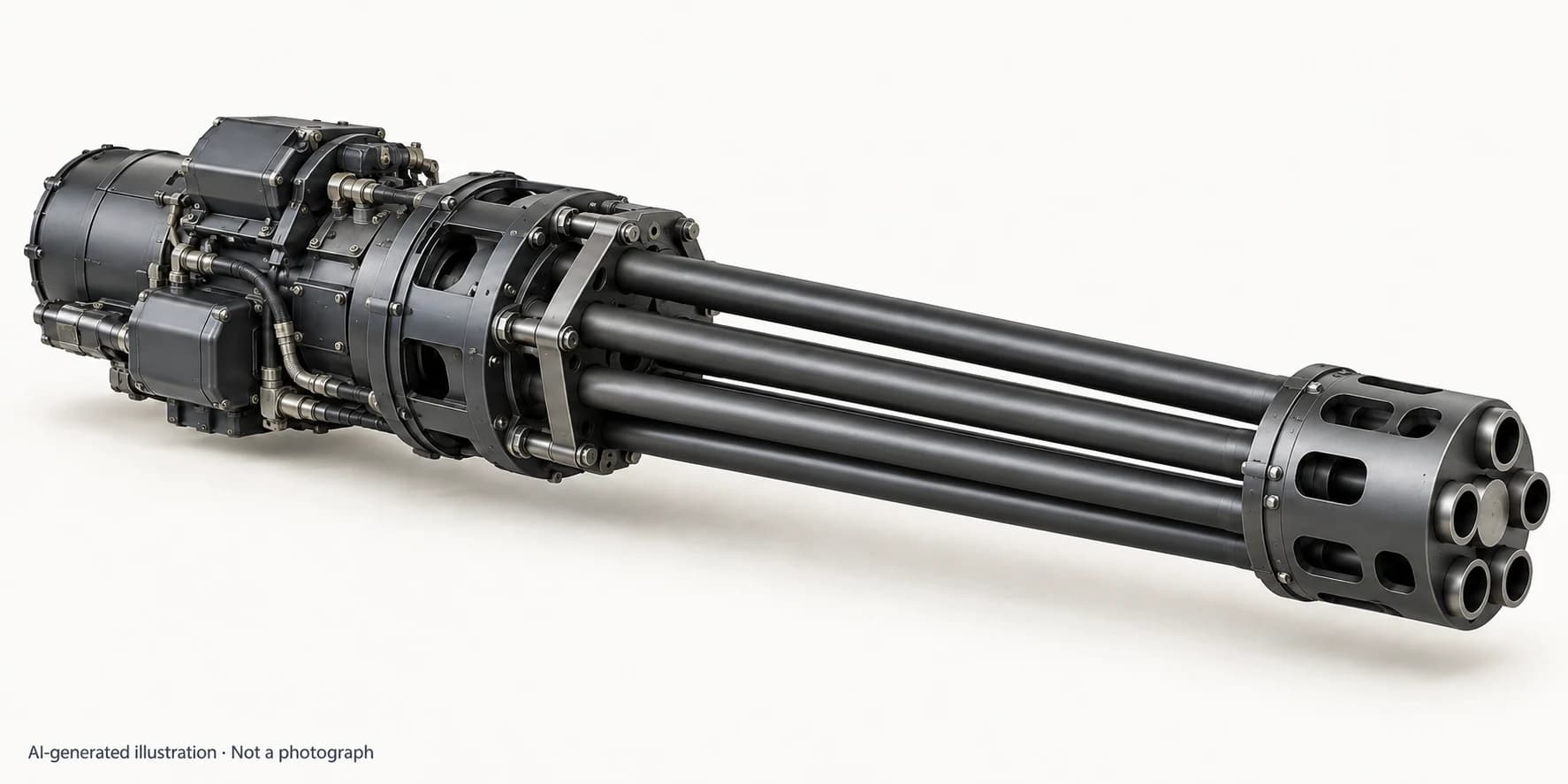

AI-generated illustration · Not a photograph
Credit
ForceTally · AI-generated illustration · Not a photograph · AI-generated · OpenAI output terms · Source ↗ · Modified


Preparing your view.

At a glance
GAU-12 Equalizerlarger figure on 2 of 2
Gryazev-Shipunov GSh-23larger figure on 0 of 2
Measured figures
Length
Single source83.2 in (2.11 m)[source]
23mm Gryazev-Shipunov GSh-23 · Length
Single sourceConfiguration
| Specification | GAU-12 Equalizer | Gryazev-Shipunov GSh-23 |
|---|---|---|
| Type | Rotary cannon[source] | Autocannon[source] Autocannon[source]23mm Gryazev-Shipunov GSh-23 Autocannon[source]23mm Gryazev-Shipunov GSh-23 Autocannon[source]23mm Gryazev-Shipunov GSh-23 Autocannon[source]23mm Gryazev-Shipunov GSh-23 |
Counts only measures both sources give with the same scope. A larger figure is not a better system.
GSh-23
Single sourceGSh-23L
Single sourceGSh-23: 1,387 mm (4 ft 7 in) GSh-23L: 1,537 mm (5 ft 1 in)[source]
1.387 m[source]23mm Gryazev-Shipunov GSh-23
1.387 mm (GSh-23) 1.537 mm (GSh-23L)[source]
1.387 m[source]23mm Gryazev-Shipunov GSh-23
1.387 m[source]23mm Gryazev-Shipunov GSh-23
1.387 m[source]23mm Gryazev-Shipunov GSh-23
GAU-12 with feed system
Single sourceGAU-22 without feed system
Single sourceGAU-12: 270 pounds (120 kg) with feed system GAU-22: 230 pounds (100 kg) without feed system[source]
23mm Gryazev-Shipunov GSh-23 · Weight
Single sourceGSh-23
Single sourceCaliber
Single source25 mm (0.98 in)[source]
GAU-12
Single sourceGAU-22
Single sourceGAU-12: 1,800–4,200 rounds per minute GAU-22: 3,300 rounds per minute[source]
23mm Gryazev-Shipunov GSh-23 · Rate of fire
Single sourcealleged
Single sourceMuzzle velocity
Single sourceAPEX
Single sourceHEI API
Single source(HEI) 3,400 ft/s (1,040 m/s); (API) 3,280 ft/s (1,000 m/s); (APEX) 3,200 ft/s (970 m/s)[source]
Muzzle velocity
Single source23mm Gryazev-Shipunov GSh-23 · Muzzle velocity
Single source23mm Gryazev-Shipunov GSh-23 · twin barrel
Single sourceBarrel length
Single source1,000 mm (3 ft 3 in)[source]
1.00 m, twin barrel[source]23mm Gryazev-Shipunov GSh-23
1.140 mm[source]
1.00 m, twin barrel[source]23mm Gryazev-Shipunov GSh-23
1.00 m, twin barrel[source]23mm Gryazev-Shipunov GSh-23
1.00 m, twin barrel[source]23mm Gryazev-Shipunov GSh-23
Bars compare reported quantities only. A larger figure does not make a system better; configurations and test conditions differ.
| Place of origin |
|---|
United States[source] |
Soviet Union[source] |
| Designer | General Electric[source] | KBP Instrument Design Bureau[source] |
|---|
| Manufacturer | General Dynamics[source] | KBP Instrument Design Bureau[source] |
|---|
| Cartridge | 25 × 137 mm[source] | 23×115 mm[source] |
|---|
| Barrels | GAU-12: 5-barrel GAU-22: 4-barrel (progressive RH parabolic twist, 11 grooves)[source] |
|---|
| Action | Hydraulic, Electric, Pneumatic[source] | Gast principle[source] Gas operated, Gast principle[source]23mm Gryazev-Shipunov GSh-23 Recarga accionada por gas[source] Gas operated, Gast principle[source]23mm Gryazev-Shipunov GSh-23 Gas operated, Gast principle[source]23mm Gryazev-Shipunov GSh-23 Gas operated, Gast principle[source]23mm Gryazev-Shipunov GSh-23 |
|---|
| Feed system | Linked or linkless[source] | Single belt feed[source]23mm Gryazev-Shipunov GSh-23 Single belt feed[source]23mm Gryazev-Shipunov GSh-23 Single belt feed[source]23mm Gryazev-Shipunov GSh-23 Single belt feed[source]23mm Gryazev-Shipunov GSh-23 |
|---|
| Sights | Lead Computing Optical Sight System (LCOSS)[source] | — |
|---|
| Operation | electric[source] | — |
|---|
| Weight (complete) | 270 lb (122 kg)[source] | — |
|---|
| Projectile weight | (HEI) 6.5 oz (184 g); (API) 7.6 oz (215 g)[source] | — |
|---|
| Muzzle energy | (HEI) 73,400 ft·lbf (99,500 joules); (API) 79,300 ft·lbf (107,500 joules)[source] | — |
|---|
| Role | five-barrel 25 mm Gatling-type rotary cannon[source] | twin-barreled 23 mm autocannon[source] |
|---|
| Source measurement | The General Dynamics GAU-12/U Equalizer is a five-barrel 25 mm Gatling-type rotary cannon . The GAU-12/U is used by the United States, Italy, and Spain, which mount the weapon in their attack jets such as the AV-8B Harrier II , airborne gunships such as the Lockheed AC-130 , and land-based fighting vehicles. A lighter four-barrel version, designated GAU-22/A , is mounted on F-35 Lightning II fighter jets.[source]GAU-12 Equalizer · Lead; only the objects and conditions stated in this passage The five-barrel Equalizer cannon was developed in the late 1970s, based on the mechanism of the 30mm GAU-8/A Avenger cannon, but firing a new NATO series of 25 mm ammunition. The GAU-12/U cannon is operated by an 11 kW (15 hp) electric motor , or in external mounts supplied by a bleed air driven pneumatic system. Its rate of fire is normally 3,600 rounds per minute, with a maximum of 4,200 rounds per minute. For use in the AC-130 gunship, the fire rate is limited to 1,800 rounds per minute in order to conserve ammunition and reduce barrel wear.[source]GAU-12 Equalizer · Development; only the objects and conditions stated in this passage The GAU-22/A is a four-barrel version of the GAU-12/U designed for use on the F-35 Lightning II . The GAU-22/A's major difference is the use of four barrels, rather than the GAU-12/U's five barrels. The GAU-22/A is therefore lighter, with a reduced rate of fire of 3,300 rounds per minute, but maintains the same, high accuracy of 5 milliradians , 80% circle of the GAU-12 and A-10's GAU-8. The weapon is produced by General Dynamics Ordnance and Tactical Systems.[source]GAU-12 Equalizer · Development / GAU-22/A; only the objects and conditions stated in this passage The Nammo 25 mm PGU-47/U APEX (Armor Piercing with Explosive) projectile has been developed for the GAU-22/A. It features a tungsten carbide penetrator in the tip and an explosive fragmentation body, to be multi-purpose against both hardened and soft targets. Also, the presence of a clockworking inertia-driven mechanical fuze in the mid-body, protects the round from shocks, misfires and cookoffs, making it safer to handle and fire.[source]GAU-12 Equalizer · Development / GAU-22/A; only the objects and conditions stated in this passage The current principal application for the Equalizer is the AV-8 Harrier IIs of the United States Marine Corps , Italian Navy and Spanish Navy . The Harrier II carries the Equalizer system in a pair of detachable pods mounted on the fuselage underside, with the cannon in the port pod and 300 rounds of ammunition in the starboard pod, fed through a bridge at the aft ends of the pods that also contains the drive system for the gun (unlike previous Harriers which used dual cannons, with each pod containing a 30mm ADEN gun and its own ammunition supply). The complete installation, which includes a double-ended feed system that returns empty cartridges to the magazine , weighs 900 lb (410 kg) empty and 1,230 lb (560 kg) loaded. The detachable pods are located and shaped to be interchangeable with the usual ventral strakes or fences under the Harrier, both serving to help trap a cushion of high-pressure air under the aircraft to add lift while in hover mode. The strakes can easily be removed and the pods attached in their place, serving the same function while adding useful firepower.[source]GAU-12 Equalizer · Uses; only the objects and conditions stated in this passage RAF and Fleet Air Arm Harriers did not adopt the Equalizer for their Harrier GR7 and GR9s. The British had originally planned a pair of ADEN 25 guns (using the same ammunition as the GAU-12/U, but based on the 30 mm ADEN cannon ). That gun was canceled in 1999 after protracted development problems, and British Harrier GR7/9s were without gun armament until retirement.[source]GAU-12 Equalizer · Uses; only the objects and conditions stated in this passage The four-barrel GAU-22 is carried internally by the F-35A (the CTOL version of the F-35) on the port side of the fuselage, with 181 PGU-47/U APEX rounds. In contrast, the F-35B STOVL and C CATOBAR aircraft mount the GAU-22 in a stealthy external gun pod under the fuselage, together with 220 rounds.[source]GAU-12 Equalizer · Uses; only the objects and conditions stated in this passage Caliber : 25 mm (0.98 in)[source]GAU-12 Equalizer · Specifications (GAU-12/U); only the objects and conditions stated in this passage Length : 83.2 in (2.11 m)[source]GAU-12 Equalizer · Specifications (GAU-12/U); only the objects and conditions stated in this passage Weight (complete) : 270 lb (122 kg)[source]GAU-12 Equalizer · Specifications (GAU-12/U); only the objects and conditions stated in this passage Rate of fire : 3,600–4,200 rounds per minute[source]GAU-12 Equalizer · Specifications (GAU-12/U); only the objects and conditions stated in this passage Muzzle velocity : (HEI) 3,400 ft/s (1,040 m/s); (API) 3,280 ft/s (1,000 m/s)[source]GAU-12 Equalizer · Specifications (GAU-12/U); only the objects and conditions stated in this passage Projectile weight : (HEI) 6.5 oz (184 g); (API) 7.6 oz (215 g)[source]GAU-12 Equalizer · Specifications (GAU-12/U); only the objects and conditions stated in this passage Muzzle energy : (HEI) 73,400 ft·lbf (99,500 joules); (API) 79,300 ft·lbf (107,500 joules)[source]GAU-12 Equalizer · Specifications (GAU-12/U); only the objects and conditions stated in this passage Weight (complete) : 230 lb (104 kg)[source]GAU-12 Equalizer · Specifications (GAU-22/A); only the objects and conditions stated in this passage Rate of fire : 3,300 rounds per minute[source]GAU-12 Equalizer · Specifications (GAU-22/A); only the objects and conditions stated in this passage Muzzle velocity : (APEX) 3,200 ft/s (970 m/s)[source]GAU-12 Equalizer · Specifications (GAU-22/A); only the objects and conditions stated in this passage Projectile weight : (APEX) 7.87 oz (223 g)[source]GAU-12 Equalizer · Specifications (GAU-22/A); only the objects and conditions stated in this passage Muzzle energy : (APEX) 77,400 ft·lbf (104,900 joules)[source]GAU-12 Equalizer · Specifications (GAU-22/A); only the objects and conditions stated in this passage | The Gryazev-Shipunov GSh-23 ( Russian : Грязев и Шипунов ГШ-23 ) is a twin-barreled 23 mm autocannon developed in the Soviet Union , primarily for military aircraft use. It entered service in 1965, replacing the earlier Nudelman-Rikhter NR-23 and Rikhter R-23 .[source]Gryazev-Shipunov GSh-23 · Lead; only the objects and conditions stated in this passage The cannon comes in a basic GSh-23 variant, and the more popular GSh-23L ( ГШ-23Л ), differing mostly in adding a muzzle brake , lowering recoil force. This cannon was standard fit on late-model MiG-21 fighters (M, SM, MF, SMT, PFM, bis), all variants of the MiG-23 , the SOKO J-22 Orao , the JF-17 Thunder , the HAL Tejas , the Aero L-39ZA Albatros and IAR 93 , and the tail turrets of the Tupolev Tu-22M bomber and some late-model Tu-95MS and Tu-142M3 . In the latter application, it had the unusual ability to fire infrared flares and chaff rounds, allowing it to function as both a weapon and a dispenser of anti-missile countermeasures. It is also mounted on late small series Mi-24 VP helicopters (in the NPPU-23 movable mounting) and Polish W-3WA Sokół helicopter in fixed mounting. The cannon was also used on cargo aircraft; specifically, Russian/Soviet Ilyushin Il-76 aircraft were designed to accommodate twin GSh-23's in a tail turret. An Il-76M with this configuration was displayed at the 2002 Ivanovo airshow.[source]Gryazev-Shipunov GSh-23 · Lead; only the objects and conditions stated in this passage Some second-generation MiG-21 models could carry the GSh-23L in an under-fuselage gondola designated the GP-9 , carrying the cannon and 200 rounds of ammunition; this was replaced by a more streamlined semi-conformal installation in later variants. There are also several gun pods available for mounting on external hardpoints: UPK-23 for air-to-air use, with one or two fixed GSh-23 guns and 200–400 rounds of ammunition, and SPPU-22 pods with barrels traversable from 0° to −30° for strafing, both carrying 280 rounds of ammunition; they were most often carried in pairs by the Su-17/-20/-22 and the Su-25/-39 .[source]Gryazev-Shipunov GSh-23 · Lead; only the objects and conditions stated in this passage |
|---|
| Used by | United States, Italy, and Spain[source]GAU-12/U Equalizer · named current operators | See Users[source] |
|---|
| Status | The current principal application for the Equalizer is the AV-8 Harrier IIs of the United States Marine Corps , Italian Navy and Spanish Navy .[source]GAU-12/U Equalizer · current aircraft application | — |
|---|
| In service | — | 1965–present[source] |
|---|
| Designed | — | Early 1960s[source] |
|---|
| Variants | — | GSh-23L[source] |
|---|
| Origin | — | Soviet Union[source]23mm Gryazev-Shipunov GSh-23 Soviet Union[source]23mm Gryazev-Shipunov GSh-23 Soviet Union[source]23mm Gryazev-Shipunov GSh-23 Soviet Union[source]23mm Gryazev-Shipunov GSh-23 |
|---|
| Rifling | — | 10 grooves, 575 mm right hand twist[source]23mm Gryazev-Shipunov GSh-23 10 grooves, 575 mm right hand twist[source]23mm Gryazev-Shipunov GSh-23 10 grooves, 575 mm right hand twist[source]23mm Gryazev-Shipunov GSh-23 10 grooves, 575 mm right hand twist[source]23mm Gryazev-Shipunov GSh-23 |
|---|
| Reported operators | — |
|---|
165 mm[source]23mm Gryazev-Shipunov GSh-23
GSh-23L
Single sourceGSh-23: 49.2 kg (108 lb) GSh-23L: 50 kg (110 lb)[source]
49.2 kg[source]23mm Gryazev-Shipunov GSh-23
49,2 kg (GSh-23) 50 kg (GSh-23L)[source]GSh-23; GSh-23L
49.2 kg[source]23mm Gryazev-Shipunov GSh-23
49.2 kg[source]23mm Gryazev-Shipunov GSh-23
49.2 kg[source]23mm Gryazev-Shipunov GSh-23