FORCETALLY
Loading the evidence…
Preparing your view.


Preparing your view.

At a glance
GAF Nomadlarger figure on 1 of 5
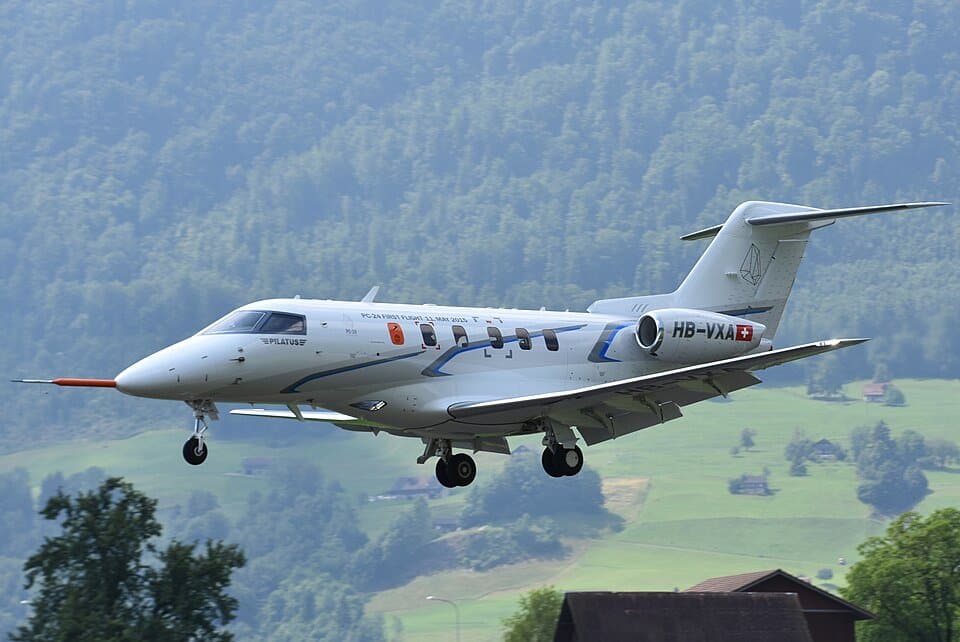
Pilatus PC-24larger figure on 4 of 5
Counts only measures both sources give with the same scope. A larger figure is not a better system.
Measured figures
Length
Single source41 ft 3 in / 12.57 m[source]
Length
Single sourceConfiguration
| Specification | GAF Nomad | Pilatus PC-24 |
|---|---|---|
| Crew | — | one or two[source] |
| Type | Light utility aircraft[source] | Light business jet[source] |
| Manufacturer | Government Aircraft Factories[source] | Pilatus Aircraft[source] |
| Status | In limited service[source] | In production[source] |
| Primary users |
16.85 m (55 ft 3 in)[source]
endurance 8 h at 161 mph / 140 kn / 259 km/h, FL50
Single source840 mi / 730 nmi / 1352 km, endurance 8 h at 161 mph / 140 kn / 259 km/h, FL50[source]
2 × Williams FJ44-4A turbofans thrust each
Single source2 × Williams FJ44-4A turbofans , 15 kN (3,400 lbf) thrust each[source]
Maximum payload
Single source1,406 kg (3,100 lb)[source]
(3,960 ft/min) MTOW, at Sea level
Single source20.1 m/s (3,960 ft/min) MTOW, at Sea level[source]
Bars compare reported quantities only. A larger figure does not make a system better; configurations and test conditions differ.
Philippine Air Force Australian Army (historical) Indonesian Navy (historical)[source]
Qatar Emiri Air Force PlaneSense Royal Flying Doctor Service[source] |
| Number built | 172[source] | 212 (Q1 2024)[source] |
|---|
| Manufactured | 1975–1985[source] | 2015–present[source] |
|---|
| First flight | 23 July 1971 (N-22) 5 December 1971 (N-24)[source] | 11 May 2015[source] |
|---|
| Retired | Royal Australian Air Force (1993)[source] | — |
|---|
| Passengers | 12[source] | — |
|---|
| Role | utility aircraft[source] | — |
|---|
| Source measurement | The GAF Nomad is a twin-engine utility/commuter aircraft capable of Short Takeoff/Landing (STOL) operations. It was produced in two primary variants, the N22B and N24A, the latter being 5 ft 10 in (177 cm) longer than the N22B; the N24A also differed by its larger nose compartment and separated access provided for the main baggage compartment, which was located aft of the cabin. Key features of the Nomad's general configuration included its rugged and straightforward design, STOL performance, its compact and economic engines and its relatively unobstructed and flat cabin floor. It had been designed to meet or exceed established military requirements of the era, as well as in compliance with regulations set out in the Federal Aviation Administration 's (FAA) FAR Part 23 .[source]GAF Nomad · Design; only the objects and conditions stated in this passage The Nomad was powered by a pair of Allison 250 B17B/C turboprop engines, capable of generating up to 400 hp (300 kW) each. Journalist Hugh Field observed the selection of this powerplant to be atypical, while its basic model had a strong reputation from its widespread use on helicopters , the Nomad was the first application of this engine model. GAF's design team, although reportedly having been initially hesitant about applying a new engine to a new airframe, praised the engine's behaviour upon the prototypes. In-flight, core engine operations could be controlled via a single lever, although additional controls are used for atypical actions such as feathering . For ease of maintenance, the nacelles were built for easy access, while the engines consist of sub-assemblies that can be individually overhauled or replaced without extracting the entire engine.[source]GAF Nomad · Design; only the objects and conditions stated in this passage The Nomad's cockpit, while typically fitted with dual flight controls, is designed to be operated by a single pilot. All of the primary controls are either duplicated or of a fail-safe design; both the flaps and undercarriage are electrically actuated; to aid low-speed manoeuvring, an auto-flap button immediately selects 20° flap. For militarised models, the cockpit can be outfitted with Stanley Aviation zero-zero ejection seats , boron - carbide armour protection around the seats, forward bulkhead and side-panels, as well as bullet-resistant glass installed in the panels of windscreen. The cockpit reportedly possesses above-average external visibility in most directions.[source]GAF Nomad · Design; only the objects and conditions stated in this passage Initial production version for 12 passengers for the Australian Army.[source]GAF Nomad · Variants; only the objects and conditions stated in this passage Cargo variant modified from N.22B with Maximum Takeoff Weight increased to 4,050 kilograms (8,930 lb).[source]GAF Nomad · Variants; only the objects and conditions stated in this passage Utility transport aircraft with a fuselage lengthened by 1.14 m (3.7 ft).[source]GAF Nomad · Variants; only the objects and conditions stated in this passage Improved version for 17 passengers, 40 built.[source]GAF Nomad · Variants; only the objects and conditions stated in this passage On 23 December 1979, a Nomad operated by Douglas Airways (P2-DNL) crashed on the airstrip (MRM) at Manari, a village on the Kokoda Track in the Central Province of Papua New Guinea , killing all 16 passengers and crew.[source]GAF Nomad · Notable incidents; only the objects and conditions stated in this passage On 12 Mar 1990, a Nomad (A18-401) of the Royal Australian Air Force (RAAF) crashed following an in-flight failure of the horizontal stabiliser, killing the test pilot who was the sole occupant. The aircraft had previously done 177 hours of single-engine ground running in tests performed by the aircraft manufacturer.[source]GAF Nomad · Notable incidents; only the objects and conditions stated in this passage On 9 September 1991, an Australian Army N22B Nomad crashed near Drake in northern NSW with the loss of four people, including the pilot.[source]GAF Nomad · Notable incidents; only the objects and conditions stated in this passage On 18 September 1998, two US Customs N22S Nomads collided over the sea between Puerto Rico and Curaçao. Both damaged planes attempted to return to Puerto Rico, however, one plane crashed into the sea one mile east of Mona Island. The pilot was killed while the copilot was rescued. The second plane was able to land safely in Aquadilla. Puerto Rico.[source]GAF Nomad · Notable incidents; only the objects and conditions stated in this passage On 2 July, 2000, a Philippine Air Force GAF Nomad experienced possible engine trouble after takeoff from Cagayancillo Airport on Cagayancillo off Palawan in the Philippines . Its pilot attempted to return to the airport, but the plane overshot the runway and crashed into the Sulu Sea , killing 11 of the 12 people on board. Philippine governor Salvatore Socrates and Philippine Air Force Major General Santiago Madrid were among the dead.[source]GAF Nomad · Notable incidents; only the objects and conditions stated in this passage On 10 February 2001, Gum Air ’s N24A Nomad (PZ-TBP) crashed on a flight from Paramaribo – Zanderij ( Johan Adolf Pengel International Airport PBM/SMJP ) to Njoeng Jacob Kondre Airstrip SMJK . The aircraft had fallen out of radio contact, and personnel at the airstrip in Jacob Kondre said it was flying low, and crashed into a mountain. All nine passengers plus the pilot perished.[source]GAF Nomad · Notable incidents; only the objects and conditions stated in this passage | — |
|---|
| National origin | — | Switzerland[source] |
|---|
| Introduction date | — | 1 April 2018[source] |
|---|
| Capacity | — | 10 passengers[source] |
|---|
| Aspect ratio | — | 9.35[source] |
|---|
| Fuel capacity | — | 2,705 kg (5,964 lb), 888.5 US gal (3,363 L)[source] |
|---|
| Cabin | — | 7.01 m × 1.69 m × 1.55 m long × wide × high ( 23 ft 0 in × 5 ft 7 in × 5 ft 1 in)[source] |
|---|
| Cabin altitude | — | 2,438 m at 13,716 m (8,000 ft at 45,000 ft), 8.78 psi (0.605 bar)[source] |
|---|
| Stall speed | — | 154 km/h (96 mph, 83 kn)[source] |
|---|
| Time to altitude | — | 45,000 ft (14,000 m) 27.1 mins[source] |
|---|
| Wing loading | — | 259 kg/m 2 (53 lb/sq ft)[source] |
|---|
| Fuel consumption | — | 0.58 kg/km (2.1 lb/mi) Mach 0.72/416 kn (770 km/h) cruise, 15,375 lb (6,974 kg) weight, FL 450, ISA+3C[source] |
|---|
| Thrust/weight | — | 0.36[source] |
|---|
| Take-off | — | 942 m; 3,091 ft (MTOW, ISA, sea level, dry paved runway)[source] |
|---|
| Landing | — | 734 m; 2,408 ft (Over 50 ft obstacle, MLW, ISA, sea level, dry paved runway)[source] |
|---|
Maximum take-off; Max takeoff weight
Single source