
AArmoured vehicles
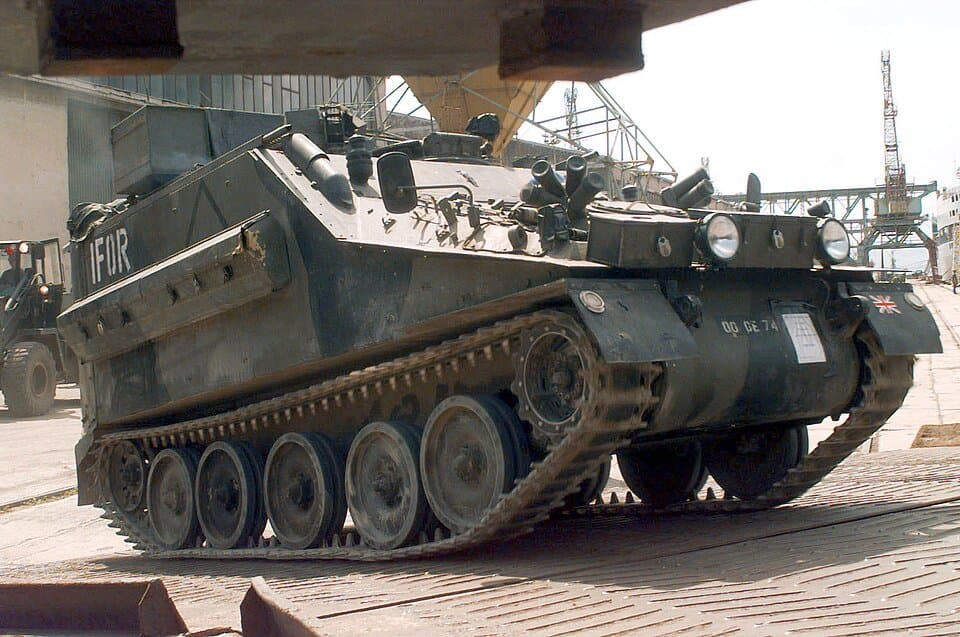
FV105 Sultan
Credit
SGT Brian Gavin · Public domain · Resized · Public domain · Source ↗ · Modified


Preparing your view.
AArmoured vehicles

At a glance
FV105 Sultanlarger figure on 2 of 5
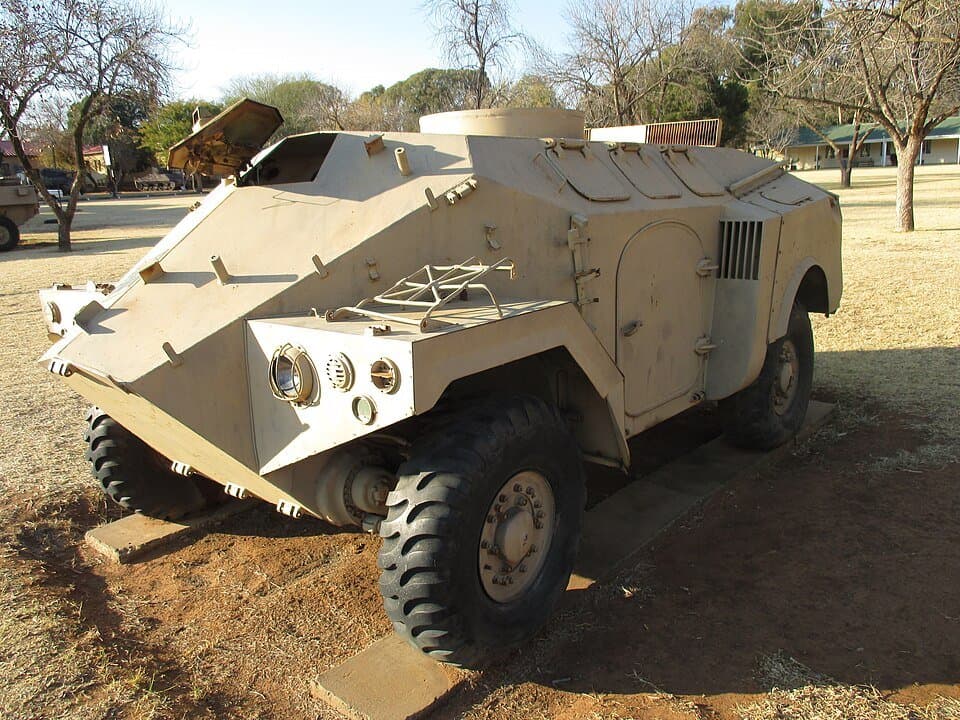
Panhard M3larger figure on 3 of 5
Measured figures
Length
Single source4.82 m (15 ft 10 in)[source]
Length
Single sourceConfiguration
| Specification | FV105 Sultan | Panhard M3 |
|---|---|---|
| Place of origin | United Kingdom[source] | France[source] |
| Main armament | FN MAG on pintle mount[source] | Various[source] |
| Suspension | torsion bar[source] | Independent; coil springs[source] |
| Manufacturer | Alvis plc[source] | Panhard |
Counts only measures both sources give with the same scope. A larger figure is not a better system.
4.45 m (14 ft 7 in)[source]
Bars compare reported quantities only. A larger figure does not make a system better; configurations and test conditions differ.
| Type | — | Armoured personnel carrier[source] |
|---|
| Used by | — | See Operators[source] |
|---|
| Wars | — | Portuguese Colonial War Angolan Civil War Lebanese Civil War Iran–Iraq War Gulf War Internal conflict in Burma Iraqi Civil War (2014–2017) Yemeni Civil War (2015–present)[source] |
|---|
| Designed | — | 1968[source] |
|---|
| Unit cost | — | US$ 166,000 (1986)[source] |
|---|
| Produced | — | 1971–1986[source] |
|---|
| No. built | — | 1,180[source] |
|---|
| Variants | — | See Variants[source] |
|---|
| Power/weight | — | 14.75 hp/tonne (10.9 kW/tonne)[source] |
|---|
| Ground clearance | — | 0.35m[source] |
|---|
| Fuel capacity | — | 165 litres[source] |
|---|
| Role | — | amphibious armoured personnel carrier[source] |
|---|
| Source measurement | — | The M3's relatively light weight and the location of its air and exhaust outlets on the hull roof made it possible to design it as an amphibious vehicle. The M3 is propelled at a modest speed of 4 km/h through water by all four wheels. Although never adopted by the French Army, the M3 series was procured in vast quantities by foreign armies and security forces, especially in Africa and the Middle East. By the time production ceased in 1986, it was the most common wheeled APC produced by any Western nation in the world.[source]Panhard M3 · Lead; only the objects and conditions stated in this passage The first VTT prototype was completed in August 1969 and incorporated a very simple boxlike hull with vertical sides, a flat roofline, and a single 7.5mm AA-52 machine gun in a Creusot-Loire CAFL-38S turret. External access to the hull was through two large entry doors on each side and twin doors at the rear of the troop compartment. The AML chassis and drive train underwent some detail modifications but the overall design remained basically unchanged despite the addition of the new hull. The same Panhard four-cylinder engine type developing 97hp was retained from the AML; however, due to the much heavier hull this left it somewhat underpowered for its weight class. The engine was also relocated from the rear of the chassis to the centre, directly behind the driver's position, to accommodate the rear troop compartment. The wheelbase of the prototype was also increased from 2.5 to 2.7m and the track from 1.6 to 2m.[source]Panhard M3 · Development history; only the objects and conditions stated in this passage The United Arab Emirates Army went on to become the single largest operator of the M3, ordering 198 in 1978.[source]Panhard M3 · Development history; only the objects and conditions stated in this passage The Iraqi Army was a close second, with 156 in service.[source]Panhard M3 · Development history; only the objects and conditions stated in this passage The hull of the M3 is of all-welded steel construction varying in thickness from 8mm to 12mm. The hull has a horizontal roofline and a pointed, tapering front with a well-sloped glacis plate, similar to that of the AML. Both hull sides are vertical to a point before sloping inwards to accommodate additional crew hatches. The bottom of the hull structure is welded to a shallow vee to partly deflect the explosive force of a land mine.[source]Panhard M3 · Description; only the objects and conditions stated in this passage The M3 is powered by a four-cylinder, air-cooled Panhard 4HD petrol engine inherited from the AML. This engine has a diminutive 2-litre displacement and a compression ratio of 7:1, enabling it to run on low octane fuel. It had a reliable reputation and was rated for a mileage of 26,000 kilometres before needing major overhaul. However, the engine was also regarded as somewhat underpowered for the M3 design and unsuitable for propelling the APC at higher speeds off-road.[source]Panhard M3 · Description; only the objects and conditions stated in this passage M3 VDA : Air defence variant armed with twin Hispano-Suiza 820 SL 20mm autocannon in a one-man turret. The weapons have a maximum elevation of +85° and a depression of -5°, and a cyclic rate of fire of 200 rounds per minute or up to 1,000 rounds per minute if the vehicle is stabilised by four hydraulic jacks. There are 650 stowed rounds of 20mm ammunition on board. The turret is fully powered and can be traversed 360° in three seconds, or elevated to maximum elevation in two seconds. It is also provided with an ESD RA-20 Doppler radar with the capacity to track four incoming targets simultaneously at a range of 8 km. This was the heaviest M3 variant to ever reach production, and weighs over 7 tonnes.[source]Panhard M3 · Variants; only the objects and conditions stated in this passage M3 VLA : Engineering variant fitted with a 2.2m-wide bulldozer blade for clearing obstacles. This can carry five passengers but most of the troop compartment has been reconfigured for internal stowage.[source]Panhard M3 · Variants; only the objects and conditions stated in this passage M3 Toucan : Variant armed with an M693 dual-feed or M621 single-feed 20mm autocannon and a co-axial machine gun mounted externally on a GIAT Toucan 1 cupola. The autocannon has an elevation of +50° and a depression of -13°, allowing it to be used against air and ground targets.[source]Panhard M3 · Variants; only the objects and conditions stated in this passage M3 VPM : Mortar carrier variant with a turreted 81mm gun-mortar. This was a VTT with an extensively modified roofline that eliminated most of the crew hatches and added a large turret ring, necessary to accommodate the size of the mortar turret. The VPM was the most heavily armed variant of the M3 ever proposed. It had a crew of four and could carry 60 mortar projectiles in its hull.[source]Panhard M3 · Variants; only the objects and conditions stated in this passage M3 VTT 60 B : Mortar carrier variant with a turreted 60mm gun-mortar. This was a VTT modified to carry the same Brandt Mle CM60A1 gun-mortar as the Panhard AML-60, albeit in a smaller turret which eliminated the co-axial machine guns. Rather, a single machine gun was mounted externally over the rearmost roof hatch.[source]Panhard M3 · Variants; only the objects and conditions stated in this passage M3 VTT TH : Tank destroyer variant armed with a mount for four HOT anti-tank guided missiles. The missile mount has a maximum elevation of +22° and a depression of -10°. Ten additional missiles are stowed inside the hull. The VTT TH has a crew of three. Like the M3 VTS, the VTT TH has a single one-piece rear door rather than the smaller twin doors normally found on the standard VTT.[source]Panhard M3 · Variants; only the objects and conditions stated in this passage M3 Internal Security : Internal security variant. This had a slightly revised crew compartment able to accommodate ten passengers, as well as twin grenade launchers mounted externally at the rearmost hatch for firing riot control agents.[source]Panhard M3 · Variants; only the objects and conditions stated in this passage A number of defence contractors offer extensive overhauls of the M3 chassis and hull to extend the vehicle's service life and improve its utility on modern battlefields. One particularly ambitious rebuild was proposed by Saymar, an Israeli firm, for the M3 VTT as well as the VLA and VPC variants. This entailed the replacement of the elderly Model 4HD petrol engine with a more fuel-efficient Toyota 2LT diesel engine. Other upgrades included a modified electrical system with a new voltage regulator and starter, the installation of an air conditioning unit, the replacement of the M3's drum brakes with new disc brakes, powered steering, and a new intercom and telecommunications system. The VLA rebuild includes the addition of a 2-tonne recovery crane to the base vehicle, while the VPC rebuild incorporates new mapboards and increased interior lighting.[source]Panhard M3 · Variants / Upgrades; only the objects and conditions stated in this passage Another M3 modernisation programme is being marketed by a subsidiary of the Saudi Military Industries Corporation . As part of the Saudi rebuild, the Model 4HD petrol engine is replaced by a new four-cylinder, liquid-cooled diesel turbocharged engine developing 102 hp (75 kW). Other upgrades include power steering, vacuum brakes, and the replacement of the Panhard electromagnetic clutch with a more conventional hydraulic pressure plate clutch.[source]Panhard M3 · Variants / Upgrades; only the objects and conditions stated in this passage |
|---|
| Country of origin | — | France[source]Inventory Origin column; table 3, row 15, cell 3; revision 1377606979; retrieved 2026-10-02 |
|---|
| Reported operators |
|
|
|---|