FORCETALLY
Loading the evidence…
Preparing your view.


Preparing your view.
At a glance
French aircraft carrier Charles de Gaullelarger figure on 1 of 3
Measured figures
LOA
Single source261.5 m (857 ft 11 in) LOA[source]
Length
Single sourceConfiguration
| Specification | French aircraft carrier Charles de Gaulle | Queen Elizabeth-class aircraft carrier |
|---|---|---|
| Name | Charles de Gaulle class[source] | Queen Elizabeth class[source] |
| Builders | DCN , Arsenal de Brest[source] | Aircraft Carrier Alliance[source] |
| Operators | French Navy[source] | Royal Navy[source] |
| Preceded by | Clemenceau class[source] |
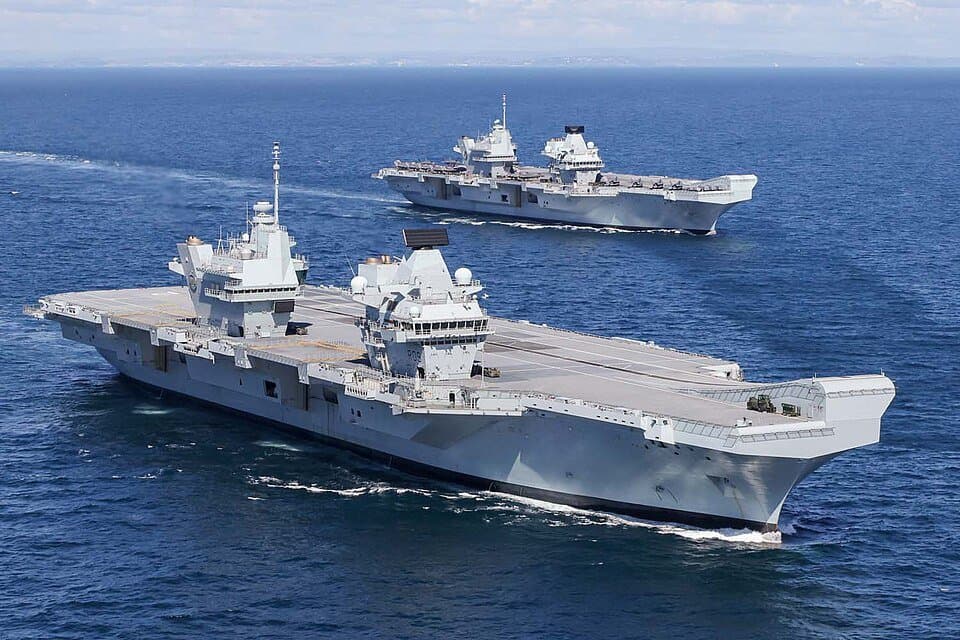
Queen Elizabeth-class aircraft carrierlarger figure on 2 of 3
Counts only measures both sources give with the same scope. A larger figure is not a better system.
Queen Elizabeth class · Length
Single sourceOverall
Single sourceWaterline
Single sourceOverall: 64.36 m (211 ft 2 in) Waterline: 31.5 m (103 ft 4 in)[source]
overall
Single sourcewaterline
Single source39 m (128 ft) waterline 73 m (240 ft) overall
full load
Single source42,500 t (41,800 long tons ) (full load)[source]
Maximum; Speed
Single source27 knots (50 km/h; 31 mph)[source]
2 × Areva K15 pressurised water reactors (PWR), 150 MWt each, LEU < 20% 2 × Alstom steam turbines with a total 61 MW (82,000 hp) shaft power 4 × diesel-electric 2 × shafts[source]
2 × Rolls-Royce Marine Trent MT30 gas turbine engine 2 × Wärtsilä 16V38 and 2 x 12V38 marine diesel engines
Single sourceInstalled power
Single sourceTotal
Single source2 × Rolls-Royce Marine Trent MT30 36 MW (48,000 hp) gas turbine engine 2 × Wärtsilä 16V38 and 2 x 12V38 marine diesel engines 40 MW (54,000 hp) Total: 118.4 MW (158,800 hp)[source]
Integrated electric propulsion 4 × GE Power Conversion 20 MW (27,000 hp) Advanced Induction Motors and VDM25000 drives 2 × shafts; fixed pitch propellers[source]
Bars compare reported quantities only. A larger figure does not make a system better; configurations and test conditions differ.
Invincible class[source] |
| Succeeded by | PA2 (cancelled) PANG (planned)[source] | — |
|---|
| Cost | € 3 billion (2001) (equivalent to € 4.47 billion in 2025)[source] | £ 7.6 billion (2019) (equivalent to £ 9.4 billion in 2024) for two units[source] |
|---|
| Built | 1989–2000[source] | 2009–2017[source] |
|---|
| In commission | 2001–present[source] | 2017–present[source] |
|---|
| Planned | — |
|---|
| Completed |
|---|
| Namesake | Charles de Gaulle[source] | — |
|---|
| Ordered | 3 February 1986[source] | — |
|---|
| Builder | Naval Group[source] | — |
|---|
| Laid down | 14 April 1989 (stacking of elements in prefabrication from 24 November 1987)[source] | — |
|---|
| Launched | 7 May 1994[source] | — |
|---|
| Maiden voyage | 18 May 2001[source] | — |
|---|
| Renamed | Ordered as Richelieu on 3 February 1986, renamed Charles de Gaulle 18 May 1987[source] | — |
|---|
| Home port | Toulon , France[source] | — |
|---|
| Identification | Pennant number : R91 MMSI number : 228711555[source] | — |
|---|
| Nickname(s) | CDG[source] | — |
|---|
| Honours and awards | Jack with the colours of the Free French Forces (front) and the ribbon of the Ordre de la Libération (back)[source] | — |
|---|
| Status | in active service[source] | — |
|---|
| Type | Aircraft carrier[source] | Aircraft carrier[source] |
|---|
| Endurance | 45 days of food[source] | — |
|---|
| Capacity | 800 commandos, 500 t (490 long tons; 550 short tons) of ammunition[source] | — |
|---|
| Sensors & processing systems | DRBJ 11 B tridimensional air search radar Thales SMART-S MK2 (replacing DRBJ 11B) DRBV 26D air search radar DRBV 15C low altitude air search radar Arabel target acquisition radar[source] | S1850M long-range radar Type 997 Artisan 3D medium range radar Ultra Electronics Series 2500 Electro Optical System (EOS) Glide path camera (GPC)[source] |
|---|
| Electronic warfare & decoys | ARBR 21 Detector ARBB 33 Countermeasures suite ARBG2 MAIGRET Interceptor 4 × Sagaie decoys launcher SLAT ( Système de lutte anti-torpille ) torpedo countermeasures[source] | — |
|---|
| Armament | 4 × 8 cell A-43 Sylver launchers carrying the MBDA Aster 15 surface-to-air missile. 2 × 6 cell Sadral launchers carrying Mistral short-range missiles 20mm autocannons 8 × Giat 20F2 20 mm cannons (original) 3 × Nexter Narwhal (since 2019)[source] | 3 × Phalanx CIWS 4 × 30-mm DS30M Mk2 guns ( for but not with ) 6 × 7.62 mm Miniguns (retired in 2023 and replaced by 0.5 inch (12.7 mm) Browning heavy machine guns )[source] |
|---|
| Aircraft carried | 30–40 aircraft, including 30 Rafale M (standard) 2 E-2C Hawkeye 2 NFH Caïman Marine 1 AS565 Panther ISR 2 AS365F Dauphin Pedro[source] | 40 aircraft in peacetime 72 aircraft in wartime; typically, F-35B Lightning (Peacetime max of 36) Chinook Apache Merlin HM2, HC4 and Crowsnest AEW Wildcat AH1 and HMA2[source] |
|---|
| Source measurement | The ship carries a complement of Dassault Rafale M and E-2C Hawkeye aircraft, AS365F Dauphin Pedro , EC725 Caracal and AS532 Cougar helicopters for combat search and rescue , as well as modern electronics and Aster missiles. She is a CATOBAR -type carrier that uses two 75 m (246 ft) C13‑3 steam catapults of a shorter version of the catapult system installed on the US Nimitz -class aircraft carriers, one at the bow and one at the waist. As of March 2026, Charles de Gaulle and the Chinese aircraft carrier Fujian were the only non-American aircraft carriers equipped with catapult launch systems. The catapults on Charles de Gaulle allow it to operate F/A-18E/F Super Hornets and C-2 Greyhounds of the United States Navy.[source]French aircraft carrier Charles de Gaulle · Lead; only the objects and conditions stated in this passage The hull was laid down in April 1989 at the DCN Brest naval shipyard. The carrier was launched in May 1994 and at 42,000 tonnes (full load) was the largest warship launched in Western Europe since HMS Ark Royal in 1950. She was to be named Richelieu in 1986 by the French president at the time, François Mitterrand , after the famous French statesman Armand-Jean du Plessis, Cardinal Richelieu . On 18 May 1987, the name of the ship was changed to Charles de Gaulle by the Gaullist Prime Minister Jacques Chirac .[source]French aircraft carrier Charles de Gaulle · Development / Construction; only the objects and conditions stated in this passage The ship left Toulon for her fourteenth and final sea trial on 24 October 2000. During the night of 9–10 November, in the Western Atlantic while en route toward Norfolk , Virginia , the port propeller broke, and the ship had to return to Toulon to have a replacement fitted. Although the supplier, Atlantic Industrie, was not believed to have intentionally been at fault, it was nevertheless blamed for poor-quality construction. Not long after the French defence minister ordered an investigation on quality management, a fire destroyed the archives of the supplier. As a temporary solution, the less advanced spare propellers of Clemenceau were used, limiting the maximum speed to 25 knots (46 km/h; 29 mph) instead of the contractual 27 knots (50 km/h; 31 mph).[source]French aircraft carrier Charles de Gaulle · Development / Trials and technical problems; only the objects and conditions stated in this passage On 5 March 2001, Charles de Gaulle returned to sea with the ex- Clemenceau propellers and reached 25.2 knots (46.7 km/h; 29.0 mph) on her trials.[source]French aircraft carrier Charles de Gaulle · Development / Trials and technical problems; only the objects and conditions stated in this passage Charles de Gaulle 's first major overhaul began in September 2007. The highlight of this 15-month refit was the refuelling of the nuclear power plant , a necessary step after six years in service, during which Charles de Gaulle sailed the equivalent of 12 times around the world, spent 900 days at sea, and performed 19,000 catapult launches. Several improvements were also made, including the installation of new propellers. These allow Charles de Gaulle to reach her design speed of 27 knots, replacing the propellers used since 2001. Aircraft maintenance and weapons stores were also upgraded to allow the operation of new Rafale F3 fighters armed with ASMP-A nuclear missiles and SCALP EG cruise missiles, and satellite communications bandwidth will be increased tenfold. This refit increased displacement to 42,500 tonnes and was completed in December 2008. After technical problems in March 2009, the carrier was back in Toulon for repairs. An intensive work-up period was planned to bring Charles de Gaulle and her air group back to operational status.[source]French aircraft carrier Charles de Gaulle · Development / Maintenance and upgrades; only the objects and conditions stated in this passage On 21 November 2001, France sent Charles de Gaulle to the Indian Ocean in support of Operation Enduring Freedom against Taliban -controlled Afghanistan. Task Force 473, with 2,900 personnel under the command of Contre-Amiral François Cluzel, sailed on 1 December. The task force was composed of Charles de Gaulle , frigates Lamotte-Picquet , Jean de Vienne and Jean Bart , the nuclear attack submarine Rubis , the tanker Meuse and the D'Estienne d'Orves -class aviso Commandant Ducuing . Embarked air power comprised sixteen Super Étendards , one E-2C Hawkeye, two Rafale Ms, and several helicopters. The Super Étendards carried out their first missions above Afghanistan on 19 December, executing reconnaissance and bombing missions, covering over 3,000 kilometres (1,900 mi). Approximately 770 sorties were carried out from the carrier.[source]French aircraft carrier Charles de Gaulle · Operational service / Afghanistan; only the objects and conditions stated in this passage On 28 November 2010, according to an Associated Press dispatch, the French Ministry of Defence announced that a French Rafale fighter jet crashed near Charles de Gaulle , which was operating 97 kilometres (60 mi) off the coast of Pakistan in the Arabian Sea in support of coalition forces in Afghanistan. The pilot parachuted to safety and was picked up by helicopter, and as of 2010 , the cause of the crash was under investigation.[source]French aircraft carrier Charles de Gaulle · Operational service / Fifth overseas deployment: Task Force 473 and Operation Agapanthus 2010; only the objects and conditions stated in this passage From 18 November to 2 December 2021, Charles de Gaulle took part in Exercise POLARIS 21 in the western Mediterranean Sea.[source]French aircraft carrier Charles de Gaulle · Operational service / Clemenceau 21; only the objects and conditions stated in this passage The aircraft carrier was located to the northwest of Cyprus and 100 km (54 nmi) from the coast of Turkey . The ship's location was inadvertently leaked when an officer used the fitness app Strava to log his own runs aboard the ship.[source]French aircraft carrier Charles de Gaulle · Operational service / Iran and Strait of Hormuz crisis; only the objects and conditions stated in this passage Following completion of the midlife upgrade, in October 2018 the French armed forces minister announced an eighteen-month study to determine the requirements for a future carrier. In December 2020, President Macron announced that construction of the New Generation Aircraft Carrier (Porte-avions de nouvelle génération or PANG) would begin in around 2025 with sea trials to start in about 2036. The carrier is planned to have a displacement of around 75,000 tons and to carry about thirty-two next-generation fighters , two or three E-2D Advanced Hawkeyes, and a yet-to-be-determined number of unmanned carrier air vehicles. In March 2026, President Macron announced that the future carrier would be named France Libre after the Free France government-in-exile led by de Gaulle during World War II. Hull assembly is expected to begin in 2032, and commissioning is targeted for 2038.[source]French aircraft carrier Charles de Gaulle · French aircraft carrier procurement; only the objects and conditions stated in this passage | — |
|---|
| Active | — |
|---|
| Decks | — | 16,000 m 2 (170,000 ft 2 ) 9 decks beneath flightdeck with hangar covering the centrepiece of two decks (without islands)[source] |
|---|
| Troops | — | 250 to 900[source] |
|---|
| Aviation facilities | — | Large flight deck with 12º ski jump Hangar deck - 155 m x 34 m x 7 m Two aircraft lifts - 27 m x 15 m - 54,500 kg max load[source] |
|---|
| Country of origin | — | United Kingdom[source] |
|---|
| Troop capacity | — | 250 to 900[source]Source-stated capacity; all configurations and qualifiers retained |
|---|