
FORCETALLY
Loading the evidence…
Preparing your view.


Preparing your view.

At a glance
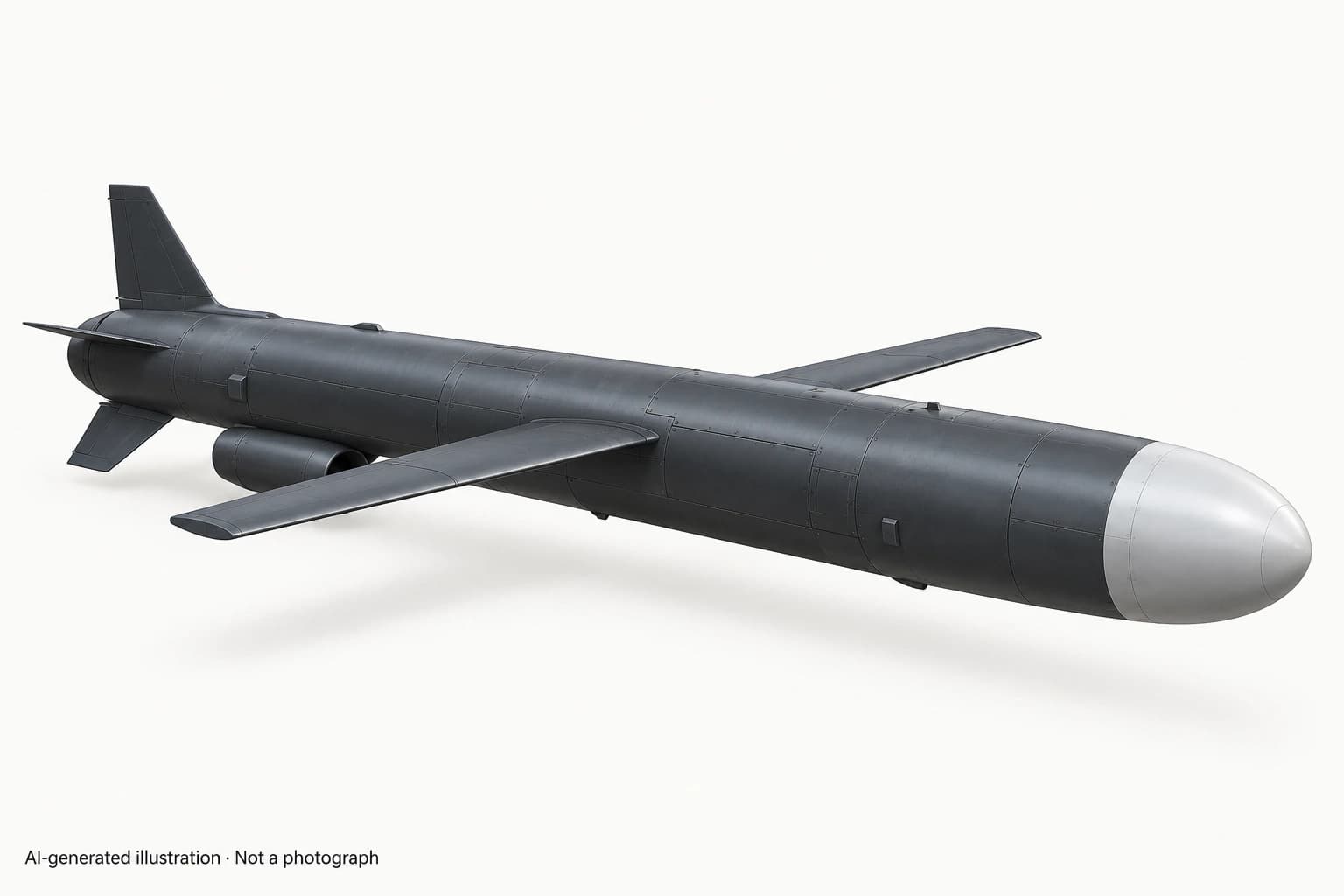
FP-5 Flamingolarger figure on 1 of 1
Hwasal-1larger figure on 0 of 1
Counts only measures both sources give with the same scope. A larger figure is not a better system.
Measured figures
Length
Single source12–14 m (39–46 ft; 13–15 yd)[source]
Maximum; Maximum cruise
Single sourceMaximum; Maximum speed
Single sourceMaximum 950 km/h; cruise 850–900 km/h[source]
Warhead weight
Single source1,150 kg (1.15 t; 2,540 lb)[source]
Bars compare reported quantities only. A larger figure does not make a system better; configurations and test conditions differ.
Configuration
| Specification | FP-5 Flamingo | Hwasal-1 |
|---|---|---|
| Type | Ground-launched cruise missile[source] | Land-attack cruise missile[source] |
| Place of origin | Ukraine[source] | North Korea[source] |
| In service | 2025–present[source] | 2021–present[source] |
| Used by | 19th Missile Brigade , Ground Forces[source] | Korean People's Army Strategic Force[source] |
| Wars | Russo-Ukrainian War[source] | — |
| Designer | Fire Point[source] | — |
| Manufacturer | Fire Point[source] | North Korea[source] |
| Unit cost | US$600,000[source] | — |
| Engine | AI-25TL turbofan[source] | — |
| Propellant | Solid fuel for booster, liquid fuel for turbofan[source] | — |
| Flight ceiling | 5,000 m (16,000 ft)[source] | — |
| Guidance system | GPS / GNSS with INS backup[source] | INS combined with TERCOM[source] |
| Accuracy | 14 m (46 ft)[source] | — |
| Role | Ukrainian ground-launched cruise missile[source] | — |
| Source measurement | The FP-5 "Flamingo" ( Ukrainian : Фламі́нго , romanized : Flaminho [flɐˈmʲinɦɔ] ⓘ ) is a Ukrainian ground-launched cruise missile developed by defence firm Fire Point . Revealed on 18 August 2025, the missile is fitted with a 1,150 kg (2,540 lb) warhead and has a range of 3,000 km (1,900 miles). The missile was in serial production in August 2025, targeting 210 units a month by the end of the year.[source]FP-5 Flamingo · Lead; only the objects and conditions stated in this passage Military production facilities and weapons depots – described as targets for the missile's 1,150 kg (2,540 lb) warhead.[source]FP-5 Flamingo · Development; only the objects and conditions stated in this passage Flamingo's warhead is claimed to be 2.5 times the weight of the warhead of the American Tomahawk Block V cruise missile, with a stated weight of 1,150 kg (2,540 lb).[source]FP-5 Flamingo · Design; only the objects and conditions stated in this passage The warhead, shown in pictures with the nose cone removed, may be a repurposed FAB-1500 bomb, but based on the warhead's size the 1,500 kg (3,300 lb) FAB-1500 seems unlikely, with a more likely bomb being either a 925 kg (2,039 lb) Mark 84 high-explosive bomb or a same-weight BLU-109/B bunker buster.[source]FP-5 Flamingo · Design; only the objects and conditions stated in this passage If the missile uses a conventional gravity bomb, the weight of the warhead would be 925 kg (2,039 lb) but the explosive filler would only be 430 kg (950 lb), more in line with comparable cruise missile systems.[source]FP-5 Flamingo · Design; only the objects and conditions stated in this passage The Flamingo claims a similar speed to its Western counterparts, 900 km/h, but does not have complex visual guidance systems ( TERCOM , DSMAC ); the primary means of navigation is by satellite navigation using a jamming-resistant, controlled reception pattern antenna layout. Claimed accuracy is a CEP of 14 m (46 ft) in ideal conditions at any range. The simplified design is intended to speed production. The main drawbacks compared to the Tomahawk are a longer pre-launch preparation time of 20 to 40 minutes and a takeoff weight that is almost five times greater. Ukrainian experts state that Russian air defence will intercept some FP-5 missiles, and emphasise the value of combined strikes by multiple weapons types.[source]FP-5 Flamingo · Design; only the objects and conditions stated in this passage The Czech crowdfunding initiative "Gift for Putin" ("Dárek pro Putina") raised approximately $520,000 (roughly 12.5 million Czech koruna) to purchase a Ukrainian-built Flamingo cruise missile in October 2025. The fundraiser, which was completed in approximately 48 hours after launching on 22 October 2025, was organised to purchase a single missile specifically priced by the manufacturer Fire Point for the campaign. The missile, designated DANA 1 in honour of the late Czech nuclear safety chief Dana Drábová , was to be transferred to the Armed Forces of Ukraine upon completion of payment, but in November 2025, the organizers suspended the deal over a corruption investigation involving Fire Point.[source]FP-5 Flamingo · Cost and affordability; only the objects and conditions stated in this passage By comparison, the American Tomahawk cruise missile costs between $1.5 million and $2.5 million per unit depending on the variant, despite having approximately half the range and a significantly smaller warhead than the Flamingo. The Flamingo's affordability is achieved through simplified design choices, including the use of repurposed Soviet-era AI-25TL turbofan engines from Aero L-39 Albatros jet trainers, a carbon-fiber fuselage that can reportedly be manufactured in six hours, and basic inertial navigation systems that trade off some precision to reduce the cost.[source]FP-5 Flamingo · Cost and affordability; only the objects and conditions stated in this passage Fire Point had purchased a large number of Ivchenko AI-25 engines with a remaining flight time of some 10 hours from various stockpiles. They restore the engines enough for a Flamingo missile's flight time of three and a half hours, although not suitable for normal more prolonged use. Previous media reports said that the engines had been made by Motor Sich , but Fire Point said that they had found "thousands of such engines" at landfills in Ukraine. Titanium parts were replaced by "cheaper and easier-to-produce alternatives" adequate to make them flightworthy. Engines can also be taken from about 6,000 still in use in aircraft such as the L-39 Albatross and Hongdu JL-8 jet trainers across "post-Soviet countries, Asia, and Africa". Fire Point has also established its own plant to produce missile engines; it is not clear if this is the Ivchenko AI-25 under licence.[source]FP-5 Flamingo · Production; only the objects and conditions stated in this passage Fire Point does not manufacture the warhead, which is said to be able to "pierce thick concrete", with ground penetration of some 10 m (33 ft) "Many types" of warhead, including cluster warheads, were reported to be in development. As of "early September 2025" the rate of production was two missiles a day, with work on an automated process that aims to "reach 200 per month by the end of this year".[source]FP-5 Flamingo · Production; only the objects and conditions stated in this passage In early December 2025, during an interview on X, Denys Shtilerman (co-founder and chief designer of Fire Point) said that a Flamingo missile had been intercepted on 9 October at a height of 114 meters. The aim was to fly at an "altitude of 30 to 40 meters above the ground", so "no one will see it from the ground". This would bring it in line with " TERCOM system, which has been in operation since the late 1980s". However Ukraine does not have maps of the Russian Federation suitable to allow the missile to fly so low.[source]FP-5 Flamingo · Production; only the objects and conditions stated in this passage As of 15 March 2026, Fire Point claimed to manufacture three Flamingos per day. New engines were close to completion to replace the current AI-25 engines used. According to Shtilerman, "All the engines (AI-25) we use now were previously used in civil aviation. Their peak efficiency is roughly between 6,000 and 10,000 meters, so they are not very effective at sea level". The new engines will be a dual-circuit turbojet engine with a low bypass ratio , unlike most cruise missile engines; the company claims that performance will be exceeded only by the Tomahawk missile . In 2025 the new engines were planned to enter production by a Ukrainian manufacturer at the beginning of the following year.[source]FP-5 Flamingo · Production; only the objects and conditions stated in this passage 23 September 2025, four Flamingo missiles struck a factory belonging to the Skif-M company, which manufactures components for the production of the Su-34 , Su-35 , and Su-57 aircraft. The blast crater was approximately 25 metres wide.[source]FP-5 Flamingo · Operational history; only the objects and conditions stated in this passage 20 February 2026, Ukraine's General Staff stated a strike of Flamingo missiles targeted the Votkinsk Machine Building Plant 1,400 km (870 mi) from Ukraine, which produces Iskander ballistic missiles.[source]FP-5 Flamingo · Operational history; only the objects and conditions stated in this passage 5 May 2026, Zelenskyy tweeted that Ukraine's armed forces had used Flamingos to conduct strikes on targets 1500 km inside Russia, including military-industrial facilities in Cheboksary . Footage online showed "a large blast followed by sustained fire". Officials said that at least four Liutyi drones followed up the attack.[source]FP-5 Flamingo · Operational history; only the objects and conditions stated in this passage 24 July 2026, Flamingo missiles attacked the Avitek plant in Kirov , with at least one missile striking the plant, which is Russia's only "serial producer of ejection seats for "every fighter and attack aircraft" used by Russia. Satellite imagery showed a hole “21.5 by 24 meters in the roof of the production facility”.[source]FP-5 Flamingo · Operational history; only the objects and conditions stated in this passage 15 August 2026, Flamingo missiles struck the Progress Rocket Space Centre in Samara . The Progress factory builds the Soyuz-2.1b rockets used to launch Rassvet satellites. Rassvet is the Russian analogue of Starlink . An area of 35 meters by 85 meters was destroyed by the attack.[source]FP-5 Flamingo · Operational history; only the objects and conditions stated in this passage 11 September 2026, Flamingo missiles struck the Volgogradpromproekt, in Volgograd. The company has been sanctioned by the US since 2023, it manufactures ferrocene which is "used as a catalyst and combustion-rate modifier for composite solid rocket propellants." The strike destroyed a “20-by-15-meter section” of the plant.[source]FP-5 Flamingo · Operational history; only the objects and conditions stated in this passage | — |
| Warhead | — | Conventional or tactical nuclear warhead[source] |
| Launch platform | — | Transporter erector launcher[source] |