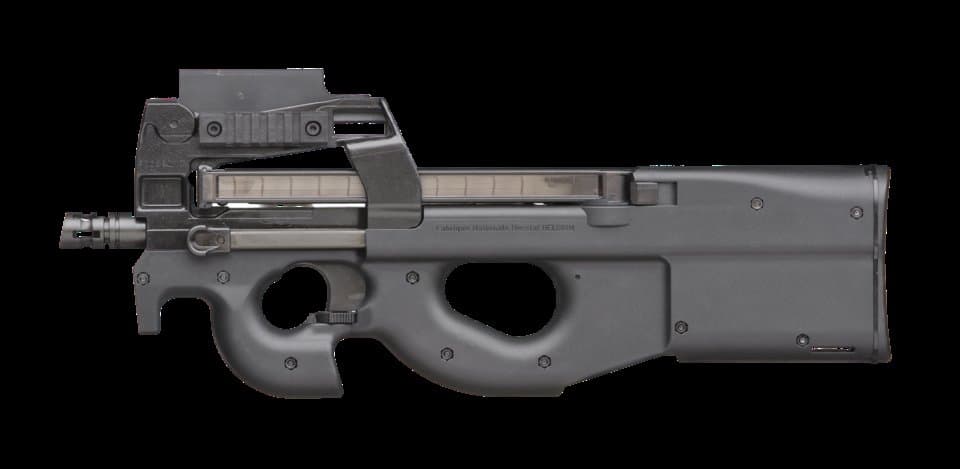

ASmall arms
FN P90
personal defense weapon chambered for the 5.7×28mm cartridge , also classified as a submachine gun ,


Preparing your view.
ASmall arms
personal defense weapon chambered for the 5.7×28mm cartridge , also classified as a submachine gun ,

At a glance
Measured figures
P90
Single sourcePS90
Single sourceConfiguration
| Specification | FN P90 | LMT Modular Ambidextrous Rifle System |
|---|---|---|
| Type | Personal defense weapon[source] | Assault rifle Battle rifle[source]LMT Modular Ambidextrous Rifle System · Type |
| Place of origin | Belgium[source] | United States[source]LMT Modular Ambidextrous Rifle System · Place of origin |
| In service | 1990–present[source] | 2015 - present[source]LMT Modular Ambidextrous Rifle System · In service |
| Used by |
50.5 cm (19.9 in) ( P90 ) 66.6 cm (26.2 in) ( PS90 )[source]
LMT Modular Ambidextrous Rifle System · Length · "Maximum"
Single source914 mm (36.0 in) ("Maximum")[source]LMT Modular Ambidextrous Rifle System · Length
P90
Single sourcePS90
Single source26.4 cm (10.4 in) ( P90 ) 40.7 cm (16.0 in) ( PS90 )[source]
L129A2 exact named variant; not a sibling record · Barrel length
Single sourceStgw 25 exact named variant; not a sibling record · Barrel length
Single sourceRate of fire
Single source850–1,100 rounds/min[source]
Muzzle velocity
Single source715 m/s (2,350 ft/s)[source]
Bars compare reported quantities only. A larger figure does not make a system better; configurations and test conditions differ.
See Users[source]
| — |
| Wars | Internal conflict in Peru War in Afghanistan Iraq War Mexican drug war Libyan Civil War[source] | — |
|---|
| Designer | Rene Predazzer[source] | Lewis Machine & Tool Company[source]LMT Modular Ambidextrous Rifle System · Designer |
|---|
| Designed | 1986–90[source] | — |
|---|
| Manufacturer | FN Herstal[source] | Lewis Machine & Tool Company[source]LMT Modular Ambidextrous Rifle System · Manufacturer |
|---|
| Produced | 1990–present[source] | — |
|---|
| Variants | See Variants[source] | — |
|---|
| Cartridge | FN 5.7×28mm[source] | 5.56×45mm NATO 7.62×51mm NATO 6.5mm Creedmoor[source]LMT Modular Ambidextrous Rifle System · Cartridge The MARS-L (light) assault rifle variants are chambered for the 5.56×45mm NATO intermediate cartridge , and the MARS-H (heavy) battle rifle and designated marksman rifle variants for the 7.62×51mm NATO , 6.5 mm Creedmoor or similar fully powered cartridges .[source]Design · explicit MARS-L/MARS-H cartridge scope MARS-H based designated marksman variant, chambered in 6.5 mm Creedmoor .[source]L129A2 · explicit MARS-L/MARS-H cartridge scope Swiss MARS-H-based designated marksman rifle chambered in 7.62×51mm NATO.[source]7.62mm Zf Stgw 20 · explicit MARS-L/MARS-H cartridge scope LMT's MRGG-A is a member of its Modular Ambidextrous Rifle System-Heavy (MARS-H) family, which are commonly described as AR-10-style rifles, but is chambered to fire the 6.5mm Creedmoor round.[source]MK24 Mid-Range Gas Gun-Assault · explicit MARS-L/MARS-H cartridge scope |
|---|
| Action | Straight blowback , closed bolt[source] | Gas-operated , rotating bolt (internal piston, not direct impingement ) or Short-stroke piston[source]LMT Modular Ambidextrous Rifle System · Action |
|---|
| Feed system | 50-round detachable box magazine[source] | 5.56×45mm NATO : 30-round detachable box magazine 7.62×51mm NATO 20-round detachable box magazine[source]LMT Modular Ambidextrous Rifle System · Feed system |
|---|
| Sights | Tritium -illuminated reflex sight , back-up iron sights[source] | — |
|---|
| Role | personal defense weapon chambered for the 5.7×28mm cartridge , also classified as a submachine gun ,[source] | — |
|---|
| Status | The P90 is currently in service with military and police forces in over 40 nations, such as Austria , Brazil , Canada , France , Greece , India , Malaysia , Poland , and the United States .[source]P90 · source-literal variant status | — |
|---|
| Source measurement | The FN P90 is a personal defense weapon chambered for the 5.7×28mm cartridge , also classified as a submachine gun , designed and manufactured by FN Herstal in Belgium . Created in response to NATO requests for a replacement for 9×19mm Parabellum firearms, the P90 was designed as a compact but powerful firearm for vehicle crews, operators of crew-served weapons, support personnel, special forces , and counter-terrorist groups.[source]FN P90 · Lead; only the objects and conditions stated in this passage Designed in conjunction with the FN 5.7×28mm NATO ammunition , development of the weapon began in 1986, and production commenced in 1990, when it was known as the Project 9.0 (from which the "90" in its name is derived ), whereupon the 5.7×28mm ammunition was redesigned and shortened. A modified version of the P90 with a magazine adapted to use the new ammunition was introduced in 1993, and the Five-seven pistol was subsequently introduced as a companion weapon using the same 5.7×28mm ammunition.[source]FN P90 · Lead; only the objects and conditions stated in this passage Featuring a compact bullpup design with an integrated reflex sight and fully ambidextrous controls, the P90 is an unconventional weapon with a futuristic appearance. Its design incorporates several innovations, such as a unique top-mounted magazine and FN's small-caliber, high- velocity 5.7×28mm ammunition. Additional integrated features include interchangeable visible or infrared laser and tritium light sources.[source]FN P90 · Lead; only the objects and conditions stated in this passage The P90 and its 5.7×28mm ammunition were developed by the Belgian company FN Herstal in response to NATO requests for a replacement for the 9×19mm Parabellum cartridge and associated pistols and submachine guns. NATO called for two types of weapons chambered for a new cartridge—one a shoulder-fired weapon, and the other a handheld weapon. According to NATO, these new weapons, termed personal defense weapons (PDWs), were to provide "personal protection in last-resort situations when the user is directly endangered by the enemy [...]." In 1989, NATO published document D/296 , outlining a number of preliminary specifications for these weapons:[source]FN P90 · History / Development; only the objects and conditions stated in this passage The new cartridge was to have greater range, accuracy, and terminal performance than the 9×19mm cartridge. Additionally, it was to be capable of penetrating body armor .[source]FN P90 · History / Development; only the objects and conditions stated in this passage The shoulder-fired personal defense weapon was to weigh less than 3 kg (6.6 lb), with a magazine capacity of at least 20 rounds.[source]FN P90 · History / Development; only the objects and conditions stated in this passage The handheld personal defense weapon (pistol) was to weigh less than 1 kg (2.2 lb), although a weight of 700 g (1.5 lb) was deemed desirable; it was to have a magazine capacity of at least 20 rounds.[source]FN P90 · History / Development; only the objects and conditions stated in this passage FN Herstal was the first small arms manufacturer to respond to NATO's requirement; FN started by developing a shoulder-fired personal defense weapon, the P90, along with a small caliber, high velocity 5.7×28mm cartridge type. The original 5.7×28mm cartridge, called the SS90 , went into production with the P90 in 1990. The SS90 propelled a 1.5 g (23 grain ) plastic-core projectile from the P90 at a muzzle velocity of roughly 850 metres per second (2,800 ft/s).[source]FN P90 · History / Development; only the objects and conditions stated in this passage Following the P90's introduction, FN revised the 5.7×28mm ammunition. The new variation, designated the SS190 , used a projectile 2.7 mm (0.11 in) shorter in length than that of the SS90. This allowed it to be used more conveniently in the 5.7×28mm FN Five-seven pistol, which was under development at that time. The SS190 projectile had more weight and a more conventional construction with an aluminium and steel core. The first prototypes of the SS190 were created in 1992, and the design was finalized in 1993, replacing the SS90. A modified version of the P90, with a magazine adapted to use the shortened ammunition, was then introduced in the same year. Several special cartridge variations were developed, such as the L191 tracer round and the SB193 subsonic round for use with a sound-suppressed P90.[source]FN P90 · History / Development; only the objects and conditions stated in this passage In 2002 and 2003, NATO conducted a series of tests with the intention of standardizing a PDW cartridge as a replacement for the 9×19mm Parabellum cartridge. The tests compared the relative merits of the FN 5.7×28mm cartridge and the HK 4.6×30mm cartridge, which was created by German small arms manufacturer Heckler & Koch as a competitor to the 5.7×28mm. The results of the NATO tests were analyzed by a group formed of experts from Canada, France, the United Kingdom , and the United States. The group's conclusion was that the 5.7×28mm was statistically the more efficient cartridge; However, NATO countries could not reach the general consensus to standardized 5.7×28mm, which halted the standardization process indefinitely. As a result, both the 4.6×30mm and 5.7×28mm cartridges (and the associated weapons) have been independently adopted by various NATO countries, according to preference; the P90 is currently in service with some military and police force units in over 40 countries. The 5.7x28mm was eventually standardized by NATO in February 2021.[source]FN P90 · History / NATO evolution; only the objects and conditions stated in this passage The P90 is a selective fire , straight blowback -operated weapon with a cyclic rate of fire of around 850–1,100 rounds per minute. The weapon is chambered for FN's 5.7×28mm ammunition. Its unusual shape is based on extensive ergonomic research. The weapon is grasped by means of a thumbhole in the frame that acts as a pistol grip , as well as an oversized trigger guard that acts as a foregrip for the shooter's support hand. The P90 fires from a closed bolt for maximum accuracy, and its design makes extensive use of polymers for reduced weight and cost. Overall, the weapon is relatively lightweight, weighing 2.5 kg (5.5 lb) empty, or 3 kg (6.6 lb) with a loaded 50-round magazine.[source]FN P90 · Design; only the objects and conditions stated in this passage The P90 was designed to have a length no greater than a man's shoulder width, to allow it to be easily carried and maneuvered in tight spaces, such as the inside of an armored vehicle . To achieve this, the weapon's design uses the unconventional bullpup configuration, in which the action and magazine are located behind the trigger and alongside the shooter's face so that there is no wasted space in the stock . The P90's dimensions are minimized by its unique horizontally mounted feeding system, wherein the box magazine sits parallel to the barrel on top of the weapon's frame. The weapon overall has an extremely compact profile—it is the most compact fixed-stock submachine gun to be made. The standard version of the weapon has an overall length of 500 mm (20 in), a height of 210 mm (8.3 in), and a width of 55 mm (2.2 in).[source]FN P90 · Design; only the objects and conditions stated in this passage The P90 requires minimal maintenance , and it can be disassembled quickly and easily. It is a modular firearm, consisting of four main component groups: the barrel and optical sight group, the moving parts group, the frame and trigger group, and the hammer group. The P90's barrel is cold hammer-forged and chrome-lined , with an overall length of 263 mm (10.4 in). The barrel has eight rifling grooves with a right-hand twist rate of 1:231 mm (1:9.1 in), and it is equipped with a diagonally cut flash suppressor that also acts as a recoil compensator. The stated service life of the barrel is 20,000 rounds.[source]FN P90 · Design; only the objects and conditions stated in this passage Particularly significant to the design of the P90 is the small-caliber, high-velocity bottlenecked cartridge it uses. The 5.7×28mm cartridge was created by FN Herstal in response to a NATO requirement that called for a replacement for the 9×19mm Parabellum cartridge, which is commonly used in pistols and submachine guns. The 5.7×28mm cartridge weighs 6.0 g (93 grains )—roughly half as much as a typical 9×19mm cartridge—allowing the same number of rounds to be carried for less weight, or allowing more rounds to be carried for the same weight. Since the 5.7×28mm cartridge has a relatively small diameter, an unusually high number of cartridges can be contained in a magazine. The cartridge has a loud report and produces considerable muzzle flash (when fired from a pistol), but it produces roughly 30 percent less recoil than the 9×19mm cartridge, improving controllability . Due to its high velocity, the 5.7×28mm exhibits an exceptionally flat trajectory compared to typical pistol ammunition.[source]FN P90 · Design / Ammunition; only the objects and conditions stated in this passage Fired from the P90, the 5.7×28mm SS190 has a muzzle velocity of roughly 716 m/s (2,350 ft/s; Mach 2.1). FN states an effective range of 200 m (220 yd) and a maximum range of 1,800 m (2,000 yd) for the 5.7×28mm cartridge when fired from the P90.[source]FN P90 · Design / Ammunition; only the objects and conditions stated in this passage In testing conducted by the Royal Canadian Mounted Police (RCMP) in 1999, the SS190 fired from the P90 at a distance of 25 m (27 yd) exhibited an average penetration depth of 25 cm (9.8 in) in ballistic gelatin covered with a Level II vest . The SS190 exhibited penetration depths ranging from 28 to 34 cm (11 to 13.5 in) when fired from the P90 into bare ballistic gelatin, in tests conducted by Houston Police Department SWAT .[source]FN P90 · Design / Ammunition; only the objects and conditions stated in this passage Since the SS190 projectile does not rely on fragmentation or the expansion of a hollow point , the cartridge (and 5.7×28mm weapons) is considered suitable for military use under the Hague Convention of 1899 , which prohibits the use of expanding bullets in warfare .[source]FN P90 · Design / Ammunition; only the objects and conditions stated in this passage The P90 uses a unique horizontally mounted feeding system—patented in the United States—that contributes to the weapon's compact profile and unusual appearance. U.S. Patent 4,905,394 ("Top mounted longitudinal magazine") was awarded in 1990, naming René Predazzer as the sole inventor. The detachable box magazine is mounted parallel to the P90's barrel, fitting flush with the top of the weapon's frame, and it contains 50 rounds of ammunition which lie in two rows facing left, offset 90° from the bore axis. As the cartridges are pushed back by spring pressure and arrive at the rear end of the magazine, they are fed as a single row into a spiral feed ramp and rotated 90 degrees, aligning them with the chamber . The magazine body is composed of polymer, and it is translucent to allow the shooter to see the amount of ammunition remaining at any time.[source]FN P90 · Design / Feeding; only the objects and conditions stated in this passage The HC-14-62 has a polymer housing and uses a forward-aimed fiber optic collector to illuminate the white daytime reticle , which consists of a large circle of about 180 minutes of arc (MOA), with a 20 MOA circle surrounding a 3.5 MOA dot in the center.[source]FN P90 · Design / Sights and accessories; only the objects and conditions stated in this passage The P90 has provisions for mounting a variety of different types of accessories, including tactical lights and laser aiming devices . A sling can be attached to the P90 for greater ease of carry, or it can be fitted with various sound suppressors such as the Gemtech SP90 , which was designed specifically for the weapon in cooperation with FN Herstal. This stainless steel suppressor with a black oxide finish is built according to MIL-SPECs , including saltwater corrosion resistance . It has a length of 184 mm (7.2 in), a diameter of 35 mm (1.4 in) and a weight of 680 g (1.50 lb). When subsonic ammunition is used in conjunction with the suppressor, it reduces the sound signature of the P90 by 33 dB . A small case collector pouch for the P90 is available which fits over the ejection port and collects spent cases as they are ejected downward; the pouch will collect up to one hundred cases before filling.[source]FN P90 · Design / Sights and accessories; only the objects and conditions stated in this passage The P90 LV (Laser Visible) and P90 IR (InfraRed) models, both of which were introduced in late 1995, have an integrated laser sight manufactured by Laserex Technologies in Australia. The P90 LV model projects an 8 mW visible laser intended to be used as a low-light shooting aid or for dissuasive effect, while the P90 IR model projects a 4.5 mW infrared laser that can only be seen with night vision equipment . Both laser systems are compact, consisting of a small, flat panel integrated into the front end of the weapon's frame.[source]FN P90 · Variants / P90 / P90 Laserex models; only the objects and conditions stated in this passage The Laserex P90 laser systems have a weight of 131 grams (0.289 lb; 4.6 oz), and they are activated by means of a green pressure switch located on the underside of the weapon's pistol grip. The lasers can be configured for three different internal settings: Off – disabled to prevent accidental activation, Training – low intensity for eye safety and extended battery life in training, or Combat – high intensity for maximum visibility. The Laserex P90 laser systems have a battery life of 250 hours when used on the Training setting, or a life of 50 hours when used on the Combat setting.[source]FN P90 · Variants / P90 / P90 Laserex models; only the objects and conditions stated in this passage In order to be legal for purchase by civilians without obtaining a tax stamp for a Short Barreled Rifle (SBR) as defined by the United States National Firearms Act , the PS90 carbine has an extended 407 mm (16.0 in) barrel and is semi-automatic, with a trigger pull of approximately 31–36 newtons (7.0–8.1 lb f ). The lengthened barrel has eight rifling grooves, with a right-hand twist rate of 1:229 mm (1:9 in) and a rifled length of 376 mm (14.8 in); the muzzle is equipped with a fixed "birdcage" type flash suppressor .[source]FN P90 · Variants / PS90; only the objects and conditions stated in this passage Despite the added barrel length, the PS90 is relatively compact and lightweight, with an overall length of 667 mm (26.3 in), and a weight of 3.4 kg (7.5 lb) with a fully loaded 50-round magazine. Due to the added barrel length, the PS90 can achieve a muzzle velocity of up to 777 metres per second (2,550 ft/s) with SS195LF ammunition, or up to 930 metres per second (3,100 ft/s) with third-party ammunition.[source]FN P90 · Variants / PS90; only the objects and conditions stated in this passage The PS90 SBR variant is functionally identical to the “PS90 Standard”, but instead of the extended 16 inch barrel, this variant retains the standard 10.5 inch barrel of its selective-fire counterpart, thus making it the ballistic equivalent, in semi-automatic only form. The PS90 SBR is not usually listed on FN Herstal's website, but is offered commercially through third-party extensions. These are made either through factory standard layouts, or conversions made by swapping the barrel. This renders the weapon a “short barreled rifle”, and thus the required tax stamp is necessary in order to purchase and/or transfer it. The weapon is regulated as “Title II”, and special certification is required in most states. As with all factory standard PS90 receivers special welding is in place to complicate full auto conversion.[source]FN P90 · Variants / PS90 / PS90 SBR; only the objects and conditions stated in this passage | — |
|---|
| Reported operators | — |
|
|---|
Stgw 25K exact named variant; not a sibling record · Barrel length
Single source