Credit
Hans-Hermann Bühling · CC BY-SA 3.0 · Resized / optimised · CC BY-SA 3.0 · Source ↗ · Modified


Preparing your view.

At a glance
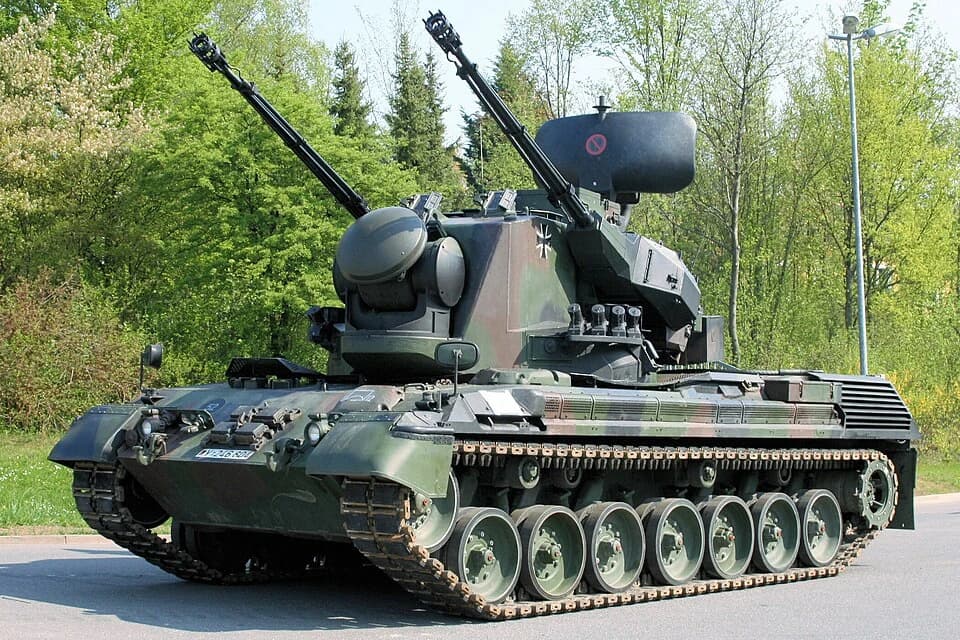
Flakpanzer Gepardlarger figure on 2 of 2
ZSU-57-2larger figure on 0 of 2
True scale
Side by side. From every angle. A human reference for perspective.
3.39 MB · Loads when you open it| Model | Length | Width / span | Height |
|---|---|---|---|
| Flakpanzer Gepard | ≈ 7.68 m | ≈ 3.8 m (Width) | ≈ 3.13 m |
| ZSU-57-2 | ≈ 6.22 m | ≈ 2.52 m (Width) | ≈ 2.2 m |
Scaled uniformly to the sourced length of 7.68 m. Not an official model or a measured survey.
ForceTally · All rights reserved
Scaled uniformly to the sourced length of 6.22 m. Not an official model or a measured survey.
ForceTally · All rights reserved
The human reference is a generic 1.75 m figure. Models describe external size, not combat performance.
Measured figures
Overall
Single sourceOverall: 7.68 m (25 ft 2 in)[source]
Hull
Configuration
| Specification | Flakpanzer Gepard | ZSU-57-2 |
|---|---|---|
| Type | Self-propelled anti-aircraft gun[source] | Self-propelled anti-aircraft gun[source] |
| Place of origin | Switzerland West Germany[source] | Soviet Union[source] |
| In service | 1976–present[source] | 1955–early 1970s ( USSR ) 1957–present (other countries)[source] |
| Used by | See Operators[source] | See Operators |
Counts only measures both sources give with the same scope. A larger figure is not a better system.
with gun in forward position (
Single source8.46 m with gun in forward position (6.22 m hull only)[source]
Operational; Operational range
Single source550 km (340 mi)[source]
Operational; Off-road
Single sourceOperational; road
Single source420 km (261 miles) (road) 320 km (199 miles) (off-road)[source]
range of up to 5,500 m[source]ZSU-57-2 · Description / Other equipment · The ZSU-57-2 is equipped with an automatic anti-aircraft sight of the plotter type with two collimators which can supervise a target with a speed of up to 350 m/s, a dive angle of between 0° and 90° and a slant range of up to 5,500 m; a simple mechanical sight is provided in case of failure.
10- cylinder , 37,400 cc (2,280 cu in ) MTU multi-fuel engine
Single source10- cylinder , 37,400 cc (2,280 cu in ) MTU multi-fuel engine 830 PS (819 hp, 610 kW)[source]
V-54, 4-stroke , airless ( mechanical )-injection, water-cooled 38.88 liter V12 diesel at 2,000 rpm
Single sourceV-54, 4-stroke , airless ( mechanical )-injection, water-cooled 38.88 liter V12 diesel 520 hp (388 kW) at 2,000 rpm[source]
Flakpanzer Gepard · primary fitted anti-aircraft gun; bore calibre
Single source35 mm[source]Flakpanzer Gepard · primary fitted anti-aircraft gun; bore calibre
ZSU-57-2 · primary fitted anti-aircraft gun; bore calibre
Single source57 mm[source]ZSU-57-2 · primary fitted anti-aircraft gun; bore calibre
Bars compare reported quantities only. A larger figure does not make a system better; configurations and test conditions differ.
| Wars | Russo-Ukrainian War[source] | See Service history and Combat history[source] |
|---|
| Designer | Oerlikon-Bührle AG (Switzerland) Contraves (Switzerland) Siemens-Albis AG (Switzerland) Krauss-Maffei AG (vehicle - West Germany)[source] | Design Bureaus of Omsk Works No. 174 and Research Institute No. 58 in Kaliningrad, Moscow Oblast[source] |
|---|
| Manufacturer | Krauss-Maffei AG (licence production)[source] | Chelyabinsk Tractor Plant[source] |
|---|
| Armor | conventional steel[source] | 8–15 mm[source] |
|---|
| Main armament | 2 × 35 mm Oerlikon GDF autocannon , each with 320 rounds anti-air ammunition and 20 rounds anti-tank[source] | 2 × 57 mm L/76.6 S-60 anti-aircraft autocannons (57 mm S-68A variant) (300 rounds)[source] |
|---|
| Secondary armament | 2 × quad 76 mm smoke grenade dischargers[source] | — |
|---|
| Power/weight | 17.5 PS/t[source] | 18.5 hp/tonne (13.81 kW/tonne)[source] |
|---|
| Suspension | Torsion bar suspension[source] | individual torsion bar with hydraulic shock absorbers on the first and last road wheels[source] |
|---|
| Role | all-weather-capable West German self-propelled anti-aircraft gun (SPAAG)[source] | Soviet self-propelled anti-aircraft gun (SPAAG), armed[source] |
|---|
| Source measurement | The Gepard was developed during the 1960s as a replacement for the M42 Duster . Two projects were investigated. These were the ‘Matador’ (designed by Rheinmetall , AEG , Siemensi , and Krauss-Maffei ) and the ‘5PFZ-A’ (designed by Oerlikon , Contraves , Siemens-Albis, Hollandse Signaalapparaten and Kraus-Maffei/Porsche ). In 1969, construction began of four A prototypes testing both 30 and 35 mm guns. In June 1970, it was decided to use the 35 mm type. In 1971, twelve second phase B prototypes were ordered. In 1971 the Dutch army ordered a CA preseries of five vehicles based on a parallel development that had used a West German 0-series Leopard 1 vehicle made available by the West German government in March 1970 as the C-prototype.[source]Flakpanzer Gepard · Developmental history; only the objects and conditions stated in this passage The vehicle is based on the hull of the Leopard 1 tank with a large fully rotating turret carrying the armament—a pair of 35 mm Oerlikon KDA autocannons.[source]Flakpanzer Gepard · Technology and systems; only the objects and conditions stated in this passage The Gepard is based on a slightly modified chassis of the Leopard 1 main battle tank, including the complete drive unit with a 37.4-liter 10-cylinder multi-fuel engine (type: MB 838 CaM 500) with two mechanical superchargers. The V-engine with a cylinder angle of 90 degrees has 610 kW at 2200 RPM (830 PS) and consumes—depending on the surface and driving style—around 150 liters per 100 kilometers. To ensure a steady supply of oil, even in difficult terrain and under extreme skew, the engine is provided with a dry sump forced lubrication. Even the gearbox (type: 4 HP-250) from ZF Friedrichshafen and the exhaust system with fresh air admixture to reduce the infrared signature were taken from the Leopard 1 main battle tank.[source]Flakpanzer Gepard · Technology and systems / Chassis and propulsion; only the objects and conditions stated in this passage The Gepard is equipped with a Daimler-Benz (type: OM 314) 4-cylinder diesel auxiliary engine for the energy supply system. This engine is on the front left of the vehicle, located where the Leopard 1 has an ammunition magazine . The engine, which has a 3.8 liter capacity, is designed as a multi-fuel engine and produces 66 kW (90 PS). It consumes between 10 and 20 liters per hour, depending on the operational status of the tank.[source]Flakpanzer Gepard · Technology and systems / Chassis and propulsion; only the objects and conditions stated in this passage The auxiliary engine is coupled with five generators to operate at different speeds: Two Metadyn machines in tandem with a flywheel (which is used to store energy during the acceleration and deceleration of the turret) for the power of the elevation and traverse drives, two 380 Hz three-phase generators with a capacity of 20 kVA for the ventilation, fire-control and radar systems, and a 300 A 28 volt direct current generator for the electrical system. The fuel capacity is 985 liters, which ensures a combined operating time of approximately 48 hours.[source]Flakpanzer Gepard · Technology and systems / Chassis and propulsion; only the objects and conditions stated in this passage The hull only had slight modifications, e.g., a modified roadwheel distance (8 cm increased distance between the third and fourth roadwheel) and the transfer of additional batteries in battery boxes at the rear. The batteries and the electrical system operate at 24 volts DC.[source]Flakpanzer Gepard · Technology and systems / Chassis and propulsion; only the objects and conditions stated in this passage Vehicles delivered to the German Bundeswehr and Belgium were equipped with a Siemens MPDR 12 S-band search radar installed on a swing arm (lowered behind the turret for transit) on the rear of the turret, which provides a 15 km hemispherical detection range and has an integrated MSR 400 Mk XII interrogator for automated target discrimination.[source]Flakpanzer Gepard · Technology and systems / Radar and laser; only the objects and conditions stated in this passage The K u band tracking radar also developed by Siemens-Albis has a 15 km range and is mounted at the front of the turret, between the guns; its dome-covered antenna is mounted on a powered base which can traverse in a 180° arc.[source]Flakpanzer Gepard · Technology and systems / Radar and laser; only the objects and conditions stated in this passage Additionally, the Gepard has a back-up optical sighting system for passive target acquisition and engagement, consisting of two stabilized, panoramic periscopes for both gunner and commander, with a variable magnification (1.5× and a field of view of 50° and 6× magnification with a narrow, 12.5° FOV).[source]Flakpanzer Gepard · Technology and systems / Radar and laser; only the objects and conditions stated in this passage The Gepard utilizes two Oerlikon GDF , 90 calibres (3.15 m (10 ft 4 in)) long, with a muzzle velocity of 1,440 m/s (4,700 ft/s) ( FAPDS (Frangible Armour Piercing Discarding Sabot) rounds), giving an effective range of 5.5 km (3.4 miles). The ammunition is 35×228mm calibre ( STANAG 4516).[source]Flakpanzer Gepard · Technology and systems / Guns; only the objects and conditions stated in this passage Each gun has a firing rate of 550 rounds/min. The combined rate of fire is 1,100 rounds/min, which – in unlimited mode – gives a continuous fire time of 35 seconds before running out of ammunition (with 640 AA rounds for both guns). It is standard to fire bursts against air targets, 24 rounds per gun for a total of 48 in limited mode and 48 rounds per gun for a total of 96 in normal mode. The Ukrainian air defence have found that the guns "take an hour-and-a-half to reload", thus limiting their effectiveness.[source]Flakpanzer Gepard · Technology and systems / Guns; only the objects and conditions stated in this passage Search radar : S band , 15 km range[source]Flakpanzer Gepard · Technology and systems / Variants; only the objects and conditions stated in this passage Tracking radar: K u band , 15 km range[source]Flakpanzer Gepard · Technology and systems / Variants; only the objects and conditions stated in this passage Search radar: X band , 15 km range[source]Flakpanzer Gepard · Technology and systems / Variants; only the objects and conditions stated in this passage Tracking radar: X/ K a band , 13 km range[source]Flakpanzer Gepard · Technology and systems / Variants; only the objects and conditions stated in this passage 55 in active service as of 2025 ; 130 delivered in 2022−2024[source]Flakpanzer Gepard · Operators / Current; only the objects and conditions stated in this passage | The ZSU-57-2 Ob'yekt 500 is a Soviet self-propelled anti-aircraft gun (SPAAG), armed with two 57 mm autocannons . 'ZSU' stands for Zenitnaya Samokhodnaya Ustanovka ( Russian : Зенитная Самоходная Установка ), meaning "anti-aircraft self-propelled mount", '57' stands for the bore of the armament in millimetres and '2' stands for the number of gun barrels . It was the first Soviet mass-produced tracked SPAAG after World War II. In the USSR, it had the unofficial nickname Sparka (Russian: Спарка ), meaning "twin mount," referring to the twin autocannon with which the vehicle is armed.[source]ZSU-57-2 · Lead; only the objects and conditions stated in this passage In 1942, Soviet engineers developed the T-60-3. The vehicle, based on the T-60 light tank chassis, was armed with two 12.7 mm DShK heavy machine guns; but the prototype did not go into production because of flaws in the design. The SU-72 SPAAG and several other experimental vehicles based on the T-60 or T-70 light tank chassis and armed with 37 mm autocannon were also tested in 1942–1943. The ZSU-37 was based on the chassis of the SU-76M self-propelled gun (SPG) and armed with one 37 mm 61K anti-aircraft autocannon in an open-top rotating armoured turret. The vehicle entered production in February 1945 and was in small-scale production until 1948.[source]ZSU-57-2 · Development history / Origins; only the objects and conditions stated in this passage After World War II it became clear that the firepower of a single 37 mm AA gun was insufficient to destroy the high-speed, low-altitude targets, which airplanes started to become at the time. SPAAGs based on light tank chassis had poor maneuverability in difficult terrain, slow off-road speed and insufficient range in comparison with medium tanks and SPGs. Thus the ZSU-37s were retired from service by the end of the 1940s.[source]ZSU-57-2 · Development history / Origins; only the objects and conditions stated in this passage For several years after World War II there were no new SPAAG models in the USSR except for the BTR-152A (which were armed with two or four 14.5mm KPV heavy machine guns , designated ZTPU-4) and the BTR-40A (ZTPU-2) wheeled SPAAGs. Two of the USSR's potential enemies – the United States and Great Britain, had high-quality air forces with substantial ground-attack experience. The need for a new tracked AA vehicle was apparent. |
|---|
| Designed | — | 1947–1954[source] |
|---|
| Produced | — | 1948–1955 (prototypes) 1957–1960 (serial production)[source] |
|---|
| No. built | — | More than 2,023 (USSR) 250 (North Korea, old turrets on new hulls) ? (PRC, Type 80)[source] |
|---|
| Ground clearance | — | 425 mm[source] |
|---|
| Fuel capacity | — | 830 L (including two externally mounted fuel tanks, 95 L each)[source] |
|---|
| Former operator · People's Republic of Angola | — | People's Republic of Angola[source] |
|---|
| Former operator · United Arab Republic | — | United Arab Republic[source] |
|---|
| Former operator · People's Republic of Bulgaria | — | People's Republic of Bulgaria[source] |
|---|
| Former operator · Republic of Bosnia and Herzegovina | — | Republic of Bosnia and Herzegovina[source] |
|---|
| Former operator · China | — | China[source] |
|---|
| Former operator · Derg | — | Derg[source] |
|---|
| Former operator · Finland | — | Finland[source] |
|---|
| Former operator · East Germany | — | East Germany[source] |
|---|
| Former operator · Germany | — | Germany[source] |
|---|
| Former operator · Hungarian People's Republic | — | Hungarian People's Republic[source] |
|---|
| Former operator · Ba'athist Iraq | — | Ba'athist Iraq[source] |
|---|
| Former operator · Democratic People's Republic of Korea | — | Democratic People's Republic of Korea[source] |
|---|
| Former operator · Pahlavi Iran | — | Pahlavi Iran[source] |
|---|
| Former operator · People's Republic of Mozambique | — | People's Republic of Mozambique[source] |
|---|
| Former operator · Polish People's Republic | — | Polish People's Republic[source] |
|---|
| Former operator · Republika Srpska | — | Republika Srpska[source] |
|---|
| Former operator · Socialist Republic of Romania | — | Socialist Republic of Romania[source] |
|---|
| Former operator · Russia | — | Russia[source] |
|---|
| Former operator · Serbia | — | Serbia[source] |
|---|
| Former operator · Slovenia | — | Slovenia[source] |
|---|
| Former operator · Ba'athist Syria | — | Ba'athist Syria[source] |
|---|
| Former operator · Soviet Union | — | Soviet Union[source] |
|---|
| Former operator · North Vietnam | — | North Vietnam[source] |
|---|
| Former operator · South Vietnam | — | South Vietnam[source] |
|---|
| Former operator · Vietnam | — | Vietnam[source] |
|---|
| Former operator · Yugoslavia | — | Yugoslavia[source] |
|---|
| Reported operators | — |
|---|
In February 1946, the Design Bureau of Works No. 174 in Omsk and the Research Institute No. 58 in Kaliningrad, Moscow Oblast submitted a joint project for a SPAAG based on the T-34 tank chassis, to be armed with four 37 mm AA guns, to the Technical Council of the Ministry of Transport. However, the project did not proceed due to the desire to concentrate attention on the newest tank chassis available.[source]ZSU-57-2 · Development history / ZSU-57-2 prototypes; only the objects and conditions stated in this passage
The Design Bureau of Research Institute No. 58 (NII-58) (formerly known as the Central Artillery Design Bureau, TsAKB), under the supervision of V.G. Grabin , began the development of a twin 57 mm S-68 automatic anti-aircraft gun based on the 57mm S-60 in the spring of 1947. The first S-68 prototype (with ESP-76 diesel-electric drive), was ready in 1948. It was initially mounted on a S-79A four-wheel carriage; that system passed various tests but did not go into production.[source]ZSU-57-2 · Development history / ZSU-57-2 prototypes; only the objects and conditions stated in this passage
The final project of the ZSU-57-2 (Ob'yekt 500), armed with twin S-68s and based on a light-weight T-54 tank chassis, was finished in 1948. The first prototype ZSU-57-2 was built in June 1950, the second in December 1950. After official tests, taking place between 27 January and 15 March 1951 in which the vehicle was driven for 1,500 km (932 miles) and 2,000 rounds were fired from its guns, six more prototypes were built for service tests. These prototypes had some improvements included, such as an increased ammunition load (300 rounds), but development stopped again due to the absence of improved S-68A guns. Various updates continued in 1952 and 1953. The service tests, in which two vehicles participated, took place in December 1954. This was due to delays in the development of drives for the S-68 guns. The ZSU-57-2 officially entered service in the Soviet Army on 14 February 1955. With the Warsaw Pact, all Russian allied countries were given a number of the ZSU-57-2.[source]ZSU-57-2 · Development history / ZSU-57-2 prototypes; only the objects and conditions stated in this passage
Based on past experiences with SPAAG designs, Soviet engineers designed a vehicle that used a modified T-54 chassis, with four twin road wheels per side instead of five, and much thinner armour in order to not overwork the inbuild V-54 4-stroke diesel V12 engine of the T-54. The vehicle was armed with twin 57 mm S-68 autocannon in a new, large, rotating, open-topped turret. The ZSU-57-2 consists of three compartments: driver's in the front, fighting in the middle and engine-transmission at the rear. The hull is more spacious in comparison with the T-54 because of the thinner armour and has different locations for some equipment. The general layout, with transverse mounting of the engine, is the same.[source]ZSU-57-2 · Description / Overview; only the objects and conditions stated in this passage
The open-topped box-type welded turret has a ball-bearing race ring 1850 mm in diameter. The turret rear can be removed, which makes replacement of the guns easier. The turret can be covered in the travelling position by a tarpaulin which has 16 plexiglass windows.[source]ZSU-57-2 · Description / Turret; only the objects and conditions stated in this passage
To fire the guns, the breeches must first be opened. The left and right loaders , located in the forward part of the turret on both sides of the main armament, load clips into the magazines of their respective weapons. The loaders' travel seats should be stowed in clamps on the turret sides before opening fire. The gunner, seated on the left hand side in the middle of the turret, aims ("lays") the gun and opens fire using an electric trigger, which fires both barrels, or two-foot pedals, which can fire either barrel independently. If manual mechanical backup gunlaying is used instead of electro-hydraulic drive, three crew members instead of two should work with the sight. The commander, who sits on the right hand side in the middle of the turret, lays the gun in azimuth, the gunner in elevation and the sight adjuster enters data into the sight. The loaders feed clips into the twin autocannon manually as needed, similar to the Bofors 40mm .[source]ZSU-57-2 · Description / Turret; only the objects and conditions stated in this passage
The twin S-68s are recoil-operated and weigh 4,500 kg. Their construction was based on two 57 mm S-60 AA autocannons . The guns have a recoil of between 325 and 370 mm. The individual weapons cannot be swapped from one side to the other as they are mirror images. Each air-cooled gun barrel is 4365 mm long (76.6 calibers ) and is fitted with a muzzle brake . They can be elevated or depressed between −5° and +85° at a speed of between 0.3° and 20° per second, the turret can traverse 360° at a speed of between 0.2° and 36° per second. Drive is from a direct current electric motor and universal hydraulic speed gears (a manual mechanical drive is also provided in case of electrohydraulic failure; with the use of mechanical drive, elevation speed is 4.5° per second and the turret traverse speed is 4° per second).[source]ZSU-57-2 · Description / Armament; only the objects and conditions stated in this passage
The guns firing together are capable of firing up to 210–240 fragmentation and armour-piercing tracer (AP-T) shells per minute, with a practical rate of fire of between 100 and 140 rounds per minute, which gives a fire time of 2–3 minutes before running out of ammo. Muzzle velocity is 1,000 m/s. Each clip has 4 rounds, each of which weighs 6.6 kg; the charge in each round consists of 1.2 kg of 11/7 nitrocellulose powder, a projectile weighs 2.8 kg. Maximum horizontal range is 12 km / 7 miles (with an effective range against ground targets of up to 4 km / 2.5 miles. Maximum vertical range is 8.8 km / 28,871 ft with a maximum effective vertical range of 4.5 km / 14,750 ft). Fragmentation rounds have a safety-destructor which activates between 12 and 16 seconds after being fired to ensure the shells will not fall back to ground, so the maximum slant range of anti-aircraft fire is 6.5–7 km / 4-4.3 miles. BR-281 armour-piercing rounds are able to penetrate 110 mm armour at 500 m or 70 mm armour at 2,000 m (at 90° impact angle).[source]ZSU-57-2 · Description / Armament; only the objects and conditions stated in this passage
The S-68 autocannon was the most powerful AA gun installed on SPAAGs at that time. According to the statistical data of the Air Defence Research Institute No. 2, a direct hit of a single 57 mm shell could destroy a contemporary jet aircraft. In order to shoot down a jet bomber of the Canberra type, an average of 1.7 hits were deemed necessary.[source]ZSU-57-2 · Description / Armament; only the objects and conditions stated in this passage
The ZSU-57-2's armour is welded rolled steel sufficient to protect the vehicle from 7.62mm armour-piercing bullets at 250 meters.[source]ZSU-57-2 · Description / Armour protection; only the objects and conditions stated in this passage
Hull front: (upper) – 13.5 mm; (lower) – 15 mm; at 60 degrees upper[source]ZSU-57-2 · Description / Armour protection; only the objects and conditions stated in this passage
Hull sides: (upper) – 15 mm; (lower) – 13.5 mm[source]ZSU-57-2 · Description / Armour protection; only the objects and conditions stated in this passage
Hull rear: 8 – 10.6 mm at 45 degrees[source]ZSU-57-2 · Description / Armour protection; only the objects and conditions stated in this passage
Hull roof: 15 mm[source]ZSU-57-2 · Description / Armour protection; only the objects and conditions stated in this passage
Hull bottom: 13.5 mm[source]ZSU-57-2 · Description / Armour protection; only the objects and conditions stated in this passage
Turret sides: 13.5 mm[source]ZSU-57-2 · Description / Armour protection; only the objects and conditions stated in this passage
Gun mantlet: 15 mm[source]ZSU-57-2 · Description / Armour protection; only the objects and conditions stated in this passage
The ZSU-57-2 has a maximum road speed of 50 kilometres per hour (31 miles per hour), which is reduced to around 30 km/h off-road(19 mph). The vehicle has better acceleration compared with the T-54 because of its better power-to-weight ratio (18.6 hp per tonne). It has an operational range of 420 km(261 miles) on roads and 320 km(199 miles) across country. The vehicle can cross 0.8 m high vertical obstacles, 2.7 m wide trenches , ford 1.4 m deep water obstacles and climb 30° gradients.[source]ZSU-57-2 · Description / Maneuverability; only the objects and conditions stated in this passage
The ZSU-57-2 uses the same engine as the T-54. It is a water-cooled V-54 4-stroke diesel V12 engine with a displacement of 38.88 litres, which develops 520 hp (388 kW) at 2,000 rpm. The engine itself weighs 895 kg. Fuel capacity is 830 litres carried in three fuel tanks inside the hull (640 L total) and two external fuel tanks on the right fender each of 95 L; fuel capacity was increased in comparison with the T-54. External rear-mounted supplemental fuel tanks can increase the road range to 595 km (370 miles).[source]ZSU-57-2 · Description / Maneuverability; only the objects and conditions stated in this passage
The mechanical transmission in the rear part of the hull consists of a change gear quadrant, a primary multiplate clutch unit with metallic friction pads, a manual gearbox with five forward gears, two multiplate planetary steering clutches with band brakes and two in-line final drive groups.[source]ZSU-57-2 · Description / Maneuverability; only the objects and conditions stated in this passage
The chassis has four twin rubber-tyred road wheels with individual torsion bar suspension , a rear drive sprocket with detachable sprocket rings (lantern-wheel gear) and an idler wheel on each side. The first and last road wheels each have a hydraulic rotary shock absorber . The track is 12.33 m long, 580 mm wide and has 90 links; despite having four road wheels instead of five the ground contact area of the track is the same as the T-54 (3.84 m). Track center distance is 2.64 m The vehicle has a ground pressure of 0.63 kg/cm 2 .[source]ZSU-57-2 · Description / Maneuverability; only the objects and conditions stated in this passage
The ZSU-57-2's electrical power unit partially differs from the T-54, in that it consists of a more powerful G-74 direct current generator which develops 3 kW (108 A at 27–29 V) at 2100 rpm and six 24 volt 6-STEN-140M or 6-MST-140 accumulator batteries (total battery capacity is 420 A-h), the batteries are used for starting the engine and an electrical power supply when the generator is shut down.[source]ZSU-57-2 · Description / Other equipment; only the objects and conditions stated in this passage
The ZSU-57-2 is equipped with an automatic anti-aircraft sight of the plotter type with two collimators which can supervise a target with a speed of up to 350 m/s, a dive angle of between 0° and 90° and a slant range of up to 5,500 m; a simple mechanical sight is provided in case of failure. There is also an optical sight for direct fire at ground targets.[source]ZSU-57-2 · Description / Other equipment; only the objects and conditions stated in this passage
The 10RT-26E portable radio transceiver is located on the right hand side of the turret interior. It has a range of 9–20 km(5–12 miles) when the vehicle is stationary, and from 7–15 km(4–9 miles) when the vehicle is on the move. It was later replaced by R-113 or R-113 radio transceivers. The TPU-4-47 intercom system was later replaced by R-120 or R-124 intercom systems.[source]ZSU-57-2 · Description / Other equipment; only the objects and conditions stated in this passage
Small arms for the crew members include two AK-47 assault rifles and a 26 mm signalling pistol .[source]ZSU-57-2 · Description / Other equipment; only the objects and conditions stated in this passage
Although the ZSU-57-2 had the highest firepower among production SPAAGs of its time, the anti-aircraft fire efficiency of a battery of four vehicles was even lower than that of a battery of six towed 57 mm S-60 anti-aircraft guns controlled by the PUAZO-6 anti-aircraft artillery director with the SON-9 fire control radar or later by the RPK-1 Vaza radar.[source]ZSU-57-2 · Description / Weaknesses; only the objects and conditions stated in this passage
Aircraft technology had improved to the point that a SPAAG required a much higher rate of fire, turret traverse speeds of 50–100° per second and a fully automatic radar-controlled fire control system.[source]ZSU-57-2 · Description / Weaknesses; only the objects and conditions stated in this passage
Works No. 174 started a modernization programme for the ZSU-57-2 in parallel with the beginning of its serial production in 1957, but this programme was rejected due to the development of new radar-guided SPAAGs armed with small-bore autocannons and another tracked chassis.[source]ZSU-57-2 · Description / Weaknesses; only the objects and conditions stated in this passage
Nevertheless, its Western counterparts that were operationally available in the 1950s, such as the US M19 Multiple Gun Motor Carriage (based on the M24 Chaffee light tank) and the M42 Duster SPAAGs (both armed with the famous 40 mm Bofors M2A1 twin AA gun ), had similar problems and were armed with less powerful weapons. The M42 Duster was tested with a T50 radar system in 1956 though it was a failure (production of the ZSU-57-2 had not started at this point).[source]ZSU-57-2 · Description / Weaknesses; only the objects and conditions stated in this passage
Although the vehicle entered service in 1955 and in the same year the No. 174 Works located in Omsk began producing the hulls and turrets, the first vehicles were completed in 1957 after the first 249 57 mm twin S-68 guns were produced by the Artillery Works No. 946 located in Krasnoyarsk . A total of 5,300 of these weapons were produced by the end of the 1950s. The hulls and turrets were produced by No. 174 Works where the final assembly also took place while the Krasnoyarsk Works, belonging to the Ministry of Heavy Engineering, participated in some production stages. The ZSU-57-2 remained in production until 1960 when the No. 174 Works stopped producing the hulls and turrets for ZSU-57-2. More than 2,023 ZSU-57-2 s were produced in Soviet Union.[source]ZSU-57-2 · Production history; only the objects and conditions stated in this passage
Initially, tank regiments had a single battery equipped with four SPAAGs, later increased to two batteries, each equipped with four SPAAGs. The vehicle was also used by some motor rifle regiments (which in the 1960s had one battery equipped with four SPAAGs or, more likely, with six 23 mm ZU-23 towed twin AA guns). The anti-aircraft performance of the ZSU-57-2, however, was quickly found to be unsatisfactory and, because of rapid air force development, the vehicle was deemed obsolete by the early 1960s.[source]ZSU-57-2 · Service history / Former USSR; only the objects and conditions stated in this passage
Poland received its 129 ZSU-57-2s between 1957 and 1961. They were also offered a production license for twin S-68 AA autocannons, but declined it. Eventually, Poland replaced all its ZSU-57-2s with ZSU-23-4s. Seven Polish ZSU-57-2s are preserved, one at the Lubuskie Military Museum in Drzonów, one in Wicko Morskie, the largest anti-aircraft artillery firing range in Poland, one at the Land Forces Museum in Warsaw, one at the History and Tradition of Suvalkai Soldiers Museum in Suwalszczyzna , one in Koszalin and two at the Polish Army Museum in Warsaw .[source]ZSU-57-2 · Service history / Foreign service / Poland; only the objects and conditions stated in this passage
The Socialist Federal Republic of Yugoslavia ordered 100 ZSU-57-2s in 1963. Deliveries were completed between 1963 and 1964. They were passed on to the successor states during the 1992 breakup of the federal state. They were then used by the Federal Republic of Yugoslavia. There were 54 of those vehicles in service as of 1999, but this number decreased to 36 in the subsequent decade; they were withdrawn from active service by 2003. A number of ZSU-57-2 remained in Serbia national inventories until 2008. Two vehicles captured by Croatian forces during the Croatian War of Independence and were later also scrapped.[source]ZSU-57-2 · Service history / Foreign service / Former Yugoslavia; only the objects and conditions stated in this passage
Finland imported 12 ZSU-57-2 SPAAGs between 1960 and 1961 alongside other kinds of Soviet equipment. The ZSU-57-2 s were designated 57 ItPsv SU 57-2, some of them remained in service to the end of the century. A ZSU-57-2M modernization programme was being developed in Finland which would equip the vehicle with radar and configurable ammunition. However, after the prototype was produced the project was abandoned because of high costs. ItPsv SU-57 s were withdrawn from service in 2006.[source]ZSU-57-2 · Service history / Foreign service / Finland; only the objects and conditions stated in this passage
Unlike the production ZSU-57-2, the prototype weighted 26.172 tonnes, carried only 252 rounds: 172 rounds in clips inside the turret and 80 separate rounds in the nose part of the hull in a special ammunition stowage, had thinner armour (8–10 mm) and antennae mounted at the rear of the turret upper right side instead of in the middle.[source]ZSU-57-2 · Variants / Former USSR; only the objects and conditions stated in this passage
Type 80 (WZ305) – Chinese SPAAG. It has the same turret as the ZSU-57-2, but it is armed with the Type 59 twin anti-aircraft autocannon (a copy of the Soviet S-68), mounted on the chassis of a Chinese Type 69-II MBT. It is heavier than the ZSU-57-2 at 30 tonnes.[source]ZSU-57-2 · Variants / People's Republic of China; only the objects and conditions stated in this passage
ItPsv SU-57 – Finnish designation for ZSU-57-2. ItPsv SU-57 with a machine gun mounted on the front of the turret. ZSU-57-2M – Finnish ZSU-57-2 modernization which equips the vehicle with radar and configurable ammunition. Only one prototype was produced and the project was abandoned because of high costs.[source]ZSU-57-2 · Variants / Finland; only the objects and conditions stated in this passage