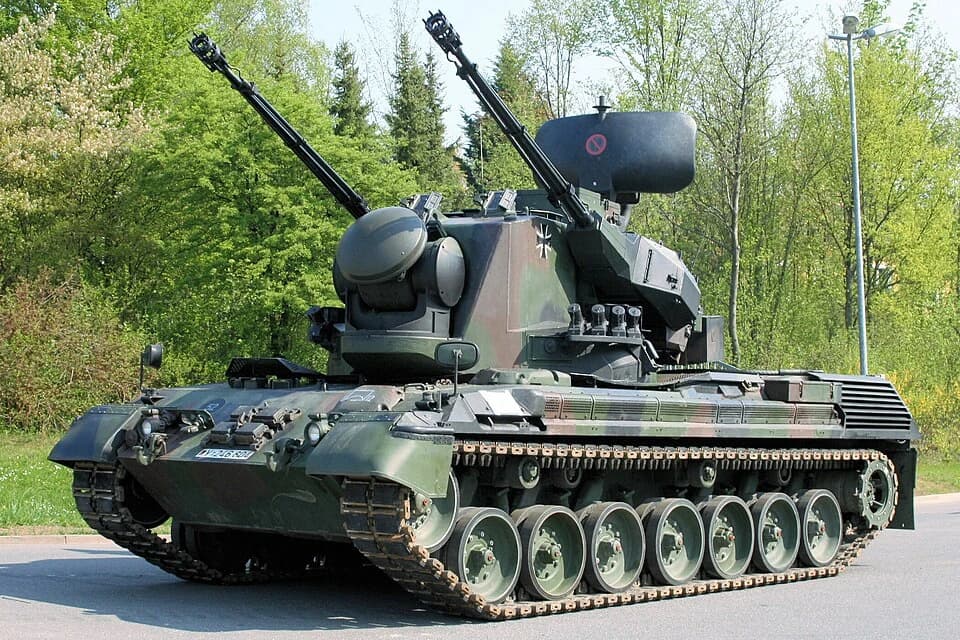
Credit
Hans-Hermann Bühling · CC BY-SA 3.0 · Resized / optimised · CC BY-SA 3.0 · Source ↗ · Modified


Preparing your view.
At a glance
Flakpanzer Gepardlarger figure on 2 of 2
ZSU-23-4 Shilkalarger figure on 0 of 2
Counts only measures both sources give with the same scope. A larger figure is not a better system.
True scale
Side by side. From every angle. A human reference for perspective.
3.31 MB · Loads when you open it| Model | Length | Width / span | Height |
|---|---|---|---|
| Flakpanzer Gepard | ≈ 7.68 m | ≈ 3.8 m (Width) | ≈ 3.13 m |
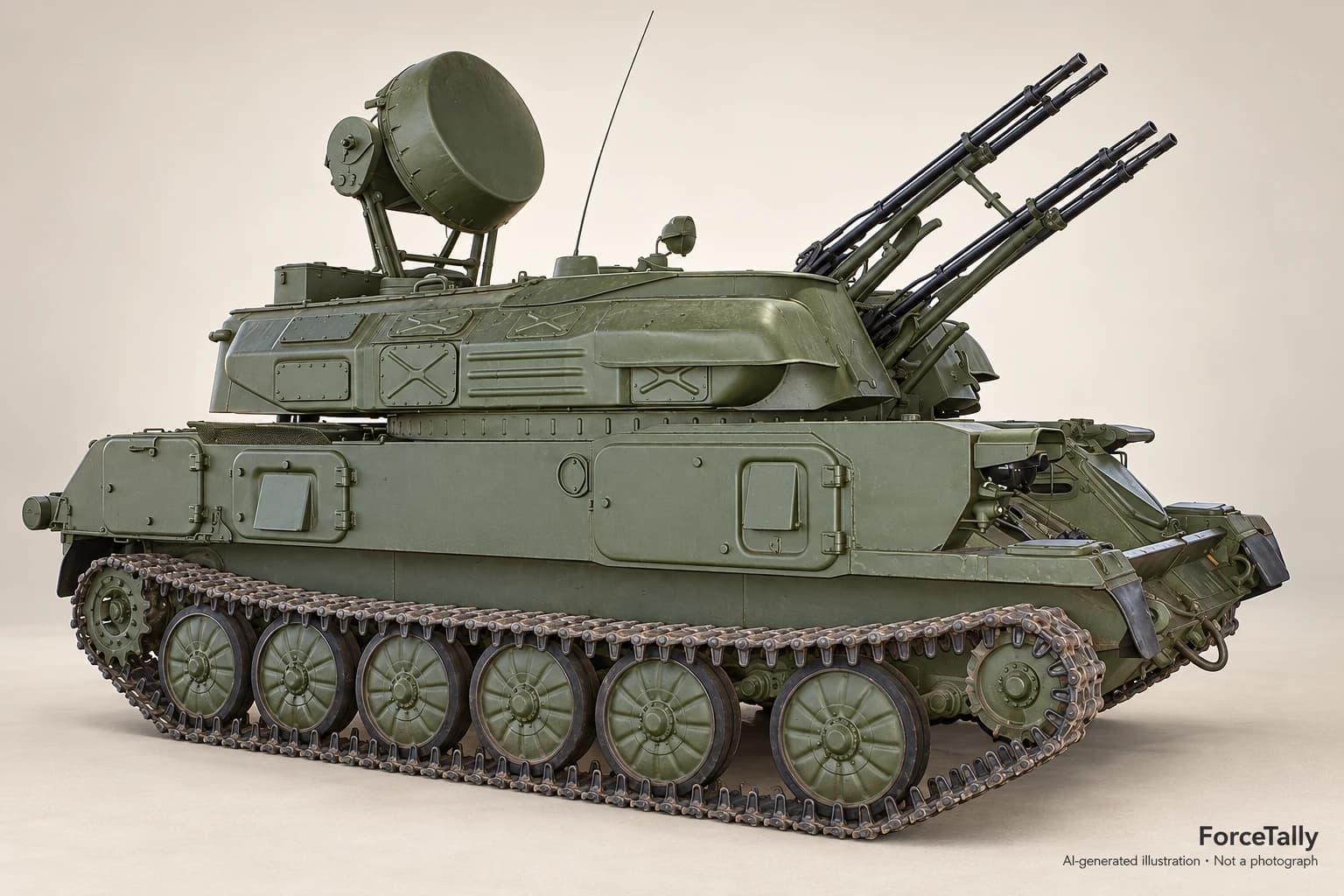
| ZSU-23-4 Shilka | ≈ 6.54 m | ≈ 3.2 m (Width) | ≈ 3.19 m |
Scaled uniformly to the sourced length of 7.68 m. Not an official model or a measured survey.
ForceTally · All rights reserved
Scaled uniformly to the sourced length of 6.535 m. Not an official model or a measured survey.
ForceTally · All rights reserved
The human reference is a generic 1.75 m figure. Models describe external size, not combat performance.
Measured figures
Overall
Single sourceOverall: 7.68 m (25 ft 2 in)[source]
Length
Single sourceConfiguration
| Specification | Flakpanzer Gepard | ZSU-23-4 Shilka |
|---|---|---|
| Type | Self-propelled anti-aircraft gun[source] | Self-propelled anti-aircraft gun[source] |
| Place of origin | Switzerland West Germany[source] | Soviet Union[source] |
| In service | 1976–present[source] | 1960–present[source] |
| Used by | See Operators[source] | See Operators |
6.535 m (21 ft 5.3 in)[source]
10- cylinder , 37,400 cc (2,280 cu in ) MTU multi-fuel engine
Single source10- cylinder , 37,400 cc (2,280 cu in ) MTU multi-fuel engine 830 PS (819 hp, 610 kW)[source]
V-6R, 6-cylinder 4-stroke airless-injection water-cooled 20-litre diesel at 2,000 rpm
Single sourceV-6R, 6-cylinder 4-stroke airless-injection water-cooled 20-litre diesel 280 hp (209 kW) at 2,000 rpm[source]
Flakpanzer Gepard · primary fitted anti-aircraft gun; bore calibre
Single source35 mm[source]Flakpanzer Gepard · primary fitted anti-aircraft gun; bore calibre
Fitted ZSU-23-4 Shilka autocannons only; contrast with later 30 mm Tunguska is not inherited · Fitted ZSU-23-4 Shilka autocannons only; contrast with later 30 mm Tunguska is not inherited
Single source23 mm[source]Fitted ZSU-23-4 Shilka autocannons only; contrast with later 30 mm Tunguska is not inherited
Bars compare reported quantities only. A larger figure does not make a system better; configurations and test conditions differ.
| Wars | Russo-Ukrainian War[source] | See Combat history[source] |
|---|
| Designer | Oerlikon-Bührle AG (Switzerland) Contraves (Switzerland) Siemens-Albis AG (Switzerland) Krauss-Maffei AG (vehicle - West Germany)[source] | — |
|---|
| Manufacturer | Krauss-Maffei AG (licence production)[source] | Ulyanovsk Mechanical Plant (UMZ), Mytishchi Machine-Building Plant (MMZ)[source] |
|---|
| Armor | conventional steel[source] | Welded steel, 9.2 mm (0.36 in) turret, up to 15 mm hull[source] |
|---|
| Main armament | 2 × 35 mm Oerlikon GDF autocannon , each with 320 rounds anti-air ammunition and 20 rounds anti-tank[source] | 4 × 23 mm 2A7 autocannons (AZP-23 "Amur" quad automatic anti-aircraft gun), ammunition 2,000 rounds[source] |
|---|
| Secondary armament | 2 × quad 76 mm smoke grenade dischargers[source] | — |
|---|
| Power/weight | 17.5 PS/t[source] | 14.7 hp/tonne (11.0 kW/tonne)[source] |
|---|
| Suspension | Torsion bar suspension[source] | Individual torsion bar[source] |
|---|
| Role | all-weather-capable West German self-propelled anti-aircraft gun (SPAAG)[source] | lightly armoured Soviet self-propelled, radar -guided anti-aircraft weapon system ( SPAAG )[source] |
|---|
| Source measurement | The Gepard was developed during the 1960s as a replacement for the M42 Duster . Two projects were investigated. These were the ‘Matador’ (designed by Rheinmetall , AEG , Siemensi , and Krauss-Maffei ) and the ‘5PFZ-A’ (designed by Oerlikon , Contraves , Siemens-Albis, Hollandse Signaalapparaten and Kraus-Maffei/Porsche ). In 1969, construction began of four A prototypes testing both 30 and 35 mm guns. In June 1970, it was decided to use the 35 mm type. In 1971, twelve second phase B prototypes were ordered. In 1971 the Dutch army ordered a CA preseries of five vehicles based on a parallel development that had used a West German 0-series Leopard 1 vehicle made available by the West German government in March 1970 as the C-prototype.[source]Flakpanzer Gepard · Developmental history; only the objects and conditions stated in this passage The vehicle is based on the hull of the Leopard 1 tank with a large fully rotating turret carrying the armament—a pair of 35 mm Oerlikon KDA autocannons.[source]Flakpanzer Gepard · Technology and systems; only the objects and conditions stated in this passage The Gepard is based on a slightly modified chassis of the Leopard 1 main battle tank, including the complete drive unit with a 37.4-liter 10-cylinder multi-fuel engine (type: MB 838 CaM 500) with two mechanical superchargers. The V-engine with a cylinder angle of 90 degrees has 610 kW at 2200 RPM (830 PS) and consumes—depending on the surface and driving style—around 150 liters per 100 kilometers. To ensure a steady supply of oil, even in difficult terrain and under extreme skew, the engine is provided with a dry sump forced lubrication. Even the gearbox (type: 4 HP-250) from ZF Friedrichshafen and the exhaust system with fresh air admixture to reduce the infrared signature were taken from the Leopard 1 main battle tank.[source]Flakpanzer Gepard · Technology and systems / Chassis and propulsion; only the objects and conditions stated in this passage The Gepard is equipped with a Daimler-Benz (type: OM 314) 4-cylinder diesel auxiliary engine for the energy supply system. This engine is on the front left of the vehicle, located where the Leopard 1 has an ammunition magazine . The engine, which has a 3.8 liter capacity, is designed as a multi-fuel engine and produces 66 kW (90 PS). It consumes between 10 and 20 liters per hour, depending on the operational status of the tank.[source]Flakpanzer Gepard · Technology and systems / Chassis and propulsion; only the objects and conditions stated in this passage The auxiliary engine is coupled with five generators to operate at different speeds: Two Metadyn machines in tandem with a flywheel (which is used to store energy during the acceleration and deceleration of the turret) for the power of the elevation and traverse drives, two 380 Hz three-phase generators with a capacity of 20 kVA for the ventilation, fire-control and radar systems, and a 300 A 28 volt direct current generator for the electrical system. The fuel capacity is 985 liters, which ensures a combined operating time of approximately 48 hours.[source]Flakpanzer Gepard · Technology and systems / Chassis and propulsion; only the objects and conditions stated in this passage The hull only had slight modifications, e.g., a modified roadwheel distance (8 cm increased distance between the third and fourth roadwheel) and the transfer of additional batteries in battery boxes at the rear. The batteries and the electrical system operate at 24 volts DC.[source]Flakpanzer Gepard · Technology and systems / Chassis and propulsion; only the objects and conditions stated in this passage Vehicles delivered to the German Bundeswehr and Belgium were equipped with a Siemens MPDR 12 S-band search radar installed on a swing arm (lowered behind the turret for transit) on the rear of the turret, which provides a 15 km hemispherical detection range and has an integrated MSR 400 Mk XII interrogator for automated target discrimination.[source]Flakpanzer Gepard · Technology and systems / Radar and laser; only the objects and conditions stated in this passage The K u band tracking radar also developed by Siemens-Albis has a 15 km range and is mounted at the front of the turret, between the guns; its dome-covered antenna is mounted on a powered base which can traverse in a 180° arc.[source]Flakpanzer Gepard · Technology and systems / Radar and laser; only the objects and conditions stated in this passage Additionally, the Gepard has a back-up optical sighting system for passive target acquisition and engagement, consisting of two stabilized, panoramic periscopes for both gunner and commander, with a variable magnification (1.5× and a field of view of 50° and 6× magnification with a narrow, 12.5° FOV).[source]Flakpanzer Gepard · Technology and systems / Radar and laser; only the objects and conditions stated in this passage The Gepard utilizes two Oerlikon GDF , 90 calibres (3.15 m (10 ft 4 in)) long, with a muzzle velocity of 1,440 m/s (4,700 ft/s) ( FAPDS (Frangible Armour Piercing Discarding Sabot) rounds), giving an effective range of 5.5 km (3.4 miles). The ammunition is 35×228mm calibre ( STANAG 4516).[source]Flakpanzer Gepard · Technology and systems / Guns; only the objects and conditions stated in this passage Each gun has a firing rate of 550 rounds/min. The combined rate of fire is 1,100 rounds/min, which – in unlimited mode – gives a continuous fire time of 35 seconds before running out of ammunition (with 640 AA rounds for both guns). It is standard to fire bursts against air targets, 24 rounds per gun for a total of 48 in limited mode and 48 rounds per gun for a total of 96 in normal mode. The Ukrainian air defence have found that the guns "take an hour-and-a-half to reload", thus limiting their effectiveness.[source]Flakpanzer Gepard · Technology and systems / Guns; only the objects and conditions stated in this passage Search radar : S band , 15 km range[source]Flakpanzer Gepard · Technology and systems / Variants; only the objects and conditions stated in this passage Tracking radar: K u band , 15 km range[source]Flakpanzer Gepard · Technology and systems / Variants; only the objects and conditions stated in this passage Search radar: X band , 15 km range[source]Flakpanzer Gepard · Technology and systems / Variants; only the objects and conditions stated in this passage Tracking radar: X/ K a band , 13 km range[source]Flakpanzer Gepard · Technology and systems / Variants; only the objects and conditions stated in this passage 55 in active service as of 2025 ; 130 delivered in 2022−2024[source]Flakpanzer Gepard · Operators / Current; only the objects and conditions stated in this passage | The previous Soviet self-propelled anti-aircraft gun ( SPAAG ), the ZSU-57-2 , was armed with two 57 mm autocannons ; it was aimed optically using a basic tracking and lead calculating system. The ZSU-57-2 was not particularly successful despite its very powerful autocannons; given their large caliber, it could only carry 300 rounds, was inaccurate as it lacked radar and could not fire while on the move.[source]ZSU-23-4 Shilka · History; only the objects and conditions stated in this passage The ZPU series armed with 14.5 mm heavy machine guns carried on a towed mount for stationary, point air defence had a much higher rate of fire. The 23 mm version of this weapon system was known as the ZU-23-2 , a towed mount carrying two 23 mm cannons. However, these towed or improvised truck-mounted weapons had similar disadvantages.[source]ZSU-23-4 Shilka · History; only the objects and conditions stated in this passage The ZSU-23-4 combined a proven radar system, the non-amphibious chassis based on GM-575 tracked vehicle , and four 23 mm autocannons.[source]ZSU-23-4 Shilka · History; only the objects and conditions stated in this passage The radar-guided ZSU-23-4 "Shilka" SPAAG, with its four 23 mm (0.90") autocannons, was a revolutionary SPAAG, proving to be an extremely effective weapon against enemy attack aircraft and helicopters under every weather and light condition. The ZSU-23-4 has a very high density, rate and accuracy of fire, as well as the capability for each of the four autocannons to fire its own type of projectile from separate belts. While it is technically possible that each cannon shoots different type of ammunition, there were two types commonly used in late 1970s: OFZT incendiary fragmentation and BZT armour-piercing tracer, which were to be loaded in 3:1 ratio—three OFZT, then one BZT, every 10th BZT round equipped with so-called "copper remover" and marked. Operators were strongly discouraged from shooting from a single barrel.[source] |
|---|
| Designed | — | 1957–1960[source] |
|---|
| Unit cost | — | US$ 357,000 (export price to Libya , 1972/73)[source] |
|---|
| Produced | — | 1964–1982[source] |
|---|
| No. built | — | About 6,500[source] |
|---|
| Ground clearance | — | 375 mm (14.8 in)[source] |
|---|
| Fuel capacity | — | 515 L[source] |
|---|
| Alternative designation | — | Shilka[source] |
|---|
| Former operator · Afghanistan | — | Afghanistan[source] |
|---|
| Former operator · Bosnia and Herzegovina | — | Bosnia and Herzegovina[source] |
|---|
| Former operator · Czechoslovakia | — | Czechoslovakia[source] |
|---|
| Former operator · East Germany | — | East Germany[source] |
|---|
| Former operator · Ecuador | — | Ecuador[source] |
|---|
| Former operator · Hungary | — | Hungary[source] |
|---|
| Former operator · Iraq | — | Iraq[source] |
|---|
| Former operator · Islamic State | — | Islamic State[source] |
|---|
| Former operator · Israel | — | Israel[source] |
|---|
| Former operator · Lebanon | — | Lebanon[source] |
|---|
| Former operator · Libya | — | Libya[source] |
|---|
| Former operator · Mali | — | Mali[source] |
|---|
| Former operator · Mongolia | — | Mongolia[source] |
|---|
| Former operator · Nicaragua | — | Nicaragua[source] |
|---|
| Former operator · North Korea | — | North Korea[source] |
|---|
| Former operator · Palestine Liberation Organization | — | Palestine Liberation Organization[source] |
|---|
| Former operator · Somalia | — | Somalia[source] |
|---|
| Former operator · South Yemen | — | South Yemen[source] |
|---|
| Former operator · Soviet Union | — | Soviet Union[source] |
|---|
| Former operator · Yemen | — | Yemen[source] |
|---|
| Reported operators | — |
|---|
Based on the GM-575 tracked vehicle chassis, which used components from the PT-76 light amphibious tank, the ZSU-23-4 mounts an armored turret holding four liquid-cooled 23 mm (0.9") 2A7 autocannons linked to an RPK-2 "Tobol" radar (NATO designator: "Gun Dish"). The vehicle weighs 19 tonnes (late modifications up to 21 tonnes), has a movement range of 450 km (280 mi) and a top speed of 50 km/h (31 mph). Additional firepower of late modifications can be supplied by a roof-mounted pod of six short-range SA-18 SAMs, or side-mounted SA-16s.[source]ZSU-23-4 Shilka · Description; only the objects and conditions stated in this passage
The transmission consists of a multi-plate metal-contact main clutch, a manual gearbox with five forward gears, two planetary two-step steering gears with locking frictions and two final drive groups. The vehicle chassis has six single rubber tired road wheels, a rear drive sprocket with detachable sprocket rings (lantern-wheel gear) and one idler wheel per side. The first and fifth left, and sixth right road wheels have hydraulic shock absorbers. The track is 11.904 m long, 382 mm (15") wide and has 93 links.[source]ZSU-23-4 Shilka · Description; only the objects and conditions stated in this passage
The ZSU-23-4 can cross vertical obstacles 0.7 m (2.3') high, trenches 2.5 m (8.2') wide, has a 1.0 m (3.3') fording depth and can climb 30° gradients. The ZSU-23-4 has good maneuverability and cross-country ability, but its diesel engine's power is insufficient for a vehicle of its weight. As a result, off-road acceleration capabilities are sub-par, and the vehicle lags behind MBTs and IFVs on up-hill terrain.[source]ZSU-23-4 Shilka · Description; only the objects and conditions stated in this passage
The ZSU-23-4 is equipped with an NBC system with an air filtration unit, fire-fighting equipment, TNA-2 navigational system, infrared vision device, R-123 radio set, R-124 intercom and electric power supply system consisting of a DG4M-1 single-shaft gas turbine engine (70 hp at 6,000 rpm) and a direct-current generator (which provides 27 V and 54 V direct current or 220 V 400 Hz alternating current).[source]ZSU-23-4 Shilka · Description; only the objects and conditions stated in this passage
Each water-cooled 23 mm 2A7 autocannon has a cyclic rate of 850–1,000 rounds per minute for a combined rate of fire of 3,400–4,000 rounds per minute, which gives a continuous fire time of 30–35 seconds before running out of ammunition (not considering the constraints that limit the practical rate of fire, such as barrel overheating). The welded turret has a race ring transplanted from a T-54 medium tank with a 1,840 mm (6 ft 0 in) diameter. The 360° rotating turret is fully stabilised and capable of firing on the move. The turret rotation and autocannon elevation mechanisms provide very good speed and guidance accuracy. The hydraulically driven aiming mechanisms have been proven to be very reliable. Manual aim is used against ground targets. The quad automatic anti-aircraft gun AZP-23 "Amur" has a range of elevation from −4° to +85°. The GRAU designation for ZSU-23-4 turret with 23 mm (0.9") AZP-23 "Amur" quad automatic gun is 2A10. An armoured plate inside the turret protects crew members from fire and explosive gas during intense firing.[source]ZSU-23-4 Shilka · Weapons and fire control / Turret and guns; only the objects and conditions stated in this passage
The water-cooled 2A7 23mm guns of ZSU-23-4 fire the same 23×152B mm caliber ammunition as the 2A14 guns of the twin-barrel ZU-23-2 towed gun. While the 23mm Volkov-Yartsev VYa-23 aircraft gun used in the Second World War era Il-2 Sturmovik also fired ammunition of the same cartridge case dimensions, the rounds differed in loading and primer, and are thus not interchangeable with the post-war AA gun ammunition. Compared to the VYa and its ammunition, the air defence guns have slightly higher muzzle velocity, and explosive rounds also have slightly larger HE fillings. The VYa ammunition has brass cases, while 2A7/2A14 ammunition has steel cases.[source]ZSU-23-4 Shilka · Weapons and fire control / Ammunition; only the objects and conditions stated in this passage
Three main types of 23mm anti-aircraft ammunition were manufactured post-war: API-T, HEI and HEI-T. In addition to the original Soviet rounds, a number of ammunition manufacturers have since begun to produce ammunition for what is still a widely used caliber; these include new ammunition types such as sub-caliber armor-piercing rounds and frangible ammunition. The following table lists the main characteristics of some of the available 23×152B mm ammunition used in 23mm AA guns:[source]ZSU-23-4 Shilka · Weapons and fire control / Ammunition; only the objects and conditions stated in this passage
A typical loading of each ammunition belt contains 40 OFZT and 10 BZT rounds. They can be fired to a maximum horizontal range of 7 km (4.3 mi), and a vertical range of 5.1 km (3.2 mi). The effective vertical range is 1.5 km (0.93 mi) at a direct range to target of 2.5 km (1.6 mi) and target speed of 250 m/s (up to 500 m/s if a modern fire control system is used). The usual autocannon burst consists of 3–10 projectiles and target lead angle is calculated for each burst (fire without adjustment) by computer. In attacking targets on the ground, its effective range is around 2.5 km (1.6 mi). The short range of its 23 mm autocannons and relatively low explosive effect of its small-calibre projectiles mean it is less able to engage threats such as jet attack aircraft and cruise missiles than modern systems like the 2K22 Tunguska armed with more powerful 30 mm autocannons and integrated missile armaments. A special 23 mm round with composite projectiles was developed for a modern variant of SPAAG (ZSU-23-4M4) to be used against cruise missiles.[source]ZSU-23-4 Shilka · Weapons and fire control / Ammunition; only the objects and conditions stated in this passage
The RPK-2 "Tobol" a.k.a. 1RL33 radar operates in the Ku band and can detect aircraft up to 20 km (12 mi) away. It has excellent target tracking capability and is relatively hard to detect by the enemy. However, the radar picks up many false returns ( ground clutter ) under 60 m (200 ft) of altitude. The radar antenna is mounted on collapsible supports in the top rear of the turret. There is an optical alignment sight. The RPK-2 radar proved to have good protection against enemy passive electronic radar counter-measures. Nevertheless, the radar system of the ZSU-23-4 has a short detection range during target search, depending on weather conditions (mainly dependent on rain and snow conditions). It is hard to automatically track the target at ranges less than 7–8 km (4.3–5.0 mi) because of the high angular speed of the target at close distances. The radar needs to be reset quite often because of the unstable parameters of electronic cathode-ray tubes of the target selection system. The absence of an automatic laser range finder requires a skilful commander and gunner.[source]ZSU-23-4 Shilka · Weapons and fire control / Radar; only the objects and conditions stated in this passage
Despite the fact that this seldom happened, Soviet operators learned to give these machines a wide berth.( Perrett 1987:100 ) It was not recommended to perform continuous fire (bursts longer than 15 seconds without pause) on earlier models until the problem with autocannon reliability and overheating during intense fire was solved on ZSU-23-4M (welded tubes of coolant outlet were replaced with flexible pipes).[source]ZSU-23-4 Shilka · Weapons and fire control / Limitations and problems; only the objects and conditions stated in this passage
The ZSU-23-4 has an 1A7 SRP electro-mechanical fire solution calculator, weighing 180 kg, that occupies all of the space before the Commander. It contains 60 electric motors driving 110 axles over different potentiometers , shafts, rods, cams , gears and linkages to mechanically calculate ammunition flight time until impact, elevation lead angle , and azimuth lead angle using the target parameters received from the 1RL33 RPK-2 ( gun dish ) radar, and the correction angle received from the GAG (gyroscope) unit.[source]ZSU-23-4 Shilka · Weapons and fire control / Limitations and problems; only the objects and conditions stated in this passage
Soviet doctrine supplied the vehicle since 1965 in an anti-aircraft artillery battery of two, four-vehicle platoons for anti-aircraft defence of motor rifle and tank regiments.[source]ZSU-23-4 Shilka · Deployment; only the objects and conditions stated in this passage
The ZSU-23-4 is very vulnerable to enemy anti-tank missiles, cannons and heavy machine guns; the armour is thin (not exceeding 15 mm) and the exposed wheels, tracks, radar, and gun barrels can easily be damaged in combat. Firing positions of ZSU-23-4 SPAAGs are typically placed near the forward edge of the battle area ( FEBA ) but behind the main forces, usually 600–1000 m behind objectives when on the defensive or 400–600 m behind the leading tanks on the offensive. ZSU-23-4 SPAAGs are divided evenly along the troop columns on the march.[source]ZSU-23-4 Shilka · Deployment; only the objects and conditions stated in this passage
At first each ZSU-23-4 operated in combat autonomously, without target marking from regimental or divisional air defence. In 1978, the PPRU-1 (mobile reconnaissance and control post) was passed into service of the Soviet Army. The PPRU-1 ("Ovod-M-SV") vehicle is based on MT-LBu armoured tracked chassis and it was intended for control of motor rifle or tank regimental anti-aircraft unit equipped with ZSU-23-4 SPAAGs and 9K31 "Strela-1M" mobile surface-to-air missile systems. The PPRU-1 is equipped with the "Luk-23" radar and an automatic fire control system associated with the divisional air defence system.[source]ZSU-23-4 Shilka · Deployment; only the objects and conditions stated in this passage
ZSU-23-4V1 "Shilka" (1970): modernized variant with enhanced reliability of radar system and other details, ventilation system cases located on front bilges of the turret. Guidance-system computer was improved (as well as accuracy and efficiency of anti-aircraft fire on the move at 40 km/h). It is fitted with a slightly improved diesel engine V-6R-1.[source]ZSU-23-4 Shilka · Variants / Soviet Union; only the objects and conditions stated in this passage
ZSU-23-4M3 "Biryusa" (1977): equipped with the "Luk" IFF system. All ZSU-23-4M were upgraded to ZSU-23-4M3 level during scheduled repairs. Army unofficially continued to use the name "Shilka" for all variants of ZSU-23-4.[source]ZSU-23-4 Shilka · Variants / Soviet Union; only the objects and conditions stated in this passage
ZSU-23-4M4 and ZSU-23-4M5 (1999): modernized variants, armed with two additional paired "Igla" man-portable air-defense systems on each side of the turret and equipped with 81mm smoke grenade launchers, laser emission sensors, electro-optical vision devices (including television system for driver) and improved weapon radar system. The mechanical transmission was replaced with hydrostatic transmission, and hydraulic boosters were installed. Mobility increased to the level of main battle tanks. This upgrade was first shown during the MAKS-99 exhibition in Zhukovsky and was carried out by the Minotor Service Enterprise and Peleng Joint Stock Company from the Republic of Belarus , and the Ulyanovsk Mechanical Plant of Russia. The Ulyanovsk Mechanical Plant is also offering ZSU-23-4 upgrade packages independently.[source]ZSU-23-4 Shilka · Variants / Russian Federation and Belarus; only the objects and conditions stated in this passage
Donets (1999): This is a Ukrainian modernization developed by the Malyshev Tank Factory in Kharkiv . It uses a modified ZSU-23-4 turret, armed with two additional missiles from the 9K35 Strela-10 , installed on the hull of the T-80UD main battle tank. The ammunition capacity for its 23 mm autocannons is doubled.[source]ZSU-23-4 Shilka · Variants / Ukraine; only the objects and conditions stated in this passage
ZSU-23-4M-A1 "Rokach" (2017): A modernization package developed by the Arsenal Factory in Kyiv, this system features a new Rokach-AS radar, laser rangefinder, and four automatic Igla missiles.[source]ZSU-23-4 Shilka · Variants / Ukraine; only the objects and conditions stated in this passage
ZSU-23-4 upgrade : This version was developed by Bharat Electronics Ltd (BEL) of India in cooperation with Israel Aircraft Industries (IAI). The upgraded systems will feature an advanced 3D active phased array radar and computers, electro-optical fire control systems, a new Caterpillar 359 BHP diesel engine and a new APU. The upgraded systems are able to operate despite enemy jamming, are able to pick up targets from more than 15 km away, and functions in temperatures between 55 °C and minus 40 °C. The gun is able to shoot down targets flying at 450 miles per hour up to 1,500 metres and out to 2,500 metres. The purpose of the upgrade is to extend the life of the air defence system by 15 years. In December 2004 it was reported that the Indian Army awarded a US$104 million contract to upgrade its 48 ZSU-23-4 air defence systems.[source]ZSU-23-4 Shilka · Variants / India; only the objects and conditions stated in this passage