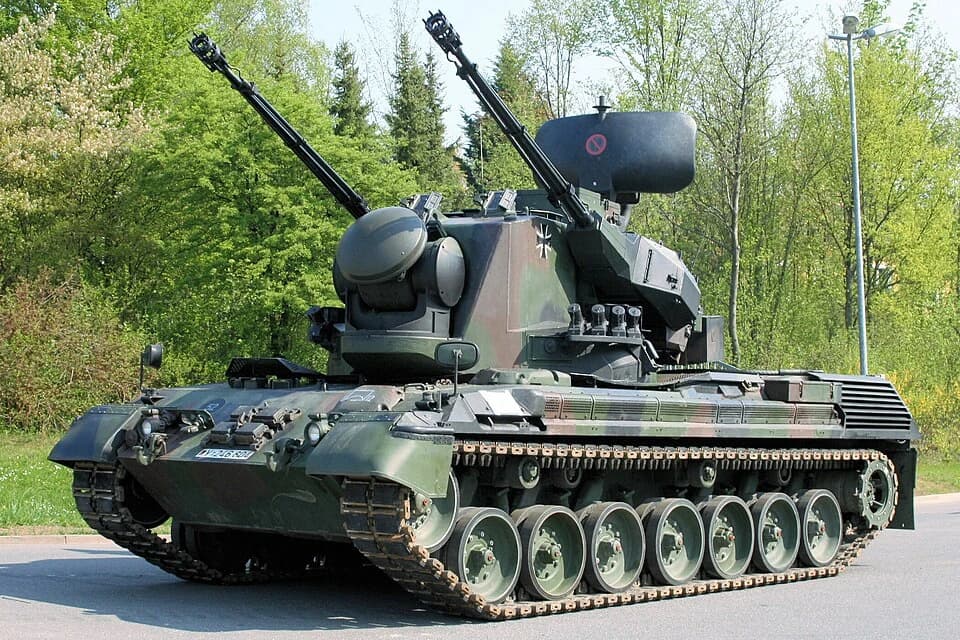
Credit
Hans-Hermann Bühling · CC BY-SA 3.0 · Resized / optimised · CC BY-SA 3.0 · Source ↗ · Modified


Preparing your view.

At a glance
Flakpanzer Gepardlarger figure on 4 of 4
M53/59 Pragalarger figure on 0 of 4
Counts only measures both sources give with the same scope. A larger figure is not a better system.
True scale
Side by side. From every angle. A human reference for perspective.
3.29 MB · Loads when you open it| Model | Length | Width / span | Height |
|---|---|---|---|
| Flakpanzer Gepard | ≈ 7.68 m | ≈ 3.8 m (Width) | ≈ 3.13 m |
| M53/59 Praga | ≈ 6.92 m | ≈ 2.35 m (Width) | ≈ 3.65 m |
Scaled uniformly to the sourced length of 7.68 m. Not an official model or a measured survey.
ForceTally · All rights reserved
Scaled uniformly to the sourced length of 6.92 m. The width was fitted to the sourced 2.35 m. Not an official model or a measured survey.
ForceTally · All rights reserved
The human reference is a generic 1.75 m figure. Models describe external size, not combat performance.
Measured figures
Overall
Single sourceOverall: 7.68 m (25 ft 2 in)[source]
Length
Single sourceConfiguration
| Specification | Flakpanzer Gepard | M53/59 Praga |
|---|---|---|
| Type | Self-propelled anti-aircraft gun[source] | Self-propelled anti-aircraft gun[source] |
| Place of origin | Switzerland West Germany[source] | Czechoslovakia[source] |
| In service | 1976–present[source] | 1959−1992 (Czechoslovakia)[source] |
| Used by | See Operators[source] | See operators |
6.92 m (22.7 ft)[source]
Operational; Operational range
Single source550 km (340 mi)[source]
10- cylinder , 37,400 cc (2,280 cu in ) MTU multi-fuel engine
Single source10- cylinder , 37,400 cc (2,280 cu in ) MTU multi-fuel engine 830 PS (819 hp, 610 kW)[source]
Tatra T912-2 6-cylinder air-cooled diesel at 2,200 rpm
Single sourceTatra T912-2 6-cylinder air-cooled diesel 110 hp (82 kW) at 2,200 rpm[source]
per barrel (cyclic)
Single sourceper barrel (practical)
Single source450−500 rpm per barrel (cyclic) 150 rpm per barrel (practical)[source]
Bars compare reported quantities only. A larger figure does not make a system better; configurations and test conditions differ.
| Wars | Russo-Ukrainian War[source] | Gulf War Yugoslav Wars Second Congo War[source] |
|---|
| Designer | Oerlikon-Bührle AG (Switzerland) Contraves (Switzerland) Siemens-Albis AG (Switzerland) Krauss-Maffei AG (vehicle - West Germany)[source] | — |
|---|
| Manufacturer | Krauss-Maffei AG (licence production)[source] | Praga[source] Praga[source] Strojárske a metalurgické závody, závod Trenčín-Kubrá (1959–1961) Škoda, n. p., Plzeň[source]M53/59 own native Manufacturer row · original Trenčín-Kubrá 1959–1961 and Škoda Plzeň production, retaining source dates |
|---|
| Armor | conventional steel[source] | Steel, 10 mm (0.39 in) max (estimated)[source] |
|---|
| Main armament | 2 × 35 mm Oerlikon GDF autocannon , each with 320 rounds anti-air ammunition and 20 rounds anti-tank[source] | 30 mm twin AA autocannon (600−900 rounds)[source] |
|---|
| Secondary armament | 2 × quad 76 mm smoke grenade dischargers[source] | — |
|---|
| Power/weight | 17.5 PS/t[source] | 11.57 hp/t (8.63 kW/t)[source] |
|---|
| Suspension | Torsion bar suspension[source] | — |
|---|
| Role | all-weather-capable West German self-propelled anti-aircraft gun (SPAAG)[source] | Czechoslovak self-propelled anti-aircraft gun[source] |
|---|
| Source measurement | The Gepard was developed during the 1960s as a replacement for the M42 Duster . Two projects were investigated. These were the ‘Matador’ (designed by Rheinmetall , AEG , Siemensi , and Krauss-Maffei ) and the ‘5PFZ-A’ (designed by Oerlikon , Contraves , Siemens-Albis, Hollandse Signaalapparaten and Kraus-Maffei/Porsche ). In 1969, construction began of four A prototypes testing both 30 and 35 mm guns. In June 1970, it was decided to use the 35 mm type. In 1971, twelve second phase B prototypes were ordered. In 1971 the Dutch army ordered a CA preseries of five vehicles based on a parallel development that had used a West German 0-series Leopard 1 vehicle made available by the West German government in March 1970 as the C-prototype.[source]Flakpanzer Gepard · Developmental history; only the objects and conditions stated in this passage The vehicle is based on the hull of the Leopard 1 tank with a large fully rotating turret carrying the armament—a pair of 35 mm Oerlikon KDA autocannons.[source]Flakpanzer Gepard · Technology and systems; only the objects and conditions stated in this passage The Gepard is based on a slightly modified chassis of the Leopard 1 main battle tank, including the complete drive unit with a 37.4-liter 10-cylinder multi-fuel engine (type: MB 838 CaM 500) with two mechanical superchargers. The V-engine with a cylinder angle of 90 degrees has 610 kW at 2200 RPM (830 PS) and consumes—depending on the surface and driving style—around 150 liters per 100 kilometers. To ensure a steady supply of oil, even in difficult terrain and under extreme skew, the engine is provided with a dry sump forced lubrication. Even the gearbox (type: 4 HP-250) from ZF Friedrichshafen and the exhaust system with fresh air admixture to reduce the infrared signature were taken from the Leopard 1 main battle tank.[source]Flakpanzer Gepard · Technology and systems / Chassis and propulsion; only the objects and conditions stated in this passage The Gepard is equipped with a Daimler-Benz (type: OM 314) 4-cylinder diesel auxiliary engine for the energy supply system. This engine is on the front left of the vehicle, located where the Leopard 1 has an ammunition magazine . The engine, which has a 3.8 liter capacity, is designed as a multi-fuel engine and produces 66 kW (90 PS). It consumes between 10 and 20 liters per hour, depending on the operational status of the tank.[source]Flakpanzer Gepard · Technology and systems / Chassis and propulsion; only the objects and conditions stated in this passage The auxiliary engine is coupled with five generators to operate at different speeds: Two Metadyn machines in tandem with a flywheel (which is used to store energy during the acceleration and deceleration of the turret) for the power of the elevation and traverse drives, two 380 Hz three-phase generators with a capacity of 20 kVA for the ventilation, fire-control and radar systems, and a 300 A 28 volt direct current generator for the electrical system. The fuel capacity is 985 liters, which ensures a combined operating time of approximately 48 hours.[source]Flakpanzer Gepard · Technology and systems / Chassis and propulsion; only the objects and conditions stated in this passage The hull only had slight modifications, e.g., a modified roadwheel distance (8 cm increased distance between the third and fourth roadwheel) and the transfer of additional batteries in battery boxes at the rear. The batteries and the electrical system operate at 24 volts DC.[source]Flakpanzer Gepard · Technology and systems / Chassis and propulsion; only the objects and conditions stated in this passage Vehicles delivered to the German Bundeswehr and Belgium were equipped with a Siemens MPDR 12 S-band search radar installed on a swing arm (lowered behind the turret for transit) on the rear of the turret, which provides a 15 km hemispherical detection range and has an integrated MSR 400 Mk XII interrogator for automated target discrimination.[source]Flakpanzer Gepard · Technology and systems / Radar and laser; only the objects and conditions stated in this passage The K u band tracking radar also developed by Siemens-Albis has a 15 km range and is mounted at the front of the turret, between the guns; its dome-covered antenna is mounted on a powered base which can traverse in a 180° arc.[source]Flakpanzer Gepard · Technology and systems / Radar and laser; only the objects and conditions stated in this passage Additionally, the Gepard has a back-up optical sighting system for passive target acquisition and engagement, consisting of two stabilized, panoramic periscopes for both gunner and commander, with a variable magnification (1.5× and a field of view of 50° and 6× magnification with a narrow, 12.5° FOV).[source]Flakpanzer Gepard · Technology and systems / Radar and laser; only the objects and conditions stated in this passage The Gepard utilizes two Oerlikon GDF , 90 calibres (3.15 m (10 ft 4 in)) long, with a muzzle velocity of 1,440 m/s (4,700 ft/s) ( FAPDS (Frangible Armour Piercing Discarding Sabot) rounds), giving an effective range of 5.5 km (3.4 miles). The ammunition is 35×228mm calibre ( STANAG 4516).[source]Flakpanzer Gepard · Technology and systems / Guns; only the objects and conditions stated in this passage Each gun has a firing rate of 550 rounds/min. The combined rate of fire is 1,100 rounds/min, which – in unlimited mode – gives a continuous fire time of 35 seconds before running out of ammunition (with 640 AA rounds for both guns). It is standard to fire bursts against air targets, 24 rounds per gun for a total of 48 in limited mode and 48 rounds per gun for a total of 96 in normal mode. The Ukrainian air defence have found that the guns "take an hour-and-a-half to reload", thus limiting their effectiveness.[source]Flakpanzer Gepard · Technology and systems / Guns; only the objects and conditions stated in this passage Search radar : S band , 15 km range[source]Flakpanzer Gepard · Technology and systems / Variants; only the objects and conditions stated in this passage Tracking radar: K u band , 15 km range[source]Flakpanzer Gepard · Technology and systems / Variants; only the objects and conditions stated in this passage Search radar: X band , 15 km range[source]Flakpanzer Gepard · Technology and systems / Variants; only the objects and conditions stated in this passage Tracking radar: X/ K a band , 13 km range[source]Flakpanzer Gepard · Technology and systems / Variants; only the objects and conditions stated in this passage 55 in active service as of 2025 ; 130 delivered in 2022−2024[source]Flakpanzer Gepard · Operators / Current; only the objects and conditions stated in this passage | The M53/59 Praga is a Czechoslovak self-propelled anti-aircraft gun developed in the late 1950s. It consists of an armoured version of the Praga V3S six-wheel drive truck chassis, armed with a modified version of the M53 twin 30 mm (1.2 in) anti-aircraft gun mounted on the rear, which can be removed and used to provide ground support.[source]M53/59 Praga · Lead; only the objects and conditions stated in this passage The twin guns have an elevation of +85°, and a depression of −10°, except over the crew compartment where the depression is limited to +2° and the commander's cupola where there is none. A steel plate on the back of the crew compartment prevents the gun barrels from hitting the roof. The turret can fully traverse 360° degrees and the traverse, elevation, and depression hydraulic systems can be manually controlled in case of emergency. The gunner is seated on the left side of the turret under the armoured cabin protection.[source]M53/59 Praga · Description; only the objects and conditions stated in this passage The 30 mm twin autocannons are gas-operated , with a maximum rate of fire of 450 to 500 rounds per barrel/minute and a practical rate of fire of 150 rounds per barrel/minute. Each gun has a 50-round magazine which are fed with 10-round clips. Each vehicle typically carries around 600 to 800 rounds. Fully loaded magazines are carried in the back of the crew compartment fastened to the floor by quick-release catches, while three spare magazines are carried on either side of the platform. Originally the guns were fitted with muzzle brakes , but they were later observed with conical flash hiders instead. The barrels can be quickly changed when overheated, and spare barrels were provided to the crews as part of the basic equipment.[source]M53/59 Praga · Description; only the objects and conditions stated in this passage Maximum horizontal range is 9.7 km (6 mi), maximum vertical range is 6.3 km (4 mi), and effective anti-aircraft range is 3 km (2 mi). The M53 guns can fire armor-piercing incendiary rounds capable of penetrating 55 mm (2.2 in) of RHA at a 0° angle at a range of 500 m (550 yd) and high-explosive incendiary rounds. |
|---|
| Produced | — | 1959–1978[source] |
|---|
| No. built | — | 900+[source] |
|---|
| Shell | — | Armour-piercing incendiary (API) High-explosive incendiary (HEI)[source] |
|---|
| Barrels | — |
|---|
| Action | — | Gas-operated[source] |
|---|
| Elevation | — | -10° – +85°[source] |
|---|
| Traverse | — | 360°[source] |
|---|
| Feed system | — | 50-round box magazines[source] |
|---|
| Transmission | — | Manual with 4 forward and 2 reverse gears[source] |
|---|
| Fuel capacity | — | 120 L (26 imp gal; 32 US gal)[source] |
|---|
| Former operator · Bosnia and Herzegovina | — | Bosnia and Herzegovina[source] |
|---|
| Former operator · Croatia | — | Croatia[source] |
|---|
| Former operator · Czech Republic | — | Czech Republic[source] |
|---|
| Former operator · Czechoslovakia | — | Czechoslovakia[source] |
|---|
| Former operator · Herzeg-Bosnia | — | Herzeg-Bosnia[source] |
|---|
| Former operator · Iraq | — | Iraq[source] |
|---|
| Former operator · Libya | — | Libya[source] |
|---|
| Former operator · Republika Srpska | — | Republika Srpska[source] |
|---|
| Former operator · Serbia and Montenegro | — | Serbia and Montenegro[source] |
|---|
| Former operator · Serbian Krajina | — | Serbian Krajina[source] |
|---|
| Former operator · Slovakia | — | Slovakia[source] |
|---|
| Former operator · Slovenia | — | Slovenia[source] |
|---|
| Former operator · Yugoslavia | — | Yugoslavia[source] |
|---|
| Reported operators | — |
|
|---|
Maximum; vertical
Single sourceThe system lacks radar guidance, and night vision equipment, which makes it only effective during the day under good weather conditions. Other drawbacks of the M53/59 are the lack of a NBC protection system, no amphibious capabilities, and no central tire pressure regulation system. It also suffers from poor cross-country mobility, preventing effective coordination with tracked vehicles. Despite these drawbacks, the Czechoslovak Army used the M53/59 in place of the Soviet ZSU-57-2 .[source]M53/59 Praga · Description; only the objects and conditions stated in this passage
Praga VS35 M19 − A proposed upgrade by Srboauto in 2019 to meet the requirements of the Serbian Armed Forces . Improvements included a new four-door cab fully armoured to the NATO STANAG 4569 Level 2 standard, fitted with bullet/splinter proof windows on the front and sides and an Eberspächer 8 kW (11 hp) heater installed in the crew compartment.[source]M53/59 Praga · Variants / Serbia; only the objects and conditions stated in this passage
At least one M53/59 was seen in 2012 in the city of Goma . While its exact origin is unknown (possibly from Serbia, Slovakia, or Libya), it is known that the newly reformed DRC Army was armed with weapons left by the former Zairean Army and whatever could be purchased abroad.[source]M53/59 Praga · Combat history / Democratic Republic of Congo; only the objects and conditions stated in this passage