
Credit
Z3144228 · CC BY-SA 4.0 · Resized · CC BY-SA 4.0 · Source ↗ · Modified


Preparing your view.

At a glance
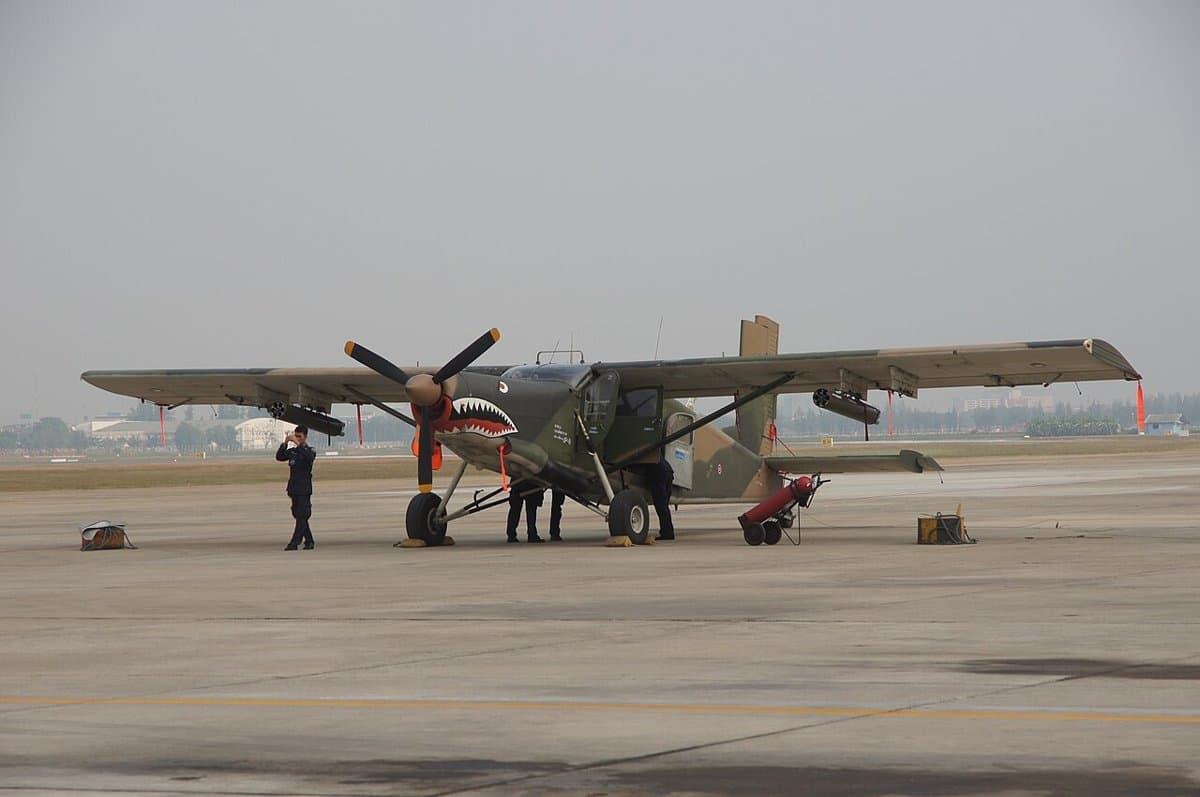
Fairchild AU-23 Peacemakerlarger figure on 1 of 3
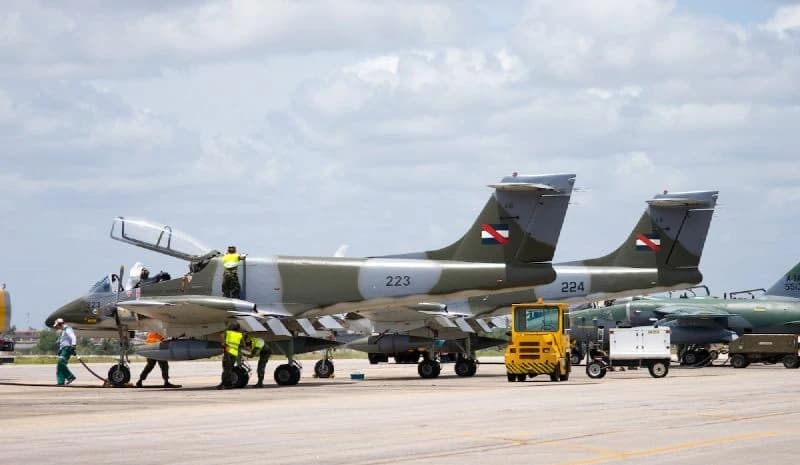
FMA IA 58 Pucarálarger figure on 2 of 3
Counts only measures both sources give with the same scope. A larger figure is not a better system.
True scale
Side by side. From every angle. A human reference for perspective.
3.11 MB · Loads when you open it| Model | Length | Width / span | Height |
|---|---|---|---|
| Fairchild AU-23 Peacemaker | ≈ 11.23 m | ≈ 15.14 m (Wingspan) | ≈ 4.13 m |
| FMA IA 58 Pucará | ≈ 14.25 m | ≈ 14.5 m (Wingspan) | ≈ 6.46 m |
Scaled uniformly to the sourced length of 11.23 m. The shape was turned square to the axes; the width was fitted to the sourced 15.14 m wingspan. Not an official model or a measured survey.
ForceTally · All rights reserved
Scaled uniformly to the sourced length of 14.25 m. The shape was turned square to the axes; the width was fitted to the sourced 14.5 m wingspan. Not an official model or a measured survey.
ForceTally · All rights reserved
The human reference is a generic 1.75 m figure. Models describe external size, not combat performance.
Measured figures
Length
Single sourceFairchild Hiller AU-23A / General information · Length
Single sourceConfiguration
| Specification | Fairchild AU-23 Peacemaker | FMA IA 58 Pucará |
|---|---|---|
| Type | Armed gunship, counter-insurgency, utility transport[source] | Counter-insurgency aircraft[source] |
| Manufacturer | Fairchild Aircraft[source] | Fábrica Militar de Aviones[source] |
| Primary users | United States Air Force Royal Thai Air Force[source] | Argentine Air Force Sri Lanka Air Force (historical) Uruguayan Air Force (historical)[source] |
| Number built | 35 |
Length
Single source14.25 m (46 ft 9 in)[source]
Empty; Fairchild Hiller AU-23A / General information · Empty weight
Single sourceGross; Gross weight
Single sourceMaximum take-off; Fairchild Hiller AU-23A / General information · Maximum takeoff weight
Single source6,100 lb (2,767 kg)[source]
1260 kg[source]Fairchild Hiller AU-23A / General information
2767 kg[source]Fairchild Hiller AU-23A / General information
Empty; Empty weight
Single sourceMaximum take-off; Max takeoff weight
Single sourceCruise; at maximum continuous power
Single sourceCruise; combat cruise
Single sourceCruise; Fairchild Hiller AU-23A / General information · Cruising speed
Single sourceMaximum; at take-off power, 5,000 ft (1,524 m) altitude, 6,000 lb (2,722 kg) gross weight
Single sourceMaximum; Fairchild Hiller AU-23A / General information · Maximum speed
Single source148 kn (170 mph, 274 km/h) at take-off power, 5,000 ft (1,524 m) altitude, 6,000 lb (2,722 kg) gross weight[source]
77 kn (88 mph, 142 km/h) at maximum continuous power, 129 kn (239 km/h) combat cruise[source]
280 km/h[source]Fairchild Hiller AU-23A / General information
262 km/h[source]Fairchild Hiller AU-23A / General information
Cruise; at 6,000 ft (1,800 m) (econ cruise)
Single sourceMaximum; at 3,000 m (9,800 ft)
Single sourceWing area
Single source30.30 m 2 (326.1 sq ft)[source]
3,500 ft/min
Single source18 m/s (3,500 ft/min)[source]
Bars compare reported quantities only. A larger figure does not make a system better; configurations and test conditions differ.
110[source] |
| First flight | 1971[source] | 20 August 1969[source] |
|---|
| Developed from | Pilatus PC-6 Porter[source] | — |
|---|
| Capacity | 5 troops or 6 passengers or 1 litter patient, 3 ambulatory patients with 1 medical attendant[source] | — |
|---|
| Endurance | 4.84[source] | — |
|---|
| National origin | United States[source] | Argentina[source] |
|---|
| Role | American armed fixed-wing counter-insurgency and utility transport aircraft[source] | — |
|---|
| Source measurement | The Porter, designated AU-23A, was fitted with a side-firing 20mm 3 barreled M197 electric cannon , four wing pylons and a center fuselage station for external ordnance.[source]Fairchild AU-23 Peacemaker · Design and development; only the objects and conditions stated in this passage The 20mm cannon was essentially a three-barrel version of the M61 Vulcan 6-barrel 20mm cannon.[source]Fairchild AU-23 Peacemaker · Design and development; only the objects and conditions stated in this passage The aircraft could carry a variety of ordnance including forward-firing gun pods, 500 and 250 pounds (230 and 110 kg) bombs, napalm units, cluster bomb units, flares, rockets, smoke grenades and leaflet dispensers.[source]Fairchild AU-23 Peacemaker · Design and development; only the objects and conditions stated in this passage The combat evaluation, PAVE COIN, was done in June and July 1971. The AU-23A was tested for eight possible missions: armed escort of helicopters, close air support, hamlet defense, STOL airlift and resupply, armed reconnaissance, border surveillance, forward air control, and counter infiltration. USAF crews flew 73 missions (94 sorties) and RVNAF crews flew 68 missions (85 sorties). Several types of weapons were test dropped/fired including 2.75-inch (70 mm) rockets (explosive and smoke), CBU-14 cluster bombs , MK 6 Mod 3 flares, and MK 81, -82, and -106 practice bombs. More than 8,000 rounds of 20mm ammunition were fired, both high explosive incendiary and target practice tracer types. Several problems were discovered during the PAVE COIN program, the most serious was the extreme vulnerability of the aircraft to all but the lightest antiaircraft fire (below 12.7mm). Despite the problems, the USAF continued with the development program and ordered 15 AU-23As for further testing.[source]Fairchild AU-23 Peacemaker · Operational history; only the objects and conditions stated in this passage The 4400th recommended the aircraft not be used in combat without a major upgrade program. Specific problems identified included a slow combat speed (135 knots (250 km/h)), a low working altitude, no capability for "zoom" escapes after delivering ordnance and a complete lack of armor protection for the crew and vital aircraft systems. On June 30, 1972, the 4400th SOS ferried the AU-23As to Davis-Monthan Air Force Base , Arizona, for storage.[source]Fairchild AU-23 Peacemaker · Operational history; only the objects and conditions stated in this passage Royal Thai Air Force : 34 AU-23A: 14 x AU-23A delivered by USAF (13 in 1972 and one in 1977) and 20 others (s/n 2073 to 2092) delivered in 1976 by Fairchild. In 2024, 14 are on duty (501 Light Attack Sqn, Wing 5 Prachuap Royal Air Force base at Prachuap Khiri Khan ). Locally designated B.JT.2 ( Thai : บ.จธ.๒ ).[source]Fairchild AU-23 Peacemaker · Operators; only the objects and conditions stated in this passage United States Air Force : 15 AU-23A (s/n 2020, 2039 and 2050 to 2062), 4400th Special Operations Squadron (Provisional) - former operator. 13 delivered to Thailand in 1972 and 1 in 1977. 72-1309 (s/n 2055) crashes before delivery at Eglin AFB on 10 May 1972.[source]Fairchild AU-23 Peacemaker · Operators; only the objects and conditions stated in this passage Capacity: 5 troops or 6 passengers or 1 litter patient, 3 ambulatory patients with 1 medical attendant[source]Fairchild AU-23 Peacemaker · Specifications; only the objects and conditions stated in this passage Length: 36 ft 10 in (11.23 m)[source]Fairchild AU-23 Peacemaker · Specifications; only the objects and conditions stated in this passage Wingspan: 49 ft 8 in (15.14 m)[source]Fairchild AU-23 Peacemaker · Specifications; only the objects and conditions stated in this passage Height: 14 ft 4 in (4.37 m)[source]Fairchild AU-23 Peacemaker · Specifications; only the objects and conditions stated in this passage Gross weight: 6,100 lb (2,767 kg)[source]Fairchild AU-23 Peacemaker · Specifications; only the objects and conditions stated in this passage Powerplant: 1 × Garrett TPE-331-1-101F turboprop engine, 650 hp (480 kW)[source]Fairchild AU-23 Peacemaker · Specifications; only the objects and conditions stated in this passage Maximum speed: 148 kn (170 mph, 274 km/h) at take-off power, 5,000 ft (1,524 m) altitude, 6,000 lb (2,722 kg) gross weight[source]Fairchild AU-23 Peacemaker · Specifications; only the objects and conditions stated in this passage Cruise speed: 77 kn (88 mph, 142 km/h) at maximum continuous power, 129 kn (239 km/h) combat cruise[source]Fairchild AU-23 Peacemaker · Specifications; only the objects and conditions stated in this passage Range: 360 nmi (420 mi, 680 km)[source]Fairchild AU-23 Peacemaker · Specifications; only the objects and conditions stated in this passage Combat range: 175 nmi (201 mi, 323 km)[source]Fairchild AU-23 Peacemaker · Specifications; only the objects and conditions stated in this passage Up to 1,925 pounds (873 kg) of external stores on five pylons[source]Fairchild AU-23 Peacemaker · Specifications; only the objects and conditions stated in this passage XM197 20mm cannon, door-mounted[source]Fairchild AU-23 Peacemaker · Specifications; only the objects and conditions stated in this passage XM93 7.62mm minigun[source]Fairchild AU-23 Peacemaker · Specifications; only the objects and conditions stated in this passage XM59 .50-cal. (12.7 mm) machine gun and XMU-470 20mm fixed side-firing gun pods.[source]Fairchild AU-23 Peacemaker · Specifications; only the objects and conditions stated in this passage 2.75-inch (70 mm) rocket pods[source]Fairchild AU-23 Peacemaker · Specifications; only the objects and conditions stated in this passage BDU33 with 25 lb (11 kg) bomblets[source]Fairchild AU-23 Peacemaker · Specifications; only the objects and conditions stated in this passage Mark 81 250 lb (110 kg) bombs[source]Fairchild AU-23 Peacemaker · Specifications; only the objects and conditions stated in this passage Mark 82 500 lb (230 kg) bombs[source]Fairchild AU-23 Peacemaker · Specifications; only the objects and conditions stated in this passage BLU118 500 lb (230 kg) napalm canisters[source]Fairchild AU-23 Peacemaker · Specifications; only the objects and conditions stated in this passage CBU55 500 lb (230 kg) cluster bomb units[source]Fairchild AU-23 Peacemaker · Specifications; only the objects and conditions stated in this passage | — |
|---|
| Engine | 1 Garrett TPE331-1-101F[source]Fairchild Hiller AU-23A / General information | — |
|---|
| Status | — | In service[source] |
|---|
| Manufactured | — | 1974–1993[source] |
|---|
| Introduction date | — | May 1975[source] |
|---|
| Aspect ratio | — | 6.9:1[source] |
|---|
| Airfoil | — | NACA 64 2 A215 at root, NACA64 1 at tip[source] |
|---|
| Fuel capacity | — | 1,280 L (280 imp gal; 340 US gal) internal, up to 1,736 L (382 imp gal; 459 US gal) in external tanks[source] |
|---|
| Stall speed | — | 143 km/h (89 mph, 77 kn) (flaps and undercarriage down)[source] |
|---|
| Never exceed speed | — | 750 km/h (470 mph, 400 kn)[source] |
|---|
| g limits | — | +6/-3 g[source] |
|---|
| Guns | — | 2× 20 mm Hispano-Suiza HS.804 autocannons 4× 7.62 mm FN Browning machine guns[source] |
|---|
| Hardpoints | — | 3 with a capacity of centerline 1,000 kg (2,200 lb), wing pylons 500 kg (1,100 lb), total external stores 1,620 kg (3,570 lb)[source] |
|---|
| Rockets | — | ARM-657 Mamboretá pods[source] |
|---|