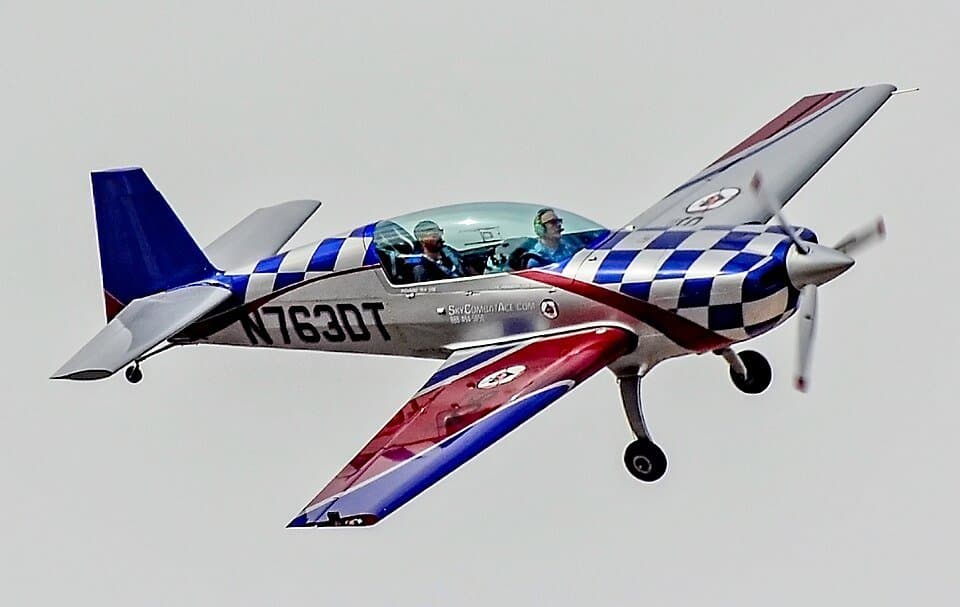

Credit
Tomás Del Coro · CC BY-SA 2.0 · Resized · CC BY-SA 2.0 · Source ↗ · Modified


Preparing your view.

At a glance
Measured figures
EA-330LT · Length
Single source7.01 m (23 ft 0 in)[source]
KC-130J
Configuration
| Specification | Extra EA-300 | KC-130J |
|---|---|---|
| Type | Aerobatic monoplane[source] | — |
| National origin | Germany[source] | — |
| Manufacturer | Extra Flugzeugbau[source] | Lockheed Martin, Marietta, Ga.[source]KC-130J · System Lockheed Martin[source]KC-130J · KC-130J Tanker |
| Designer | Walter Extra[source] | — |
KC-130J · Dimensions · KC-130J
Single sourceKC-130J · Only the source-declared variant KC-130J · KC-130J
Single source97 ft 9 in (29.79 m)[source]Only the source-declared variant KC-130J
29.79 m[source]KC-130J · Dimensions
97 feet 9 inches (29.79 meters)[source]KC-130J
EA-330LT · Height
Single source2.6 m (8 ft 6 in)[source]
KC-130J · Dimensions · KC-130J
Single sourceKC-130J · Only the source-declared variant KC-130J · KC-130J
Single sourceKC-130J · Tail Height
Single source38 ft 10 in (11.84 m)[source]Only the source-declared variant KC-130J
11.66 m[source]KC-130J · Dimensions
(Tail Height) 38 feet 3 inches (11.66 meters)[source]KC-130J
Empty; EA-330LT · typ. equipped
Single sourceGross; EA-330LT · Gross weight
Single sourceGross; EA-330LT · normal category (+6/
Single sourceMaximum take-off; EA-330LT · Max takeoff weight
Single sourceMaximum take-off; EA-330LT · single-pilot acro (+10/
Single source677 kg (1,493 lb) typ. equipped[source]
950 kg (2,094 lb) normal category (+6/-3g)[source]
820 kg (1,808 lb) single-pilot acro (+10/-10g)[source]
Empty; KC-130J · Only the source-declared variant KC-130J · KC-130J
Single sourceGross; KC-130J · Only the source-declared variant KC-130J · KC-130J
Single source1 or 2[source]
KC-130J · Only the source-declared variant KC-130J · KC-130J · two pilots, one crew chief and one loadmaster are minimum crew
Single sourceKC-130J · System · KC-130J · 2 pilots, navigator, flight engineer, radio operator/loadmaster
Single source4 (two pilots, one crew chief and one loadmaster are minimum crew)[source]Only the source-declared variant KC-130J
5 (2 pilots, navigator, flight engineer, radio operator/loadmaster)[source]KC-130J · System
Five (two pilots, one ACS operator and two loadmasters)[source]KC-130J · KC-130J Tanker
Pilot, co-pilot and crewmaster[source]KC-130J
Cruise; EA-330LT · TAS
Single source380 km/h (236 mph, 205 kn) TAS[source]
Cruise; KC-130J · Only the source-declared variant KC-130J · KC-130J
Single sourceMaximum; KC-130J · Only the source-declared variant KC-130J · KC-130J
Single source362 kn (417 mph, 670 km/h)[source]Only the source-declared variant KC-130J
348 kn (400 mph, 644 km/h)[source]Only the source-declared variant KC-130J
Extra 300 · exact own native article technical table column 2; no range is stated for Extra 300/LC column4
Single sourceExtra 300L · exact own native article technical table column 3; no range is stated for Extra 300/LC column4
Single source850 km[source]Extra 300 · exact own native article technical table column 2; no range is stated for Extra 300/LC column4
768 km[source]Extra 300L · exact own native article technical table column 3; no range is stated for Extra 300/LC column4
KC-130J
Single sourceKC-130J · /6,570.90 kilometers
Single sourceEA-330LT · 1 × Lycoming AEIO-580 -B1A 6-cylinder air-cooled horizontally-opposed piston engine
Single source1 × Lycoming AEIO-580 -B1A 6-cylinder air-cooled horizontally-opposed piston engine, 235 kW (315 hp)[source]
KC-130J · Only the source-declared variant KC-130J · KC-130J · 4 × Allison T56 and Rolls-Royce AE 2100D3 turboprop engines, 4,637 shp ( ) each
Single source4 × Allison T56 and Rolls-Royce AE 2100D3 turboprop engines, 4,637 shp (3,458 kW) each[source]Only the source-declared variant KC-130J
KC-130J · System · KC-130J
Single source19,356 kg[source]KC-130J · System
Bars compare reported quantities only. A larger figure does not make a system better; configurations and test conditions differ.
| Status |
|---|
Active[source] |
| — |
| Manufactured | 1988-present[source] | — |
|---|
| First flight | May 1988[source] | — |
|---|
| Fuel capacity | 209 L / 55,2 gal (usable)[source] | 61,364 lb (27,834 kg) (with external tanks)[source]Only the source-declared variant KC-130J |
|---|
| Airfoil | root: MA 15S; tip: MA 12S[source] | root: NACA 64A318 ; tip: NACA 64A412[source]Only the source-declared variant KC-130J |
|---|
| Propellers | 3-bladed Muehlbauer MTV 9-B-C/C198-25[source] | 6-bladed Dowty R391 constant-speed fully feathering reversible-pitch composite propellers[source]Only the source-declared variant KC-130J |
|---|
| Stall speed | 110 km/h (69 mph, 60 kn) at 820 kg / 1,808 lbs[source] | — |
|---|
| Never exceed speed | 410 km/h (250 mph, 220 kn)[source] | — |
|---|
| g limits | +10/-10g at 820 kg / 1,808 lbs[source] | — |
|---|
| Source measurement | Design of the Extra 300 was based on the Extra 230 , an early 1980s monoplane having a wing made of wood . The Extra 300 has a welded steel tube fuselage covered in aluminium and fabric. The midset wing has a carbon fiber composite spar and carbon composite skins. A symmetrical airfoil , mounted with a zero angle of incidence , provides equal performance in both upright and inverted flight. The landing gear is fixed taildragger style with composite main legs and fiberglass wheel pants. The powerplant is a fuel-injected Lycoming AEIO-540 which produces 220 kW (300 hp).[source]Extra EA-300 · Design and development; only the objects and conditions stated in this passage The Extra 300 is stressed for ±10 G with one person on board and ±8 G with two. Some Extra 300s are registered in the experimental category under a Special Certificate of Airworthiness in the U.S., while others are type certified in the aerobatic category.[source]Extra EA-300 · Design and development; only the objects and conditions stated in this passage Regular inspections are mandated to ensure continued airworthiness. A 50-hour inspection typically includes checks on the elevator trim system, while a 1,000-hour inspection involves detailed evaluations of trim tab hinges and actuator levers for wear or damage.[source]Extra EA-300 · Maintenance and operating costs; only the objects and conditions stated in this passage The 300S is a single-seat version, with a wingspan reduced by 50 cm ( 19 + 1 ⁄ 2 in), and fitted with larger ailerons .[source]Extra EA-300 · Variants; only the objects and conditions stated in this passage The Extra 300L is a Lycoming AEIO-540-powered two-seat aircraft, with low-mounted wing and shorter fuselage. More of these two-seater variants have been produced than any other model. Its wing is mounted at the bottom of the fuselage, with its span reduced from 7.9 to 7.3 m (26 to 24 ft). Improved ailerons boost the 300L's roll rate to 400° per second. All 300Ls are fully certified under FAA and European Joint Aviation Authorities regulations.[source]Extra EA-300 · Variants; only the objects and conditions stated in this passage The Extra 330LC (C = carbon) is a refined version of the 330L, with more extensive use of carbon fiber materials, especially in the fuselage and wings. It boasts a top speed of 407 km/h; 220 kn (253 mph) and a ±10 G load factor.[source]Extra EA-300 · Variants; only the objects and conditions stated in this passage The Extra 330LX is a high-performance, two-seat aerobatic aircraft powered by a 315 horsepower Lycoming AEIO-580-B1A engine. Designed for advanced aerobatic training and competition, it features a tandem seating arrangement, carbon fiber wing assembly with integral tanks, and a carbon composite empennage structure. The fuselage is constructed from 1.7734 steel, and the aircraft is equipped with a Muehlbauer MTV 9-B-C/C198-25 three-blade propeller. The 330LX offers exceptional aerobatic performance, making it a preferred choice for serious competition pilots and airshow performers.[source]Extra EA-300 · Variants; only the objects and conditions stated in this passage The Extra 330LE is a one-seat aircraft powered by an electric engine made by Siemens, delivering 260 kW (350 hp), for 50 kg. On Thursday, March 23, 2017, the Extra 330LE set two new speed records, said Siemens : "At the Dinslaken Schwarze Heide airfield in Germany, the electric aircraft reached a top speed of around 340 km/h (180 kn; 210 mph) over a distance of 3 km (1.9 mi). On Friday, March 24, 2017, the Extra 330LE gave another premiere performance by becoming the world's first electric aircraft to tow a glider into the sky".[source]Extra EA-300 · Variants; only the objects and conditions stated in this passage Patty Wagstaff has flown the Extra 230, 260, and various models of the 300 in aerobatic competitions and airshows since the mid-1980s.[source]Extra EA-300 · Operators / Civilian; only the objects and conditions stated in this passage Length: 7.01 m (23 ft 0 in)[source]Extra EA-300 · Specifications (EA-330LT); only the objects and conditions stated in this passage Wingspan: 8 m (26 ft 3 in)[source]Extra EA-300 · Specifications (EA-330LT); only the objects and conditions stated in this passage Height: 2.6 m (8 ft 6 in)[source]Extra EA-300 · Specifications (EA-330LT); only the objects and conditions stated in this passage Wing area: 10.84 m 2 (116.7 sq ft)[source]Extra EA-300 · Specifications (EA-330LT); only the objects and conditions stated in this passage Empty weight: 677 kg (1,493 lb) typ. equipped[source]Extra EA-300 · Specifications (EA-330LT); only the objects and conditions stated in this passage Gross weight: 950 kg (2,094 lb) normal category (+6/-3g)[source]Extra EA-300 · Specifications (EA-330LT); only the objects and conditions stated in this passage Max takeoff weight: 820 kg (1,808 lb) single-pilot acro (+10/-10g)[source]Extra EA-300 · Specifications (EA-330LT); only the objects and conditions stated in this passage Powerplant: 1 × Lycoming AEIO-580 -B1A 6-cylinder air-cooled horizontally-opposed piston engine, 235 kW (315 hp)[source]Extra EA-300 · Specifications (EA-330LT); only the objects and conditions stated in this passage Cruise speed: 380 km/h (236 mph, 205 kn) TAS[source]Extra EA-300 · Specifications (EA-330LT); only the objects and conditions stated in this passage Stall speed: 110 km/h (69 mph, 60 kn) at 820 kg / 1,808 lbs[source]Extra EA-300 · Specifications (EA-330LT); only the objects and conditions stated in this passage Never exceed speed : 410 km/h (250 mph, 220 kn)[source]Extra EA-300 · Specifications (EA-330LT); only the objects and conditions stated in this passage g limits: +10/-10g at 820 kg / 1,808 lbs[source]Extra EA-300 · Specifications (EA-330LT); only the objects and conditions stated in this passage | KC-130J[source]KC-130J · System Multirole Tactical Tanker[source]KC-130J · System 4[source]KC-130J · System INA[source]KC-130J · System 13,629 liter[source]KC-130J · System 25.91 m[source]KC-130J · System 2,272 liters per minute[source]KC-130J · System 40.41 m |
|---|
| Variant description | — | KC-130J[source]Only the source-declared variant KC-130J Variant from C-130J[source]Only the source-declared variant KC-130J |
|---|
| Capacity | — | 42,000 lb (19,051 kg)[source]Only the source-declared variant KC-130J |
|---|
| Take-off run | — | 3,127 ft (953 m) at 155,000 lb (70,307 kg)[source]Only the source-declared variant KC-130J |
|---|
| Country of origin | — | United States[source]Inventory Origin column; table 1, row 23, cell 2; revision 1374114200 United States[source]KC-130J |
|---|
| Passengers | — | 92 troops or 64 paratroops[source]KC-130J |
|---|
KC-130J · Max. recommended gross take-off
Single sourceMaximum take-off; KC-130J · Dimensions · KC-130J
Single sourceMaximum take-off; KC-130J · KC 130J Tanker · KC-130J
Single sourceMaximum take-off; KC-130J · Only the source-declared variant KC-130J · KC-130J
Single source75,562 lb (34,274 kg)[source]Only the source-declared variant KC-130J
164,000 lb (74,389 kg)[source]Only the source-declared variant KC-130J
175,000 lb (79,379 kg)[source]Only the source-declared variant KC-130J
79,380 kg[source]KC-130J · Dimensions
164,000 lbs[source]KC-130J · KC 130J Tanker
Max. recommended gross take-off: 164,000 pounds (74,389 kilograms)[source]KC-130J
KC-130J · KC-130J Tanker · KC-130J
Single sourceKC-130J · Only the source-declared variant KC-130J · KC-130J
Single source2,835 nmi (3,262 mi, 5,250 km)[source]Only the source-declared variant KC-130J
4,275nmi[source]KC-130J · KC-130J Tanker
3,548 nautical miles (4,082.97 miles/6,570.90 kilometers)[source]KC-130J
162.12 m sq[source]KC-130J · Dimensions
2.77 m[source]KC-130J · Dimensions
3.05 m[source]KC-130J · Dimensions
12.22 m[source]KC-130J · Dimensions
2.81 m[source]KC-130J · Dimensions
3.30 m[source]KC-130J · Dimensions
129 cu m[source]KC-130J · Dimensions
34,686 kg[source]KC-130J · Dimensions
70,310 kg[source]KC-130J · Dimensions
25.91 m[source]KC-130J · Dimensions
4 x Allison T56-A-15[source]KC-130J · Automotive
Turboprop[source]KC-130J · Automotive
4,591 hp each[source]KC-130J · Automotive
36,636 liters internal[source]KC-130J · Automotive
602 km/h[source]KC-130J · Automotive
556 km/h[source]KC-130J · Automotive
185 km/h[source]KC-130J · Automotive
1,091 m[source]KC-130J · Automotive
518 m[source]KC-130J · Automotive
579 m/min[source]KC-130J · Automotive
10,060 m[source]KC-130J · Automotive
3,791 km[source]KC-130J · Automotive
7,876 km[source]KC-130J · Automotive
7,010 m[source]KC-130J · Automotive
142 m[source]KC-130J · Automotive
None[source]KC-130J · Protection
No[source]KC-130J · Protection
INA[source]KC-130J · Protection
INA[source]KC-130J · Protection
INA[source]KC-130J · Protection
INA[source]KC-130J · Protection