Credit
commons.wikimedia · CC BY-SA 2.5 · Resized · CC BY-SA 2.5 · Source ↗ · Modified


Preparing your view.
At a glance
Measured figures
H225 · Length
Single source19.5 m (64 ft 0 in)[source]
NH90 · Length
Single sourceConfiguration
| Specification | Eurocopter EC225 Super Puma | NHIndustries NH90 |
|---|---|---|
| Type | Passenger transport helicopter[source] | Medium utility military helicopter[source] |
| National origin | Multinational[source] | Multinational[source] |
| Manufacturer | Eurocopter Airbus Helicopters[source] | NHIndustries[source] |
| Primary user | CHC Helicopter[source] |
16.13 m (52 ft 11 in)[source]
H225 · Height
Single source4.97 m (16 ft 4 in)[source]
External Dimensions / Overall dimensions (rotors turning) · Height
Single sourceOfficial specification · nh90; 5.31 m 17.42 ft** * Rotors turning ** At tail rotor
Manufacturer claimEmpty; H225 · Empty weight
Single sourceGross; H225 · Gross weight
Single sourceMaximum take-off; H225 · Max takeoff weight
Single source5,256 kg (11,587 lb)[source]
11,000 kg (24,251 lb)[source]
11,200 kg (24,692 lb)[source]
Empty; NH90 · Empty weight
Single sourceMaximum take-off; NH90 · Max takeoff weight
Single sourceH225 · 2 × Turbomeca Makila 2A1 turboshaft engines each
Single source2 × Turbomeca Makila 2A1 turboshaft engines, 1,776 kW (2,382 hp) each[source]
NH90 · 2 × General Electric CT7-8E turboshaft engines each (option)
Single source2 × General Electric CT7-8E turboshaft engines, 1,845 kW (2,474 hp) each (option)[source]
NH90 · Endurance
Single source5 hours[source]
Bars compare reported quantities only. A larger figure does not make a system better; configurations and test conditions differ.
| — |
| Number built | 170+ (as of 2016 )[source] | 525 as of Jan. 2026[source] |
|---|
| Manufactured | 1999–present[source] | 1995–present[source] |
|---|
| Introduction date | December 2004[source] | 2007[source] |
|---|
| First flight | 27 November 2000[source] | 18 December 1995[source] |
|---|
| Developed from | Eurocopter AS332 Super Puma[source] | — |
|---|
| Variant | Eurocopter EC725[source] | NHIndustries MRH-90 Taipan[source] |
|---|
| Capacity | 24 passengers + 1 cabin attendant[source] | 20 seated troops; or 12 medevac stretchers; or 2 NATO pallets; or 4,200 kg (9,259 lb) external slung load[source] |
|---|
| Main rotor area | 206.15 m 2 (2,219.0 sq ft)[source] | 208.699 m 2 (2,246.42 sq ft) root: ONERA OA312; tip: ONERA OA409/OA407[source] |
|---|
| Never exceed speed | 324 km/h (201 mph, 175 kn)[source] | — |
|---|
| Role | long-range passenger transport helicopter[source] | medium-sized European twin-engine multi-role military helicopter[source] |
|---|
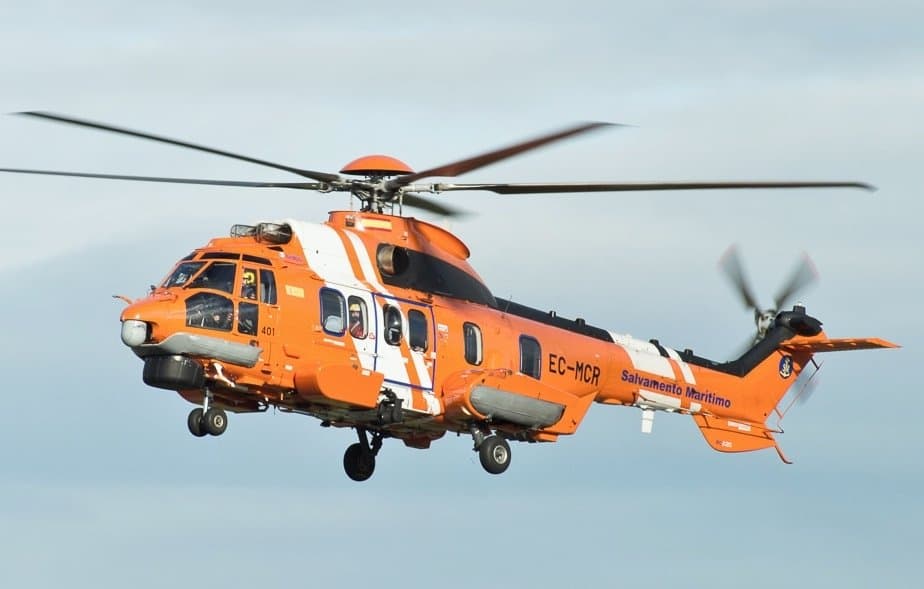
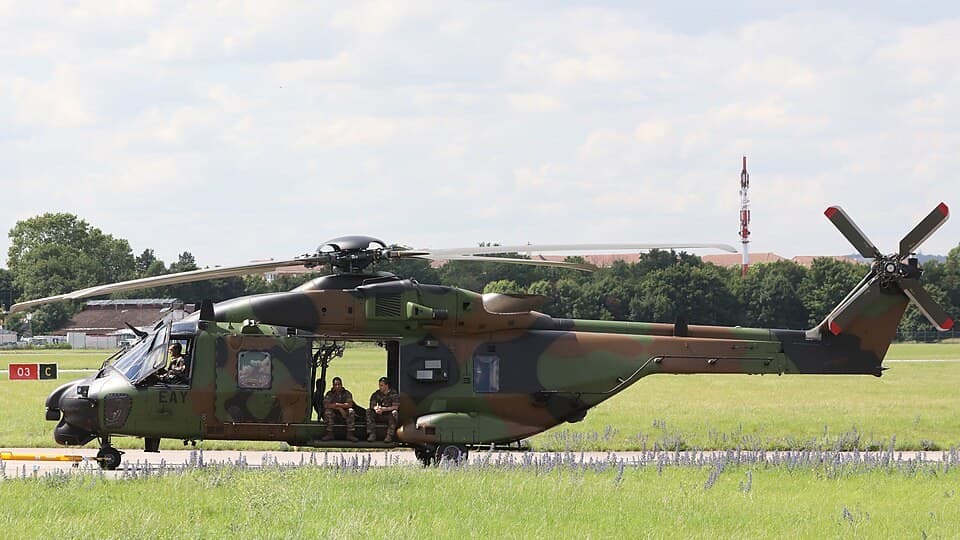
| Source measurement | The Airbus Helicopters H225 (formerly Eurocopter EC225 Super Puma ) is a long-range passenger transport helicopter developed by Eurocopter as the next generation of the civilian Super Puma family. It is a twin-engined aircraft and can carry up to 24 passengers along with two crew and a cabin attendant, dependent on customer configuration. The helicopter is marketed for offshore support and VIP passenger transport duties, as well as public service missions.[source]Eurocopter EC225 Super Puma · Lead; only the objects and conditions stated in this passage In February 2014, Airbus Helicopters announced at Heli-Expo 2014 the development of an improved variant, the EC225e. The EC225e features numerous changes including new avionics systems, such as the TCAS II collision avoidance system, an automatic identification system, and a specialized rig-approach system; it was also intended to feature an improved Turbomeca Makila 2B engine to increase the EC225e's maximum takeoff weight by 550 kg, and an additional fuel tank in the rear baggage compartment to extend its range to 300 nautical miles with up to ten passengers on board. Some, but not all, modifications can be retrofitted onto existing EC225s. In the same announcement, in February 2014, Lease Corporation International said that they had placed a $645 million order for 15 EC225e (along with 6 Airbus Helicopters EC175 ) helicopters as the launch customer. In February 2016, the Makila 2B engine was dropped from the EC225e as a cost reduction measure, development of the other structural and avionics aspects is proceeding.[source]Eurocopter EC225 Super Puma · Development; only the objects and conditions stated in this passage A key safety feature of the aircraft's main gear box (MGB) is an emergency oil spraying sub-system present in the lubrication system; this is designed to exceed the JAR 29 Standard's requirements of a 30-minute running time in the event of the loss of MGB oil pressure, and has demonstrated up to 50-minute running time. The engine also incorporates a "blade shedding" system to ensure engine integrity during an overspeed instance. Energy absorbent self-sealing fuel tanks are contained in the aircraft's sponsons , along with other equipment such as downward-facing illumination and navigation lighting fixtures. The transmission can accommodate more power than the maximum output of the engines; however two aircraft were lost in 2012 due to the cracking of the bevel gear shaft, a gearbox component. In response, the design of the transmission was modified in 2013, and the onboard health and usage monitoring system (HUMS) was upgraded to provide real-time monitoring of the bevel gear shaft against the threat of crack formation.[source]Eurocopter EC225 Super Puma · Design; only the objects and conditions stated in this passage In terms of cockpit equipment and avionics, the H225 is equipped with a full glass cockpit with active-matrix liquid crystal displays ; these include four 6-inch by 8-inch multi-functional displays as the predominant instrumentation for key flight information, two 4-inch by 5-inch monitors for displaying aircraft parameters, and a 3-inch screen for backup. The advanced helicopter cockpit and avionics system is described as serving to reduce pilot and crew workload, being used to display flight management and sub-systems information and is complete with a four-axis digital autopilot. During a typical flight, the pilot programs the route into the aircraft and then monitors it, as opposed to direct continuous control of the flight; the need for paper charts has been eliminated by these systems. Under autopilot, the automatic flight control system acts to prevent pilot actions from exceeding the established flight envelope; the H225 remains flyable with all automatic systems disabled. From initiating the startup sequence to being ready to takeoff only takes three minutes.[source]Eurocopter EC225 Super Puma · Design; only the objects and conditions stated in this passage There are currently a total of four principal configurations designed by Airbus Helicopters for the H225. The passenger transport version has a crash-worthy seating arrangement for up to 19 passengers with a high-density seating arrangement accommodating up to 28 passengers available to be fitted. The VIP transport version has a large lounge with seating for up to 12 passengers and a cabin attendant. The emergency medical services (EMS) configuration has medical units for six stretchers and four seats for medical workers. The search and rescue (SAR) configuration allows space for search and rescue equipment with an operator seat, hoistman seat and up to eight rescue seats and three stretchers. While a single pilot is capable of controlling the aircraft under visual meteorical conditions, two pilots are used in a typical crew complement and, dependent on role, a cabin attendant or flight engineer may also be present.[source]Eurocopter EC225 Super Puma · Design; only the objects and conditions stated in this passage Icelandic Coast Guard — received 2 H225s in 2019 and 1 in 2021.[source]Eurocopter EC225 Super Puma · Operators / Military operators; only the objects and conditions stated in this passage 18 February 2009: G-REDU, an EC225 LP operated by Bond Offshore Helicopters . During a night visual approach to the ETAP platform, the helicopter descended and impacted the surface of the sea. The crew's perception of the helicopter's position and orientation relative to the platform during the final approach was erroneous. All 18 people on board survived the controlled flight into terrain (water) .[source]Eurocopter EC225 Super Puma · Accidents and incidents; only the objects and conditions stated in this passage 10 May 2012: G-REDW, an EC225 LP, carried out a controlled ditching following indications of a failure of the main gearbox (MGB) lubrication system and a subsequent failure indication warning on the emergency lubrication system. An investigation by the Air Accidents Investigation Branch (AAIB) identified a 360° circumferential crack in the bevel gear vertical shaft in the main gearbox, in the vicinity of a manufacturing weld, causing disengagement of the drive to both mechanical oil pumps.[source]Eurocopter EC225 Super Puma · Accidents and incidents; only the objects and conditions stated in this passage 22 October 2012: G-CHCN, an EC225 LP of CHC Scotia, ditched in the North Sea 32 miles south west of Shetland whilst en route from Aberdeen to the West Phoenix drilling rig. All 19 on board were rescued. A special bulletin issued by the Air Accidents Investigation Branch (AAIB) said the main and standby oil pumps were not working; a 360-degree crack found on the bevel gear vertical shaft of the gearbox had prevented the oil pump gears from being driven. A worldwide grounding of the type was initiated in response. In both of the 2012 incidents, although the main gearbox lubrication system had failed, the backup system was working correctly but displaying an erroneous warning light, due to an incorrect specification of a pressure switch, which led to the helicopters being ditched.[source]Eurocopter EC225 Super Puma · Accidents and incidents; only the objects and conditions stated in this passage 29 April 2016: LN-OJF , an EC225 LP of CHC Helikopter Service , crashed at an islet near Turøy in the Bergen archipelago, en route to Bergen Airport, Flesland , from the Gullfaks B platform in the North Sea. The helicopter was carrying 11 passengers and 2 crew members; everyone on board died. Eyewitnesses reported that the main rotor separated from the hull immediately before the crash. Due to the crash, all commercial flights by EC225 helicopters, excluding search and rescue flights, were grounded by both Norwegian and British civil aviation authorities. The subsequent investigation concluded that a gear in the main rotor gearbox had failed due to a fatigue crack that had propagated under-surface, escaping detection. As a result of the incident the German Defence Ministry had also decided to ground 3 AS532 Helicopter in government use which were manufactured by the same company.[source]Eurocopter EC225 Super Puma · Accidents and incidents; only the objects and conditions stated in this passage 18 January 2023: an EC225 carrying the Minister of Internal Affairs of Ukraine , Denys Monastyrsky , his deputy Yevhen Yenin and state secretary Yurii Lubkovych , crashed at a kindergarten in Brovary , a suburb of Kyiv , Ukraine . The crash killed 14 people, including Monastyrsky, Yenin and Lubkovych; a child was also among the fatalities, while 25 others were injured.[source]Eurocopter EC225 Super Puma · Accidents and incidents; only the objects and conditions stated in this passage Capacity: 24 passengers + 1 cabin attendant[source]Eurocopter EC225 Super Puma · Specifications (H225); only the objects and conditions stated in this passage Length: 19.5 m (64 ft 0 in)[source]Eurocopter EC225 Super Puma · Specifications (H225); only the objects and conditions stated in this passage Height: 4.97 m (16 ft 4 in)[source]Eurocopter EC225 Super Puma · Specifications (H225); only the objects and conditions stated in this passage Empty weight: 5,256 kg (11,587 lb)[source]Eurocopter EC225 Super Puma · Specifications (H225); only the objects and conditions stated in this passage Gross weight: 11,000 kg (24,251 lb)[source]Eurocopter EC225 Super Puma · Specifications (H225); only the objects and conditions stated in this passage Max takeoff weight: 11,200 kg (24,692 lb)[source]Eurocopter EC225 Super Puma · Specifications (H225); only the objects and conditions stated in this passage Powerplant: 2 × Turbomeca Makila 2A1 turboshaft engines, 1,776 kW (2,382 hp) each[source]Eurocopter EC225 Super Puma · Specifications (H225); only the objects and conditions stated in this passage Main rotor diameter: 16.2 m (53 ft 2 in)[source]Eurocopter EC225 Super Puma · Specifications (H225); only the objects and conditions stated in this passage Main rotor area: 206.15 m 2 (2,219.0 sq ft)[source]Eurocopter EC225 Super Puma · Specifications (H225); only the objects and conditions stated in this passage Maximum speed: 275.5 km/h (171.2 mph, 148.8 kn)[source]Eurocopter EC225 Super Puma · Specifications (H225); only the objects and conditions stated in this passage Cruise speed: 260.5 km/h (161.9 mph, 140.7 kn)[source]Eurocopter EC225 Super Puma · Specifications (H225); only the objects and conditions stated in this passage Never exceed speed : 324 km/h (201 mph, 175 kn)[source]Eurocopter EC225 Super Puma · Specifications (H225); only the objects and conditions stated in this passage Range: 857 km (533 mi, 463 nmi)[source]Eurocopter EC225 Super Puma · Specifications (H225); only the objects and conditions stated in this passage Ferry range: 985 km (612 mi, 532 nmi)[source]Eurocopter EC225 Super Puma · Specifications (H225); only the objects and conditions stated in this passage Service ceiling: 5,900 m (19,400 ft)[source]Eurocopter EC225 Super Puma · Specifications (H225); only the objects and conditions stated in this passage Rate of climb: 8.7 m/s (1,710 ft/min)[source]Eurocopter EC225 Super Puma · Specifications (H225); only the objects and conditions stated in this passage | The NHIndustries NH90 is a medium-sized European twin-engine multi-role military helicopter . It was the first production helicopter to feature entirely fly-by-wire flight controls. It makes extensive use of composite materials and electronic sensors. The helicopter has two primary models: the Tactical Transport Helicopter (TTH), oriented towards land applications (able to carry up to 20 troops); and the NATO Frigate Helicopter (NFH), oriented towards naval use in contexts such as anti-submarine warfare (ASW) and search and rescue (SAR) operations. Over 600 units have been produced for over a dozen NATO countries as of early 2026, and the model remains in production.[source]NHIndustries NH90 · Lead; only the objects and conditions stated in this passage In 2010, German tabloid Bild reported that German Army experts had concerns that the helicopter was not yet ready for the transportation of combat troops. They stated that the seats were rated for only 110 kg (240 lb), not considered enough for a fully equipped soldier. Heavy infantry weapons could not be adequately secured and the cabin floor was prone to damage, citing an anecdote of damage caused by footwear. The helicopter could only land on firm ground, with obstacles not exceeding 16 cm (6.3 in). Troops carrying full equipment could not use the rear ramp due to weight limitations placed on it. Adding a door machine gun was not possible due to space taken by troop ingress and egress; there was also no provision for fast roping or paratrooper equipment. In response, the German Defense Ministry proclaimed that this article referred to a prototype, not to the production model; the specifications for which were not even finalized at the time. The prototype evaluation and its results were described as a normal procedure in an ongoing design process.[source]NHIndustries NH90 · Development / Performance concerns; only the objects and conditions stated in this passage In contrast, the HPK 16, MH-60M Blackhawks in Swedish service had a cost of 40,000 SEK per hour.[source]NHIndustries NH90 · Development / Performance concerns / Operational costs; only the objects and conditions stated in this passage |
|---|
| Status | — | In service[source] |
|---|
| Primary users | — | Italian Armed Forces Bundeswehr (Germany) French Armed Forces Spanish Armed Forces[source] |
|---|
| Guns | — | 2 door guns[source] |
|---|
| Missiles | — | anti-submarine and/or air to surface missiles (NFH version), 20 mm cannon pod and rockets pod (TTH)[source] |
|---|
NH90 · Mass · Gefechtsgewicht
Single source300 km/h (190 mph, 160 kn)[source]
800 km (500 mi, 430 nmi) TTH[source]
In this debate, it was also pointed out that the Finnish defense had budgeted CPFH to €15,900 in 2017, which the year after had been lowered to €10,000.[source]NHIndustries NH90 · Development / Performance concerns / Operational costs; only the objects and conditions stated in this passage
Axel Aloccio, head of NHI since mid-September 2022, believes that most problems stem from the teething issues of a new system that take a few years of service to find and correct, and that most are either solved or will be addressed with the transformation plan called "New Horizon" that Aloccio's predecessor, Nathalie Tarnaud Laude, launched. This program of system-wide changes had the aim of 50–60% average global fleet availability by the end of 2022 through better spare part availability and localization of overhaul services. It also seeks to lower operating costs. The time between maintenance inspections and overhaul for dynamic components have both been raised by 50% to keep them synchronized, from 600/1200 flight hours to 900/1800 hours, respectively. The Australian fleet is to be dismantled for spare parts, which it is hoped will increase the supply of spare parts for other users.[source]NHIndustries NH90 · Development / Performance concerns / Operational costs; only the objects and conditions stated in this passage
One key innovation of the rotorcraft is the four-channel fly-by-wire control system employed; the NH90 is the first helicopter in the world to be equipped with full fly-by-wire flight controls. A four-axis autopilot is also integrated with the fly-by-wire system, as are mission and navigation systems, to enable greater autonomy during operations and reduce pilot workload. The flight envelope of the NH90 is capable of all-weather day-and-night operations, ship-borne operations during high sea states, across a temperature range from −40 °C to +50 °C, and up to a maximum altitude of 20,000 feet. Power is provided by a pair of turboshaft engines, dependent on customer selection, the NH90 is either fitted with Rolls-Royce Turbomeca RTM322 or General Electric CT7-8F power-plants; exhaust gases from the engines are filtered through an infrared suppression system for decreased sensory visibility. The NH90 has three gearboxes including the Main Gearbox (MGB), Intermediate Gearbox (IGB), and a Tail Rotor Gearbox (TGB).[source]NHIndustries NH90 · Design; only the objects and conditions stated in this passage
In June 2024, plans were announced for the Block 1 upgrade, which was also called software release 3 (SWR3); called a "roadmap milestone", this involves an upgrade to NH90 software, weapons systems, and capabilities. Standard 3 configuration of an NH90 includes stronger landing gear, automatic folding main rotor, maximum take-off weight of 11 tonnes, enhanced communication and safety features. The first Standard 3 configuration NH90 helicopters were delivered in December 2024.[source]NHIndustries NH90 · Design; only the objects and conditions stated in this passage
Australia ordered the NH90 in 2004 to replace its S-70A Black Hawk helicopters, eventually acquiring 46 aircraft designated MRH-90 Taipan, most of which were assembled domestically. The type entered service in 2007 with the Australian Army and later with the Royal Australian Navy . The program was affected by technical issues, delays and increased costs, prompting repeated groundings and extending the service life of older helicopters. After multiple operational challenges and two serious accidents in 2023, the fleet was permanently withdrawn from Australian Defence Force service in September 2023, ahead of its planned retirement, and replaced by the UH-60M Black Hawk.[source]NHIndustries NH90 · Operational history / Australia; only the objects and conditions stated in this passage
In 2007, Belgium signed on for a firm order of 8 aircraft (4 TTH, 4 NFH) and an option for 2 additional TTH. In September 2012, NHI performed the first flight of Belgium's TTH, which is broadly similar to the French NH90 "Caiman" version. In January 2013, eight NH90s were on firm order. On 1 August 2013, Belgium received its first NH90 NFH at full operational capability. On 23 October 2013, Belgium's first NH90 TTH entered service, and the last was delivered on 13 November 2014. From first delivery until the last, three NH90s flew 34 hours a month for a total of 450 flight hours with a 67 percent availability rate, making Belgium one of the type's most intensive users. Two NH90 NFHs for the navy were delivered. The final two were delivered by early 2015 to replace their Westland Sea King helicopters for search and rescue operations.[source]NHIndustries NH90 · Operational history / Belgium; only the objects and conditions stated in this passage
In June 2011, nine Finnish NH90s participated in the Finnish Defence Forces ' main field exercise, transporting 157 soldiers across 320 kilometres in two rotations; their performance was described as having exceeded expectations. In January 2015, it was reported that Finnish NH90s had been experiencing considerable reliability issues, at one time in 2014 fleet availability dipped to 19%, and some spare parts had up to seven months waiting time. By early 2015, the combined NH90s fleet had accumulated a total of 7,000 flight hours, and had an availability rate of 40%. On 18 June 2015, delivery of the final Finnish NH90 took place. In November 2015, the availability rate was reported as having surpassed 50 percent. All were in Final Operational Configuration (FOC) in 2018.[source]NHIndustries NH90 · Operational history / Finland; only the objects and conditions stated in this passage
The French government had initially ordered a total of 34 NH90 TTHs for the French Army Light Aviation and 27 NFH for the Navy . Both versions will be named "Caïman" and final assembly will be carried out by Airbus Helicopters . Early on, the French Army stated its intention to buy 68 NH90 in two separate contracts. Under the "Bonn rebate" deal, France received a 12% discount on its 68 Army NH90s; a November 2012 Senate report put the French TTH unit price at €28.6M after discount, set on the assumption of total orders of 605 aircraft by 2020. Cuts to France's order would have led to workshare reallocation; possibly including French Navy NFH90s being assembled in Italy and Fokker performing maintenance of French TTHs. On 29 May 2013, France formally ordered the second batch of 34 NH90 TTHs for just under €1 billion. In January 2016, France placed an order for six additional NH90 TTHs.[source]NHIndustries NH90 · Operational history / France; only the objects and conditions stated in this passage
Just one week after entering service, a French NH90 rescued 19 people from supply ship TK Bremen at night.[source]NHIndustries NH90 · Operational history / France; only the objects and conditions stated in this passage
In October 2020, France signed a contract to develop the TFRA Standard 2 configuration for the French Army's special forces using the final batch of 10 NH90 TTH already ordered. A design study for the new configuration began 18 months earlier in cooperation with Belgium and Australia. The first phase featured a Safran EuroFLIR 410 electro-optical system (EOS), external 500 kg (1,100 lb) fuel tanks and a digital 3D map. The cabin was outfitted with a central rappelling and extraction device, gun mounts for M3M .50 caliber machine guns and foldable step. The rear ramp has a quick removable leaf doors system, fast-rope beam, foldable step, and various improvements made to enable the door's use mid-flight. Future gear, such as the Safran Eurofl'Eye distributed aperture system (DAS) and Thales TopOwl helmet-mounted display, may be integrated in a second phase with electrical and mechanical provisions made for their installation. The first five are to be delivered in 2025 and the last five in 2026 to the 4th Special Forces Helicopter Regiment .[source]NHIndustries NH90 · Operational history / France; only the objects and conditions stated in this passage
In 2021, French NH90s rescued six people (and one stranded rescuer) from a capsized yacht in an offshore civilian sea rescue, in extreme sea and wind conditions at the edge of its flight envelope. The weather was so extreme the first rescuer was stranded when the winch line snapped, but the rescuer along with the boaters, who were in a life raft were able to be retrieved by an additional NH90. At the end of 2022, the French Navy finally retired its last Alouette III helicopters which had been in service for 60 years, and were the training helicopters before pilots moved onto the NH90, along with Dauphin.[source]NHIndustries NH90 · Operational history / France; only the objects and conditions stated in this passage
By early 2017, 12 NH90s had been delivered and were in service, with eight aircraft yet to be delivered. By December 2023, there were 16 NH90 in service, which operated alongside around twelve AS332 Super Puma and 60 older UH-1H ( AB-205 ) as multirole helicopters; at this time it was announced the UH-60 was selected to replace both these older types. All 20 were delivered by October 2025. The follow-on support contract was signed in December 2025.[source]NHIndustries NH90 · Operational history / Greece; only the objects and conditions stated in this passage
In July 2006, the New Zealand government signed a NZ$771 million (~€500M) contract to purchase eight NH90s (plus one extra for spares) to replace the Royal New Zealand Air Force 's (RNZAF) fleet of 13 UH-1 Iroquois helicopters. For ease of manufacture and logistics, New Zealand deliberately chose its NH90 configuration to be nearly identical to the larger Australian fleet. On 7 December 2011, deliveries to New Zealand formally began with the first two NH90s being airlifted by a leased Antonov An-124 cargo aircraft to RNZAF Base Ohakea . In February 2013, the first phase of the RNZAF's operational evaluation of the NH90 was completed, clearing the type to begin operational duties.[source]NHIndustries NH90 · Operational history / New Zealand; only the objects and conditions stated in this passage
In April 2016, NH90s flew 160 hours during relief missions in Fiji following the devastation of Cyclone Winston , and transported a variety of staff to different locations. The NH90 served alongside the NZ Sea sprites, and with additional logistical support from fixed wing aircraft. After the Kaikōura earthquakes in November 2016, the NH90s were critical in delivering aid and supplies to the area. They also assisted with civilian evacuations of foreign nationals.[source]NHIndustries NH90 · Operational history / New Zealand; only the objects and conditions stated in this passage
In September 2025, two New Zealand NH90s flew from Cairns , Australia, to Port Moresby in Papua New Guinea. The 838 km flight across the Coral Sea , which took four hours to complete, was the longest NH90 flight conducted by the RNZAF and necessitated two 500 kg external gas tanks and an additional internal gas tank as a reserve. It was the first time New Zealand NH90s had flown between two countries.[source]NHIndustries NH90 · Operational history / New Zealand; only the objects and conditions stated in this passage
In July 2004, the Sultanate of Oman issued an order for a total of 20 NH90 TTHs for the Royal Air Force of Oman (RAFO). To cope with the extreme flight conditions of the Middle East , RAFO NH90s are equipped with enhanced power plants; the type is to replace the Agusta/Bell 205A and Agusta/Bell 212 used for tactical transport, and search and rescue operations. On 23 June 2010, the first two NH90 TTHs were delivered to the RAFO at Musona Air Base. By July 2012, ten NH90s had been delivered to the RAFO; in Omani service, the NH90 has established an endurance record, flying 700 nautical miles (1,300 km; 810 mi) without refuelling during a 5-hour 21 minute-long mission. The Oman NH90 are known to use 20mm gun pods, as opposed to smaller calibre door guns.[source]NHIndustries NH90 · Operational history / Oman; only the objects and conditions stated in this passage
On 20 May 2005 the Council of Ministers authorised the acquisition of 45 NH90 TTHs; in December 2006, it was announced that a procurement contract for the Spanish Armed Forces had been signed. The Spanish NH90 variant features domestically assembled General Electric CT7-8F5 engines, a customised communications suite, and Indra-developed electronic warning systems. The original budget for the procurement was for €1,260 million; by 2010, this had grown to €2,463M. In June 2012, it was announced that Spain was negotiating to cut its purchase to 37 aircraft. On 18 December 2014, Spain took delivery of the first NH90 TTH, which had been assembled at Airbus Helicopters Albacete facility; by this point, the order had been reduced to a total of 22 NH90s of the TTH variant. Spain chose the GE CT7-8F5 turbine engine for its fleet.[source]NHIndustries NH90 · Operational history / Spain; only the objects and conditions stated in this passage
The Spanish Ministry of Defence is evaluating the possibility to integrate weapons and systems to the potential NH90 HSPN for the Spanish Navy . In December 2024, Spain took deliver of its first Standard 3 NH90, which featured a gross take off weight of 11 tonnes, enhanced communication and safety features among other enhancements.[source]NHIndustries NH90 · Operational history / Spain; only the objects and conditions stated in this passage
Sweden did not expect its NH90s to be operational until 2020 and ordered 15 UH-60M Black Hawks in 2011, deploying four of its new Black Hawks to Afghanistan in March 2013. In December 2015, the first Swedish NH90 in a full ASW configuration was delivered. On 1 November 2022, the Swedish Supreme Commander, General Michael Byden, announced that Sweden's NH90s will be replaced with S-70 (H-60) variants and a yet-to-be-determined type. In December 2023, Sweden finished upgrades on the SAR version of its NH90 fleet.[source]NHIndustries NH90 · Operational history / Sweden; only the objects and conditions stated in this passage
Portugal was the fifth nation to join the programme with an order for ten transport NH90 in June 2001; it was intended for these to equip the Portuguese Army Light Aviation Unit . However, in July 2012, fiscal consequences of the Great Recession led Portugal to cancel the order, despite having already spent €87m on the project, to save another €420m in acquisition and running costs to 2020.[source]NHIndustries NH90 · Order campaigns; only the objects and conditions stated in this passage
The Tactical Transport Helicopter is intended for transport of up to 20 troops or more than 2,500 kg of cargo and for search and rescue. It can be adapted to medical evacuation (MEDEVAC) and casualty evacuation (CASEVAC) missions by fitting up to 12 stretchers. Additional roles include special operations, electronic warfare, airborne command post, parachuting, VIP transport and flight training.[source]NHIndustries NH90 · Variants / TTH: Tactical Transport Helicopter; only the objects and conditions stated in this passage
This is the variant of the Swedish Armed Forces , it was designed with a higher cabin, and is referred to as the HCV for High Cabin Version. It was designed as such to enable the capacity to be used as an air ambulance. The cabin height is increased by 24 cm (9.4 in) to 1.82 m (6.0 ft). The high ceiling was considered as necessary as the standard NH90 has a cabin height of 1.57 m (5.2 ft), which was insufficient to comply with peacetime work safety regulations.[source]NHIndustries NH90 · Variants / TTH: Tactical Transport Helicopter / Helikopter 14 (HKP 14); only the objects and conditions stated in this passage
In July 2023, an Australian MRH-90 crashed at night during Exercise Talisman Sabre off the coast of Hamilton Island , Queensland , with the loss of its four crew. A debris field was discovered near the presumed crash site, containing parts of the airframe and human remains at a depth of 40 metres, consistent with a catastrophic impact. The cause remained under investigation as of late 2023.[source]NHIndustries NH90 · Accidents; only the objects and conditions stated in this passage
Capacity: 20 seated troops; or 12 medevac stretchers; or 2 NATO pallets; or 4,200 kg (9,259 lb) external slung load[source]NHIndustries NH90 · Specifications (NH90); only the objects and conditions stated in this passage
Length: 16.13 m (52 ft 11 in)[source]NHIndustries NH90 · Specifications (NH90); only the objects and conditions stated in this passage
Empty weight: 6,400 kg (14,110 lb)[source]NHIndustries NH90 · Specifications (NH90); only the objects and conditions stated in this passage
Max takeoff weight: 10,600 kg (23,369 lb)[source]NHIndustries NH90 · Specifications (NH90); only the objects and conditions stated in this passage
Powerplant: 2 × General Electric CT7-8E turboshaft engines, 1,845 kW (2,474 hp) each (option)[source]NHIndustries NH90 · Specifications (NH90); only the objects and conditions stated in this passage
Powerplant: 2 × Rolls-Royce Turbomeca RTM322 -1/9 turboshaft engines, 1,802 kW (2,417 hp) each (option)[source]NHIndustries NH90 · Specifications (NH90); only the objects and conditions stated in this passage
Main rotor diameter: 16.3 m (53 ft 6 in)[source]NHIndustries NH90 · Specifications (NH90); only the objects and conditions stated in this passage
Main rotor area: 208.699 m 2 (2,246.42 sq ft) root: ONERA OA312; tip: ONERA OA409/OA407[source]NHIndustries NH90 · Specifications (NH90); only the objects and conditions stated in this passage
Maximum speed: 300 km/h (190 mph, 160 kn)[source]NHIndustries NH90 · Specifications (NH90); only the objects and conditions stated in this passage
Range: 800 km (500 mi, 430 nmi) TTH[source]NHIndustries NH90 · Specifications (NH90); only the objects and conditions stated in this passage
1,000 km (620 mi; 540 nmi) NFH[source]NHIndustries NH90 · Specifications (NH90); only the objects and conditions stated in this passage
Endurance: 5 hours[source]NHIndustries NH90 · Specifications (NH90); only the objects and conditions stated in this passage
Service ceiling: 6,000 m (20,000 ft)[source]NHIndustries NH90 · Specifications (NH90); only the objects and conditions stated in this passage
Rate of climb: 8 m/s (1,600 ft/min)[source]NHIndustries NH90 · Specifications (NH90); only the objects and conditions stated in this passage
Missiles: anti-submarine and/or air to surface missiles (NFH version), 20 mm cannon pod and rockets pod (TTH)[source]NHIndustries NH90 · Specifications (NH90); only the objects and conditions stated in this passage