Credit
commons.wikimedia · CC BY-SA 2.5 · Resized · CC BY-SA 2.5 · Source ↗ · Modified


Preparing your view.

At a glance
Measured figures
H225 · Length
Single source19.5 m (64 ft 0 in)[source]
Mi-26 · Length
Single sourceConfiguration
| Specification | Eurocopter EC225 Super Puma | Mil Mi-26 |
|---|---|---|
| Type | Passenger transport helicopter[source] | Heavy lift transport helicopter[source] |
| National origin | Multinational[source] | Soviet Union / Russia[source] |
| Manufacturer | Eurocopter Airbus Helicopters[source] | Rostvertol[source] |
| Primary user | CHC Helicopter[source] |
40.025 m (131 ft 4 in)[source]
Empty; H225 · Empty weight
Single sourceGross; H225 · Gross weight
Single sourceMaximum take-off; H225 · Max takeoff weight
Single source5,256 kg (11,587 lb)[source]
11,000 kg (24,251 lb)[source]
11,200 kg (24,692 lb)[source]
Empty; Mi-26 · Empty weight
Single sourceGross; Mi-26 · Gross weight
Single sourceH225 · 2 × Turbomeca Makila 2A1 turboshaft engines each
Single source2 × Turbomeca Makila 2A1 turboshaft engines, 1,776 kW (2,382 hp) each[source]
Mi-26 · 2 × ZMKB Progress D-136 turboshaft engines each
Single source2 × ZMKB Progress D-136 turboshaft engines, 8,500 kW (11,400 hp) each[source]
H225 · 1,710 ft/min
Single source8.7 m/s (1,710 ft/min)[source]
Bars compare reported quantities only. A larger figure does not make a system better; configurations and test conditions differ.
| — |
| Number built | 170+ (as of 2016 )[source] | Over 300 as of 2026[source] |
|---|
| Manufactured | 1999–present[source] | 1980–present[source] |
|---|
| Introduction date | December 2004[source] | 1983[source] |
|---|
| First flight | 27 November 2000[source] | 14 December 1977[source] |
|---|
| Developed from | Eurocopter AS332 Super Puma[source] | — |
|---|
| Variant | Eurocopter EC725[source] | — |
|---|
| Capacity | 24 passengers + 1 cabin attendant[source] | **90 troops or 60 stretchers[source] |
|---|
| Main rotor area | 206.15 m 2 (2,219.0 sq ft)[source] | 804.25 m 2 (8,656.9 sq ft)[source] |
|---|
| Never exceed speed | 324 km/h (201 mph, 175 kn)[source] | — |
|---|
| Role | long-range passenger transport helicopter[source] | Soviet / Russian heavy transport helicopter[source] |
|---|
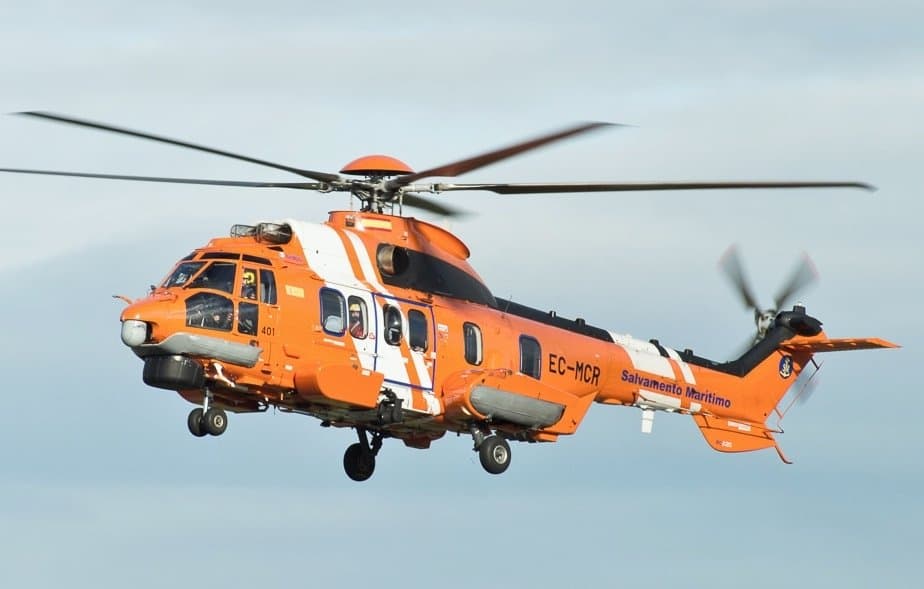
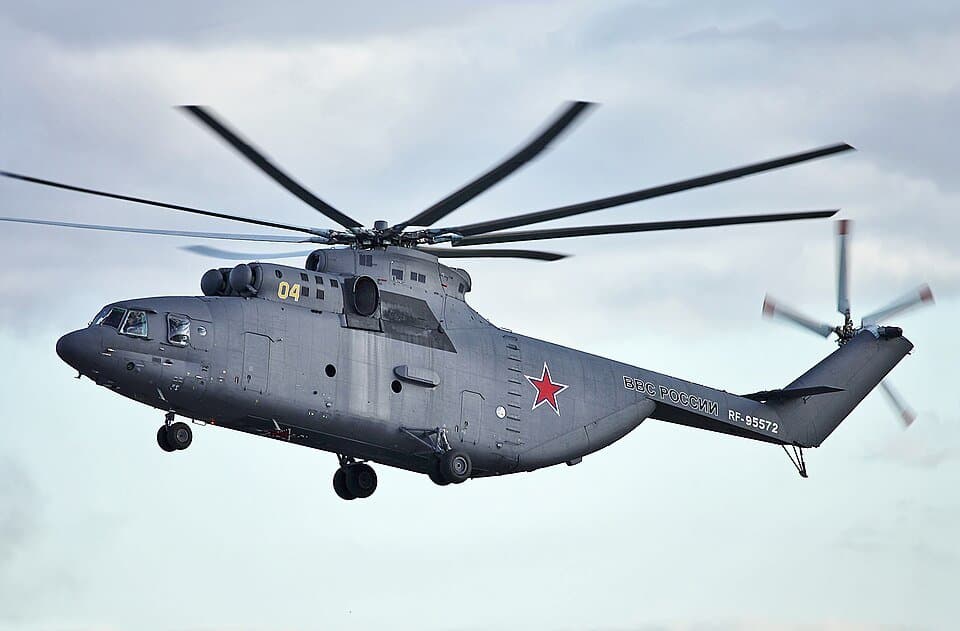
| Source measurement | The Airbus Helicopters H225 (formerly Eurocopter EC225 Super Puma ) is a long-range passenger transport helicopter developed by Eurocopter as the next generation of the civilian Super Puma family. It is a twin-engined aircraft and can carry up to 24 passengers along with two crew and a cabin attendant, dependent on customer configuration. The helicopter is marketed for offshore support and VIP passenger transport duties, as well as public service missions.[source]Eurocopter EC225 Super Puma · Lead; only the objects and conditions stated in this passage In February 2014, Airbus Helicopters announced at Heli-Expo 2014 the development of an improved variant, the EC225e. The EC225e features numerous changes including new avionics systems, such as the TCAS II collision avoidance system, an automatic identification system, and a specialized rig-approach system; it was also intended to feature an improved Turbomeca Makila 2B engine to increase the EC225e's maximum takeoff weight by 550 kg, and an additional fuel tank in the rear baggage compartment to extend its range to 300 nautical miles with up to ten passengers on board. Some, but not all, modifications can be retrofitted onto existing EC225s. In the same announcement, in February 2014, Lease Corporation International said that they had placed a $645 million order for 15 EC225e (along with 6 Airbus Helicopters EC175 ) helicopters as the launch customer. In February 2016, the Makila 2B engine was dropped from the EC225e as a cost reduction measure, development of the other structural and avionics aspects is proceeding.[source]Eurocopter EC225 Super Puma · Development; only the objects and conditions stated in this passage A key safety feature of the aircraft's main gear box (MGB) is an emergency oil spraying sub-system present in the lubrication system; this is designed to exceed the JAR 29 Standard's requirements of a 30-minute running time in the event of the loss of MGB oil pressure, and has demonstrated up to 50-minute running time. The engine also incorporates a "blade shedding" system to ensure engine integrity during an overspeed instance. Energy absorbent self-sealing fuel tanks are contained in the aircraft's sponsons , along with other equipment such as downward-facing illumination and navigation lighting fixtures. The transmission can accommodate more power than the maximum output of the engines; however two aircraft were lost in 2012 due to the cracking of the bevel gear shaft, a gearbox component. In response, the design of the transmission was modified in 2013, and the onboard health and usage monitoring system (HUMS) was upgraded to provide real-time monitoring of the bevel gear shaft against the threat of crack formation.[source]Eurocopter EC225 Super Puma · Design; only the objects and conditions stated in this passage In terms of cockpit equipment and avionics, the H225 is equipped with a full glass cockpit with active-matrix liquid crystal displays ; these include four 6-inch by 8-inch multi-functional displays as the predominant instrumentation for key flight information, two 4-inch by 5-inch monitors for displaying aircraft parameters, and a 3-inch screen for backup. The advanced helicopter cockpit and avionics system is described as serving to reduce pilot and crew workload, being used to display flight management and sub-systems information and is complete with a four-axis digital autopilot. During a typical flight, the pilot programs the route into the aircraft and then monitors it, as opposed to direct continuous control of the flight; the need for paper charts has been eliminated by these systems. Under autopilot, the automatic flight control system acts to prevent pilot actions from exceeding the established flight envelope; the H225 remains flyable with all automatic systems disabled. From initiating the startup sequence to being ready to takeoff only takes three minutes.[source]Eurocopter EC225 Super Puma · Design; only the objects and conditions stated in this passage There are currently a total of four principal configurations designed by Airbus Helicopters for the H225. The passenger transport version has a crash-worthy seating arrangement for up to 19 passengers with a high-density seating arrangement accommodating up to 28 passengers available to be fitted. The VIP transport version has a large lounge with seating for up to 12 passengers and a cabin attendant. The emergency medical services (EMS) configuration has medical units for six stretchers and four seats for medical workers. The search and rescue (SAR) configuration allows space for search and rescue equipment with an operator seat, hoistman seat and up to eight rescue seats and three stretchers. While a single pilot is capable of controlling the aircraft under visual meteorical conditions, two pilots are used in a typical crew complement and, dependent on role, a cabin attendant or flight engineer may also be present.[source]Eurocopter EC225 Super Puma · Design; only the objects and conditions stated in this passage Icelandic Coast Guard — received 2 H225s in 2019 and 1 in 2021.[source]Eurocopter EC225 Super Puma · Operators / Military operators; only the objects and conditions stated in this passage 18 February 2009: G-REDU, an EC225 LP operated by Bond Offshore Helicopters . During a night visual approach to the ETAP platform, the helicopter descended and impacted the surface of the sea. The crew's perception of the helicopter's position and orientation relative to the platform during the final approach was erroneous. All 18 people on board survived the controlled flight into terrain (water) .[source]Eurocopter EC225 Super Puma · Accidents and incidents; only the objects and conditions stated in this passage 10 May 2012: G-REDW, an EC225 LP, carried out a controlled ditching following indications of a failure of the main gearbox (MGB) lubrication system and a subsequent failure indication warning on the emergency lubrication system. An investigation by the Air Accidents Investigation Branch (AAIB) identified a 360° circumferential crack in the bevel gear vertical shaft in the main gearbox, in the vicinity of a manufacturing weld, causing disengagement of the drive to both mechanical oil pumps.[source]Eurocopter EC225 Super Puma · Accidents and incidents; only the objects and conditions stated in this passage 22 October 2012: G-CHCN, an EC225 LP of CHC Scotia, ditched in the North Sea 32 miles south west of Shetland whilst en route from Aberdeen to the West Phoenix drilling rig. All 19 on board were rescued. A special bulletin issued by the Air Accidents Investigation Branch (AAIB) said the main and standby oil pumps were not working; a 360-degree crack found on the bevel gear vertical shaft of the gearbox had prevented the oil pump gears from being driven. A worldwide grounding of the type was initiated in response. In both of the 2012 incidents, although the main gearbox lubrication system had failed, the backup system was working correctly but displaying an erroneous warning light, due to an incorrect specification of a pressure switch, which led to the helicopters being ditched.[source]Eurocopter EC225 Super Puma · Accidents and incidents; only the objects and conditions stated in this passage 29 April 2016: LN-OJF , an EC225 LP of CHC Helikopter Service , crashed at an islet near Turøy in the Bergen archipelago, en route to Bergen Airport, Flesland , from the Gullfaks B platform in the North Sea. The helicopter was carrying 11 passengers and 2 crew members; everyone on board died. Eyewitnesses reported that the main rotor separated from the hull immediately before the crash. Due to the crash, all commercial flights by EC225 helicopters, excluding search and rescue flights, were grounded by both Norwegian and British civil aviation authorities. The subsequent investigation concluded that a gear in the main rotor gearbox had failed due to a fatigue crack that had propagated under-surface, escaping detection. As a result of the incident the German Defence Ministry had also decided to ground 3 AS532 Helicopter in government use which were manufactured by the same company.[source]Eurocopter EC225 Super Puma · Accidents and incidents; only the objects and conditions stated in this passage 18 January 2023: an EC225 carrying the Minister of Internal Affairs of Ukraine , Denys Monastyrsky , his deputy Yevhen Yenin and state secretary Yurii Lubkovych , crashed at a kindergarten in Brovary , a suburb of Kyiv , Ukraine . The crash killed 14 people, including Monastyrsky, Yenin and Lubkovych; a child was also among the fatalities, while 25 others were injured.[source]Eurocopter EC225 Super Puma · Accidents and incidents; only the objects and conditions stated in this passage Capacity: 24 passengers + 1 cabin attendant[source]Eurocopter EC225 Super Puma · Specifications (H225); only the objects and conditions stated in this passage Length: 19.5 m (64 ft 0 in)[source]Eurocopter EC225 Super Puma · Specifications (H225); only the objects and conditions stated in this passage Height: 4.97 m (16 ft 4 in)[source]Eurocopter EC225 Super Puma · Specifications (H225); only the objects and conditions stated in this passage Empty weight: 5,256 kg (11,587 lb)[source]Eurocopter EC225 Super Puma · Specifications (H225); only the objects and conditions stated in this passage Gross weight: 11,000 kg (24,251 lb)[source]Eurocopter EC225 Super Puma · Specifications (H225); only the objects and conditions stated in this passage Max takeoff weight: 11,200 kg (24,692 lb)[source]Eurocopter EC225 Super Puma · Specifications (H225); only the objects and conditions stated in this passage Powerplant: 2 × Turbomeca Makila 2A1 turboshaft engines, 1,776 kW (2,382 hp) each[source]Eurocopter EC225 Super Puma · Specifications (H225); only the objects and conditions stated in this passage Main rotor diameter: 16.2 m (53 ft 2 in)[source]Eurocopter EC225 Super Puma · Specifications (H225); only the objects and conditions stated in this passage Main rotor area: 206.15 m 2 (2,219.0 sq ft)[source]Eurocopter EC225 Super Puma · Specifications (H225); only the objects and conditions stated in this passage Maximum speed: 275.5 km/h (171.2 mph, 148.8 kn)[source]Eurocopter EC225 Super Puma · Specifications (H225); only the objects and conditions stated in this passage Cruise speed: 260.5 km/h (161.9 mph, 140.7 kn)[source]Eurocopter EC225 Super Puma · Specifications (H225); only the objects and conditions stated in this passage Never exceed speed : 324 km/h (201 mph, 175 kn)[source]Eurocopter EC225 Super Puma · Specifications (H225); only the objects and conditions stated in this passage Range: 857 km (533 mi, 463 nmi)[source]Eurocopter EC225 Super Puma · Specifications (H225); only the objects and conditions stated in this passage Ferry range: 985 km (612 mi, 532 nmi)[source]Eurocopter EC225 Super Puma · Specifications (H225); only the objects and conditions stated in this passage Service ceiling: 5,900 m (19,400 ft)[source]Eurocopter EC225 Super Puma · Specifications (H225); only the objects and conditions stated in this passage Rate of climb: 8.7 m/s (1,710 ft/min)[source]Eurocopter EC225 Super Puma · Specifications (H225); only the objects and conditions stated in this passage | The Mi-26 was designed to replace earlier Mi-6 and Mi-12 heavy lift helicopters and act as a heavy-lift helicopter for military and civil use, having twice the cabin space and payload of the Mi-6, then the world's largest and fastest production helicopter. The primary purpose of the Mi-26 was to transport military equipment such as 13-tonne (29,000 lb) amphibious armored personnel carriers and mobile ballistic missiles to remote locations after delivery by military transport aircraft such as the Antonov An-22 or Ilyushin Il-76 .[source]Mil Mi-26 · Design and development; only the objects and conditions stated in this passage The Mi-26 was the first factory-equipped helicopter with a single, eight-blade main lift rotor . It is capable of flight in the event of power loss by one engine (depending on aircraft mission weight) because of an engine load sharing system. While its empty weight is only slightly higher than the Mi-6's, the Mi-26 has a payload of up to 20 tonnes (44,000 lb). It is the second largest and heaviest helicopter ever constructed, after the experimental Mil V-12. The tail rotor has about the same diameter and thrust as the four-bladed main rotor fitted to the MD Helicopters MD 500 .[source]Mil Mi-26 · Design and development; only the objects and conditions stated in this passage The Mi-26's unique main gearbox is relatively light at 3,639 kg (8,023 lb) but can absorb 14,700 kilowatts (19,725 shp), which was accomplished using a non-planetary, split-torque design with quill shafts for torque equalization. The Mil Design Bureau designed the VR-26 transmission itself, due to Mil's normal gearbox supplier not being able to design such a gearbox. The gearbox housing is stamped aluminum. A split-torque design is also used in the 5,670 kg (12,500 lb) gearbox assembly on the American three-engine Sikorsky CH-53K King Stallion .[source]Mil Mi-26 · Design and development; only the objects and conditions stated in this passage As of 2024 , the Mi-26 still holds the Fédération Aéronautique Internationale world record for the greatest mass lifted by a helicopter to 2,000 metres (6,562 ft) – 56,768.8 kilograms (125,000 lb) on a flight in 1982. |
|---|
| Designer | — | Mil Moscow Helicopter Plant[source] |
|---|
| Status | — | In service[source] |
|---|
| Primary users | — | Russian Aerospace Forces Algerian Air Force Utair Russian Ministry of Emergency Situations[source] |
|---|
| Fuel capacity | — | 12,000 L (3,200 US gal; 2,600 imp gal)[source] |
|---|
| Blade section | — | root: TsAGI 12%; tip: TsAGI 9%[source] |
|---|
Maximum take-off; Mi-26 · Max takeoff weight
Single source500 km (310 mi, 270 nmi) with 7,700 kg (17,000 lb) cargo[source]
1,920 km (1,190 mi, 1,040 nmi) (with auxiliary tanks)[source]
In July 2010 a proposed Russian-Chinese development of a 33-ton heavy-lift helicopter was announced.[source]Mil Mi-26 · Design and development; only the objects and conditions stated in this passage
In October 1999, an Mi-26 was used to transport a 23-tonne (25-short-ton) block of frozen soil encasing a preserved, 23,000-year-old woolly mammoth ( Jarkov Mammoth ) from the Siberian tundra to a lab in Khatanga , Russia . Due to the weight of the load, the Mi-26 had to be returned to the factory afterward to check for airframe and rotor warping caused by the potential of structural over-stressing.[source]Mil Mi-26 · Operational history / Siberian Woolly Mammoth recovery; only the objects and conditions stated in this passage
In early 2002, a civilian Mi-26 was leased to recover two U.S. Army MH-47E Chinook helicopters from a mountain in Afghanistan. While the second craft was too badly damaged to recover, the first was determined to be repairable and estimated to weigh 12 tonnes (26,000 lb) with fuel, rotors, and non-essential equipment removed. That weight exceeded the maximum payload of 9.1 tonnes (20,000 lb) at an altitude of 2,600 metres (8,500 ft) of the U.S. military's Sikorsky CH-53E .[source]Mil Mi-26 · Operational history / Afghanistan Chinook recovery; only the objects and conditions stated in this passage
The Mi-26 was located through Skylink Aviation in Toronto , which had connections with a Russian company called Sportsflite that operated three civilian Mi-26 versions called "Heavycopters". One of the aircraft, aiding in construction and firefighting work in neighboring Tajikistan, was leased for $300,000; it lifted the Chinook, flew it to Kabul , then later to Bagram Air Base , Afghanistan to ship to Fort Campbell , Kentucky , U.S. for repairs. Six months later, a second U.S. Army CH-47 that had made a hard landing 160 kilometres (100 mi) north of Bagram at an altitude of 1,200 metres (3,900 ft) was recovered by another Sportsflite-operated Mi-26 Heavycopter.[source]Mil Mi-26 · Operational history / Afghanistan Chinook recovery; only the objects and conditions stated in this passage
On 14 December 2010, an Indian Air Force Mi-26 crashed seconds after taking off from Jammu Airport , injuring all nine passengers. The aircraft fell from an altitude of about 15 metres (50 ft). The Indian Institute of Flight Safety released an investigation report that stated improper fastening of the truck inside caused an imbalance of the helicopter and led to the crash. The Mi-26 had been carrying machines from Konkan Railway to Jammu–Baramulla line project.[source]Mil Mi-26 · Operational history / Indian Air Force Mi-26 crash; only the objects and conditions stated in this passage
Mi-26M[source]Mil Mi-26 · Variants; only the objects and conditions stated in this passage
Firefighting version with internal 15,000 litres (4,000 US gal; 3,300 imp gal) fire retardant tank.[source]Mil Mi-26 · Variants; only the objects and conditions stated in this passage
Capacity: **90 troops or 60 stretchers 20,000 kg (44,000 lb) cargo[source]Mil Mi-26 · Specifications (Mi-26); only the objects and conditions stated in this passage
Length: 40.025 m (131 ft 4 in)[source]Mil Mi-26 · Specifications (Mi-26); only the objects and conditions stated in this passage
Height: 8.145 m (26 ft 9 in)[source]Mil Mi-26 · Specifications (Mi-26); only the objects and conditions stated in this passage
Empty weight: 28,200 kg (62,170 lb)[source]Mil Mi-26 · Specifications (Mi-26); only the objects and conditions stated in this passage
Gross weight: 49,600 kg (109,349 lb)[source]Mil Mi-26 · Specifications (Mi-26); only the objects and conditions stated in this passage
Max takeoff weight: 56,000 kg (123,459 lb)[source]Mil Mi-26 · Specifications (Mi-26); only the objects and conditions stated in this passage
Powerplant: 2 × ZMKB Progress D-136 turboshaft engines, 8,500 kW (11,400 hp) each[source]Mil Mi-26 · Specifications (Mi-26); only the objects and conditions stated in this passage
Main rotor diameter: 32 m (105 ft 0 in)[source]Mil Mi-26 · Specifications (Mi-26); only the objects and conditions stated in this passage
Main rotor area: 804.25 m 2 (8,656.9 sq ft)[source]Mil Mi-26 · Specifications (Mi-26); only the objects and conditions stated in this passage
Maximum speed: 295 km/h (183 mph, 159 kn)[source]Mil Mi-26 · Specifications (Mi-26); only the objects and conditions stated in this passage
Cruise speed: 255 km/h (158 mph, 138 kn)[source]Mil Mi-26 · Specifications (Mi-26); only the objects and conditions stated in this passage
Range: 500 km (310 mi, 270 nmi) with 7,700 kg (17,000 lb) cargo[source]Mil Mi-26 · Specifications (Mi-26); only the objects and conditions stated in this passage
Ferry range: 1,920 km (1,190 mi, 1,040 nmi) (with auxiliary tanks)[source]Mil Mi-26 · Specifications (Mi-26); only the objects and conditions stated in this passage
Service ceiling: 4,600 m (15,100 ft) operational, 1,524 metres (5,000 ft) HOGE at max. gross weight[source]Mil Mi-26 · Specifications (Mi-26); only the objects and conditions stated in this passage