Credit
commons.wikimedia · CC BY-SA 2.5 · Resized · CC BY-SA 2.5 · Source ↗ · Modified


Preparing your view.

At a glance
Measured figures
Ka-50 · Combat range
Single source470 km (290 mi, 250 nmi)[source]
H225 · 2 × Turbomeca Makila 2A1 turboshaft engines each
Single source2 × Turbomeca Makila 2A1 turboshaft engines, 1,776 kW (2,382 hp) each[source]
Ka-50 · 2 × Klimov VK-2500 turboshaft engines (2,400 shp) each
Single source2 × Klimov VK-2500 turboshaft engines, 1,800 kW (2,400 shp) each[source]
Bars compare reported quantities only. A larger figure does not make a system better; configurations and test conditions differ.
Configuration
| Specification | Eurocopter EC225 Super Puma | Kamov Ka-50 |
|---|---|---|
| Type | Passenger transport helicopter[source] | Attack helicopter , scout helicopter[source] |
| National origin | Multinational[source] | Soviet Union / Russia[source] |
| Manufacturer | Eurocopter Airbus Helicopters[source] | Kamov[source] |
| Primary user | CHC Helicopter[source] | — |
| Number built | 170+ (as of 2016 )[source] | Ka-50: 18–19 Ka-52: >196[source] |
| Manufactured | 1999–present[source] | 1990–present[source] |
| Introduction date | December 2004[source] | 28 August 1995[source] |
| First flight | 27 November 2000[source] | Ka-50: 17 June 1982 Ka-52: 25 June 1997 Ka-52M: 9 January 2023[source] |
| Developed from | Eurocopter AS332 Super Puma[source] | Kamov V-80[source] |
| Variant | Eurocopter EC725[source] | — |
| Capacity | 24 passengers + 1 cabin attendant[source] | — |
| Main rotor area | 206.15 m 2 (2,219.0 sq ft)[source] | 330.3 m 2 (3,555 sq ft) contra-rotating 3-bladed main rotors[source] |
| Never exceed speed | 324 km/h (201 mph, 175 kn)[source] | 350 km/h (220 mph, 190 kn)[source] |
| Role | long-range passenger transport helicopter[source] | Soviet/Russian single-seat attack helicopter[source] |
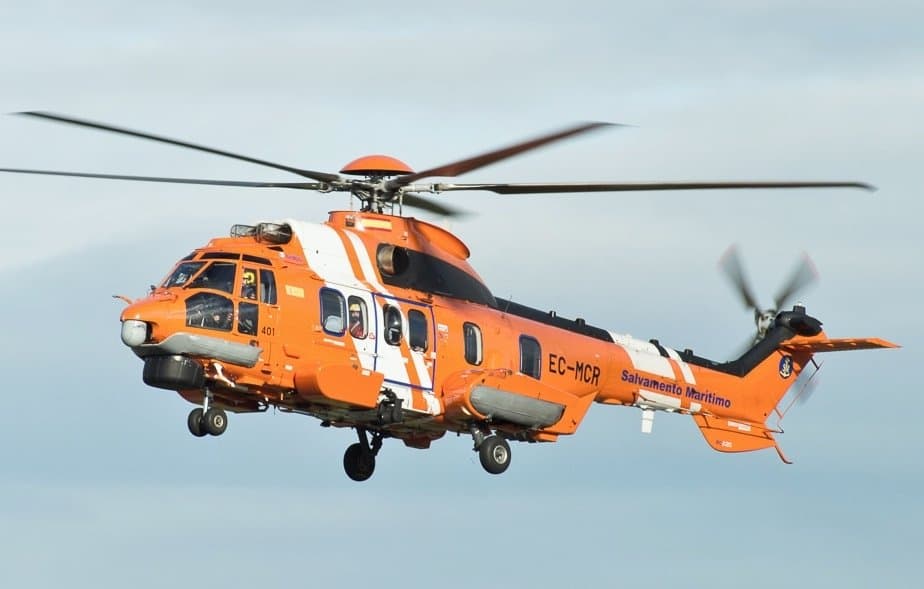
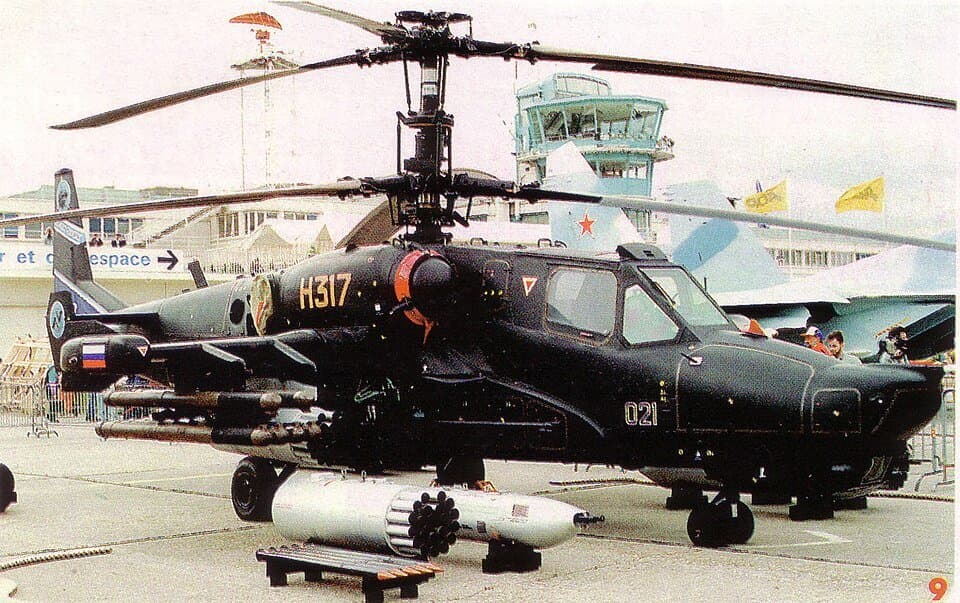
| Source measurement | The Airbus Helicopters H225 (formerly Eurocopter EC225 Super Puma ) is a long-range passenger transport helicopter developed by Eurocopter as the next generation of the civilian Super Puma family. It is a twin-engined aircraft and can carry up to 24 passengers along with two crew and a cabin attendant, dependent on customer configuration. The helicopter is marketed for offshore support and VIP passenger transport duties, as well as public service missions.[source]Eurocopter EC225 Super Puma · Lead; only the objects and conditions stated in this passage In February 2014, Airbus Helicopters announced at Heli-Expo 2014 the development of an improved variant, the EC225e. The EC225e features numerous changes including new avionics systems, such as the TCAS II collision avoidance system, an automatic identification system, and a specialized rig-approach system; it was also intended to feature an improved Turbomeca Makila 2B engine to increase the EC225e's maximum takeoff weight by 550 kg, and an additional fuel tank in the rear baggage compartment to extend its range to 300 nautical miles with up to ten passengers on board. Some, but not all, modifications can be retrofitted onto existing EC225s. In the same announcement, in February 2014, Lease Corporation International said that they had placed a $645 million order for 15 EC225e (along with 6 Airbus Helicopters EC175 ) helicopters as the launch customer. In February 2016, the Makila 2B engine was dropped from the EC225e as a cost reduction measure, development of the other structural and avionics aspects is proceeding.[source]Eurocopter EC225 Super Puma · Development; only the objects and conditions stated in this passage A key safety feature of the aircraft's main gear box (MGB) is an emergency oil spraying sub-system present in the lubrication system; this is designed to exceed the JAR 29 Standard's requirements of a 30-minute running time in the event of the loss of MGB oil pressure, and has demonstrated up to 50-minute running time. The engine also incorporates a "blade shedding" system to ensure engine integrity during an overspeed instance. Energy absorbent self-sealing fuel tanks are contained in the aircraft's sponsons , along with other equipment such as downward-facing illumination and navigation lighting fixtures. The transmission can accommodate more power than the maximum output of the engines; however two aircraft were lost in 2012 due to the cracking of the bevel gear shaft, a gearbox component. In response, the design of the transmission was modified in 2013, and the onboard health and usage monitoring system (HUMS) was upgraded to provide real-time monitoring of the bevel gear shaft against the threat of crack formation.[source]Eurocopter EC225 Super Puma · Design; only the objects and conditions stated in this passage In terms of cockpit equipment and avionics, the H225 is equipped with a full glass cockpit with active-matrix liquid crystal displays ; these include four 6-inch by 8-inch multi-functional displays as the predominant instrumentation for key flight information, two 4-inch by 5-inch monitors for displaying aircraft parameters, and a 3-inch screen for backup. The advanced helicopter cockpit and avionics system is described as serving to reduce pilot and crew workload, being used to display flight management and sub-systems information and is complete with a four-axis digital autopilot. During a typical flight, the pilot programs the route into the aircraft and then monitors it, as opposed to direct continuous control of the flight; the need for paper charts has been eliminated by these systems. Under autopilot, the automatic flight control system acts to prevent pilot actions from exceeding the established flight envelope; the H225 remains flyable with all automatic systems disabled. From initiating the startup sequence to being ready to takeoff only takes three minutes.[source]Eurocopter EC225 Super Puma · Design; only the objects and conditions stated in this passage There are currently a total of four principal configurations designed by Airbus Helicopters for the H225. The passenger transport version has a crash-worthy seating arrangement for up to 19 passengers with a high-density seating arrangement accommodating up to 28 passengers available to be fitted. The VIP transport version has a large lounge with seating for up to 12 passengers and a cabin attendant. The emergency medical services (EMS) configuration has medical units for six stretchers and four seats for medical workers. The search and rescue (SAR) configuration allows space for search and rescue equipment with an operator seat, hoistman seat and up to eight rescue seats and three stretchers. While a single pilot is capable of controlling the aircraft under visual meteorical conditions, two pilots are used in a typical crew complement and, dependent on role, a cabin attendant or flight engineer may also be present.[source]Eurocopter EC225 Super Puma · Design; only the objects and conditions stated in this passage Icelandic Coast Guard — received 2 H225s in 2019 and 1 in 2021.[source]Eurocopter EC225 Super Puma · Operators / Military operators; only the objects and conditions stated in this passage 18 February 2009: G-REDU, an EC225 LP operated by Bond Offshore Helicopters . During a night visual approach to the ETAP platform, the helicopter descended and impacted the surface of the sea. The crew's perception of the helicopter's position and orientation relative to the platform during the final approach was erroneous. All 18 people on board survived the controlled flight into terrain (water) .[source]Eurocopter EC225 Super Puma · Accidents and incidents; only the objects and conditions stated in this passage 10 May 2012: G-REDW, an EC225 LP, carried out a controlled ditching following indications of a failure of the main gearbox (MGB) lubrication system and a subsequent failure indication warning on the emergency lubrication system. An investigation by the Air Accidents Investigation Branch (AAIB) identified a 360° circumferential crack in the bevel gear vertical shaft in the main gearbox, in the vicinity of a manufacturing weld, causing disengagement of the drive to both mechanical oil pumps.[source]Eurocopter EC225 Super Puma · Accidents and incidents; only the objects and conditions stated in this passage 22 October 2012: G-CHCN, an EC225 LP of CHC Scotia, ditched in the North Sea 32 miles south west of Shetland whilst en route from Aberdeen to the West Phoenix drilling rig. All 19 on board were rescued. A special bulletin issued by the Air Accidents Investigation Branch (AAIB) said the main and standby oil pumps were not working; a 360-degree crack found on the bevel gear vertical shaft of the gearbox had prevented the oil pump gears from being driven. A worldwide grounding of the type was initiated in response. In both of the 2012 incidents, although the main gearbox lubrication system had failed, the backup system was working correctly but displaying an erroneous warning light, due to an incorrect specification of a pressure switch, which led to the helicopters being ditched.[source]Eurocopter EC225 Super Puma · Accidents and incidents; only the objects and conditions stated in this passage 29 April 2016: LN-OJF , an EC225 LP of CHC Helikopter Service , crashed at an islet near Turøy in the Bergen archipelago, en route to Bergen Airport, Flesland , from the Gullfaks B platform in the North Sea. The helicopter was carrying 11 passengers and 2 crew members; everyone on board died. Eyewitnesses reported that the main rotor separated from the hull immediately before the crash. Due to the crash, all commercial flights by EC225 helicopters, excluding search and rescue flights, were grounded by both Norwegian and British civil aviation authorities. The subsequent investigation concluded that a gear in the main rotor gearbox had failed due to a fatigue crack that had propagated under-surface, escaping detection. As a result of the incident the German Defence Ministry had also decided to ground 3 AS532 Helicopter in government use which were manufactured by the same company.[source]Eurocopter EC225 Super Puma · Accidents and incidents; only the objects and conditions stated in this passage 18 January 2023: an EC225 carrying the Minister of Internal Affairs of Ukraine , Denys Monastyrsky , his deputy Yevhen Yenin and state secretary Yurii Lubkovych , crashed at a kindergarten in Brovary , a suburb of Kyiv , Ukraine . The crash killed 14 people, including Monastyrsky, Yenin and Lubkovych; a child was also among the fatalities, while 25 others were injured.[source]Eurocopter EC225 Super Puma · Accidents and incidents; only the objects and conditions stated in this passage Capacity: 24 passengers + 1 cabin attendant[source]Eurocopter EC225 Super Puma · Specifications (H225); only the objects and conditions stated in this passage Length: 19.5 m (64 ft 0 in)[source]Eurocopter EC225 Super Puma · Specifications (H225); only the objects and conditions stated in this passage Height: 4.97 m (16 ft 4 in)[source]Eurocopter EC225 Super Puma · Specifications (H225); only the objects and conditions stated in this passage Empty weight: 5,256 kg (11,587 lb)[source]Eurocopter EC225 Super Puma · Specifications (H225); only the objects and conditions stated in this passage Gross weight: 11,000 kg (24,251 lb)[source]Eurocopter EC225 Super Puma · Specifications (H225); only the objects and conditions stated in this passage Max takeoff weight: 11,200 kg (24,692 lb)[source]Eurocopter EC225 Super Puma · Specifications (H225); only the objects and conditions stated in this passage Powerplant: 2 × Turbomeca Makila 2A1 turboshaft engines, 1,776 kW (2,382 hp) each[source]Eurocopter EC225 Super Puma · Specifications (H225); only the objects and conditions stated in this passage Main rotor diameter: 16.2 m (53 ft 2 in)[source]Eurocopter EC225 Super Puma · Specifications (H225); only the objects and conditions stated in this passage Main rotor area: 206.15 m 2 (2,219.0 sq ft)[source]Eurocopter EC225 Super Puma · Specifications (H225); only the objects and conditions stated in this passage Maximum speed: 275.5 km/h (171.2 mph, 148.8 kn)[source]Eurocopter EC225 Super Puma · Specifications (H225); only the objects and conditions stated in this passage Cruise speed: 260.5 km/h (161.9 mph, 140.7 kn)[source]Eurocopter EC225 Super Puma · Specifications (H225); only the objects and conditions stated in this passage Never exceed speed : 324 km/h (201 mph, 175 kn)[source]Eurocopter EC225 Super Puma · Specifications (H225); only the objects and conditions stated in this passage Range: 857 km (533 mi, 463 nmi)[source]Eurocopter EC225 Super Puma · Specifications (H225); only the objects and conditions stated in this passage Ferry range: 985 km (612 mi, 532 nmi)[source]Eurocopter EC225 Super Puma · Specifications (H225); only the objects and conditions stated in this passage Service ceiling: 5,900 m (19,400 ft)[source]Eurocopter EC225 Super Puma · Specifications (H225); only the objects and conditions stated in this passage Rate of climb: 8.7 m/s (1,710 ft/min)[source]Eurocopter EC225 Super Puma · Specifications (H225); only the objects and conditions stated in this passage | Trials led to two "final" versions: Ka-50N "Night Shark" (Russian: Ночная акула , " velvet belly lanternshark ") and Ka-50Sh (Russian: Ш ар , romanized: Sh ar , "ball"; because of the spherical FLIR turret). The first Ka-50Sh, which was the eighth pre-production aircraft, Bort 018, first flew on 4 March 1997. The Kamov company and Black Shark logos were displayed on the endplate fins and the vertical tail. It featured the Samshit-50 system installed within a 640 mm (25 in) diameter sphere under the nose. Shkval system was moved to the nose cone area. Neither of the Ka-50 night-attack versions has entered full production.[source]Kamov Ka-50 · Development / Ka-50N "Night Shark" and Ka-50Sh; only the objects and conditions stated in this passage The Ka-50-2 is a tandem cockpit variant of the Ka-50. It featured a modern, Israeli-made " glass cockpit " avionics and a turret-mounted folding (for landing clearance) 30 mm cannon instead of the fixed cannon on the Ka-50. It features combat-proven avionics and advanced anti-tank guided missiles for a high level of combat effectiveness. It is equipped with IAI's flexible modular avionics suite, which can be readily tailored to meet the TLF's operational requirements and provides growth potential.[source]Kamov Ka-50 · Development / Ka-50-2 "Erdogan"; only the objects and conditions stated in this passage In comparison to the original Ka-50, the Ka-52 has a new radome with a nose-mounted radar system for targeting, giving the Ka-52 a rounder nose profile. A day-and-night TV/thermal sighting system is fitted in a spherical turret under the nose (some examples have an additional mast radar for aerial targets and a second sighting system above the cockpit). The Ka-52 has the side-mounted cannon of the original Ka-50. It features six wing-mounted hardpoints compared to four on the Ka-50. To keep the weight and performance on par with that of the Ka-50, the armor and the capacity of the cannon magazine/feed were reduced. Also, some flight parameters deteriorated: rate of climb dropped from 10 to 8 m/s and maximum positive load factor became 3.0 g. Most of the problems were solved by installing the new VK-2500 engine. The Ka-52 is approved for day, night and adverse weather conditions.[source]Kamov Ka-50 · Development / Ka-52 "Alligator"; only the objects and conditions stated in this passage The helicopter features the Arbalet-52 dual-band coherent pulse radar, which has an Earth mapping range of 32 km and a detection range of 25 km for ground targets and 15 km for aerial targets.[source]Kamov Ka-50 · Development / Ka-52 "Nile Crocodile"; only the objects and conditions stated in this passage The new version announced by the Russian Ministry of Defence in 2018 eventually crystallized into the Ka-52M; 114 helicopters of this new version are to be acquired. Additionally, older Ka-52s are to be upgraded to Ka-52M standard. The contract for the first 30 Ka-52Ms was signed in August 2021. A new contract was signed in August 2022. Upgrades embodied in the Ka-52M include a modernized GOES-451M electro-optical targeting turret with an increased range, stronger undercarriage wheels, and improved cockpit ergonomics, with better adaptation to the use of night-vision goggles . The LMUR missile is added to the helicopter's armament options. Several new radar types are being considered for the Ka-52M. A new self-protection system will also be fitted to the Ka-52M, replacing the current L370-5 Vitebsk. Lastly, the Ka-52M is adapted to work within a new battlefield command and control system. The Russian military received its first 10 modified Ka-52M helicopters on 9 January 2023. The state defense order for the helicopters was doubled in 2023.[source]Kamov Ka-50 · Development / Ka-52M; only the objects and conditions stated in this passage The hovering ceiling is 4,000 m and vertical rate of climb 10 m/s at an altitude of 2,500 m. Having a coaxial rotor with blades of polymer results in low inertia both relative to vertical and lateral axes, at 50%–75% as compared to a single rotor helicopter with tail rotor. No tail rotor also means it can perform flat turns at all speeds. A maximum vertical load of 3.5 g combined with low inertia makes the Ka-50 highly agile.[source]Kamov Ka-50 · Design / Maneuvering; only the objects and conditions stated in this passage For its own protection, Ka-50 is fitted with a radar warning receiver, electronic warfare system, and chaff and flare dispensers. Aerodynamic cases at wings' ends each contain two dispensers, which in turn have 32 x 26 mm countermeasures each. The whole system works on the principle of evaluated response based on infrared or electronic impulse irradiation. Extensive all-round armour in the cockpit protects the pilot against 12.7 mm armour-piercing bullets and 23 mm projectile fragments. The rotor blades are rated to withstand several hits from ground-based automatic weapons.[source]Kamov Ka-50 · Design / Protection and survivability; only the objects and conditions stated in this passage The aircraft has one Shipunov 2A42 autocannon with selective fire , and a dual-feed, giving it a cyclic rate of fire between 200 and 800 rounds per minute. It is mounted near centre of gravity for accuracy, and carries 460 high-fragmentation, explosive incendiary, or armour-piercing rounds. The type of ammunition is selected by the pilot during flight. The integrated 30 mm cannon is semi-rigidly fixed on the helicopter's side, movable only slightly in elevation and azimuth . Semi-rigid mounting improves the cannon's accuracy, giving the 30 mm a longer practical range and better hit ratio at medium ranges than with a free-turning turret mount.[source]Kamov Ka-50 · Design / Armament; only the objects and conditions stated in this passage Weapons can be carried on four external hardpoints under the stub wings, plus two on the wingtips, a total of more than 2,000 kg (depending on the mix). The pylons can be tilted 10 degrees downward. Fuel tanks may be mounted on a suspension point whenever necessary.[source]Kamov Ka-50 · Design / Armament; only the objects and conditions stated in this passage Anti-tank armament comprises twelve Vikhr laser-guided anti-tank missiles (transl. Vortex or whirlwind), with a maximum range of some 8 km. The laser guidance is reported to be virtually jam-proof, and the system features automatic guidance to target, enabling evasive action immediately after missile launch; alternatively, it can also use Ataka laser-guided anti-tank missiles. Before firing laser-guided missiles, it often must hover a few hundred feet off the ground to direct a laser at a target, leaving itself briefly exposed.[source]Kamov Ka-50 · Design / Armament; only the objects and conditions stated in this passage On 6 February, in the forest-covered mountain area to the south of the village of Tsentoroj, a strike group composed of two Ka-50s and the sole Ka-29 discovered and, from a range of 3 km, destroyed a fortified camp of insurgents using two " 9K121 Vikhr " guided missiles.[source]Kamov Ka-50 · Operational history / Second Chechen War; only the objects and conditions stated in this passage In difficult conditions, pilots found and destroyed eight targets.[source]Kamov Ka-50 · Operational history / Second Chechen War; only the objects and conditions stated in this passage On 4 June, Ukrainian forces of the 128th Mountain Brigade reported the downing of a Russian Ka-52 in the north.[source]Kamov Ka-50 · Operational history / Russo-Ukrainian War; only the objects and conditions stated in this passage Reportedly, a few Ka-52s have suffered from wing vibration under heavy-load attack missions. This was observed months after the invasion. It has been suggested that this may be due to causes such as fatigue, inadequate design, lack of maintenance, and poor management. Ukrainian military intelligence claimed that the Ka-52 can be "disabled with a 7.62mm machine gun" despite a claimed ability to withstand 12.7mm rounds.[source]Kamov Ka-50 · Operational history / Russo-Ukrainian War; only the objects and conditions stated in this passage As of late July 2023, the UK MoD claimed that Russia has lost 40 Ka-52s since the start of the Russian invasion. At the same time the UK MoD said on 27 July 2023: "One of the single most influential Russian weapon systems in the sector is the Ka-52 HOKUM attack helicopter". With the LMUR missile, the Ka-52 has an attack range of 15 km, putting it beyond the range of Ukrainian air defences.[source]Kamov Ka-50 · Operational history / Russo-Ukrainian War; only the objects and conditions stated in this passage On 7 August 2024 during the Ukrainian incursion into Kursk , a Ka-52 was destroyed along with the two-man crew. The Ukrainians are concerned about the ability of the aircraft to carry 9K121 Vikhr air-to-surface missiles, as they are able to penetrate tank armour. The Ka-52 "can carry up to 12 units, allowing it to attack targets from 5 to 11 kilometres."[source]Kamov Ka-50 · Operational history / Russo-Ukrainian War; only the objects and conditions stated in this passage Russia has deployed the Ka-52 against Ukrainian kamikaze drones; downing a number with the Ka-52's 30mm cannon.[source]Kamov Ka-50 · Operational history / Russo-Ukrainian War; only the objects and conditions stated in this passage In June 2015, Sergei Kornev, the head of Rosoboronexport's 's delegation, said that Russia has signed its first contracts on the export of Ka-52 Alligator attack helicopters. "We have the Ka-52 in its export model, and we have contracts for it, and it's already being spun because it has a good, firm future" he said at the airshow outside Paris. Kornev did not specify the volume of contracts or with whom they were signed.[source]Kamov Ka-50 · Operational history / Other; only the objects and conditions stated in this passage Kamov Ka-52M[source]Kamov Ka-50 · Variants; only the objects and conditions stated in this passage Length: 16 m (52 ft 6 in)[source]Kamov Ka-50 · Specifications (Ka-50); only the objects and conditions stated in this passage Height: 4.93 m (16 ft 2 in)[source]Kamov Ka-50 · Specifications (Ka-50); only the objects and conditions stated in this passage Empty weight: 7,700 kg (16,976 lb)[source]Kamov Ka-50 · Specifications (Ka-50); only the objects and conditions stated in this passage Gross weight: 9,800 kg (21,605 lb)[source]Kamov Ka-50 · Specifications (Ka-50); only the objects and conditions stated in this passage Max takeoff weight: 10,800 kg (23,810 lb)[source]Kamov Ka-50 · Specifications (Ka-50); only the objects and conditions stated in this passage Powerplant: 2 × Klimov VK-2500 turboshaft engines, 1,800 kW (2,400 shp) each[source]Kamov Ka-50 · Specifications (Ka-50); only the objects and conditions stated in this passage Main rotor diameter: 2 × 14.5 m (47 ft 7 in)[source]Kamov Ka-50 · Specifications (Ka-50); only the objects and conditions stated in this passage Main rotor area: 330.3 m 2 (3,555 sq ft) contra-rotating 3-bladed main rotors[source]Kamov Ka-50 · Specifications (Ka-50); only the objects and conditions stated in this passage Maximum speed: 315 km/h (196 mph, 170 kn)[source]Kamov Ka-50 · Specifications (Ka-50); only the objects and conditions stated in this passage Cruise speed: 270 km/h (170 mph, 150 kn)[source]Kamov Ka-50 · Specifications (Ka-50); only the objects and conditions stated in this passage Never exceed speed : 350 km/h (220 mph, 190 kn)[source]Kamov Ka-50 · Specifications (Ka-50); only the objects and conditions stated in this passage Range: 545 km (339 mi, 294 nmi)[source]Kamov Ka-50 · Specifications (Ka-50); only the objects and conditions stated in this passage Combat range: 470 km (290 mi, 250 nmi)[source]Kamov Ka-50 · Specifications (Ka-50); only the objects and conditions stated in this passage Ferry range: 1,160 km (720 mi, 630 nmi)[source]Kamov Ka-50 · Specifications (Ka-50); only the objects and conditions stated in this passage Service ceiling: 5,500 m (18,000 ft)[source]Kamov Ka-50 · Specifications (Ka-50); only the objects and conditions stated in this passage Rate of climb: 12 m/s (2,400 ft/min)[source]Kamov Ka-50 · Specifications (Ka-50); only the objects and conditions stated in this passage Guns: 1 × mobile semi-rigid 30 mm Shipunov 2A42 cannon (460 rounds total, dual feeding AP or HE-Frag )[source]Kamov Ka-50 · Specifications (Ka-50); only the objects and conditions stated in this passage Hardpoints: 6 × under-wing hardpoints, plus 2 on wingtips for countermeasures or air-to-air missiles with a capacity of 2,000 kg, with provisions to carry combinations of: Rockets: 80 × 80 mm S-8 rockets and 20 × 122 mm S-13 rocket , 4 × Igla air-to-air missiles Missiles: 2 × APU-6 Missile racks, able to accommodate a total of 12 × 9K121 Vikhr anti-tank missiles, 2 × LMUR Bombs: 4 × 250 kg (550 lb) bombs or 2 × 500 kg (1,100 lb) bombs, Other: 23 mm UPK-23-250 gun pods (240 rounds each), 500 L (130 US gal) external fuel tanks.[source]Kamov Ka-50 · Specifications (Ka-50); only the objects and conditions stated in this passage |
| Status | — | In service[source] |
| Primary users | — | Russian Aerospace Forces Russian Naval Aviation Egyptian Air Force[source] |
| Disk loading | — | 30 kg/m 2 (6.1 lb/sq ft)[source] |
| Power/mass | — | 0.33 kW/kg (0.20 hp/lb)[source] |
| Guns | — | 1 × mobile semi-rigid 30 mm Shipunov 2A42 cannon (460 rounds total, dual feeding AP or HE-Frag )[source] |
| Hardpoints | — | 6 × under-wing hardpoints, plus 2 on wingtips for countermeasures or air-to-air missiles with a capacity of 2,000 kg, with provisions to carry combinations of:[source] |
| Rockets | — | 80 × 80 mm S-8 rockets and 20 × 122 mm S-13 rocket , 4 × Igla air-to-air missiles[source] |
| Missiles | — | 2 × APU-6 Missile racks, able to accommodate a total of 12 × 9K121 Vikhr anti-tank missiles, 2 × LMUR[source] |
| Bombs | — | 4 × 250 kg (550 lb) bombs or 2 × 500 kg (1,100 lb) bombs,[source] |
| Other | — | 23 mm UPK-23-250 gun pods (240 rounds each), 500 L (130 US gal) external fuel tanks.[source] |
| Rate of fire | — | rate of fire between 200 and 800 rounds per minute[source]Kamov Ka-50 · Design / Armament · The aircraft has one Shipunov 2A42 autocannon with selective fire , and a dual-feed, giving it a cyclic rate of fire between 200 and 800 rounds per minute. |