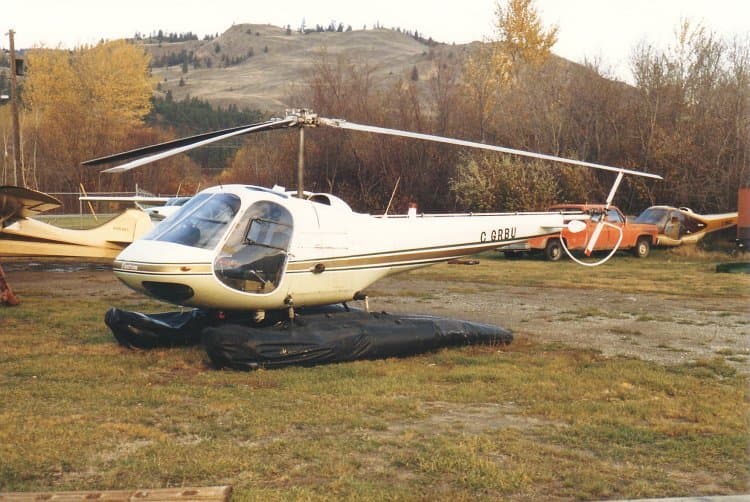

Credit
Original uploader was User:Ahunt at en:wikipedia · Public domain · Resized · Public domain · Source ↗ · Modified


Preparing your view.

At a glance
Measured figures
F28F · Length
Single source29 ft 3 in (8.92 m)[source]
Mi-26 · Length
Single sourceConfiguration
| Specification | Enstrom F-28 | Mil Mi-26 |
|---|---|---|
| Type | Light helicopter[source] | Heavy lift transport helicopter[source] |
| Manufacturer | Enstrom Helicopter Corporation[source] | Rostvertol[source] |
| Manufactured | 1965-present[source] | 1980–present[source] |
| Introduction date | 1965[source] | 1983 |
40.025 m (131 ft 4 in)[source]
F28F · Range
Single source241 nmi (277 mi, 446 km)[source]
F28F · 1 × Lycoming HIO-360-F1AD four-cylinder, direct-drive, horizontally opposed, air-cooled, piston aircraft engine
Single source1 × Lycoming HIO-360-F1AD four-cylinder, direct-drive, horizontally opposed, air-cooled, piston aircraft engine, 225 hp (168 kW)[source]
Mi-26 · 2 × ZMKB Progress D-136 turboshaft engines each
Single source2 × ZMKB Progress D-136 turboshaft engines, 8,500 kW (11,400 hp) each[source]
F28F · Endurance
Single source3 hr 30 min[source]
F28F · 1,450 ft/min (
Single source1,450 ft/min (7.4 m/s)[source]
Bars compare reported quantities only. A larger figure does not make a system better; configurations and test conditions differ.
| Variants | Enstrom TH180 Spitfire Mark I[source] | — |
|---|
| Developed into | Enstrom 480[source] | — |
|---|
| Capacity | two passengers[source] | **90 troops or 60 stretchers[source] |
|---|
| Main rotor area | 804 sq ft (74.7 m 2 ) NACA 0013.5[source] | 804.25 m 2 (8,656.9 sq ft)[source] |
|---|
| Country of origin | Vereinigte Staaten[source]Country of design · Entwurfsland | — |
|---|
| National origin | — | Soviet Union / Russia[source] |
|---|
| Designer | — | Mil Moscow Helicopter Plant[source] |
|---|
| Status | — | In service[source] |
|---|
| Primary users | — | Russian Aerospace Forces Algerian Air Force Utair Russian Ministry of Emergency Situations[source] |
|---|
| Number built | — | Over 300 as of 2026[source] |
|---|
| First flight | — | 14 December 1977[source] |
|---|
| Fuel capacity | — | 12,000 L (3,200 US gal; 2,600 imp gal)[source] |
|---|
| Blade section | — | root: TsAGI 12%; tip: TsAGI 9%[source] |
|---|
| Role | — | Soviet / Russian heavy transport helicopter[source] |
|---|
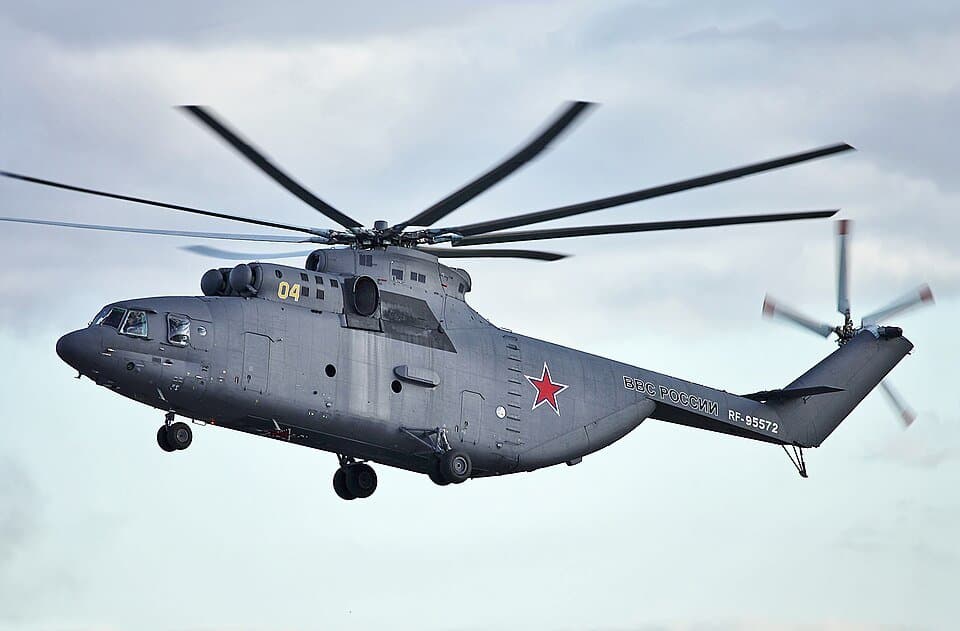
| Source measurement | — | The Mi-26 was designed to replace earlier Mi-6 and Mi-12 heavy lift helicopters and act as a heavy-lift helicopter for military and civil use, having twice the cabin space and payload of the Mi-6, then the world's largest and fastest production helicopter. The primary purpose of the Mi-26 was to transport military equipment such as 13-tonne (29,000 lb) amphibious armored personnel carriers and mobile ballistic missiles to remote locations after delivery by military transport aircraft such as the Antonov An-22 or Ilyushin Il-76 .[source]Mil Mi-26 · Design and development; only the objects and conditions stated in this passage The Mi-26 was the first factory-equipped helicopter with a single, eight-blade main lift rotor . It is capable of flight in the event of power loss by one engine (depending on aircraft mission weight) because of an engine load sharing system. While its empty weight is only slightly higher than the Mi-6's, the Mi-26 has a payload of up to 20 tonnes (44,000 lb). It is the second largest and heaviest helicopter ever constructed, after the experimental Mil V-12. The tail rotor has about the same diameter and thrust as the four-bladed main rotor fitted to the MD Helicopters MD 500 .[source]Mil Mi-26 · Design and development; only the objects and conditions stated in this passage The Mi-26's unique main gearbox is relatively light at 3,639 kg (8,023 lb) but can absorb 14,700 kilowatts (19,725 shp), which was accomplished using a non-planetary, split-torque design with quill shafts for torque equalization. The Mil Design Bureau designed the VR-26 transmission itself, due to Mil's normal gearbox supplier not being able to design such a gearbox. The gearbox housing is stamped aluminum. A split-torque design is also used in the 5,670 kg (12,500 lb) gearbox assembly on the American three-engine Sikorsky CH-53K King Stallion .[source]Mil Mi-26 · Design and development; only the objects and conditions stated in this passage As of 2024 , the Mi-26 still holds the Fédération Aéronautique Internationale world record for the greatest mass lifted by a helicopter to 2,000 metres (6,562 ft) – 56,768.8 kilograms (125,000 lb) on a flight in 1982.[source]Mil Mi-26 · Design and development; only the objects and conditions stated in this passage In July 2010 a proposed Russian-Chinese development of a 33-ton heavy-lift helicopter was announced.[source]Mil Mi-26 · Design and development; only the objects and conditions stated in this passage In October 1999, an Mi-26 was used to transport a 23-tonne (25-short-ton) block of frozen soil encasing a preserved, 23,000-year-old woolly mammoth ( Jarkov Mammoth ) from the Siberian tundra to a lab in Khatanga , Russia . Due to the weight of the load, the Mi-26 had to be returned to the factory afterward to check for airframe and rotor warping caused by the potential of structural over-stressing.[source]Mil Mi-26 · Operational history / Siberian Woolly Mammoth recovery; only the objects and conditions stated in this passage In early 2002, a civilian Mi-26 was leased to recover two U.S. Army MH-47E Chinook helicopters from a mountain in Afghanistan. While the second craft was too badly damaged to recover, the first was determined to be repairable and estimated to weigh 12 tonnes (26,000 lb) with fuel, rotors, and non-essential equipment removed. That weight exceeded the maximum payload of 9.1 tonnes (20,000 lb) at an altitude of 2,600 metres (8,500 ft) of the U.S. military's Sikorsky CH-53E .[source]Mil Mi-26 · Operational history / Afghanistan Chinook recovery; only the objects and conditions stated in this passage The Mi-26 was located through Skylink Aviation in Toronto , which had connections with a Russian company called Sportsflite that operated three civilian Mi-26 versions called "Heavycopters". One of the aircraft, aiding in construction and firefighting work in neighboring Tajikistan, was leased for $300,000; it lifted the Chinook, flew it to Kabul , then later to Bagram Air Base , Afghanistan to ship to Fort Campbell , Kentucky , U.S. for repairs. Six months later, a second U.S. Army CH-47 that had made a hard landing 160 kilometres (100 mi) north of Bagram at an altitude of 1,200 metres (3,900 ft) was recovered by another Sportsflite-operated Mi-26 Heavycopter.[source]Mil Mi-26 · Operational history / Afghanistan Chinook recovery; only the objects and conditions stated in this passage On 14 December 2010, an Indian Air Force Mi-26 crashed seconds after taking off from Jammu Airport , injuring all nine passengers. The aircraft fell from an altitude of about 15 metres (50 ft). The Indian Institute of Flight Safety released an investigation report that stated improper fastening of the truck inside caused an imbalance of the helicopter and led to the crash. The Mi-26 had been carrying machines from Konkan Railway to Jammu–Baramulla line project.[source]Mil Mi-26 · Operational history / Indian Air Force Mi-26 crash; only the objects and conditions stated in this passage Mi-26M[source]Mil Mi-26 · Variants; only the objects and conditions stated in this passage Firefighting version with internal 15,000 litres (4,000 US gal; 3,300 imp gal) fire retardant tank.[source]Mil Mi-26 · Variants; only the objects and conditions stated in this passage Capacity: **90 troops or 60 stretchers 20,000 kg (44,000 lb) cargo[source]Mil Mi-26 · Specifications (Mi-26); only the objects and conditions stated in this passage Length: 40.025 m (131 ft 4 in)[source]Mil Mi-26 · Specifications (Mi-26); only the objects and conditions stated in this passage Height: 8.145 m (26 ft 9 in)[source]Mil Mi-26 · Specifications (Mi-26); only the objects and conditions stated in this passage Empty weight: 28,200 kg (62,170 lb)[source]Mil Mi-26 · Specifications (Mi-26); only the objects and conditions stated in this passage Gross weight: 49,600 kg (109,349 lb)[source]Mil Mi-26 · Specifications (Mi-26); only the objects and conditions stated in this passage Max takeoff weight: 56,000 kg (123,459 lb)[source]Mil Mi-26 · Specifications (Mi-26); only the objects and conditions stated in this passage Powerplant: 2 × ZMKB Progress D-136 turboshaft engines, 8,500 kW (11,400 hp) each[source]Mil Mi-26 · Specifications (Mi-26); only the objects and conditions stated in this passage Main rotor diameter: 32 m (105 ft 0 in)[source]Mil Mi-26 · Specifications (Mi-26); only the objects and conditions stated in this passage Main rotor area: 804.25 m 2 (8,656.9 sq ft)[source]Mil Mi-26 · Specifications (Mi-26); only the objects and conditions stated in this passage Maximum speed: 295 km/h (183 mph, 159 kn)[source]Mil Mi-26 · Specifications (Mi-26); only the objects and conditions stated in this passage Cruise speed: 255 km/h (158 mph, 138 kn)[source]Mil Mi-26 · Specifications (Mi-26); only the objects and conditions stated in this passage Range: 500 km (310 mi, 270 nmi) with 7,700 kg (17,000 lb) cargo[source]Mil Mi-26 · Specifications (Mi-26); only the objects and conditions stated in this passage Ferry range: 1,920 km (1,190 mi, 1,040 nmi) (with auxiliary tanks)[source]Mil Mi-26 · Specifications (Mi-26); only the objects and conditions stated in this passage Service ceiling: 4,600 m (15,100 ft) operational, 1,524 metres (5,000 ft) HOGE at max. gross weight[source]Mil Mi-26 · Specifications (Mi-26); only the objects and conditions stated in this passage |
|---|
Maximum take-off; Mi-26 · Max takeoff weight
Single source