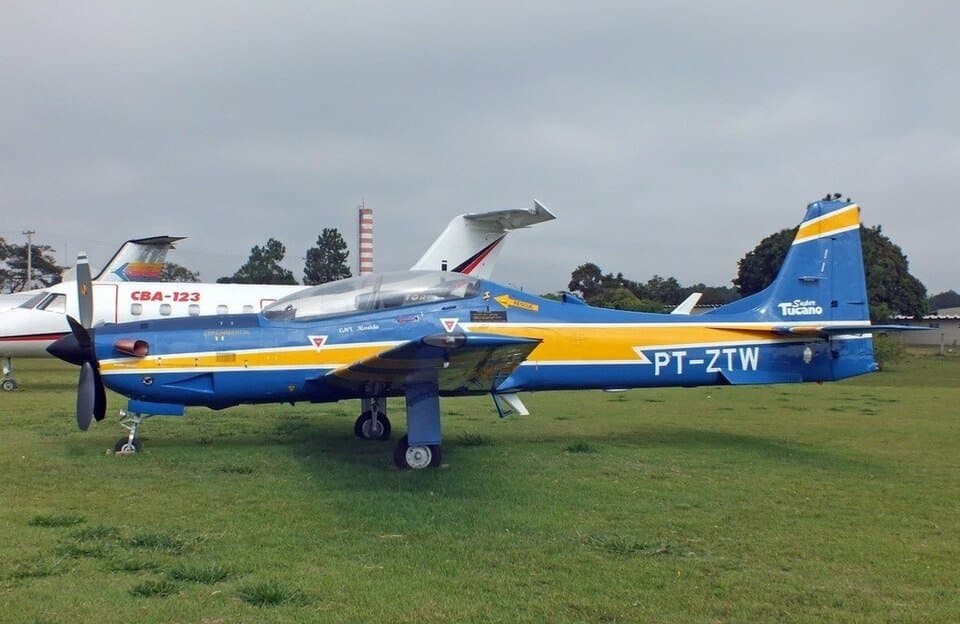

Credit
George Trussell · CC BY-SA 3.0 · Resized · CC BY-SA 3.0 · Source ↗ · Modified


Preparing your view.

At a glance
Measured figures
standard EMB 312 · Length
Single source9.86 m (32 ft 4 in)[source]
G 115E · Length
Configuration
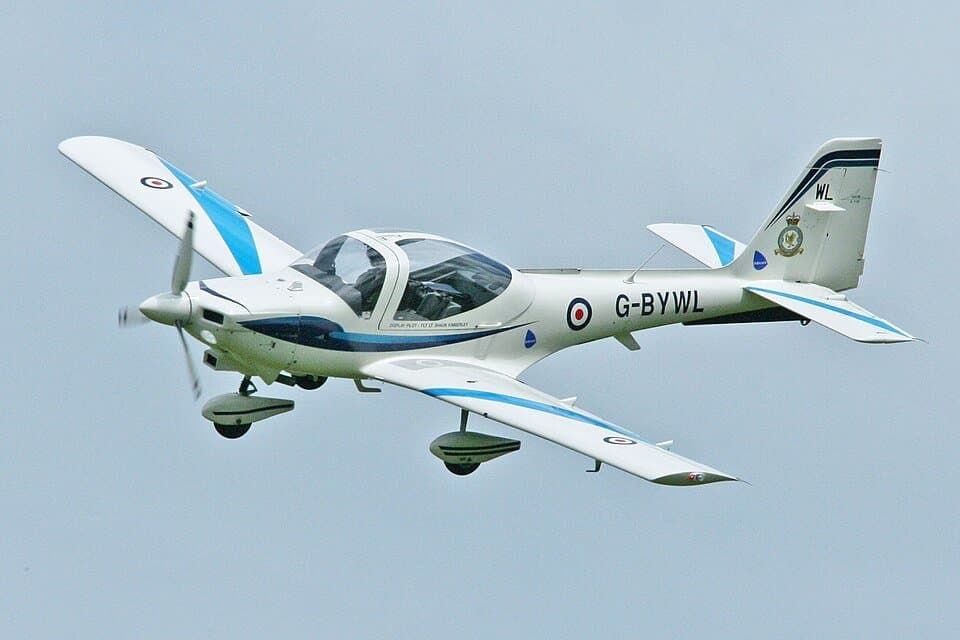
| Specification | Embraer EMB 312 Tucano | Grob G 115 |
|---|---|---|
| Type | Trainer and light attack aircraft[source] | Basic trainer[source] |
| National origin | Brazil[source] | — |
| Manufacturer | Embraer[source] | Grob Aircraft[source] |
| Status | In service[source] | active[source] |
7.79 m (25 ft 7 in)[source]
Empty; standard EMB 312 · Empty weight
Single sourceMaximum take-off; standard EMB 312 · Max takeoff weight
Single source1,810 kg (3,990 lb)[source]
3,175 kg (7,000 lb)[source]
Empty; G 115E · Empty weight
Single sourceMaximum take-off; G 115E · Max takeoff weight
Single sourceCruise; standard EMB 312 · Cruise speed
Single sourceMaximum; standard EMB 312 · at 4,115 metres (13,500 ft)
Single source458 km/h (285 mph, 247 kn) at 4,115 metres (13,500 ft)[source]
441 km/h (274 mph, 238 kn)[source]
Cruise; G 115E · long range cruising speed
Single sourceMaximum; G 115E · Maximum speed
Single sourcestandard EMB 312 · 1 × Pratt & Whitney Canada PT6A-25C turboprop engine
Single source1 × Pratt & Whitney Canada PT6A-25C turboprop engine, 552 kW (740 hp)[source]
G 115E · 1 × Lycoming AEIO-360-B1F/B 4-cylinder air-cooled horizontally-opposed piston engine
Single source1 × Lycoming AEIO-360-B1F/B 4-cylinder air-cooled horizontally-opposed piston engine, 130 kW (180 hp)[source]
G 115E · 1,050 ft/min
Single source5.3 m/s (1,050 ft/min)[source]
Bars compare reported quantities only. A larger figure does not make a system better; configurations and test conditions differ.
| Primary users |
|---|
Brazilian Air Force Egyptian Air Force Argentine Air Force Peruvian Air Force[source] |
Royal Air Force Egyptian Air Force Finnish Air Force Royal Navy Army Air Corps (UK)[source] |
| Number built | 637[source] | — |
|---|
| Manufactured | 1980–1996[source] | 1985–present[source] |
|---|
| Introduction date | September 1983[source] | 1999[source] |
|---|
| First flight | 16 August 1980[source] | November 1985[source] |
|---|
| Variant | Short Tucano[source] | — |
|---|
| Developed into | Embraer EMB 314 Super Tucano[source] | — |
|---|
| Airfoil | root: NACA 63A415 ; tip: NACA 63A212[source] | Eppler 696[source] |
|---|
| Fuel capacity | 694 litres (183 US gal; 153 imp gal)[source] | 143 L (31 imp gal; 38 US gal) usable[source] |
|---|
| Propellers | 4-bladed constant-speed propeller[source] | 3-bladed Hoffmann HO-V343K-V/183GY Constant-speed propeller , 1.83 m (6 ft 0 in) diameter[source] |
|---|
| Stall speed | 124 km/h (77 mph, 67 kn)[source] | 91 km/h (57 mph, 49 kn) (60 degree flap)[source] |
|---|
| Never exceed speed | 539 km/h (335 mph, 291 kn)[source] | 341 km/h (212 mph, 184 kn)[source] |
|---|
| g limits | + 6 /- 3[source] | + 6.0/ - 3.0[source] |
|---|
| Wing loading | 164 kg/m 2 (34 lb/sq ft)[source] | — |
|---|
| Guns | ** Gun pods :[source] | — |
|---|
| Rocket Machine Gun pod | RMP LC with a 12.7mm M3P and (4x) 70 mm[source] | — |
|---|
| Hardpoints | 4 under-wing pylons with a capacity of 1,000 kg (2,200 lb)[source] | — |
|---|
| Rockets | ** 127 mm HVAR ground rockets[source] | — |
|---|
| Rocket pods | SBAT (7x) 37 mm SBAT (7x) 70 mm[source] | — |
|---|
| Bombs | ** General-purpose bomb :[source] | — |
|---|
| Practice bomb | MK 76 (20 lb)[source] | — |
|---|
| Others | Ferry tanks: 2x 660 litres (170 US gal) or 330 litres (87 US gal)[source] | — |
|---|
| Ferry tanks | 2x 660 litres (170 US gal) or 330 litres (87 US gal)[source] | — |
|---|
| Source measurement | After all-jet training program trials during the 1950s, a variety of propeller-driven aircraft were used for pilot training during the 1960s and 1970s. In the 1970s, oil prices rapidly increased with the price of a crude oil barrel having risen from $3 in 1973 to $36 by 1980, deflating the Brazilian economy. At that time, the Brazilian Air Force operated the J69 -powerered Cessna T-37C , which was a 1950s design and following the 1970s energy crisis , became expensive to operate. In 1977, the Brazilian Air Force expressed a desire to replace the T-37, specifying that the replacement would need to be cheap to operate, designed to closely imitate the characteristics of jet aircraft and should have ejection seats.[source]Embraer EMB 312 Tucano · Development / Background; only the objects and conditions stated in this passage During the 1970s the Brazilian Air Force operated over 100 piston-powered Neiva Universal basic trainers. Encouraged to undertake a follow-on project known as "Universal II", Indústria Aeronáutica Neiva rolled out the prototype N621A (YT-25A) in 1975 with an extended body, four hard points, and the more powerful 400 hp Lycoming IO-720-A1A engine which drove a three-bladed Hartzell propeller. The YT-25B prototype, a further modified version with six external hard points, flew on 22 October 1978, but it did not meet requirements since the type was slower and smaller, and had side-by-side seats and a rear jump seat. Two years later, the company was acquired by Embraer. In 1973, Hungarian-Brazilian designer Joseph Kovács moved from Neiva to Embraer, bringing with him a number of studies based on the Neiva Universal, including a development of the tandem-seat, turboprop Carajá.[source]Embraer EMB 312 Tucano · Development / Background; only the objects and conditions stated in this passage Within 21 months of the contract being signed, the first prototype took flight on 16 August 1980, bearing the FAB serial 1300. The second prototype flew for the first time on 10 December 1980, implementing system accessibility enhancements to trim down maintenance overheads. Weapons captive flight trials resulted in the addition of a fin fillet to improve lateral stability . In August 1982, the second prototype was lost during clearance trials, in which full rudder was applied when the type exceeded the maximum designed diving speed ( Vd ) of 539 kilometres per hour (291 kn; 335 mph) by 64.7 kilometres per hour (34.9 kn; 40.2 mph), causing the leading edge skin to tear apart, followed by a −30 g dive, resulting in a complete disintegration of the airframe. Both the pilot and co-pilot were able to safely eject. The tailplane leading edge of the first prototype was modified, and requirements were cleared in 1983, after which it achieved a maximum diving speed of 607.5 kilometres per hour (328.0 kn; 377.5 mph).[source]Embraer EMB 312 Tucano · Development / Responding to requirements; only the objects and conditions stated in this passage It also researched a helicopter attack version designated as the "helicopter killer" or EMB-312H.[source]Embraer EMB 312 Tucano · Development / Further development / EMB-312H; only the objects and conditions stated in this passage The aircraft featured a 1.37-m (4.49-ft) fuselage extension with the addition of sections fore and aft of the cockpit to restore its centre of gravity and stability, a strengthened airframe, cockpit pressurization, and stretched nose to house the more powerful PT6A-67R (1.424 Shp) engine.[source]Embraer EMB 312 Tucano · Development / Further development / EMB-312H; only the objects and conditions stated in this passage Two new prototypes EMB-312H with the PT6A-68A (1.250 Shp) engine were built in 1993.[source]Embraer EMB 312 Tucano · Development / Further development / EMB-312H; only the objects and conditions stated in this passage The EMB-312H's design later served as a starting point for the EMB-314 Super Tucano , dubbed the ALX, and adopted by the Brazilian Air Force as the A-29.[source]Embraer EMB 312 Tucano · Development / Further development / EMB-312H; only the objects and conditions stated in this passage High manoeuvrability, stability at low speeds, and four underwing pylons providing for up to 1,000 kg (2,200 lb) of ordnance, allow the training aircraft to engage in tactical bombing campaigns in low-intensity conflict or counterinsurgency environments and in counternarcotics interceptions. The type can carry up to 694 litres (183 US gal) of fuel internally; additionally, two fuel tanks of 660 litres (170 US gal) can be fitted to underwing weapon stations for extended endurance, enabling up to nine flight hours.[source]Embraer EMB 312 Tucano · Design; only the objects and conditions stated in this passage As part of the FAB's four-year pilot-training program at the Academia da Força Aérea (AFA), the EMB-312 is flown on the last year as an advanced training vector. After flying 75 hours on the Neiva Universal basic training aircraft, the student pilots progress to fly 125 hours of advanced training on the Tucano, in which cadets learn to dominate the airplane with acrobatics, precision manoeuvring, instrumental flight, and fly-pasts. Brazilian Naval Aviation cadets are required to fly 100 hours on the Tucano at the AFA during the first stage of the three-year training program. According to a Brazilian Air Force brigadier, the AFA Tucanos are forecast to be withdrawn in 2022.[source]Embraer EMB 312 Tucano · Operational history / Brazil; only the objects and conditions stated in this passage On 14 April 2003, the type was used to shoot down an Aero Commander 500 with 7.62 mm (0.30 in) machine gun pods. The two Colombian occupants died during the crash, while 942 kilograms (2,077 lb) of cocaine were collected from the wreckage. In August 2010, a Piper Seneca aircraft coming from Colombia was tracked down by an AT-27. Five criminals were arrested and 550 kilograms (1,210 lb) of cocaine were seized. Three months later, a Tucano was used to intercept an aircraft with 550 kilograms (1,210 lb) of cocaine.[source]Embraer EMB 312 Tucano · Operational history / Honduras; only the objects and conditions stated in this passage In February 2012, the military of Honduras and Embraer began a study of the aging AT-27 cells for a possible reconditioning program. Later on that month, the Honduras defence minister disclosed that the reconditioning of six aircraft would cost US$10 million. In May of the same year, a Tucano intercepted an aircraft from which 400 kilograms (880 lb) of cocaine were seized. In the following month, a Honduran Tucano shot down a drug-smuggling, twin-engined prop Cessna over the Bay Islands , killing the two occupants, including an undercover DEA agent. Honduran law does not permit shooting down illegal flights, so the event led to the dismissal of the Honduran general who ordered the attack.[source]Embraer EMB 312 Tucano · Operational history / Honduras; only the objects and conditions stated in this passage Iraq bought 80 aircraft produced under license by Helwan, with deliveries being completed in 1987. Following the end of the Gulf and Iraq wars , Iraq had no EMB-312 in its inventory.[source]Embraer EMB 312 Tucano · Operational history / Iraq; only the objects and conditions stated in this passage The 3o Escuadrón de caza "Moros" in Asunción operates the Tucanos in counter-insurgency missions, forming the squads "Gamma" and "Omega" since 1996. In April 2011, Paraguayan Tucano fitted with 20 mm autocannon gun pods and ferry tanks were deployed at Mariscal Estigarribia Air Base to monitor illicit flights entering Paraguayan airspace from Bolivia.[source]Embraer EMB 312 Tucano · Operational history / Paraguay; only the objects and conditions stated in this passage The standard production model with fatigue life of 8,000 hours:[source]Embraer EMB 312 Tucano · Variants / EMB-312A; only the objects and conditions stated in this passage Also known as the Short Tucano , the EMB-312S is an uprated, licence-produced trainer version built at Short Brothers of Belfast in Northern Ireland for the Royal Air Force and licensed for export. The type features a more powerful Honeywell 820 kW (1,100 shp) Garrett TPE331 -12B engine with four-blade, variable-pitch propeller, custom avionics, structural strengthening expanding fatigue life to 12,000hr, two-piece canopy for better bird strike proofing, pressurized cabin , a ventral airbrake, aerodynamic changes to the wing, better wheel brakes, and an optional armament capability.[source]Embraer EMB 312 Tucano · Variants / EMB-312S; only the objects and conditions stated in this passage Brazilian Air Force – 102 EMB-312 Smoke Squadron (EDA) Brazilian Air Force Academy (Academia da Força Aérea) (AFA) First Squadron of the Fourteenth Aviation Group (1º/14º GAv) Esquadrão "Pampa" at Canoas Second Squadron of the Fourteenth Aviation Group (2º/14º GAv) at Canoas First Squadron of the First Aviation Group (1°/1° GAv) Esquadrão "Jambock" at Santa Cruz Second Squadron of the First Aviation Group (2°/1° GAv) Esquadrão "Pif-Faf" at Santa Cruz Third Squadron of the Third Aviation Group (3º/3º GAV) Esquadrão "Flecha" at Campo Grande Seventh Regional Air Command HQ Flight at Boa Vista Seventh Regional Air Command HQ Flight at Porto Velho Fifth Regional Air Command HQ Flight at Natal[source]Embraer EMB 312 Tucano · Operators; only the objects and conditions stated in this passage Honduran Air Force – 8 EMB-312, 2 in service 6 in storage . Escuela de Aviacion Militar (EAM)[source]Embraer EMB 312 Tucano · Operators; only the objects and conditions stated in this passage French Air Force : 50 EMB-312F from 1995 to 2009, 20 in 2007. Flying School at Salon-de-Provence Air Base[source]Embraer EMB 312 Tucano · Operators / Former operators; only the objects and conditions stated in this passage The Embraer EMB 312F MSN 312496, a former aircraft of the Armée de l'Air is on display in Musée de l'air et de l'espace from 2014 in a typical French livery.[source]Embraer EMB 312 Tucano · Aircraft on display; only the objects and conditions stated in this passage Short/Embraer EMB 312S prototype MSN 312007 G-BTUC (ex PP-ZTC) is on display at Ulster Aviation Society museum , Maze Long Kesh, Lisburn, Northern Ireland[source]Embraer EMB 312 Tucano · Aircraft on display; only the objects and conditions stated in this passage Length: 9.86 m (32 ft 4 in)[source]Embraer EMB 312 Tucano · Specifications (standard EMB 312); only the objects and conditions stated in this passage Wingspan: 11.14 m (36 ft 7 in)[source]Embraer EMB 312 Tucano · Specifications (standard EMB 312); only the objects and conditions stated in this passage Height: 3.4 m (11 ft 2 in)[source]Embraer EMB 312 Tucano · Specifications (standard EMB 312); only the objects and conditions stated in this passage Wing area: 19.4 m 2 (209 sq ft)[source]Embraer EMB 312 Tucano · Specifications (standard EMB 312); only the objects and conditions stated in this passage Empty weight: 1,810 kg (3,990 lb)[source]Embraer EMB 312 Tucano · Specifications (standard EMB 312); only the objects and conditions stated in this passage Max takeoff weight: 3,175 kg (7,000 lb)[source]Embraer EMB 312 Tucano · Specifications (standard EMB 312); only the objects and conditions stated in this passage Fuel capacity: 694 litres (183 US gal; 153 imp gal)[source]Embraer EMB 312 Tucano · Specifications (standard EMB 312); only the objects and conditions stated in this passage Powerplant: 1 × Pratt & Whitney Canada PT6A-25C turboprop engine, 552 kW (740 hp)[source]Embraer EMB 312 Tucano · Specifications (standard EMB 312); only the objects and conditions stated in this passage Maximum speed: 458 km/h (285 mph, 247 kn) at 4,115 metres (13,500 ft)[source]Embraer EMB 312 Tucano · Specifications (standard EMB 312); only the objects and conditions stated in this passage Cruise speed: 441 km/h (274 mph, 238 kn)[source]Embraer EMB 312 Tucano · Specifications (standard EMB 312); only the objects and conditions stated in this passage Stall speed: 124 km/h (77 mph, 67 kn)[source]Embraer EMB 312 Tucano · Specifications (standard EMB 312); only the objects and conditions stated in this passage Never exceed speed : 539 km/h (335 mph, 291 kn)[source]Embraer EMB 312 Tucano · Specifications (standard EMB 312); only the objects and conditions stated in this passage Range: 1,916 km (1,191 mi, 1,035 nmi)[source]Embraer EMB 312 Tucano · Specifications (standard EMB 312); only the objects and conditions stated in this passage Service ceiling: 8,750 m (28,700 ft)[source]Embraer EMB 312 Tucano · Specifications (standard EMB 312); only the objects and conditions stated in this passage Guns: ** Gun pods : AN/M-B machine gun 12,7 mm machine gun 7,62 mm machine gun (500 rounds) Rocket Machine Gun pod: RMP LC with a 12.7mm M3P and (4x) 70 mm[source]Embraer EMB 312 Tucano · Specifications (standard EMB 312); only the objects and conditions stated in this passage Hardpoints: 4 under-wing pylons with a capacity of 1,000 kg (2,200 lb)[source]Embraer EMB 312 Tucano · Specifications (standard EMB 312); only the objects and conditions stated in this passage Rockets: ** 127 mm HVAR ground rockets Rocket pods: SBAT (7x) 37 mm SBAT (7x) 70 mm[source]Embraer EMB 312 Tucano · Specifications (standard EMB 312); only the objects and conditions stated in this passage Bombs: ** General-purpose bomb : Mk 81 Mk 82 Practice bomb: MK 76 (20 lb)[source]Embraer EMB 312 Tucano · Specifications (standard EMB 312); only the objects and conditions stated in this passage Others: Ferry tanks: 2x 660 litres (170 US gal) or 330 litres (87 US gal)[source]Embraer EMB 312 Tucano · Specifications (standard EMB 312); only the objects and conditions stated in this passage | — |
|---|
| Aspect ratio | — | 8.2:1[source] |
|---|
| Country of origin | — | Deutschland[source]Country of design · Entwurfsland |
|---|