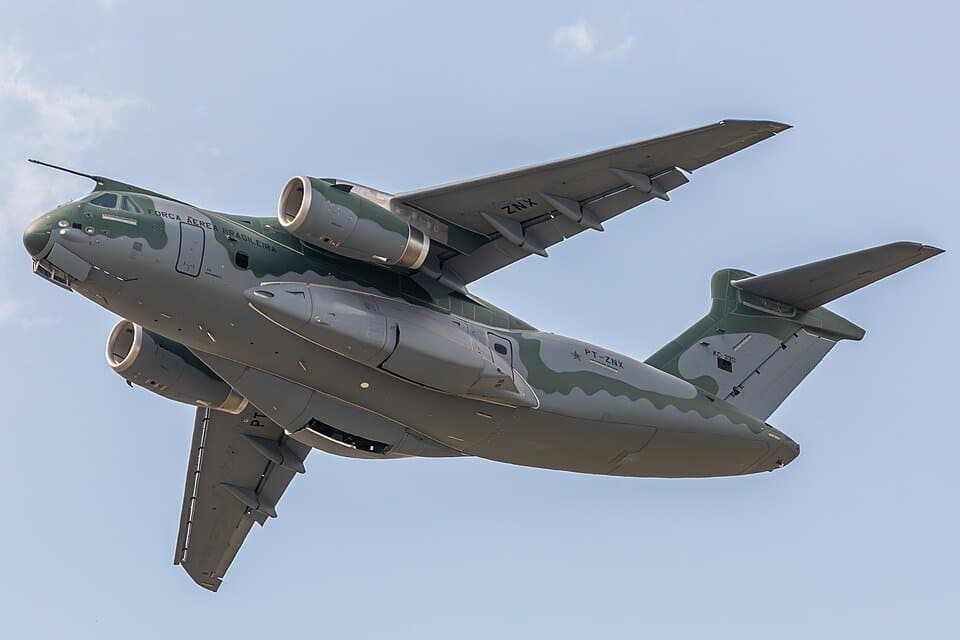

Reference photo · Configuration may differ
Credit
Matti Blume · CC BY-SA 4.0 · Resized · CC BY-SA 4.0 · Source ↗ · Modified


Preparing your view.

At a glance
Measured figures
C-390 Millennium · Length
Single source35.2 m (115 ft 6 in)[source]
Kawasaki C-1 · Length
Configuration
| Specification | Embraer C-390 Millennium | Kawasaki C-1 |
|---|---|---|
| Type | Military transport , aerial refuelling aircraft[source] | Military transport aircraft[source] |
| National origin | Brazil[source] | Japan[source] |
| Manufacturer | Embraer[source] | Kawasaki Heavy Industries[source] |
| Status | In service[source] | Retired |
29 m (95 ft 2 in)[source]
Empty; C-390 Millennium · Empty weight
Single sourceMaximum take-off; C-390 Millennium · Max takeoff weight
Single source35,000 kg (77,162 lb)[source]
86,999 kg (191,800 lb)[source]
Empty; Kawasaki C-1 · Empty weight
Single sourceMaximum take-off; Kawasaki C-1 · Max takeoff weight
Single sourceCruise; C-390 Millennium · Mach 0.8
Single sourceMaximum; C-390 Millennium · Mach 0.93
Single source988 km/h (614 mph, 533 kn) Mach 0.93[source]
870 km/h (540 mph, 470 kn) Mach 0.8[source]
Cruise; Kawasaki C-1 · at 10,670 m (35,010 ft) at 35,450 kg (78,150 lb)
Single sourceMaximum; Kawasaki C-1 · at 7,620 m (25,000 ft) at 35,450 kg (78,150 lb)
Single sourceC-390 Millennium · Range · source measurement 2
Single sourceC-390 Millennium · Range · source measurement 4
Single sourceC-390 Millennium · with 14,000 kg (31,000 lb) payload
Single sourceC-390 Millennium · with 23,000 kg (51,000 lb) payload
Single sourceC-390 Millennium · with 26,000 kg (57,000 lb) payload
Single sourceFerry; C-390 Millennium · Ferry range
Single sourceFerry; C-390 Millennium · max. with aux. fuel tanks
Single source5,020 km (3,120 mi, 2,710 nmi) ; with 14,000 kg (31,000 lb) payload 2,720 km; 1,690 mi (1,470 nmi) with 23,000 kg (51,000 lb) payload 2,000 km; 1,240 mi (1,080 nmi) with 26,000 kg (57,000 lb) payload[source]
6,240 km (3,880 mi, 3,370 nmi) – 8,460 km; 5,260 mi (4,570 nmi) max. with aux. fuel tanks[source]
5,020 km (3,120 mi, 2,710 nmi) ; with 14,000 kg (31,000 lb) payload[source]
Kawasaki C-1 · with max fuel & 2,300 kg (5,100 lb) payload
Single source3,353 km (2,083 mi, 1,810 nmi) with max fuel & 2,300 kg (5,100 lb) payload[source]
C-390 Millennium · 2 × IAE V2500 -E5 turbofan thrust each
Single source2 × IAE V2500 -E5 turbofan , 139.4 kN (31,330 lbf) thrust each[source]
Kawasaki C-1 · 2 × Pratt & Whitney JT8D -M-9 ( Mitsubishi -built) low-bypass turbofans thrust each
Single source2 × Pratt & Whitney JT8D -M-9 ( Mitsubishi -built) low-bypass turbofans , 64 kN (14,500 lbf) thrust each[source]
Kawasaki C-1 · Wing area
Single source120.5 m 2 (1,297 sq ft)[source]
Kawasaki C-1 · (3,494 ft/min) at sea level
Single source17.75 m/s (3,494 ft/min) at sea level[source]
Bars compare reported quantities only. A larger figure does not make a system better; configurations and test conditions differ.
| Primary users | Brazilian Air Force Portuguese Air Force Hungarian Air Force Czech Air Force[source] | — |
|---|
| Number built | 16 (including 3 prototypes)[source] | 31[source] |
|---|
| Manufactured | 2014–present[source] | — |
|---|
| Introduction date | 2019[source] | December 1974[source] |
|---|
| First flight | 3 February 2015[source] | 12 November 1970[source] |
|---|
| Capacity | 26,000 kg (57,000 lb) / 80 troops / 74 stretchers and 8 attendants / 66 paratroopers / 7 463L master pallets / 6 463L master pallets and 36 troops[source] | 8,000 kg (18,000 lb) normal payload[source] |
|---|
| Fuel capacity | 23,000 to 35,000 kg (50,700 to 77,160 lb) with 3 aux. fuel tanks[source] | 15,200 L (4,000 US gal; 3,300 imp gal) in 4 integral tanks in the wings[source] |
|---|
| Hardpoints | 3 with a capacity of POD Optical / IR Rafael Litening II / IFR Cobham 900E[source] | — |
|---|
| Useful lift | 26,000 kg (57,320 lb)[source] | — |
|---|
| Cargo hold length × height × width | 18.5 m × 3.0 m × 3.4 m (60.6 ft × 9.8 ft × 11.3 ft)[source] | — |
|---|
| Stall speed | 193 km/h (120 mph, 104 kn) IAS[source] | — |
|---|
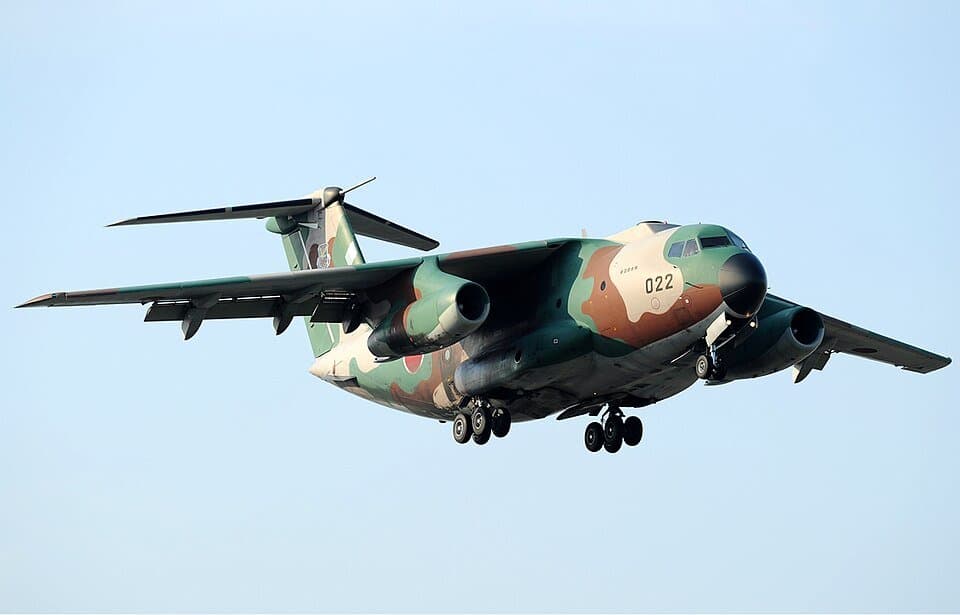
| Role | medium-size, twin-engine , jet-powered military transport aircraft[source] | twin-engined short-range military transport aircraft[source] |
|---|
| Source measurement | Work on the project began at Embraer during the mid-2000s, with early efforts centred around a conceptual derivative of the E190 jetliner of a similar size to the Lockheed C-130 Hercules . In May 2008, the Brazilian government invested R$ 800 million ( US$ 440M) in the project's development. In April 2009, Embraer received a $1.5 billion contract from the Brazilian Air Force for two prototypes. The aircraft was initially designated C-390 before changing to KC-390 in early 2011. At the 2011 Paris Air Show , Embraer announced plans to launch a stretched version of the aircraft as a civilian freighter. Partnerships were promptly formed with various other aerospace companies, including FAdeA , ENAER , OGMA , and Boeing . Major subcontractors in the aircraft's manufacturing include Aero Vodochody , BAE Systems , and Rockwell Collins .[source]Embraer C-390 Millennium · Lead; only the objects and conditions stated in this passage Utilizing turbofan jet engines, the C-390 can be configured to perform various conventional operations such as troop, VIP and cargo transportation, and more specialised logistical operations such as aerial refuelling as a tanker. It can carry payloads of up to 26 t (57,000 lb)—such as two fully-tracked M113 armored personnel carriers , one Boxer armoured vehicle, a Sikorsky H-60 helicopter, 74 litters with life-support equipment, up to 80 soldiers or 66 paratroopers with full gear—and loads of up to 42,000 lb (19 t) can be air dropped . Each aircraft costs around € 80 million as of 2024.[source]Embraer C-390 Millennium · Lead; only the objects and conditions stated in this passage By 2006, Embraer was studying a military tactical transport design of a similar size to the Lockheed C-130 Hercules , to be powered by 17,000–22,000 lbf (75.6–98 kN) jet engines, such as the Pratt & Whitney PW6000 and Rolls-Royce BR715 . In April 2007, Embraer publicly stated that it was studying a medium-size airlifter. Referred to by the company designation C-390 , this transport aircraft was said to incorporate many of the technological solutions present on the Embraer E-Jet series and feature a rear ramp for the loading and unloading of a wide range of cargo.[source]Embraer C-390 Millennium · Development / Studies; only the objects and conditions stated in this passage In March 2008, the Brazilian government planned to invest about R$ 60 million (equivalent to US$ 33 million ) in the aircraft's initial development. Simultaneously, the Brazilian Air Force was in the process of finalizing an initial purchase contract for between 22 and 30 aircraft, while Embraer was negotiating with possible partners on the programme. Two months later, the Brazilian Congress released R$800 million (US$440M) to be invested in the project and fund the aircraft's development. Around this time, the media claimed that the aircraft would be operated by the Brazilian Air Force and the Army and Navy , and that there were unconfirmed sales to other government agencies in the works.[source]Embraer C-390 Millennium · Development / Studies; only the objects and conditions stated in this passage In March 2010, Embraer drew up a development schedule, upon which the first prototype aircraft was scheduled to be delivered in late 2014. In July 2010, at the Farnborough Airshow , the Brazilian Air Force announced its intent to order 28 C-390s, while Embraer announced an increase in the aircraft's cargo capacity to 21 t (46,000 lb). At the 2011 Paris Air Show , Embraer announced plans to launch a stretched version of the C-390 focused on the civil market for freighters sometime around 2018. It estimated that the company would receive 200–250 orders over a 10-year period. To increase internal capacity, two plugs will be added fore and aft of the centre fuselage section, which would also provide a new side cargo door.[source]Embraer C-390 Millennium · Development / Program launch; only the objects and conditions stated in this passage In April 2012, the American aerospace giant Boeing and Embraer signed a cooperation agreement. Two months later, an agreement was signed by the two companies to collaborate on the development of the C-390, and possibly extending to sales as well. In June 2013, Boeing agreed to market the C-390 in the US, UK, and Middle East, building on the June 2012 MoU. In November 2019, it was announced that Boeing and Embraer were to form a new joint venture company to promote and develop new markets for the C-390 Millennium . This new company, Boeing Embraer – Defense , was to have its ownership divided between a 51% stake held by Embraer and 49% by Boeing. It was to begin operations following the granting of regulatory approvals and the satisfaction of closing conditions. However, in April 2020, Boeing terminated the planned joint ventures with Embraer.[source]Embraer C-390 Millennium · Development / Partnerships; only the objects and conditions stated in this passage In July 2015, the company announced a two-year delay in the flight test program, citing the devaluation of the Brazilian currency and government spending cuts. However, a second test flight took place at Gavião Peixoto on 26 October 2015. By February 2016, the first prototype had logged more than 100 hours of flight. Following the resumption of flight-testing, the manufacturer expected to certify the C-390 sometime in 2017 and begin deliveries in 2018. The eight months between test flights were used to conduct ground vibration tests to validate aeroelastic models , as well as avionics , mission, landing gear and electric and hydraulic flight control system testing. Embraer reported good availability for testing, sometimes conducting two flights per day. The aircraft was tested to the limits of speed, Mach number , and altitude, as well as all slats , flaps and landing gear positions.[source]Embraer C-390 Millennium · Development / Flight testing; only the objects and conditions stated in this passage On 17 October 2017, the first prototype (PT-ZNF) made an uncommanded descent from 20,000 ft to 3,100 ft at 4,500 ft/min. In December 2017, as the two prototypes accumulated over 1,500 flight hours and laboratory testing over 40,000 hours, initial operating capability was reached, while full operational capability was expected in 2018. On 5 May 2018, the first prototype (PT-ZNF) ran off the runway during a ground test in Gaviao Peixoto, Brazil. The first production C-390, which was the third aircraft to be built including the prototypes, made its first flight on 6 October 2018.[source]Embraer C-390 Millennium · Development / Flight testing; only the objects and conditions stated in this passage The Embraer C-390 Millennium is a mid-sized utility transport aircraft. Its design permits flexible operations. Both the internal and external configuration of the aircraft can be rapidly interchanged to accommodate different mission roles due the modular design adopted since the aircraft concept for all missions systems. It incorporates modern technology and mission software to aid crews in carrying out operations. The cockpit has head-up displays for the enhanced vision system with four cameras and Rockwell Collins Pro Line Fusion commercial avionics. The C-390 can provide inflight refueling to other aircraft through two wing-mounted probe and drogue pods from Cobham plc . These can deliver fuel at up to 1,500 L (400 US gal) per minute from a 35 t (77,000 lb) total fuel capacity, between 120 and 300 kn (220 and 560 km/h) and from 2,000 to 32,000 ft (610 to 9,750 m).[source]Embraer C-390 Millennium · Design; only the objects and conditions stated in this passage The aircraft is powered by a pair of IAE V2500 -E5 turbofan engines, which are mounted forward on the high wing . This wing features an anhedral angle , slats , and High-lift devices able to deflect up to 40°. The landing gear is equipped with low-pressure tires, two 5.9 bar (85 psi) on the nose and four 7.2 bar (105 psi) on either side bogies , which facilitate the aircraft's use upon soft, unpaved ground, such as austere airstrips, or damaged runways. The C-390 has a cruising speed of Mach 0.8 which, according to Embraer, enables payloads to be transported faster than any other airplane in the medium airlift market. It can attain a controlled descend rate of 9,000 ft/min (2,700 m/min) at its 300 kn (560 km/h) maximum IAS through a combination of extended slats, idle thrust, and flight spoilers extended to 40°. When its flaps are fully deployed at 40 degrees, it has a stall speed of 104 kn (193 km/h) IAS.[source]Embraer C-390 Millennium · Design; only the objects and conditions stated in this passage The aircraft is equipped with fully fly-by-wire flight controls combined with active sidesticks , which reduces the crew's workload over conventional counterparts and permits load factors up to 3g. An autothrottle system is installed. The navigation systems, which were largely supplied by Thales Group , include an Inertial Navigation System (INS), GPS , and Collision Avoidance System (TCAS) transponder. It is fitted with SELEX Galileo 's Gabbiano tactical radar, capable of GMTI , SAR , ISAR , SART modes amongst others. For self-defense purposes, an Elbit Systems -supplied directional infrared countermeasures suite is typically installed. An integrated onboard maintenance system actively monitors the health of the overall aircraft and various subsystems at all times.[source]Embraer C-390 Millennium · Design; only the objects and conditions stated in this passage The hold of the C-390 has a length of 18.5 m (61 ft), width of 3.45 m (11.3 ft), and height of 2.95 m (9 ft 8 in), and is primarily accessed via a large rear ramp built into the tail. It can carry payloads of up to 26 t (57,000 lb). This allows for the carriage of either two fully-tracked M113 armored personnel carriers , one Boxer or Brazilian VBTP-MR Guarani wheeled armoured vehicle, a Sikorsky H-60 helicopter, 74 litters with life-support equipment, up to 80 soldiers or 66 paratroopers with full gear. Loads of up to 42,000 lb (19 t) can be air dropped . A cargo handling and aerial delivery system, produced by DRS Defense Solutions, is incorporated. Typical amenities present in the hold include a galley , an accessibility-friendly toilet, automatic temperature control, and noise/vibration mitigation measures. Embraer have stated that considerable attention was paid to passenger comfort.[source]Embraer C-390 Millennium · Design; only the objects and conditions stated in this passage In the first 3.5 years of operation, the C-390 in the FAB totaled more than 8,200 flight hours with 6,000 flights, the technical availability was around 80% and the mission completion rate was 99.5%, according to Embraer data and the FAB.[source]Embraer C-390 Millennium · Operational history / Brazil; only the objects and conditions stated in this passage Following the 2020 Beirut explosion , a C-390 and an Embraer 190 VC-2 were sent with around six tons of medicines, food and health equipment to provide emergency care. It was the first international mission of the aircraft in FAB service.[source]Embraer C-390 Millennium · Operational history / Brazil; only the objects and conditions stated in this passage A single C-390 flew to Ushuaia carrying spare parts in support of a FAB C-130 that was on an Antarctic operation. In the 2022 Russian invasion of Ukraine , a KC-390 and a VC-99B Legacy were sent with a mission to rescue Brazilian nationals and other countries. The mission also brought around 12 tons of humanitarian aid to Ukraine. The mission rescued national, Ukrainian, Argentine and Colombian citizens, all of whom were taken to Brazil.[source]Embraer C-390 Millennium · Operational history / Brazil; only the objects and conditions stated in this passage As of June 2022, a C-390 from the Fat Squadron (1st/1st GT) of the FAB participated for the first time in the Brazilian Antarctic Campaign, dropping supply loads for the Comandante Ferraz Antarctic Station . The C-390 participated in 2022 in Operation Cooperation VII in Colombia, operating on runways of up to 2,100 meters, at altitudes simulating missions of humanitarian assistance and paratrooper launches.[source]Embraer C-390 Millennium · Operational history / Brazil; only the objects and conditions stated in this passage Slovakia: The Slovak Air Force selected the C-390 in December 2024. Negotiations for the purchase of three aircraft are to begin.[source]Embraer C-390 Millennium · Marketing and potential orders; only the objects and conditions stated in this passage Colombian Aerospace Force – On 30 March 2026, Colombian President Gustavo Petro ordered the purchase for two C-390 aircraft to replace two C-130H aircraft which were out of service. Petro also named the C-390, along with Airbus A400 Atlas and the Lockheed Martin C-130J Super Hercules, as contenders to replace the entirety of the C-130H Hercules fleet. In August 2026, the order for two KC-390s was confirmed with orders expected between 2029 and 2030.[source]Embraer C-390 Millennium · Operators / Future operators; only the objects and conditions stated in this passage Hellenic Air Force – three C-390s ordered in 2026, through a bilateral agreement with Portugal . Greece is to receive the first C-390 in 2027. These aircraft are to operate as mobile hospitals, personnel carriers, and tanker aircraft. This is the first time Greece has acquired aerial refuelling aircraft.[source]Embraer C-390 Millennium · Operators / Future operators; only the objects and conditions stated in this passage Royal Netherlands Air and Space Force – selected the C-390 in 2022 with five airlifters ordered to replace its C-130H . Contract signed in July 2024 with deliveries to begin at the end of 2027. During the 2025 Paris Air Show, it was announced that the Netherlands ordered one aeromedical module unit, a self-contained, air-transportable and fully compatible with the C-390 cargo handling system roll-on/roll-off system. It will enhance the Netherlands' (and its partners Austria and Sweden) ability to conduct humanitarian, disaster relief and military medical operations abroad. The contract allows for potentially seven more of these modules for the three C-390 partners.[source]Embraer C-390 Millennium · Operators / Future operators; only the objects and conditions stated in this passage Swedish Air Force – selected in November 2024, four units ordered plus an additional seven in option. The order is part of a trilateral agreement between Sweden, Austria and the Netherlands, including an option for seven additional aircraft.[source]Embraer C-390 Millennium · Operators / Future operators; only the objects and conditions stated in this passage Capacity: 26,000 kg (57,000 lb) / 80 troops / 74 stretchers and 8 attendants / 66 paratroopers / 7 463L master pallets / 6 463L master pallets and 36 troops[source]Embraer C-390 Millennium · Specifications (C-390 Millennium); only the objects and conditions stated in this passage Length: 35.2 m (115 ft 6 in)[source]Embraer C-390 Millennium · Specifications (C-390 Millennium); only the objects and conditions stated in this passage Wingspan: 35.05 m (115 ft 0 in)[source]Embraer C-390 Millennium · Specifications (C-390 Millennium); only the objects and conditions stated in this passage Height: 11.84 m (38 ft 10 in)[source]Embraer C-390 Millennium · Specifications (C-390 Millennium); only the objects and conditions stated in this passage Empty weight: 35,000 kg (77,162 lb)[source]Embraer C-390 Millennium · Specifications (C-390 Millennium); only the objects and conditions stated in this passage Max takeoff weight: 86,999 kg (191,800 lb)[source]Embraer C-390 Millennium · Specifications (C-390 Millennium); only the objects and conditions stated in this passage Fuel capacity: 23,000 to 35,000 kg (50,700 to 77,160 lb) with 3 aux. fuel tanks[source]Embraer C-390 Millennium · Specifications (C-390 Millennium); only the objects and conditions stated in this passage Useful lift: 26,000 kg (57,320 lb)[source]Embraer C-390 Millennium · Specifications (C-390 Millennium); only the objects and conditions stated in this passage Cargo hold length × height × width : 18.5 m × 3.0 m × 3.4 m (60.6 ft × 9.8 ft × 11.3 ft)[source]Embraer C-390 Millennium · Specifications (C-390 Millennium); only the objects and conditions stated in this passage Powerplant: 2 × IAE V2500 -E5 turbofan , 139.4 kN (31,330 lbf) thrust each[source]Embraer C-390 Millennium · Specifications (C-390 Millennium); only the objects and conditions stated in this passage Maximum speed: 988 km/h (614 mph, 533 kn) Mach 0.93[source]Embraer C-390 Millennium · Specifications (C-390 Millennium); only the objects and conditions stated in this passage Cruise speed: 870 km/h (540 mph, 470 kn) Mach 0.8[source]Embraer C-390 Millennium · Specifications (C-390 Millennium); only the objects and conditions stated in this passage Stall speed: 193 km/h (120 mph, 104 kn) IAS[source]Embraer C-390 Millennium · Specifications (C-390 Millennium); only the objects and conditions stated in this passage Range: 5,020 km (3,120 mi, 2,710 nmi) ; with 14,000 kg (31,000 lb) payload 2,720 km; 1,690 mi (1,470 nmi) with 23,000 kg (51,000 lb) payload 2,000 km; 1,240 mi (1,080 nmi) with 26,000 kg (57,000 lb) payload[source]Embraer C-390 Millennium · Specifications (C-390 Millennium); only the objects and conditions stated in this passage Ferry range: 6,240 km (3,880 mi, 3,370 nmi) – 8,460 km; 5,260 mi (4,570 nmi) max. with aux. fuel tanks[source]Embraer C-390 Millennium · Specifications (C-390 Millennium); only the objects and conditions stated in this passage Service ceiling: 11,000 m (36,000 ft)[source]Embraer C-390 Millennium · Specifications (C-390 Millennium); only the objects and conditions stated in this passage | Development of the C-1 commenced in 1966 in response to a requirement from the JASDF, which sought an indigenous jet-powered replacement for its aging Second World War –era Curtiss C-46 Commando transport fleet. First flown on 12 November 1970, quantity production of the type commenced during the following year. The C-1 has formed the backbone of the JASDF's transport capability throughout the latter half of the twentieth century and the initial years of the twenty-first century as well. During the 2010s, Kawasaki developed a newer, larger, and longer-range airlifter, the Kawasaki C-2 , which will eventually replace the JASDF's C-1 fleet entirely.[source]Kawasaki C-1 · Lead; only the objects and conditions stated in this passage In terms of its basic configuration, the C-1 is a twin-engine medium-range airlifter, somewhat resembling the larger Lockheed C-141 Starlifter . It is powered by a pair of Pratt & Whitney JT8D -M-9 low-bypass turbofan engines, which were locally manufactured under license by Mitsubishi, each capable of generating up to 64 kN (14,500 lbf) of thrust. In terms of payload capacity, a single C-1 could carry up to 80 fully-equipped troops, 45 paratroopers , or 36 stretcher-bound personnel, in addition to bulky cargo, including a whole truck or a pair of jeeps , which would be loaded via a ramp deployed at the airlifter's rear. It was designed to be typically operated by a crew of five, comprising two pilots, a flight engineer , a navigator , and a loadmaster. The C-1 incorporates a high-lift system, which includes aerodynamic features such as a leading edge slat and a four-stage Fowler flap , facilitates a high level of short takeoff and landing (STOL) performance, while day-and-night all-weather operations are achieved via the application of numerous electronic navigation systems.[source]Kawasaki C-1 · Design and development; only the objects and conditions stated in this passage The maximum range of C-1 caused a problem after the island of Okinawa was returned to Japan from the United States; the airlifter was unable to fly directly to Okinawa from most parts of the Japanese home islands. This may have been a factor in the decision to reduce the planned procurement of the C-1 in favour of the American-built C-130H Hercules utility transport aircraft instead, which entered service with the JASDF's 401st Tactical Airlift Squadron in 1989. Another reason for the curtailment was the enactment of general cutbacks upon various military programmes and procurement initiatives during the 1970s. |
|---|
| Primary user | — | Japan Air Self-Defense Force[source] |
|---|
| Retired | — | 15 March 2025[source] |
|---|
| Aspect ratio | — | 7.8[source] |
|---|
| Wing loading | — | 321.2 kg/m 2 (65.8 lb/sq ft)[source] |
|---|
| Thrust/weight | — | 0.003 kN/kg (0.34 lbf/lb)[source] |
|---|
| Country of origin | — | Japan[source]Inventory Origin column; table 2, row 41, cell 2; revision 1359403478 |
|---|
806 km/h (501 mph, 435 kn) at 7,620 m (25,000 ft) at 35,450 kg (78,150 lb)[source]
657 km/h (408 mph, 355 kn) at 10,670 m (35,010 ft) at 35,450 kg (78,150 lb)[source]
The last five C-1s ordered were fitted with an additional 4,730-litre fuel tank.[source]Kawasaki C-1 · Variants; only the objects and conditions stated in this passage
Two C-1s of the 401st Tactical Airlift Squadron crashed near Toba, Mie when the lead two airplanes of a formation of 5 en route from Komaki Air Base to Iruma Air Base flew into a hill while flying in low visibility at low altitude. A third airplane narrowly avoided also crashing and struck trees, but was able to return to Komaki Air Base. Fourteen personnel were killed in these two aircraft, six personnel in airplane 68-1015 and eight in aircraft 58–1009.[source]Kawasaki C-1 · Accidents; only the objects and conditions stated in this passage
A C-1 crashed into the sea of Japan's west coast during a test flight with five personnel on board. There were no survivors.[source]Kawasaki C-1 · Accidents; only the objects and conditions stated in this passage
Capacity: 8,000 kg (18,000 lb) normal payload[source]Kawasaki C-1 · Specifications (Kawasaki C-1); only the objects and conditions stated in this passage
Length: 29 m (95 ft 2 in)[source]Kawasaki C-1 · Specifications (Kawasaki C-1); only the objects and conditions stated in this passage
Wingspan: 30.6 m (100 ft 5 in)[source]Kawasaki C-1 · Specifications (Kawasaki C-1); only the objects and conditions stated in this passage
Height: 9.99 m (32 ft 9 in)[source]Kawasaki C-1 · Specifications (Kawasaki C-1); only the objects and conditions stated in this passage
Wing area: 120.5 m 2 (1,297 sq ft)[source]Kawasaki C-1 · Specifications (Kawasaki C-1); only the objects and conditions stated in this passage
Empty weight: 23,220 kg (51,191 lb)[source]Kawasaki C-1 · Specifications (Kawasaki C-1); only the objects and conditions stated in this passage
Max takeoff weight: 38,700 kg (85,319 lb)[source]Kawasaki C-1 · Specifications (Kawasaki C-1); only the objects and conditions stated in this passage
Powerplant: 2 × Pratt & Whitney JT8D -M-9 ( Mitsubishi -built) low-bypass turbofans , 64 kN (14,500 lbf) thrust each[source]Kawasaki C-1 · Specifications (Kawasaki C-1); only the objects and conditions stated in this passage
Maximum speed: 806 km/h (501 mph, 435 kn) at 7,620 m (25,000 ft) at 35,450 kg (78,150 lb)[source]Kawasaki C-1 · Specifications (Kawasaki C-1); only the objects and conditions stated in this passage
Cruise speed: 657 km/h (408 mph, 355 kn) at 10,670 m (35,010 ft) at 35,450 kg (78,150 lb)[source]Kawasaki C-1 · Specifications (Kawasaki C-1); only the objects and conditions stated in this passage
Range: 3,353 km (2,083 mi, 1,810 nmi) with max fuel & 2,300 kg (5,100 lb) payload[source]Kawasaki C-1 · Specifications (Kawasaki C-1); only the objects and conditions stated in this passage
Service ceiling: 11,580 m (37,990 ft)[source]Kawasaki C-1 · Specifications (Kawasaki C-1); only the objects and conditions stated in this passage
Rate of climb: 17.75 m/s (3,494 ft/min) at sea level[source]Kawasaki C-1 · Specifications (Kawasaki C-1); only the objects and conditions stated in this passage