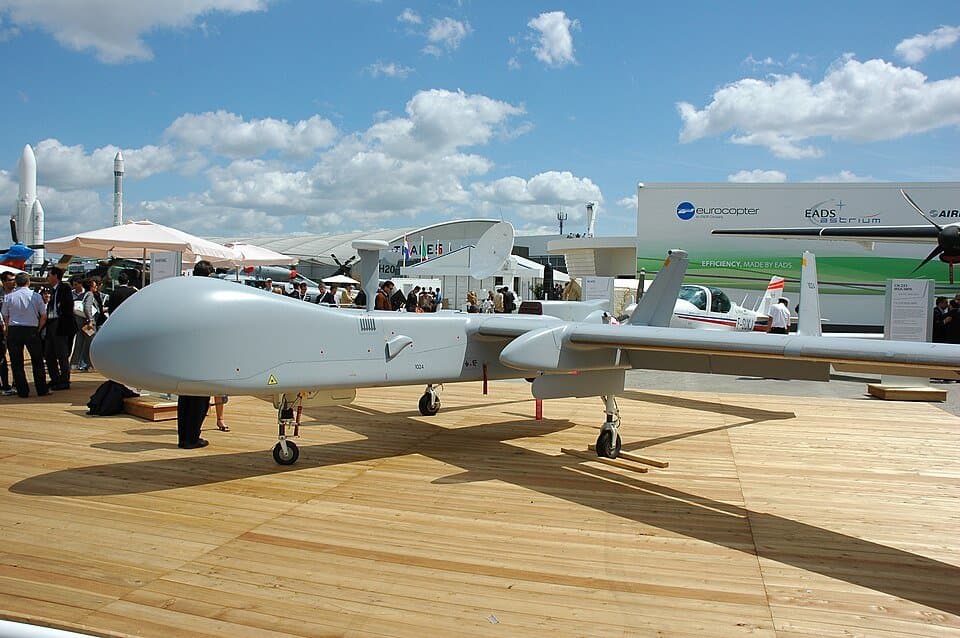


Credit
Calips · CC BY-SA 3.0 · Resized · CC BY-SA 3.0 · Source ↗ · Modified


Preparing your view.

At a glance
EADS Harfanglarger figure on 6 of 6
True scale
Side by side. From every angle. A human reference for perspective.
3.25 MB · Loads when you open it| Model | Length | Width / span | Height |
|---|---|---|---|
| EADS Harfang | ≈ 9.3 m | ≈ 16.6 m (Width) | ≈ 2.23 m |
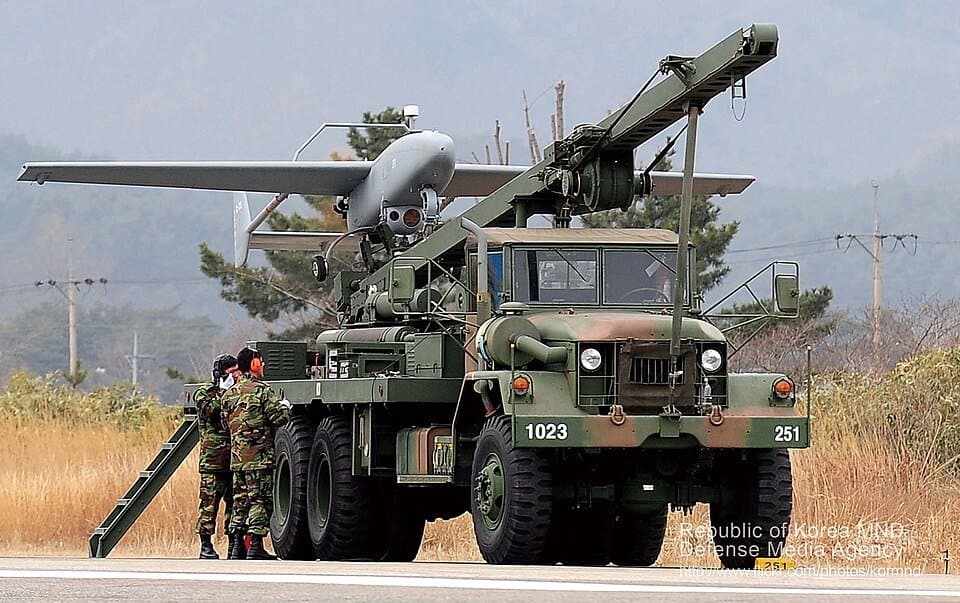
| KAI RQ-101 Songgolmae | ≈ 4.7 m | ≈ 5.73 m (Width) | ≈ 1.497 m |
Scaled uniformly to the sourced length of 9.3 m. The shape was turned square to the axes; the wing panels were fitted to the sourced 16.6 m wingspan. Not an official model or a measured survey.
ForceTally · All rights reserved
Scaled uniformly to the sourced length of 4.7 m. The shape was turned square to the axes. Not an official model or a measured survey.
ForceTally · All rights reserved
The human reference is a generic 1.75 m figure. Models describe external size, not combat performance.
Measured figures
Length
Single source9.3 m (30 ft 6 in)[source]
Length
Single sourceConfiguration
| Specification | EADS Harfang | KAI RQ-101 Songgolmae |
|---|---|---|
| Crew | — | Unmanned[source] |
| Type | Unmanned surveillance and reconnaissance aerial vehicle[source] | Unmanned surveillance and reconnaissance aerial vehicle[source] |
| Manufacturer | EADS and IAI[source] | Korea Aerospace Industries[source] |
| Primary users | French Air Force (historical) Royal Moroccan Air Force[source] | — |
| Number built | 4 |
KAI RQ-101 Songgolmaelarger figure on 0 of 6
Counts only measures both sources give with the same scope. A larger figure is not a better system.
4.7 m (15 ft 5 in)[source]
Maximum; Maximum speed
Single source207 km/h[source]EADS Harfang / Système intérimaire de drone MALE · own French article infobox maximum speed; not Eagle 2 or parent Heron
1 × Rotax 914F 4-cylinder turbo-charged four-stroke horizontally-opposed piston engine with air-cooled cylinders and liquid-cooled cylinder heads
Single source1 × Rotax 914F 4-cylinder turbo-charged four-stroke horizontally-opposed piston engine with air-cooled cylinders and liquid-cooled cylinder heads., 86 kW (115 hp)[source]
1 × propeller engine 52 shp (
Single source1 × propeller engine 52 shp (39 kW)[source]
Bars compare reported quantities only. A larger figure does not make a system better; configurations and test conditions differ.
| — |
| Introduction date | June 2008[source] | 2002[source] |
|---|
| First flight | 9 September 2006 at Istres-Le Tubé airbase 125[source] | 1993[source] |
|---|
| Developed from | IAI Heron[source] | — |
|---|
| Propellers | 2-bladed constant-speed pusher propeller[source] | — |
|---|
| Role | unmanned aerial vehicle[source] | — |
|---|
| Source measurement | The French Air Force ordered three planes and two ground control stations. The SIDM entered service in June 2008 in the Drone Experimentation Squadron 1/330 Adour, in Cognac, a unit of the Centre des expérimentations militaires . A four-phase programme took place between 2008 and 2009:[source]EADS Harfang · Development; only the objects and conditions stated in this passage The Harfang drone is an unmanned airplane propelled by a rear-mounted turbo-supercharged water-cooled flat-four engine, driving a pusher propeller. It features a flapped high wing with anti-icing system, and has a twin boom tail with two vertical surfaces. With a take-off mass of 1,200 kilograms (2,600 lb), the Harfang can carry a 250-kilogram (550 lb) payload to height of 7,500 metres (24,600 ft) for a duration of 24 hours.[source]EADS Harfang · Design / Drones; only the objects and conditions stated in this passage A line-of-sight link allows for direct communication up to 150 to 200 kilometres away. Longer ranges utilise a directional antenna and geostationary satellites. The Very High Frequency and Ultra high frequency communication relay provides for links to ground units and air traffic control.[source]EADS Harfang · Design / Control station; only the objects and conditions stated in this passage On 5–6 June 2013, Harfang UAVs carried out their hundredth sortie during Operation Serval in Mali . Deployed since 17 January, Harfangs flew 1,600 hours during the day and night. From January 2013 to September 2013, the Harfang flew 2,000 hours in support of French operations.[source]EADS Harfang · Operational history; only the objects and conditions stated in this passage Eagle 1 : first production versions, first flight on 2 June 2003 in Israel.[source]EADS Harfang · Variants; only the objects and conditions stated in this passage Length: 9.3 m (30 ft 6 in)[source]EADS Harfang · Specifications; only the objects and conditions stated in this passage Wingspan: 16.6 m (54 ft 6 in)[source]EADS Harfang · Specifications; only the objects and conditions stated in this passage Empty weight: 657 kg (1,448 lb)[source]EADS Harfang · Specifications; only the objects and conditions stated in this passage Max takeoff weight: 1,250 kg (2,756 lb)[source]EADS Harfang · Specifications; only the objects and conditions stated in this passage Powerplant: 1 × Rotax 914F 4-cylinder turbo-charged four-stroke horizontally-opposed piston engine with air-cooled cylinders and liquid-cooled cylinder heads., 86 kW (115 hp)[source]EADS Harfang · Specifications; only the objects and conditions stated in this passage Range: 1,000 km (620 mi, 540 nmi)[source]EADS Harfang · Specifications; only the objects and conditions stated in this passage Service ceiling: 7,620 m (25,000 ft)[source]EADS Harfang · Specifications; only the objects and conditions stated in this passage | — |
|---|
| Country of origin | France / Israel[source]Inventory Origin column; table 1, row 42, cell 2; revision 1377359948 France / Israel[source]Inventory Origin column; table 1, row 42, cell 2; revision 1377359948 | — |
|---|
| National origin | — | South Korea[source] |
|---|
| Designer | — | Agency for Defense Development Korea Aerospace Industries[source] |
|---|
| Status | — | In service[source] |
|---|
| Primary user | — | Republic of Korea Army[source] |
|---|
| Manufactured | — | 2000–present[source] |
|---|