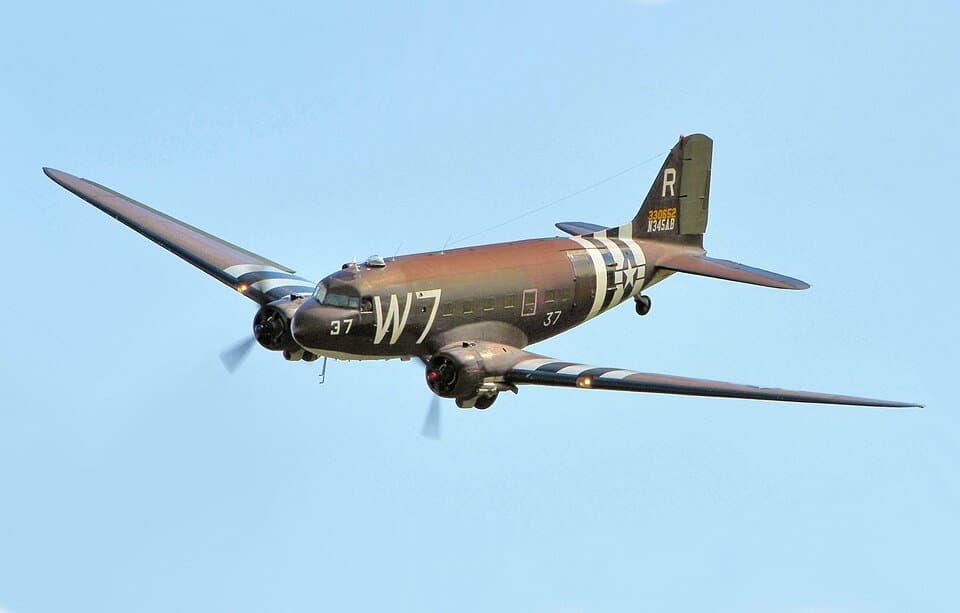

Credit
Airwolfhound · CC BY-SA 4.0 · Resized · CC BY-SA 4.0 · Source ↗ · Modified


Preparing your view.
Measured figures
C-47B-DK · Length
Single source63 ft 9 in (19.43 m)[source]
Configuration
| Specification | Douglas C-47 Skytrain | Piper PA-42 Cheyenne |
|---|---|---|
| Type | Military transport aircraft[source] | Turboprop[source] |
| National origin | United States[source] | — |
| Manufacturer | Douglas Aircraft Company[source] | Piper Aircraft[source] |
| Status | In service[source] | — |
| Primary users | United States Army Air Forces Royal Air Force United States Navy Royal Canadian Air Force See operators |
C-47B-DK · Wingspan
Single source95 ft 6 in (29.11 m)[source]
C-47B-DK · Height
Single source17 ft 0 in (5.18 m)[source]
C-47B-DK · pilot, co-pilot, navigator, radio operator
Single source4 (pilot, co-pilot, navigator, radio operator)[source]
C-47B-DK · 2 × Pratt & Whitney R-1830-90C Twin Wasp 14-cylinder air-cooled radial piston engines takeoff rating
Single sourceC-47B-DK · normal rating at 14,500 ft (4,400 m)
Single source2 × Pratt & Whitney R-1830-90C Twin Wasp 14-cylinder air-cooled radial piston engines 1,200 hp (890 kW) takeoff rating 1,000 hp (750 kW) normal rating at 14,500 ft (4,400 m)[source]
C-47B-DK · Wing area
Single source987 sq ft (91.7 m 2 )[source]
C-47B-DK · Service ceiling
Single source26,400 ft (8,000 m)[source]
Bars compare reported quantities only. A larger figure does not make a system better; configurations and test conditions differ.
| — |
| Number built | 10,174[source] | 192; 149 IIIAs and 43 400s[source] |
|---|
| First flight | 23 December 1941 ( 1941-12-23 )[source] | May 18, 1979[source] |
|---|
| Developed from | Douglas DC-3[source] | Piper PA-31T Cheyenne[source] |
|---|
| Variants | Douglas XCG-17 Douglas AC-47 Spooky Douglas R4D-8[source] | — |
|---|
| Capacity | 28 troops or 6,000 lb (2,700 kg) of cargo[source] | — |
|---|
| Airfoil | root: NACA 2215 ; tip: NACA 2206[source] | — |
|---|
| Propellers | 3-bladed constant-speed propellers[source] | — |
|---|
| Time to altitude | 10,000 ft (3,000 m) in 9 minutes 30 seconds[source] | — |
|---|
| Wing loading | 26.3 lb/sq ft (128 kg/m 2 )[source] | — |
|---|
| Power/mass | 0.0926 hp/lb (0.1522 kW/kg)[source] | — |
|---|
| Manufactured | — | 1979-1993[source] |
|---|
| Role | — | twin engine turboprop aircraft[source] |
|---|
| Source measurement | — | The PA-42 Cheyenne III was announced in September 1977. The first production Cheyenne III flew for the first time on May 18, 1979, and FAA certification was granted in early 1980. Compared with the Cheyenne II, the PA-42-720 was about 1 m (3 ft) longer, was powered by 537 kW (720-shp) PT6A-41 turboprops and introduced a T-tail, the most obvious external difference between the PA-31T and PA-42, as well as the most significant change to the series. Deliveries of production Cheyenne IIIs began on June 30, 1980.[source]Piper PA-42 Cheyenne · History / Cheyenne III; only the objects and conditions stated in this passage In the late 1970s, Piper avoided developing a clean-sheet light business jet to compete with the Cessna Citation I and upgraded its PT6As from 720 to 1,000 hp (540 to 750 kW) Honeywell TPE331 -14s. The PA-42-1000 Cheyenne IV was certified in 1984, 43 were built until 1991 and 37 remain in service in 2018.[source]Piper PA-42 Cheyenne · History / Cheyenne 400; only the objects and conditions stated in this passage Due to its top speed over 351 kn (404 mph; 650 km/h) it was renamed the Cheyenne 400LS when Lear Siegler owned Piper, then the Cheyenne 400.[source]Piper PA-42 Cheyenne · History / Cheyenne 400; only the objects and conditions stated in this passage Flat rated to ISA+37, the turboprops maintains its power to almost 20,000 ft (6,100 m). The 106 in (2.7 m) Dowty Rotol propellers have four round-tip composite blades and 8 in (20 cm) of ground clearance. Its empennage was enlarged for stability at higher speeds and altitudes, and its fuselage was strengthened. Pressurization was increased to 7.6 psi (520 hPa) to elevate its ceiling from 35,000 to 41,000 ft (10,700 to 12,500 m) while maintaining a 10,000 ft (3,000 m) cabin.[source]Piper PA-42 Cheyenne · History / Cheyenne 400; only the objects and conditions stated in this passage The aircraft's top speed is 351 kn (650 km/h; 404 mph), faster than the Citation I on most trips while burning one-third less fuel. It can fly 1,842 nmi (3,411 km) at the same speed; it can carry eight passengers farther than a King Air 200 while cruising 50 kn (93 km/h) faster. It can operate out of 3,000 ft (900 m) runways with a 97 kn (180 km/h) minimum control speed , similar to a King Air 300 ; it can operate from much shorter hot and high runways than a Citation I and landing distance is shortened by the rotating speedbrake effect of the propellers in beta pitch . It can climb directly to FL 410 at its 12,050 lb (5,470 kg) MTOW and typical single-pilot BOWs are 7,850–7,900 lb (3,560–3,580 kg). It can hold 3,819 lb (1,732 kg) of fuel plus two passengers with baggage, while each extra passenger costs 100 nmi (190 km) of range. It has a 98% dispatch reliability and a cabin that is quieter than a King Air.[source]Piper PA-42 Cheyenne · History / Cheyenne 400; only the objects and conditions stated in this passage The 400LS made aviation history on 16 April 1985 by setting two new time-to-climb records for its class (C-1e Group 2, 3000m and 9,000m) and shattering two time-to-climb records for all turboprop classes (6,000m and 12,000m): with retired United States Air Force Brigadier General Chuck Yeager at the helm of N400PS (with co-pilot Renald "Dav" Davenport flying right-seat), the aircraft departed from Portland- Hillsboro Airport 's Runway 31L, immediately reached a 5,959-foot-per-minute climbout and achieved its 3,000m record in 1 minute, 47.6 seconds; the 6,000m record in 3 minutes, 42.0 seconds; its 9,000m record at 6 minutes, 34.6 seconds; the 12,000m record at 11 minutes, 8.3 seconds (time-to-altitude records were captured by on-board video camera aimed at relevant panel gauges, timed with superimposed timer; also verified by Hillsboro Airport tower personnel via radar, using encoded altimeter data transmitted from aircraft to tower via transponder ).[source]Piper PA-42 Cheyenne · History / Cheyenne 400; only the objects and conditions stated in this passage The 400LS has 100-hour inspection intervals , engine midlife inspections are due at 1,500 hours and overhauls come at 3,000 hours. The fuselage is limited to a 15,000-hour life, while the wing and empennage have 20,000-hour life limits.[source]Piper PA-42 Cheyenne · History / Cheyenne 400; only the objects and conditions stated in this passage Cheyenne IV , model PA-42-1000, later the Cheyenne 400LS , and then Cheyenne 400 . This is the largest aircraft ever made by Piper, with 43 built. Powered by 1,000 shp (750 kW) Garrett TPE-331 engines, and four-blade props.[source]Piper PA-42 Cheyenne · Variants; only the objects and conditions stated in this passage |
|---|
| Reported operators |
| — |
|---|