FORCETALLY
Loading the evidence…
Preparing your view.


Preparing your view.

At a glance
Measured figures
AC-47D · Range
Single source2,175 mi (3,500 km, 1,890 nmi)[source]
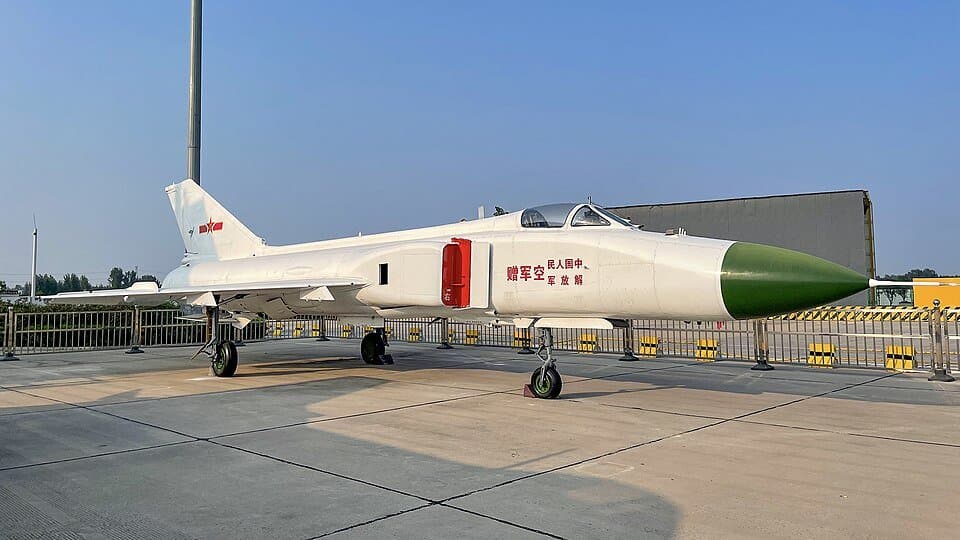
F-8 IIM · radius with 3x drop tanks
Single source1,000 km (620 mi, 540 nmi) radius with 3x drop tanks[source]
AC-47D · 2 × Pratt & Whitney R-1830 Twin Wasp 14-cylinder air-cooled radial piston engines each
Single source2 × Pratt & Whitney R-1830 Twin Wasp 14-cylinder air-cooled radial piston engines, 1,200 hp (890 kW) each[source]
F-8 IIM · 2 × Guizhou WP-13B afterburning turbojet engines thrust each dry
Single sourceF-8 IIM · with afterburner
Single source2 × Guizhou WP-13B afterburning turbojet engines, 47.1 kN (10,580 lbf) thrust each dry, 68.6 kN (15,430 lbf) with afterburner[source]
F-8 IIM · (44,100 ft/min) at sea level
Single source224 m/s (44,100 ft/min) at sea level[source]
Bars compare reported quantities only. A larger figure does not make a system better; configurations and test conditions differ.
Configuration
| Specification | Douglas AC-47 Spooky | Shenyang J-8 |
|---|---|---|
| Type | Ground-attack aircraft and close air support gunship[source] | Interceptor[source] |
| Manufacturer | Douglas Aircraft Company[source] | Shenyang Aircraft Corporation[source] |
| Status | In service within the Colombian Aerospace Force[source] | In service[source] |
| Primary users | United States Air Force (former) Philippine Air Force (historical) Royal Lao Air Force (historical) Khmer Air Force (historical) Colombian Aerospace Force[source] | People's Liberation Army Air Force People's Liberation Army Naval Air Force[source] |
| Number built | 53[source] | At least 408[source] |
| Manufactured | 1963–1965 (US military conversions) 1987 and 1993 (Colombian conversions)[source] | — |
| Introduction date | 1965[source] | 1980[source] |
| First flight | 1964[source] | J-8: 5 July 1969 J-8B: 12 June 1984[source] |
| Developed from | C-47 Skytrain[source] | — |
| Wing loading | 33.4 lb/sq ft (163 kg/m 2 )[source] | — |
| Power/mass | 0.15 hp/lb (0.25 kW/kg)[source] | — |
| Guns | 3 × 7.62 mm General Electric GAU-2/M134 miniguns , 2,000 rpm or 10 × .30 in Browning AN/M2 machine guns 32 × Mk 24 flares[source] | 1 x 23mm Type 23-III cannon[source] |
| Source measurement | The AC-47 was a United States Air Force (USAF) C-47 (the military version of the DC-3 ) that had been modified by mounting three 7.62 mm General Electric miniguns to fire through two rear window openings and the side cargo door, all on the left (pilot's) side of the aircraft, to provide close air support for ground troops. Other armament configurations could also be found on similar C-47-based aircraft around the world. The guns were actuated by a control on the pilot's yoke. The guns to be active for firing would be selected by an aerial gunner on a control panel on the right side of the cargo bay. Normally, two aerial gunners would be part of a normal crew. They would load the guns, clear malfunctions, and do inflight repair as well as select which gun(s) were online for the pilot to fire. It could orbit the target for hours, providing suppressing fire over an elliptical area about 52 yd (47.5 m) in diameter, placing a round every 2.4 yd (2.2 m) during a three-second burst. The aircraft also carried MK-24 Mod 3 parachute flares it could drop to illuminate the battleground.[source]Douglas AC-47 Spooky · Design and development; only the objects and conditions stated in this passage Puff's first significant success occurred on the night of 23–24 December 1964. An FC-47 arrived over the Special Forces outpost at Tranh Yend in the Mekong Delta just 37 minutes after an air support request, fired 4,500 rounds of ammunition, and broke the VC attack. The FC-47 was then called to support a second outpost at Trung Hung, about 20 miles (32 km) away. The aircraft again blunted the VC attack and forced a retreat. Between 15 and 26 December, all the FC-47's 16 combat sorties were successful. On 8 February 1965, an FC-47 flying over the Bồng Sơn area demonstrated its capabilities in the process of blunting a VC offensive. For over four hours, it fired 20,500 rounds into a VC hilltop position, killing an estimated 300 VC troops.[source]Douglas AC-47 Spooky · Operational history / United States Air Force; only the objects and conditions stated in this passage The 4th ACS deployed to Tan Son Nhut Air Base , Vietnam, on 14 November 1965. Now using the call sign Spooky , each of its three 7.62 mm miniguns could selectively fire either 50 or 100 rounds per second. Cruising in an overhead left-hand orbit at 120 knots air speed at an altitude of 3,000 feet (910 m), the gunship could put a bullet or glowing red tracer bullet (every fifth round) into every square yard of a football field-sized target in potentially less than 10 seconds. As long as its 45-flare and 24,000-round basic load of ammunition held out, it could do this intermittently while loitering over the target for hours.[source]Douglas AC-47 Spooky · Operational history / United States Air Force; only the objects and conditions stated in this passage One of the most publicized battles of the Vietnam War was the Battle of Khe Sanh in early 1968. More than 24,000 tactical and 2,700 B-52 strikes dropped 110,000 tons of ordnance in attacks that averaged over 300 sorties per day. During the two and a half months of combat, fighters were in the air day and night. At night, AC-47 gunships kept up constant fire against enemy troops and provided illumination for the base.[source]Douglas AC-47 Spooky · Operational history / United States Air Force; only the objects and conditions stated in this passage The AC-47D gunship should not be confused with a small number of C-47s that were fitted with electronic equipment in the 1950s. Prior to 1962, these aircraft were designated AC-47D. When a new designation system was adopted in 1962, these became EC-47Ds . The original gunships had been designated F C-47D by the USAF, but with protests from fighter pilots, this designation was changed to A C-47D during 1965. Of the 53 aircraft converted to AC-47 configuration, 41 served in Vietnam and 19 were lost to all causes, 12 in combat. Combat reports indicate that no village or hamlet under Spooky protection was ever lost, and a plethora of reports from civilians and military personnel were made about AC-47s coming to the rescue and saving their lives.[source]Douglas AC-47 Spooky · Operational history / United States Air Force; only the objects and conditions stated in this passage Airman First Class John L. Levitow , an AC-47 loadmaster with the 3rd SOS, received the Medal of Honor for saving his aircraft, Spooky 71 , from destruction on 24 February 1969 during a fire-support mission at Long Binh . The aircraft was struck by an 82-mm mortar round that inflicted 3,500 shrapnel holes, wounding Levitow 40 times, but he used his body to jettison an armed magnesium flare, which ignited shortly after Levitow ejected it from the aircraft, allowing the AC-47 to return to base.[source]Douglas AC-47 Spooky · Operational history / United States Air Force; only the objects and conditions stated in this passage In 2006, Colombia started operating five armed Basler BT-67 (Colombian Air Force designation : AC-47T), known by civilians as avion fantasma (ghost plane), on counter-insurgency operations in conjunction with Sikorsky AH-60 Arpia armed helicopters and Cessna A-37 Dragonflys against local illegally armed groups. The BT-67s are armed with .50 cal (12.7 mm) GAU-19/A machine guns slaved to a forward looking infrared system. They also have the ability to carry bombs. At least one has been seen fitted with one GAU-19/A and a 20 mm cannon, most likely a French-made M621 . The BT-67s are C-47/DC-3s modified by the Basler Corporation of Oshkosh, Wisconsin , and are not variants of the Douglas AC-47.[source]Douglas AC-47 Spooky · Operational history / Other air forces; only the objects and conditions stated in this passage South Africa converted some C-47s to gunships by installing gun mounts on a rotating platform on the rear of the aircraft and used them similarly to a helicopter gunner. South African "Dragon Daks" were known to fit 20 mm cannons[source]Douglas AC-47 Spooky · Operational history / Other air forces; only the objects and conditions stated in this passage In 1967, Thailand converted its first AC-47D installing it the SUU-11/A minigun pods. It kept converting a few more airframes and also received some former Khmer Air Force AC-47Ds from Cambodia in late 1975. Thai AC-47s also were equipped with a combination of two .50 cal machine guns and an M197 20mm Electric cannon .[source]Douglas AC-47 Spooky · Operational history / Other air forces; only the objects and conditions stated in this passage US conversion of C-47 with M134 7.62-mm minigun[source]Douglas AC-47 Spooky · Variants; only the objects and conditions stated in this passage ( Thai : บ.จล.๒ ) Thai variant with 2 .50 cal machine guns and an M197 20mm Electric cannon .[source]Douglas AC-47 Spooky · Variants; only the objects and conditions stated in this passage Length: 64 ft 5 in (19.63 m)[source]Douglas AC-47 Spooky · Specifications (AC-47D); only the objects and conditions stated in this passage Wingspan: 95 ft 0 in (28.96 m)[source]Douglas AC-47 Spooky · Specifications (AC-47D); only the objects and conditions stated in this passage Height: 16 ft 11 in (5.16 m)[source]Douglas AC-47 Spooky · Specifications (AC-47D); only the objects and conditions stated in this passage Wing area: 987 sq ft (91.7 m 2 )[source]Douglas AC-47 Spooky · Specifications (AC-47D); only the objects and conditions stated in this passage Empty weight: 18,080 lb (8,201 kg)[source]Douglas AC-47 Spooky · Specifications (AC-47D); only the objects and conditions stated in this passage Gross weight: 33,000 lb (14,969 kg)[source]Douglas AC-47 Spooky · Specifications (AC-47D); only the objects and conditions stated in this passage Powerplant: 2 × Pratt & Whitney R-1830 Twin Wasp 14-cylinder air-cooled radial piston engines, 1,200 hp (890 kW) each[source]Douglas AC-47 Spooky · Specifications (AC-47D); only the objects and conditions stated in this passage Maximum speed: 230 mph (370 km/h, 200 kn)[source]Douglas AC-47 Spooky · Specifications (AC-47D); only the objects and conditions stated in this passage Cruise speed: 175 mph (282 km/h, 152 kn)[source]Douglas AC-47 Spooky · Specifications (AC-47D); only the objects and conditions stated in this passage Range: 2,175 mi (3,500 km, 1,890 nmi)[source]Douglas AC-47 Spooky · Specifications (AC-47D); only the objects and conditions stated in this passage Service ceiling: 24,450 ft (7,450 m)[source]Douglas AC-47 Spooky · Specifications (AC-47D); only the objects and conditions stated in this passage Guns: 3 × 7.62 mm General Electric GAU-2/M134 miniguns , 2,000 rpm or 10 × .30 in Browning AN/M2 machine guns 32 × Mk 24 flares[source]Douglas AC-47 Spooky · Specifications (AC-47D); only the objects and conditions stated in this passage | — |
| National origin | — | China[source] |
| Designer | — | Shenyang Aircraft Design Institute[source] |
| Hardpoints | — | 1 centerline and 6 under-wing hardpoints with a capacity of 3 x drop tanks[source] |
| Airfoil | — | root: TsAGI S-12 (4.2%); tip: TsAGI S-12 (5%)[source] |
| Combat radius with one AAR | — | 900 km (560 mi; 490 nmi)[source] |
| g limits | — | +4.7 sustained at 5,000 m (16,000 ft)[source] |
| Thrust/weight | — | 0.74[source] |
| Unstick speed | — | 330 km/h (210 mph; 180 kn)[source] |
| Take-offrun | — | 630 m (2,070 ft)[source] |
| Touchdown speed | — | 224 km/h (139 mph; 121 kn)[source] |
| Landing run | — | 900 m (3,000 ft)[source] |
| Rockets | — | 4 x Type 90-1 FFAR pod (57-mm or 90-mm)[source] |
| Missiles | — | 6 x PL-5 AAM or PL-9 AAM or 2 x R-27R1 SARH AAM or 2 x PL-11 SARH AAM or 2 x Kh-31 anti-ship missiles[source] |
| Bombs | — | 5 x low drag 500 kg (1,100 lb) or 10 x 250 kg (550 lb) (4 under-wing, 6 on centerline)[source] |
Maximum take-off; F-8 IIM · Max takeoff weight
Single source