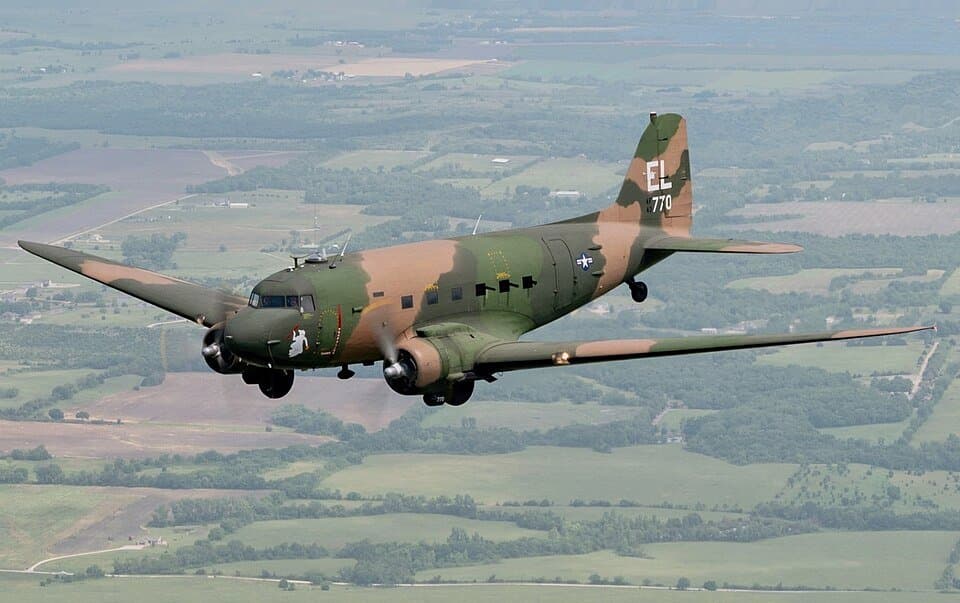

Credit
MSgt Christopher Boitz · Public domain · Resized · Public domain · Source ↗ · Modified


Preparing your view.
At a glance
Measured figures
AC-47D · Length
Single source64 ft 5 in (19.63 m)[source]
Configuration
| Specification | Douglas AC-47 Spooky | Fairchild AU-23 Peacemaker |
|---|---|---|
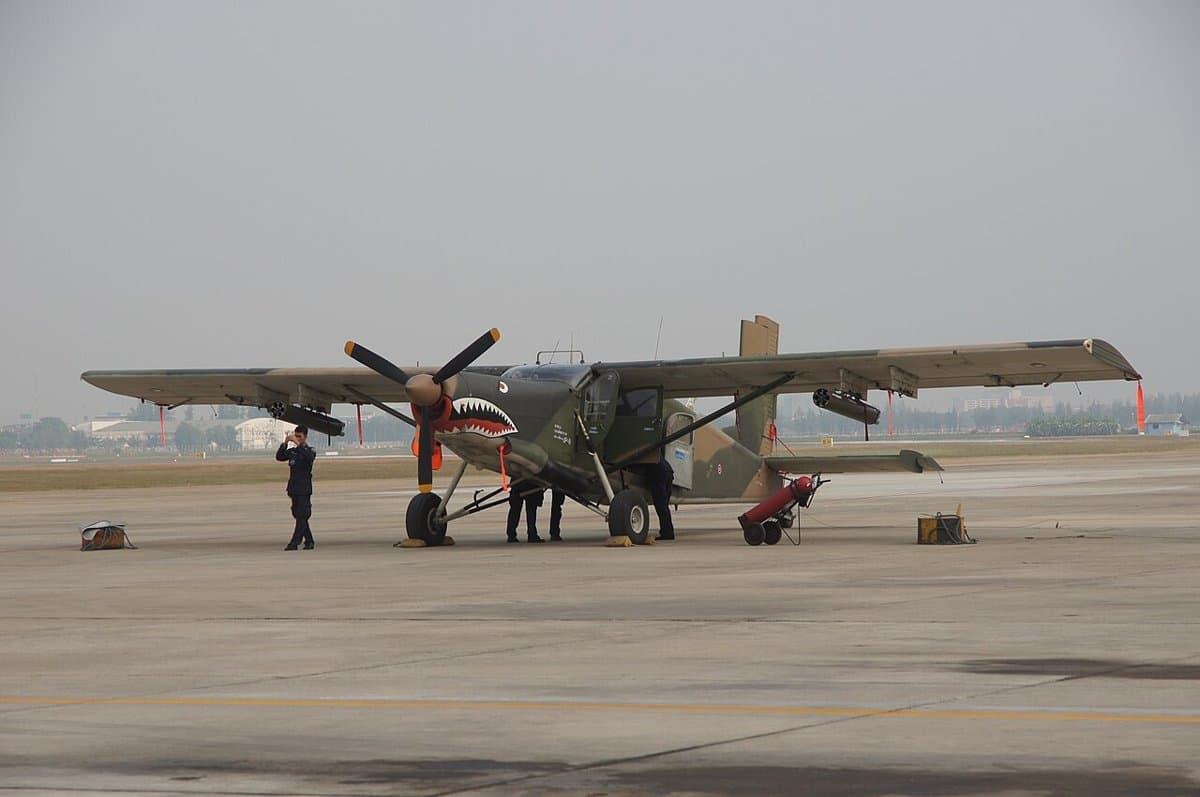
| Type | Ground-attack aircraft and close air support gunship[source] | Armed gunship, counter-insurgency, utility transport[source] |
| Manufacturer | Douglas Aircraft Company[source] | Fairchild Aircraft[source] |
| Status | In service within the Colombian Aerospace Force[source] | — |
| Primary users | United States Air Force (former) Philippine Air Force (historical) Royal Lao Air Force (historical) Khmer Air Force (historical) Colombian Aerospace Force[source] |
Fairchild Hiller AU-23A / General information · Length
Length
Single sourceEmpty; AC-47D · Empty weight
Single sourceGross; AC-47D · Gross weight
Single sourceMaximum take-off; Max takeoff weight
Single source18,080 lb (8,201 kg)[source]
33,000 lb (14,969 kg)[source]
15 000 kg[source]
Empty; Fairchild Hiller AU-23A / General information · Empty weight
Single sourceGross; Gross weight
Single sourceCombat range
Single source175 nmi (201 mi, 323 km)[source]
AC-47D · 2 × Pratt & Whitney R-1830 Twin Wasp 14-cylinder air-cooled radial piston engines each
Single source2 × Pratt & Whitney R-1830 Twin Wasp 14-cylinder air-cooled radial piston engines, 1,200 hp (890 kW) each[source]
1 × Garrett TPE-331-1-101F turboprop engine
Single source1 × Garrett TPE-331-1-101F turboprop engine, 650 hp (480 kW)[source]
AC-47D · Wing area
Single source987 sq ft (91.7 m 2 )[source]
Bars compare reported quantities only. A larger figure does not make a system better; configurations and test conditions differ.
United States Air Force Royal Thai Air Force[source] |
| Number built | 53[source] | 35[source] |
|---|
| Manufactured | 1963–1965 (US military conversions) 1987 and 1993 (Colombian conversions)[source] | — |
|---|
| Introduction date | 1965[source] | — |
|---|
| First flight | 1964[source] | 1971[source] |
|---|
| Developed from | C-47 Skytrain[source] | Pilatus PC-6 Porter[source] |
|---|
| Wing loading | 33.4 lb/sq ft (163 kg/m 2 )[source] | — |
|---|
| Power/mass | 0.15 hp/lb (0.25 kW/kg)[source] | — |
|---|
| Guns | 3 × 7.62 mm General Electric GAU-2/M134 miniguns , 2,000 rpm or 10 × .30 in Browning AN/M2 machine guns 32 × Mk 24 flares[source] | — |
|---|
| Source measurement | The AC-47 was a United States Air Force (USAF) C-47 (the military version of the DC-3 ) that had been modified by mounting three 7.62 mm General Electric miniguns to fire through two rear window openings and the side cargo door, all on the left (pilot's) side of the aircraft, to provide close air support for ground troops. Other armament configurations could also be found on similar C-47-based aircraft around the world. The guns were actuated by a control on the pilot's yoke. The guns to be active for firing would be selected by an aerial gunner on a control panel on the right side of the cargo bay. Normally, two aerial gunners would be part of a normal crew. They would load the guns, clear malfunctions, and do inflight repair as well as select which gun(s) were online for the pilot to fire. It could orbit the target for hours, providing suppressing fire over an elliptical area about 52 yd (47.5 m) in diameter, placing a round every 2.4 yd (2.2 m) during a three-second burst. The aircraft also carried MK-24 Mod 3 parachute flares it could drop to illuminate the battleground.[source]Douglas AC-47 Spooky · Design and development; only the objects and conditions stated in this passage Puff's first significant success occurred on the night of 23–24 December 1964. An FC-47 arrived over the Special Forces outpost at Tranh Yend in the Mekong Delta just 37 minutes after an air support request, fired 4,500 rounds of ammunition, and broke the VC attack. The FC-47 was then called to support a second outpost at Trung Hung, about 20 miles (32 km) away. The aircraft again blunted the VC attack and forced a retreat. Between 15 and 26 December, all the FC-47's 16 combat sorties were successful. On 8 February 1965, an FC-47 flying over the Bồng Sơn area demonstrated its capabilities in the process of blunting a VC offensive. For over four hours, it fired 20,500 rounds into a VC hilltop position, killing an estimated 300 VC troops.[source]Douglas AC-47 Spooky · Operational history / United States Air Force; only the objects and conditions stated in this passage The 4th ACS deployed to Tan Son Nhut Air Base , Vietnam, on 14 November 1965. Now using the call sign Spooky , each of its three 7.62 mm miniguns could selectively fire either 50 or 100 rounds per second. Cruising in an overhead left-hand orbit at 120 knots air speed at an altitude of 3,000 feet (910 m), the gunship could put a bullet or glowing red tracer bullet (every fifth round) into every square yard of a football field-sized target in potentially less than 10 seconds. As long as its 45-flare and 24,000-round basic load of ammunition held out, it could do this intermittently while loitering over the target for hours.[source]Douglas AC-47 Spooky · Operational history / United States Air Force; only the objects and conditions stated in this passage One of the most publicized battles of the Vietnam War was the Battle of Khe Sanh in early 1968. More than 24,000 tactical and 2,700 B-52 strikes dropped 110,000 tons of ordnance in attacks that averaged over 300 sorties per day. During the two and a half months of combat, fighters were in the air day and night. At night, AC-47 gunships kept up constant fire against enemy troops and provided illumination for the base.[source]Douglas AC-47 Spooky · Operational history / United States Air Force; only the objects and conditions stated in this passage The AC-47D gunship should not be confused with a small number of C-47s that were fitted with electronic equipment in the 1950s. Prior to 1962, these aircraft were designated AC-47D. When a new designation system was adopted in 1962, these became EC-47Ds . The original gunships had been designated F C-47D by the USAF, but with protests from fighter pilots, this designation was changed to A C-47D during 1965. Of the 53 aircraft converted to AC-47 configuration, 41 served in Vietnam and 19 were lost to all causes, 12 in combat. Combat reports indicate that no village or hamlet under Spooky protection was ever lost, and a plethora of reports from civilians and military personnel were made about AC-47s coming to the rescue and saving their lives.[source]Douglas AC-47 Spooky · Operational history / United States Air Force; only the objects and conditions stated in this passage Airman First Class John L. Levitow , an AC-47 loadmaster with the 3rd SOS, received the Medal of Honor for saving his aircraft, Spooky 71 , from destruction on 24 February 1969 during a fire-support mission at Long Binh . The aircraft was struck by an 82-mm mortar round that inflicted 3,500 shrapnel holes, wounding Levitow 40 times, but he used his body to jettison an armed magnesium flare, which ignited shortly after Levitow ejected it from the aircraft, allowing the AC-47 to return to base.[source]Douglas AC-47 Spooky · Operational history / United States Air Force; only the objects and conditions stated in this passage In 2006, Colombia started operating five armed Basler BT-67 (Colombian Air Force designation : AC-47T), known by civilians as avion fantasma (ghost plane), on counter-insurgency operations in conjunction with Sikorsky AH-60 Arpia armed helicopters and Cessna A-37 Dragonflys against local illegally armed groups. The BT-67s are armed with .50 cal (12.7 mm) GAU-19/A machine guns slaved to a forward looking infrared system. They also have the ability to carry bombs. At least one has been seen fitted with one GAU-19/A and a 20 mm cannon, most likely a French-made M621 . The BT-67s are C-47/DC-3s modified by the Basler Corporation of Oshkosh, Wisconsin , and are not variants of the Douglas AC-47.[source]Douglas AC-47 Spooky · Operational history / Other air forces; only the objects and conditions stated in this passage South Africa converted some C-47s to gunships by installing gun mounts on a rotating platform on the rear of the aircraft and used them similarly to a helicopter gunner. South African "Dragon Daks" were known to fit 20 mm cannons[source]Douglas AC-47 Spooky · Operational history / Other air forces; only the objects and conditions stated in this passage In 1967, Thailand converted its first AC-47D installing it the SUU-11/A minigun pods. It kept converting a few more airframes and also received some former Khmer Air Force AC-47Ds from Cambodia in late 1975. Thai AC-47s also were equipped with a combination of two .50 cal machine guns and an M197 20mm Electric cannon .[source]Douglas AC-47 Spooky · Operational history / Other air forces; only the objects and conditions stated in this passage US conversion of C-47 with M134 7.62-mm minigun[source]Douglas AC-47 Spooky · Variants; only the objects and conditions stated in this passage ( Thai : บ.จล.๒ ) Thai variant with 2 .50 cal machine guns and an M197 20mm Electric cannon .[source]Douglas AC-47 Spooky · Variants; only the objects and conditions stated in this passage Length: 64 ft 5 in (19.63 m)[source]Douglas AC-47 Spooky · Specifications (AC-47D); only the objects and conditions stated in this passage Wingspan: 95 ft 0 in (28.96 m)[source]Douglas AC-47 Spooky · Specifications (AC-47D); only the objects and conditions stated in this passage Height: 16 ft 11 in (5.16 m)[source]Douglas AC-47 Spooky · Specifications (AC-47D); only the objects and conditions stated in this passage Wing area: 987 sq ft (91.7 m 2 )[source]Douglas AC-47 Spooky · Specifications (AC-47D); only the objects and conditions stated in this passage Empty weight: 18,080 lb (8,201 kg)[source]Douglas AC-47 Spooky · Specifications (AC-47D); only the objects and conditions stated in this passage Gross weight: 33,000 lb (14,969 kg)[source]Douglas AC-47 Spooky · Specifications (AC-47D); only the objects and conditions stated in this passage Powerplant: 2 × Pratt & Whitney R-1830 Twin Wasp 14-cylinder air-cooled radial piston engines, 1,200 hp (890 kW) each[source]Douglas AC-47 Spooky · Specifications (AC-47D); only the objects and conditions stated in this passage Maximum speed: 230 mph (370 km/h, 200 kn)[source]Douglas AC-47 Spooky · Specifications (AC-47D); only the objects and conditions stated in this passage Cruise speed: 175 mph (282 km/h, 152 kn)[source]Douglas AC-47 Spooky · Specifications (AC-47D); only the objects and conditions stated in this passage Range: 2,175 mi (3,500 km, 1,890 nmi)[source]Douglas AC-47 Spooky · Specifications (AC-47D); only the objects and conditions stated in this passage Service ceiling: 24,450 ft (7,450 m)[source]Douglas AC-47 Spooky · Specifications (AC-47D); only the objects and conditions stated in this passage Guns: 3 × 7.62 mm General Electric GAU-2/M134 miniguns , 2,000 rpm or 10 × .30 in Browning AN/M2 machine guns 32 × Mk 24 flares[source]Douglas AC-47 Spooky · Specifications (AC-47D); only the objects and conditions stated in this passage | The Porter, designated AU-23A, was fitted with a side-firing 20mm 3 barreled M197 electric cannon , four wing pylons and a center fuselage station for external ordnance.[source]Fairchild AU-23 Peacemaker · Design and development; only the objects and conditions stated in this passage The 20mm cannon was essentially a three-barrel version of the M61 Vulcan 6-barrel 20mm cannon.[source]Fairchild AU-23 Peacemaker · Design and development; only the objects and conditions stated in this passage The aircraft could carry a variety of ordnance including forward-firing gun pods, 500 and 250 pounds (230 and 110 kg) bombs, napalm units, cluster bomb units, flares, rockets, smoke grenades and leaflet dispensers.[source]Fairchild AU-23 Peacemaker · Design and development; only the objects and conditions stated in this passage The combat evaluation, PAVE COIN, was done in June and July 1971. The AU-23A was tested for eight possible missions: armed escort of helicopters, close air support, hamlet defense, STOL airlift and resupply, armed reconnaissance, border surveillance, forward air control, and counter infiltration. USAF crews flew 73 missions (94 sorties) and RVNAF crews flew 68 missions (85 sorties). Several types of weapons were test dropped/fired including 2.75-inch (70 mm) rockets (explosive and smoke), CBU-14 cluster bombs , MK 6 Mod 3 flares, and MK 81, -82, and -106 practice bombs. More than 8,000 rounds of 20mm ammunition were fired, both high explosive incendiary and target practice tracer types. Several problems were discovered during the PAVE COIN program, the most serious was the extreme vulnerability of the aircraft to all but the lightest antiaircraft fire (below 12.7mm). Despite the problems, the USAF continued with the development program and ordered 15 AU-23As for further testing.[source]Fairchild AU-23 Peacemaker · Operational history; only the objects and conditions stated in this passage |
|---|
| Country of origin | United States[source] | — |
|---|
| Capacity | — | 5 troops or 6 passengers or 1 litter patient, 3 ambulatory patients with 1 medical attendant[source] |
|---|
| Endurance | — | 4.84[source] |
|---|
| National origin | — | United States[source] |
|---|
| Role | — | American armed fixed-wing counter-insurgency and utility transport aircraft[source] |
|---|
| Engine | — | 1 Garrett TPE331-1-101F[source]Fairchild Hiller AU-23A / General information |
|---|
Maximum take-off; Fairchild Hiller AU-23A / General information · Maximum takeoff weight
Single source6,100 lb (2,767 kg)[source]
1260 kg[source]Fairchild Hiller AU-23A / General information
2767 kg[source]Fairchild Hiller AU-23A / General information
Cruise; Fairchild Hiller AU-23A / General information · Cruising speed
Single sourceMaximum; at take-off power, 5,000 ft (1,524 m) altitude, 6,000 lb (2,722 kg) gross weight
Single sourceMaximum; Fairchild Hiller AU-23A / General information · Maximum speed
Single source148 kn (170 mph, 274 km/h) at take-off power, 5,000 ft (1,524 m) altitude, 6,000 lb (2,722 kg) gross weight[source]
77 kn (88 mph, 142 km/h) at maximum continuous power, 129 kn (239 km/h) combat cruise[source]
280 km/h[source]Fairchild Hiller AU-23A / General information
262 km/h[source]Fairchild Hiller AU-23A / General information
The 4400th recommended the aircraft not be used in combat without a major upgrade program. Specific problems identified included a slow combat speed (135 knots (250 km/h)), a low working altitude, no capability for "zoom" escapes after delivering ordnance and a complete lack of armor protection for the crew and vital aircraft systems. On June 30, 1972, the 4400th SOS ferried the AU-23As to Davis-Monthan Air Force Base , Arizona, for storage.[source]Fairchild AU-23 Peacemaker · Operational history; only the objects and conditions stated in this passage
Royal Thai Air Force : 34 AU-23A: 14 x AU-23A delivered by USAF (13 in 1972 and one in 1977) and 20 others (s/n 2073 to 2092) delivered in 1976 by Fairchild. In 2024, 14 are on duty (501 Light Attack Sqn, Wing 5 Prachuap Royal Air Force base at Prachuap Khiri Khan ). Locally designated B.JT.2 ( Thai : บ.จธ.๒ ).[source]Fairchild AU-23 Peacemaker · Operators; only the objects and conditions stated in this passage
United States Air Force : 15 AU-23A (s/n 2020, 2039 and 2050 to 2062), 4400th Special Operations Squadron (Provisional) - former operator. 13 delivered to Thailand in 1972 and 1 in 1977. 72-1309 (s/n 2055) crashes before delivery at Eglin AFB on 10 May 1972.[source]Fairchild AU-23 Peacemaker · Operators; only the objects and conditions stated in this passage
Capacity: 5 troops or 6 passengers or 1 litter patient, 3 ambulatory patients with 1 medical attendant[source]Fairchild AU-23 Peacemaker · Specifications; only the objects and conditions stated in this passage
Length: 36 ft 10 in (11.23 m)[source]Fairchild AU-23 Peacemaker · Specifications; only the objects and conditions stated in this passage
Wingspan: 49 ft 8 in (15.14 m)[source]Fairchild AU-23 Peacemaker · Specifications; only the objects and conditions stated in this passage
Height: 14 ft 4 in (4.37 m)[source]Fairchild AU-23 Peacemaker · Specifications; only the objects and conditions stated in this passage
Gross weight: 6,100 lb (2,767 kg)[source]Fairchild AU-23 Peacemaker · Specifications; only the objects and conditions stated in this passage
Powerplant: 1 × Garrett TPE-331-1-101F turboprop engine, 650 hp (480 kW)[source]Fairchild AU-23 Peacemaker · Specifications; only the objects and conditions stated in this passage
Maximum speed: 148 kn (170 mph, 274 km/h) at take-off power, 5,000 ft (1,524 m) altitude, 6,000 lb (2,722 kg) gross weight[source]Fairchild AU-23 Peacemaker · Specifications; only the objects and conditions stated in this passage
Cruise speed: 77 kn (88 mph, 142 km/h) at maximum continuous power, 129 kn (239 km/h) combat cruise[source]Fairchild AU-23 Peacemaker · Specifications; only the objects and conditions stated in this passage
Range: 360 nmi (420 mi, 680 km)[source]Fairchild AU-23 Peacemaker · Specifications; only the objects and conditions stated in this passage
Combat range: 175 nmi (201 mi, 323 km)[source]Fairchild AU-23 Peacemaker · Specifications; only the objects and conditions stated in this passage
Up to 1,925 pounds (873 kg) of external stores on five pylons[source]Fairchild AU-23 Peacemaker · Specifications; only the objects and conditions stated in this passage
XM197 20mm cannon, door-mounted[source]Fairchild AU-23 Peacemaker · Specifications; only the objects and conditions stated in this passage
XM93 7.62mm minigun[source]Fairchild AU-23 Peacemaker · Specifications; only the objects and conditions stated in this passage
XM59 .50-cal. (12.7 mm) machine gun and XMU-470 20mm fixed side-firing gun pods.[source]Fairchild AU-23 Peacemaker · Specifications; only the objects and conditions stated in this passage
2.75-inch (70 mm) rocket pods[source]Fairchild AU-23 Peacemaker · Specifications; only the objects and conditions stated in this passage
BDU33 with 25 lb (11 kg) bomblets[source]Fairchild AU-23 Peacemaker · Specifications; only the objects and conditions stated in this passage
Mark 81 250 lb (110 kg) bombs[source]Fairchild AU-23 Peacemaker · Specifications; only the objects and conditions stated in this passage
Mark 82 500 lb (230 kg) bombs[source]Fairchild AU-23 Peacemaker · Specifications; only the objects and conditions stated in this passage
BLU118 500 lb (230 kg) napalm canisters[source]Fairchild AU-23 Peacemaker · Specifications; only the objects and conditions stated in this passage
CBU55 500 lb (230 kg) cluster bomb units[source]Fairchild AU-23 Peacemaker · Specifications; only the objects and conditions stated in this passage