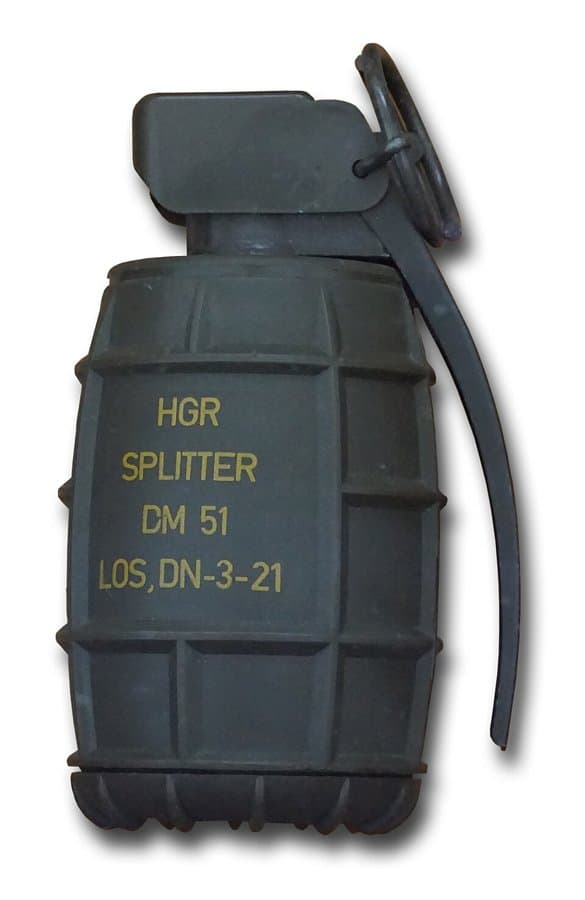
Credit
Manniman2 · CC BY-SA 4.0 · Resized · CC BY-SA 4.0 · Source ↗ · Modified


Preparing your view.

Measured figures
with fuse
Single source107 mm (4.2 in) (with fuse)[source]
with fragmentation jacket
Single sourcewith safety lever
Single source57 mm (2.2 in) (with fragmentation jacket) 66 mm (2.6 in) (with safety lever)[source]
with fuse
Single source430 g (15 oz) (with fuse )[source]
Filling weight
Single source60 g (2.1 oz)[source]
Bars compare reported quantities only. A larger figure does not make a system better; configurations and test conditions differ.
Configuration
| Specification | DM51 hand grenade | Sea Mine 2000 |
|---|---|---|
| Type | Hand grenade[source] | advanced naval mine[source] |
| Place of origin | West Germany[source] | — |
| In service | 1978–…[source] | — |
| Used by | See Users[source] | Finnish Navy[source] |
| Wars | Russo-Ukrainian War[source] | — |
| Designer | Diehl Defence[source] | Patria[source] |
| Designed | 1970s[source] | — |
| Manufacturer | Diehl Defence[source] | — |
| Unit cost | €33.60 (1996)[source] | — |
| Produced | 1970s–…[source] | — |
| Variants | See Variants[source] | — |
| Filling | PETN[source] | — |
| Detonation mechanism | DM82 delay fuse[source] | — |
| Sensors and processing systems | — | stealth and advanced target-recognition capabilities[source] |
| Target recognition | — | The mine detects the physical impulses of approaching vessels and can choose which ones are the most valuable ones.[source] |
| Production | — | 2004[source] |
| Country of origin | — | Finland[source]Inventory Origin column; table 3, row 41, cell 4; revision 1374738459; retrieved 2026-09-30 |
| Reported operators |
| — |