AI-generated illustration · Not a photograph
Credit
ForceTally · AI-generated illustration · Not a photograph · AI-generated · OpenAI output terms · Source ↗ · Modified


Preparing your view.


At a glance
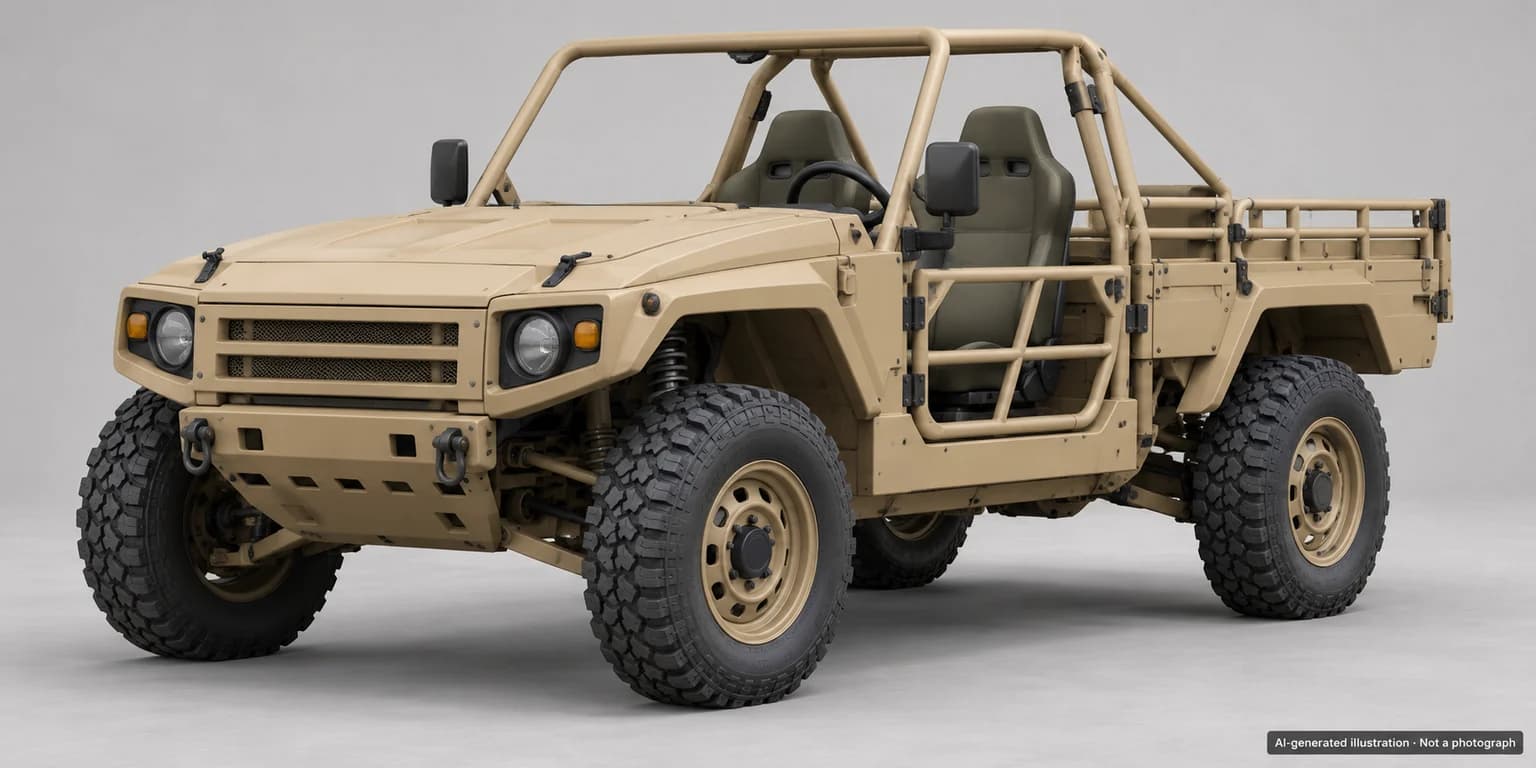
Desert Irislarger figure on 2 of 5
K10 ammunition resupply vehiclelarger figure on 3 of 5
Measured figures
Length
Single sourceAB3 Desert Iris · Length · Length (mm)
Single sourceConfiguration
| Specification | Desert Iris | K10 ammunition resupply vehicle |
|---|---|---|
| Type | Auxiliary Vehicle[source] | Ammunition resupply vehicle[source] Transloader[source] 12.7mm M2HB heavy machine gun[source] |
| Place of origin | Jordan[source] | South Korea[source] |
| In service | 2005-Present[source] |
Counts only measures both sources give with the same scope. A larger figure is not a better system.
Desert Iris · 2.8 litre four-cylinder Toyota engine · / 75 KW at 4200 rpm
Single source100 Bhp/ 75 KW at 4200 rpm[source]Desert Iris · 2.8 litre four-cylinder Toyota engine
Bars compare reported quantities only. A larger figure does not make a system better; configurations and test conditions differ.
2006–present[source] |
| Used by | Jordan , UAE , Saudi Arabia , Libya , United Nations[source] | — |
|---|
| Designed | 1999-2001[source] | 2002-2005[source] |
|---|
| Manufacturer | King Abdullah Design and Development Bureau[source] | Hanwha Defense (Now Hanwha Aerospace )[source] |
|---|
| Transmission | Manual[source] | SNT Dynamics / Allison Transmission X1100-5A3 4 forward, 2 reverse[source] S&T Dynamics X1100-5A3[source] |
|---|
| Armament | The Desert Iris can be armed with 7.62 or 12.7 mm machine, MRLS launcher or TOW launcher.[source] | — |
|---|
| Country users | Jordan[source] | — |
|---|
| Designer Company | KADDB King Abdullah II Design and Development Bureau[source] | — |
|---|
| Accessories | Weapons rings mount.[source] | — |
|---|
| Armor | No armor a[source] | — |
|---|
| Dimensions | Lenght, 4,25 m; Width, 1,9 m; Height, 1,75 m[source] | — |
|---|
| Designer | — | Samsung Techwin Agency for Defense Development Defense Agency for Technology and Quality[source] |
|---|
| Unit cost | — | 2.68 billion KRW[source] |
|---|
| Produced | — | 2005–present[source] |
|---|
| Variants | — | K10 VIDAR K10 AARV AS10 AS10C2 K11 FDCV[source] |
|---|
| Engine | — | STX Engine/ MTU Friedrichshafen MT881Ka-500 8-cylinder water-cooled diesel engine[source] MTU MT 881 Ka-500 8-cylinder water-cooled diesel[source] |
|---|
| Payload capacity | — | 104 x 155 mm projectiles + 504 charges[source] |
|---|
| Drive | — | Tracked[source] |
|---|
| Source measurement | — | The vehicle has a combat weight of 47 metric tons (46 long tons; 52 short tons), and can support a K9 team by carrying and resupplying 104 shells of 155 mm artillery ammunition and 504 units of charges under heavy fire. The vehicle is operated by a 3-person crew, requiring only one loader by applying fully automated control system. It transfers ammunition at a maximum speed of 12 rounds/min. It takes 37 minutes to fully load, and 28 minutes to empty the K10. It is often called the briquette car by military and defense industry officials.[source]K10 ammunition resupply vehicle · Lead; only the objects and conditions stated in this passage POYRAZ : Turkish variant per tech transfer in T-155 Fırtına project. It has an auxiliary power unit , which the K10 ARV lacks, that allows the vehicle's crew to use electronics and communication systems, and to run an ammunition transfer system economically without the main engines being turned on. The ARV can carry up to 96 155 mm shells and is able to transfer 48 shells in 20 minutes. It has a range of 360 km.[source]K10 ammunition resupply vehicle · Variants; only the objects and conditions stated in this passage |
|---|
| Origin | — | South Korea[source] |
|---|
| Mount | — | Pintle mount on roof[source] |
|---|
| Ammunition | — | 100 rounds ready to fire[source] Up to 104 shells[source] |
|---|
| Traverse | — | Manual elevation and traverse[source] |
|---|
| Stabilizer | — | No[source] |
|---|
| Chassis type | — | Tracked chassis, 6 roadwheels[source] |
|---|
| Layout | — | Drive sprocket front, idler rear[source] |
|---|
| Suspension | — | Hydropneumatic[source] |
|---|
| Power to weight ratio | — | 21 hp/t[source] |
|---|
| Wall | — | 0.75 m[source] |
|---|
| Trench | — | 2.8 m[source] |
|---|
| Gradient | — | 60 %[source] |
|---|
| Slope | — | 30 %[source] |
|---|
| Fording | — | 1.5 m[source] |
|---|
| Armor type | — | Steel[source] |
|---|
| Armor thickness | — | Rated against 14.5mm projectiles over frontal arc[source] |
|---|
| NBC system | — | Yes[source] |
|---|
| Fire suppression | — | Yes[source] |
|---|
| Propellant | — | Up to 504 units[source] |
|---|
| Transfer speed | — | 10 shells per minute[source] |
|---|
weight of
Single sourceCombat weight: 47 metric tons (46 long tons; 52 short tons)[source]
weight of 47 metric tons (46 long tons; 52 short tons)[source]K10 ammunition resupply vehicle · Lead · The vehicle has a combat weight of 47 metric tons (46 long tons; 52 short tons), and can support a K9 team by carrying and resupplying 104 shells of 155 mm artillery ammunition and 504 units of charges under heavy fire.
47 t combat load[source]