Credit
Nigel Ish · CC BY-SA 3.0 · Resized · CC BY-SA 3.0 · Source ↗ · Modified


Preparing your view.
At a glance
Measured figures
DH.84 Dragon 1 · Length
Single sourceLength
Single sourceConfiguration
| Specification | De Havilland Dragon | UTVA 75 |
|---|---|---|
| Type | Passenger and military transport / trainer[source] | Military and civilian trainer aircraft[source] |
| Manufacturer | de Havilland[source] | UTVA[source] |
| Number built | 202[source] | — |
| Introduction date | April 1933[source] | 1978[source] |
34 ft 6 in (10.52 m)[source]
10,5 m (34,5 ft )[source]
10,52 m (34 ft 6 in )[source]
10.52 מטר[source]DH.84 דראגון de Havilland DH.84 Dragon
10,52 m (34,5 ft )[source]
UTVA 75A21 · Length
Single source7.11 m (23 ft 4 in)[source]
DH.84 Dragon 1 · Wingspan
Single sourceWingspan
Single source47 ft 4 in (14.43 m)[source]
14,4 m (47,3 ft )[source]
14,43 m (47 ft 4 in)[source]
14.43 מטר[source]DH.84 דראגון de Havilland DH.84 Dragon
14,43 m (47,3 ft )[source]
UTVA 75A21 · Wingspan
Single source9.73 m (31 ft 11 in)[source]
Empty; DH.84 Dragon 1 · Empty weight
Single sourceEmpty; Empty weight
Single sourceGross; DH.84 Dragon 1 · Gross weight
Single source2,300 lb (1,043 kg)[source]
4,200 lb (1,905 kg)[source]
1043 kg (2298,8 lb )[source]
1 045 kg (2 300 lb )[source]
Empty; UTVA 75A21 · equipped
Single sourceMaximum take-off; UTVA 75A21 · Max takeoff weight
Single sourceCruise; DH.84 Dragon 1 · Cruise speed
Single sourceMaximum; DH.84 Dragon 1 · Maximum speed
Single sourceMaximum; Maximum speed
Single source128 mph (206 km/h, 111 kn)[source]
109 mph (175 km/h, 95 kn)[source]
206 קמ"ש[source]DH.84 דראגון de Havilland DH.84 Dragon
206 km/h (111 kn )[source]
Cruise; UTVA 75A21 · Cruise speed
Single sourceMaximum; UTVA 75A21 · Maximum speed
Single sourceDH.84 Dragon 1 · 2 × de Havilland Gipsy Major I 4-cylinder air-cooled inverted in-line piston engine each
Single source2 × de Havilland Gipsy Major I 4-cylinder air-cooled inverted in-line piston engine, 130 hp (97 kW) each[source]
UTVA 75A21 · 1 × Lycoming IO-360-B1F 4-cyl. air-cooled horizontally-opposed piston engine
Single source1 × Lycoming IO-360-B1F 4-cyl. air-cooled horizontally-opposed piston engine, 134 kW (180 hp)[source]
Bars compare reported quantities only. A larger figure does not make a system better; configurations and test conditions differ.
| First flight | 12 November 1932[source] | 19 May 1976[source] |
|---|
| Capacity | 6–10 passengers[source] | 210 kg (460 lb) max[source] |
|---|
| Airfoil | RAF 15[source] | — |
|---|
| Propellers | 2-bladed fixed-pitch propellers[source] | 2-bladed Hartzell HC-C2YK-1BF/F7666A variable-pitch metal propeller[source] |
|---|
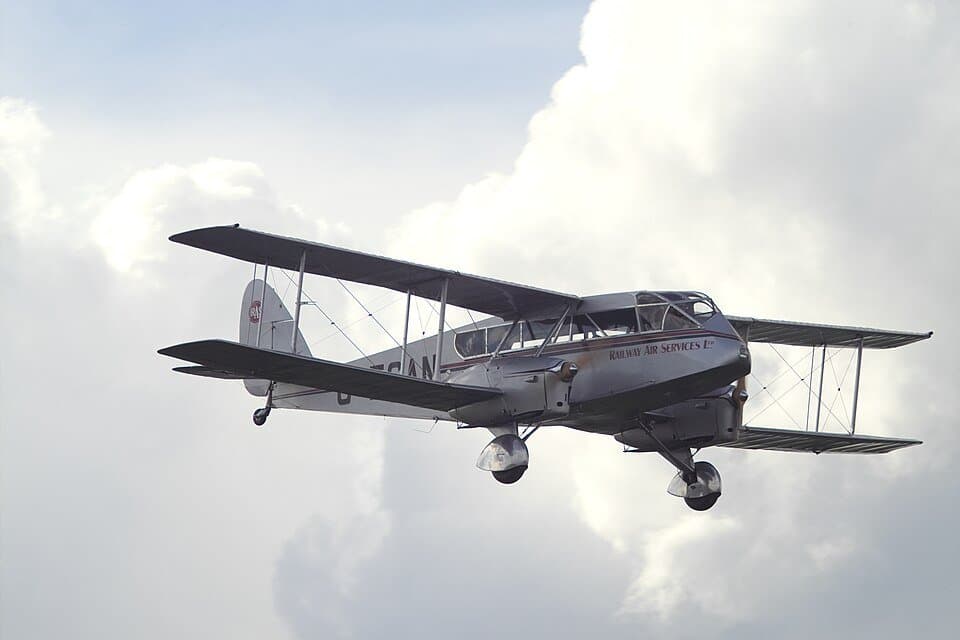
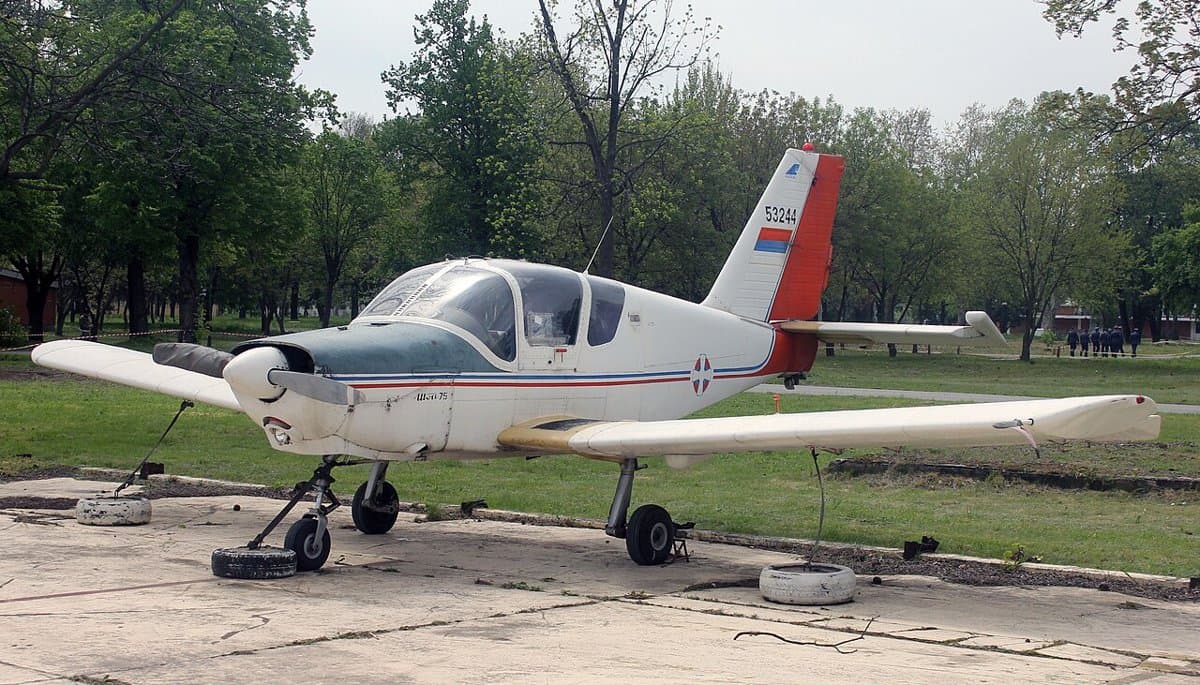
| Source measurement | Following the commercial success of its single-engined de Havilland Fox Moth that had first flown in March 1932, that aircraft's original commercial operator Hillman's Airways requested that a larger twin-engined version be built. The Dragon was a simple, light design with a plywood box fuselage using the same type of engine and similar outer wing sections of the earlier single-engined aircraft. It was originally designated the DH.84 "Dragon Moth" but marketed as the "Dragon". A prototype, which first flew at Stag Lane Aerodrome on 12 November 1932, and the next four aircraft were delivered to Hillman's which started a commercial service in April 1933. It could carry six passengers, each with 45 lb (20 kg) of luggage on the London - Paris route on a fuel consumption of just 13 gal (49 L) per hour. The wing panels outboard of the engines could be folded for storage.[source]De Havilland Dragon · Design and construction; only the objects and conditions stated in this passage The Dragon proved very attractive as a short-haul low capacity airliner and was soon in service worldwide. From the 63rd aircraft late in 1933, the Dragon 2, with improvements including individually framed windows and faired undercarriage struts, was produced. Even though these changes were largely cosmetic the streamlining improved the aircraft's speed by about 5 mph (8 km/h), allowed 250 lb (113 kg) more payload to be carried and added 85 mi (137 km) of range.[source]De Havilland Dragon · Operational service; only the objects and conditions stated in this passage A special aircraft named Seafarer was built for Amy Johnson (a pioneering English aviator) and her husband Jim Mollison (a famous Scottish pioneer aviator) to make an attempt at the world long distance record. It had a strengthened landing gear and the cabin had extra fuel tanks. It was intended to fly from New York City to Baghdad , Iraq, but at their first attempt at a transatlantic flight from Croydon Airport in South London to the United States on 8 June 1933 the landing gear collapsed. After repairs Seafarer left Pendine Sands in South Wales and arrived at Bridgeport, Connecticut , in the United States 39 hours later. However, on landing the aircraft turned over and was damaged.[source]De Havilland Dragon · Operational service; only the objects and conditions stated in this passage The engines and fuel tanks were recovered from Seafarer and used in another Dragon named Seafarer II . After three attempts to take off from Wasaga Beach, Ontario , Canada, for Baghdad , Iraq, the attempt was abandoned and the aircraft was sold. On 8 August 1934, the new owners, James Ayling and Leonard Reid, took off in the Dragon, renamed Trail of the Caribou , from Wasaga Beach in another attempt at the distance record. Although the intended target was Baghdad, throttle problems forced the attempt to be abandoned, and Trail of the Caribou landed at Heston Aerodrome , an airfield west of London, in Middlesex, England, after 30 hours 55 minutes, making the first non-stop flight between the Canadian mainland and Britain.[source]De Havilland Dragon · Operational service; only the objects and conditions stated in this passage On 1 July 1935, G-ADED of Railway Air Services crashed on take-off from Ronaldsway Airport , Isle of Man injuring all seven people on board. The aircraft, was operating a scheduled passenger flight from Ronaldsway to Ringway Airport , Manchester , Lancashire via Squires Gate Airport , Blackpool and Speke Airport , Liverpool; it was destroyed in the subsequent fire.[source]De Havilland Dragon · Accidents and incidents; only the objects and conditions stated in this passage On 22 July 1935, G-ACMP of Jersey Airways, operating a domestic flight from Bristol to Cardiff , with a pilot and two passengers on board, crashed while approaching Cardiff Airport . The aircraft spun and dived into the Bristol Channel about two miles off the Welsh coast, near Rumney, Cardiff killing all three on board.[source]De Havilland Dragon · Accidents and incidents; only the objects and conditions stated in this passage On 29 August 1938, VH-UXK Cairns of North Queensland Airways , crashed at Innisfail , Queensland killing the pilot and four passengers.[source]De Havilland Dragon · Accidents and incidents; only the objects and conditions stated in this passage 21 September 1951 – Pilot First Officer Frederick George Barlogie of Bondi, New South Wales , was killed when his Qantas DH-84 Dragon crashed into mountainous country 11 kilometres (6.8 mi) southeast of Arona in the central highlands of New Guinea .[source]De Havilland Dragon · Accidents and incidents; only the objects and conditions stated in this passage On 13 December 1951 – The pilot and two passengers were killed when a Qantas Dragon crashed in mountainous country near Mount Hagen in the central highlands of New Guinea , Qantas's third fatal crash in four months, and most recent fatal accident to date.[source]De Havilland Dragon · Accidents and incidents; only the objects and conditions stated in this passage DH.84M Dragon : Military transport version. The DH.84M was armed with two machine guns, and it could carry up to sixteen 20 lb (9 kg) bombs. Exported to Denmark , Iraq and Portugal .[source]De Havilland Dragon · Variants; only the objects and conditions stated in this passage Capacity: 6–10 passengers[source]De Havilland Dragon · Specifications (DH.84 Dragon 1); only the objects and conditions stated in this passage Length: 34 ft 6 in (10.52 m)[source]De Havilland Dragon · Specifications (DH.84 Dragon 1); only the objects and conditions stated in this passage Wingspan: 47 ft 4 in (14.43 m)[source]De Havilland Dragon · Specifications (DH.84 Dragon 1); only the objects and conditions stated in this passage Height: 10 ft 1 in (3.07 m)[source]De Havilland Dragon · Specifications (DH.84 Dragon 1); only the objects and conditions stated in this passage Wing area: 376 sq ft (34.9 m 2 )[source]De Havilland Dragon · Specifications (DH.84 Dragon 1); only the objects and conditions stated in this passage Empty weight: 2,300 lb (1,043 kg)[source]De Havilland Dragon · Specifications (DH.84 Dragon 1); only the objects and conditions stated in this passage Gross weight: 4,200 lb (1,905 kg)[source]De Havilland Dragon · Specifications (DH.84 Dragon 1); only the objects and conditions stated in this passage Powerplant: 2 × de Havilland Gipsy Major I 4-cylinder air-cooled inverted in-line piston engine, 130 hp (97 kW) each[source]De Havilland Dragon · Specifications (DH.84 Dragon 1); only the objects and conditions stated in this passage Maximum speed: 128 mph (206 km/h, 111 kn)[source]De Havilland Dragon · Specifications (DH.84 Dragon 1); only the objects and conditions stated in this passage Cruise speed: 109 mph (175 km/h, 95 kn)[source]De Havilland Dragon · Specifications (DH.84 Dragon 1); only the objects and conditions stated in this passage Range: 460 mi (740 km, 400 nmi)[source]De Havilland Dragon · Specifications (DH.84 Dragon 1); only the objects and conditions stated in this passage Service ceiling: 12,500 ft (3,800 m)[source]De Havilland Dragon · Specifications (DH.84 Dragon 1); only the objects and conditions stated in this passage Rate of climb: 612 ft/min (3.11 m/s)[source]De Havilland Dragon · Specifications (DH.84 Dragon 1); only the objects and conditions stated in this passage | — |
|---|
| Engine | 2 de Havilland Gipsy Major[source] | — |
|---|
| National origin | — | Yugoslavia[source] |
|---|
| Status | — | Active[source] |
|---|
| Primary user | — | Serbia Air Force[source] |
|---|
| Aspect ratio | — | 6.5[source] |
|---|
| Fuel capacity | — | standard:160 L (42 US gal; 35 imp gal): with drop tanks 360 L (95 US gal; 79 imp gal)[source] |
|---|
| Stall speed | — | 95 km/h (59 mph, 51 kn) flaps up at idle[source] |
|---|
| Never exceed speed | — | 270 km/h (168 mph, 146 kn)[source] |
|---|
| g limits | — | +4.4 -2.2[source] |
|---|
| Takeoff distance to 50 ft (15 m) | — | 501 m grass at Sea Level[source] |
|---|
| Landing distance from 50 ft (15 m) | — | 450 m grass at Sea Level[source] |
|---|
| Hardpoints | — | 2 with a capacity of 150 kg (330 lb) each, with provisions to carry combinations of:[source] |
|---|
| Rockets | — | 2 × RL 128-02 128 mm (HVAR-5), or 2 × 57 millimetres (2.2 in) rocket launchers with 12 rockets[source] |
|---|
| Bombs | — | 2 × 120 kg bombs, or 4 × 50 kg bombs[source] |
|---|
| Other | — | 2 × MAC-AA-52 container with 7.62 mm , or 2 × cargo container 100 kg capacity, or 2 × drop tanks[source] |
|---|
| standard | — | (model 75) KING KR85 ADF and KING KY 195B[source] |
|---|
| optional | — | (model 75A catalog only) KING KR87 ADF, RNAV KING KNS81 VOR/LOC: KING KN 53, KING KY 197 Indicators: HSI KING KI 525A, and RMI KING KI 229, DME:KING KN 62A, Transponder: KING KT 79, Audio panel: KING KMA 24[source] |
|---|