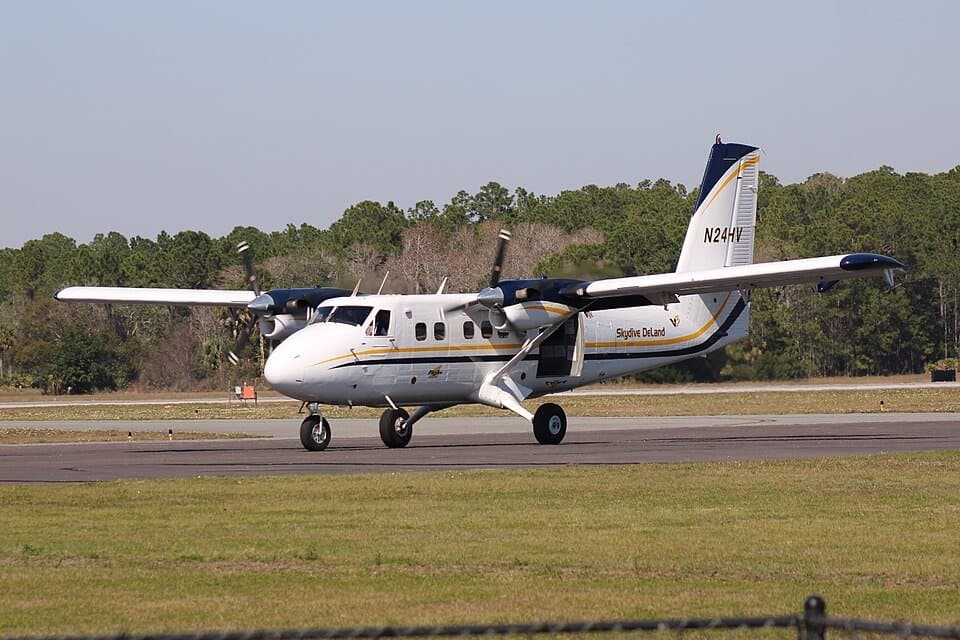

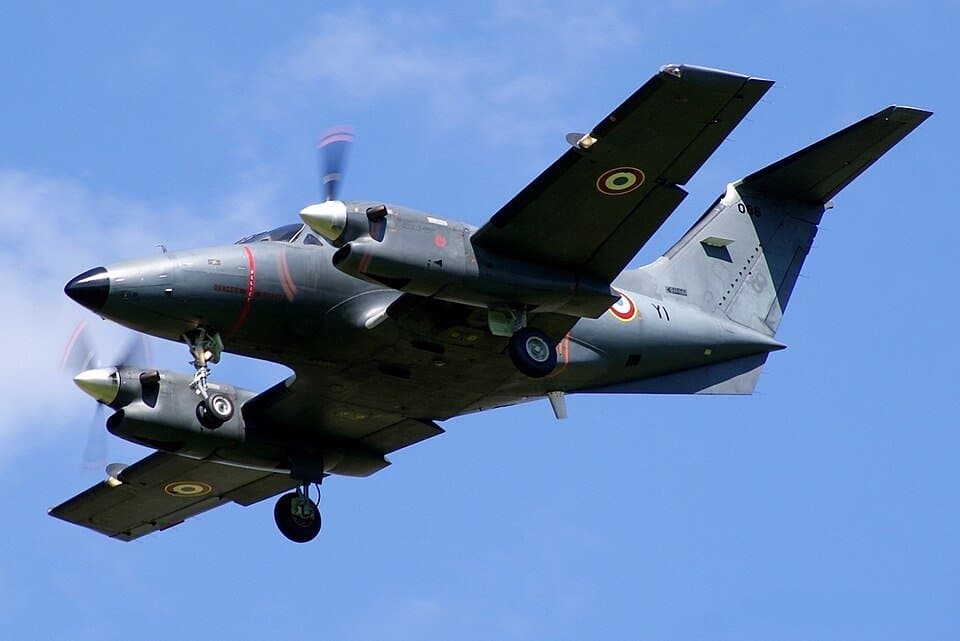
Credit
ZLEA · CC BY-SA 4.0 · Resized · CC BY-SA 4.0 · Source ↗ · Modified


Preparing your view.

At a glance
True scale
Side by side. From every angle. A human reference for perspective.
3.46 MB · Loads when you open it| Model | Length | Width / span | Height |
|---|---|---|---|
| De Havilland Canada DHC-6 Twin Otter | ≈ 15.09 m | ≈ 19.81 m (Width) | ≈ 5.94 m |
| Embraer EMB 121 Xingu | ≈ 12.25 m | ≈ 14.05 m (Width) | ≈ 4.85 m |
Scaled uniformly to the sourced length of 15.09 m. The shape was turned square to the axes; the height was fitted to the sourced 5.94 m; the width was fitted to the sourced 19.81 m. Not an official model or a measured survey.
ForceTally · All rights reserved
Scaled uniformly to the sourced length of 12.25 m. The shape was turned square to the axes; the width was fitted to the sourced 14.05 m. Not an official model or a measured survey.
ForceTally · All rights reserved
The human reference is a generic 1.75 m figure. Models describe external size, not combat performance.
Measured figures
Length
Single source49 ft 6 in (15.09 m)[source]
Configuration
| Specification | De Havilland Canada DHC-6 Twin Otter | Embraer EMB 121 Xingu |
|---|---|---|
| Type | Utility aircraft[source] | Utility aircraft[source] |
| Manufacturer | de Havilland Canada Viking Air De Havilland Canada[source] | Embraer[source] |
| Status | In production[source] | Active[source] |
| Number built | March 2026: 1000 (844 DHC, 156 Viking)[source] |
EMB 121A1 Xingu II · Length
12.25 m (40 ft 2 in)[source]
over 727 nmi (837 mi; 1,346 km)
Single source2,150 lb (980 kg) over 727 nmi (837 mi; 1,346 km)[source]
EMB 121A1 Xingu II · Wing area
Single source27.5 m 2 (296 sq ft)[source]
EMB 121A1 Xingu II · 1,800 ft/min
Single source9.1 m/s (1,800 ft/min)[source]
Bars compare reported quantities only. A larger figure does not make a system better; configurations and test conditions differ.
106[source] |
| Manufactured | 1965–1988 (Series 100–300) 2008–present (Series 400) 2023–present (Series 300-G)[source] | 1977-1987[source] |
|---|
| Introduction date | 1966[source] | 20 May 1977[source] |
|---|
| First flight | 20 May 1965[source] | 10 October 1976[source] |
|---|
| Developed from | de Havilland Canada DHC-3 Otter[source] | EMB 110 Bandeirante[source] |
|---|
| Passengers | 20[source] | — |
|---|
| Wing geometry | 65 ft 0 in (19.81 m) span, 420 sq ft (39 m 2 ) area (10.05 AR)[source] | — |
|---|
| Powerplant | P&WC PT6 A-20[source] | — |
|---|
| Stall Speed | 65 mph (56 kn; 105 km/h)[source] | 141 km/h (87 mph, 76 kn) power off, flaps down[source] |
|---|
| National origin | Canada[source] | Brazil[source] |
|---|
| Primary users | — | French Air and Space Force Brazilian Air Force French Navy[source] |
|---|
| Capacity | — | 9 passengers or 770 kg (1,700 lb) cargo with 1 pilot[source] |
|---|
| Fuel capacity | — | 1,308 kg (2,884 lb)[source] |
|---|
| Aspect ratio | — | 7.18[source] |
|---|
| Propellers | — | 4-bladed Hartzell HC-B4TN-3C/T9212B, 2.36 m (7 ft 9 in) diameter constant-speed metal propeller with auto-feathering and full reverse-pitch[source] |
|---|
| Wing loading | — | 206.2 kg/m 2 (42.2 lb/sq ft)[source] |
|---|
| Fuel consumption | — | 0.52 kg/km (1.86 lb/mi) : 250 lb (110 kg)/h per engine at 234 kn (433 km/h) TAS, FL200, -4°C[source] |
|---|
| Power/mass | — | 0.197 kW/kg (0.12 shp/lb)[source] |
|---|