

Credit
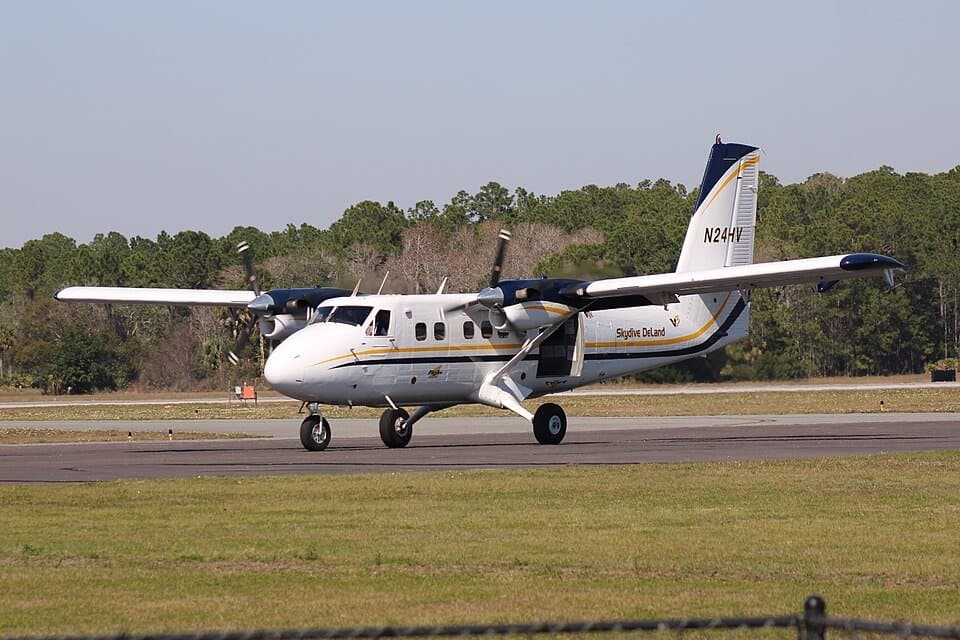
Ahunt at English Wikipedia · Public domain · Resized · Public domain · Source ↗ · Modified


Preparing your view.
At a glance
True scale
Side by side. From every angle. A human reference for perspective.
3.29 MB · Loads when you open it| Model | Length | Width / span | Height |
|---|---|---|---|
| De Havilland Canada DHC-5 Buffalo | ≈ 24.08 m | ≈ 29.26 m (Width) | ≈ 8.74 m |
| De Havilland Canada DHC-6 Twin Otter | ≈ 15.09 m | ≈ 19.81 m (Width) | ≈ 5.94 m |
Scaled uniformly to the sourced length of 24.08 m. The shape was turned square to the axes; the height was fitted to the sourced 8.74 m; the width was fitted to the sourced 29.26 m. Not an official model or a measured survey.
ForceTally · All rights reserved
Scaled uniformly to the sourced length of 15.09 m. The shape was turned square to the axes; the height was fitted to the sourced 5.94 m; the width was fitted to the sourced 19.81 m. Not an official model or a measured survey.
ForceTally · All rights reserved
The human reference is a generic 1.75 m figure. Models describe external size, not combat performance.
Measured figures
DHC-5D · Length
Single source79 ft 0 in (24.08 m)[source]
Configuration
| Specification | De Havilland Canada DHC-5 Buffalo | De Havilland Canada DHC-6 Twin Otter |
|---|---|---|
| Type | Utility aircraft[source] | Utility aircraft[source] |
| Manufacturer | de Havilland Canada[source] | de Havilland Canada Viking Air De Havilland Canada[source] |
| Status | In limited service[source] | In production[source] |
| Primary user | Royal Canadian Air Force (historical) |
Length
49 ft 6 in (15.09 m)[source]
DHC-5D · at 10,000 ft (3,048 m) with maximum payload
Single sourceFerry; DHC-5D · zero payload
Single source600 nmi (690 mi, 1,100 km) at 10,000 ft (3,048 m) with maximum payload[source]
1,770 nmi (2,040 mi, 3,280 km) zero payload[source]
Ferry; Ferry Range
Single source771 nmi (887 mi; 1,428 km)[source]
DHC-5D · Wing area
Single source945 sq ft (87.8 m 2 )[source]
DHC-5D · 1,820 ft/min (
Single source1,820 ft/min (9.2 m/s)[source]
over 727 nmi (837 mi; 1,346 km)
Single source2,150 lb (980 kg) over 727 nmi (837 mi; 1,346 km)[source]
Bars compare reported quantities only. A larger figure does not make a system better; configurations and test conditions differ.
| — |
| Number built | 122[source] | March 2026: 1000 (844 DHC, 156 Viking)[source] |
|---|
| Manufactured | 1965–1972, 1974–1986[source] | 1965–1988 (Series 100–300) 2008–present (Series 400) 2023–present (Series 300-G)[source] |
|---|
| Introduction date | 1965[source] | 1966[source] |
|---|
| First flight | 9 April 1964[source] | 20 May 1965[source] |
|---|
| Developed from | De Havilland Canada DHC-4 Caribou[source] | de Havilland Canada DHC-3 Otter[source] |
|---|
| Capacity | 41 troops or 24 stretchers or 18,000 lb (8,200 kg) payload[source] | — |
|---|
| Aspect ratio | 9.75:1[source] | — |
|---|
| Airfoil | root: NACA 64 3 A417.5 (mod); tip: NACA 63 2 A615[source] | — |
|---|
| Fuel capacity | 1,755 imp gal (2,108 US gal; 7,980 L)[source] | — |
|---|
| Propellers | 3-bladed Hamilton Standard 63E60-25, 14 ft 6 in (4.42 m) diameter fully-feathering reversible-pitch propellers[source] | — |
|---|
| Stall speed | 73 kn (84 mph, 135 km/h) 40 degree flaps at 46,900 lb (21,273 kg)[source] | 65 mph (56 kn; 105 km/h)[source] |
|---|
| g limits | 2.5g (manoeuvring limit load)[source] | — |
|---|
| Take-off run | 2,300 ft (701 m)[source] | — |
|---|
| Take-off distance to 50 ft (15 m) | 2,750 ft (838 m) (mid cg range)[source] | — |
|---|
| Landing run | 850 ft (259 m)[source] | — |
|---|
| Landing distance from 50 ft (15 m) | 2,010 ft (613 m)[source] | — |
|---|
| Country of origin | Canada[source]Inventory Origin column; table 1, row 11, cell 2; revision 1376550040; retrieved 2026-09-30 | — |
|---|
| Passengers | — | 20[source] |
|---|
| Wing geometry | — | 65 ft 0 in (19.81 m) span, 420 sq ft (39 m 2 ) area (10.05 AR)[source] |
|---|
| Powerplant | — | P&WC PT6 A-20[source] |
|---|
| National origin | — | Canada[source] |
|---|