

Credit
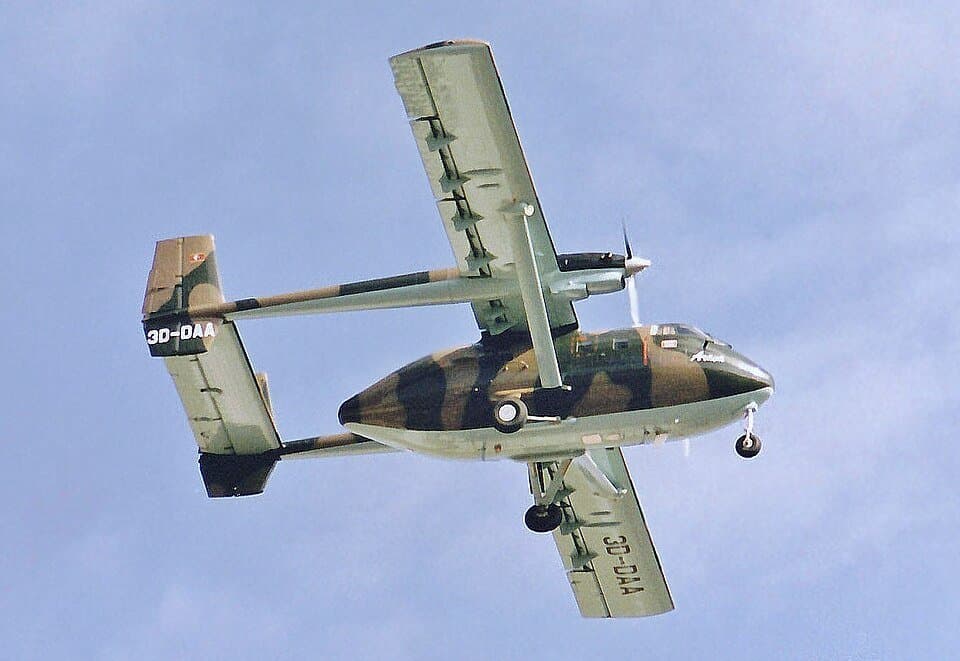
Raimond Spekking · CC BY-SA 4.0 · Resized · CC BY-SA 4.0 · Source ↗ · Modified


Preparing your view.

At a glance
True scale
Side by side. From every angle. A human reference for perspective.
3.23 MB · Loads when you open it| Model | Length | Width / span | Height |
|---|---|---|---|
| De Havilland Canada DHC-2 Beaver | ≈ 9.22 m | ≈ 14.63 m (Width) | ≈ 2.74 m |
| IAI Arava | ≈ 13.03 m | ≈ 20.96 m (Width) | ≈ 5.21 m |
Scaled uniformly to the sourced length of 9.22 m. The shape was turned square to the axes; the height was fitted to the sourced 2.74 m; the width was fitted to the sourced 14.63 m. Not an official model or a measured survey.
ForceTally · All rights reserved
Scaled uniformly to the sourced length of 13.03 m. The shape was turned square to the axes; the height was fitted to the sourced 5.21 m; the width was fitted to the sourced 20.96 m. Not an official model or a measured survey.
ForceTally · All rights reserved
The human reference is a generic 1.75 m figure. Models describe external size, not combat performance.
Measured figures
DHC-2 · Length
Single source30 ft 3 in (9.22 m)[source]
Configuration
| Specification | De Havilland Canada DHC-2 Beaver | IAI Arava |
|---|---|---|
| Type | STOL utility transport[source] | Light STOL Transport aircraft[source] |
| National origin | Canada[source] | — |
| Manufacturer | de Havilland Canada[source] | Israeli Aircraft Industries[source] |
| Status | In service[source] | Out of production, limited use[source] |
IAI 201 · Length
13.03 m (42 ft 9 in)[source]
Empty; DHC-2 · Empty weight
Single sourceGross; DHC-2 · Gross weight
Single sourceMaximum take-off; Remanufactured DHC-2T Turbo Beaver with 680 shp (510 kW) PT6A-34 only; not original piston DHC-2, not every Beaver configuration
Single source3,000 lb (1,361 kg)[source]
5,100 lb (2,313 kg)[source]
6,000 lb (2,700 kg)[source]Remanufactured DHC-2T Turbo Beaver with 680 shp (510 kW) PT6A-34 only; not original piston DHC-2, not every Beaver configuration
Empty; IAI 201 · Empty weight
Single sourceMaximum take-off; IAI 201 · Max takeoff weight
Single sourceCruise; DHC-2 · at 5,000 ft (1,500 m)
Single sourceMaximum; DHC-2 · Maximum speed
Single source158 mph (255 km/h, 137 kn)[source]
143 mph (230 km/h, 124 kn) at 5,000 ft (1,500 m)[source]
Cruise; IAI 201 · at 3,050 m (10,000 ft) (econ. cruise)
Single sourceMaximum; IAI 201 · at 3,050 m (10,000 ft)
Single sourceDHC-2 · 1 × Pratt & Whitney R-985 Wasp Jr. 9 cylinder radial engine
Single source1 × Pratt & Whitney R-985 Wasp Jr. 9 cylinder radial engine , 450 hp (340 kW)[source]
IAI 201 · 2 × Pratt & Whitney Canada PT6A-34 turboprops (750 shp) each
Single source2 × Pratt & Whitney Canada PT6A-34 turboprops , 560 kW (750 shp) each[source]
Bars compare reported quantities only. A larger figure does not make a system better; configurations and test conditions differ.
| Primary users | regional and remote air carriers United States Army Civil Air Patrol[source] | Israeli Air Force (IAF) 14 other militaries[source] |
|---|
| Number built | 1,657[source] | 103[source] |
|---|
| Manufactured | 1947–1967[source] | 1972–1988[source] |
|---|
| Introduction date | 1948[source] | — |
|---|
| First flight | 16 August 1947[source] | 27 November 1969[source] |
|---|
| Capacity | 6 passengers, 2,100 lb (953 kg) useful load[source] | 24 fully equipped troops or 16 paratroopers or 2,351 kg (5,183 lb) payload[source] |
|---|
| Fuel capacity | 79 imp gal (95 US gal; 360 L)[source] | 1,663 L (439 US gal; 366 imp gal) (normal)[source] |
|---|
| Airfoil | D.H. high lift wing section[source] | NACA 63(215)A 417[source] |
|---|
| Propellers | 2-bladed Hamilton-Standard controllable-pitch propeller, 8 ft 6 in (2.59 m) diameter[source] | 3-bladed Hartzell HC-B3TN fully-feathering reversible pitch propellers[source] |
|---|
| Source measurement | On 17 September 1946, de Havilland officially put together a design team consisting of Fred Buller, Dick Hiscocks, Jim Houston and Wsiewołod Jakimiuk, led by Phil Garratt. The new aircraft was designed to be all-metal (unlike older designs, like the Noorduyn Norseman ), using "steel from the engine to the firewall, heavy aluminium truss frames with panels and doors throughout the front seat area, lighter trusses toward the rear and all monocoque construction aft". At the time, de Havilland Canada was still a British-owned company and there were plans to fit the evolving design with the British de Havilland Gipsy engine. As a result of its comparatively limited power, the wing area was greatly increased in order to maintain STOL performance. When Pratt & Whitney Canada offered to supply war-surplus 450 hp (340 kW) Wasp Junior radial engines at a low price, the aircraft ended up with extra power as well as the original long wing. The result was unbeatable STOL performance for an aircraft of its size.[source]De Havilland Canada DHC-2 Beaver · Development / Origins; only the objects and conditions stated in this passage At one point in its production, plans to license-build the Beaver in New Zealand were proposed. The remaining tooling was purchased by Viking Air of Victoria, British Columbia , Canada, which manufactures replacement parts for most of the early de Havilland line. The company markets and sells the remanufactured DHC-2T Turbo Beaver, an improved variant of the aircraft which has been upgraded with a 680 shp (510 kW) PT6A-34, which enables an increased maximum gross takeoff weight of 6,000 lb (2,700 kg) and the carriage of up to 2,450 lb (1,110 kg) of freight, a roughly 25 per cent increase in usable payload. By August 1995, Viking completed its 30th Turbo Beaver conversion. The firm has also developed and marketed other improvements for the type, such as an advanced wing and modified floats. Other manufacturers have also offered aftermarket upgrades and modifications for the type, such as re-engining programmes by Orenda Aerospace and Wipaire .[source]De Havilland Canada DHC-2 Beaver · Development / 1995 to 2024; only the objects and conditions stated in this passage Advanced Wing Technologies of Vancouver, British Columbia has developed and certified a new wing for the DHC-2. The FAA Supplemental Type Certificate also raises the aircraft's gross weight to 6,000 lb (2,700 kg). So far, at least two Beavers have been modified in such a manner.[source]De Havilland Canada DHC-2 Beaver · Development / 1995 to 2024; only the objects and conditions stated in this passage The Beaver is typically powered by a single 450 hp (340 kW) Pratt & Whitney R-985 Wasp Junior radial engine . In order to provide the necessary weight balance for optimal loading flexibility, the engine was mounted as far rearwards as possible, resulting in elements intruding into the cockpit space, such as the oil tank being positioned within the center console between the pilot and copilot's feet and the main fuel tank within the forward belly of the aircraft, which also improves accessibility for replenishment. Many Beavers have had wingtip tanks also installed; careful fuel management between the various fuel tanks is required throughout flights in order to maintain the aircraft's center of gravity . The remanufactured DHC-2T Turbo Beaver is equipped with a 680 shp (510 kW) PT6A-34 turboprop engine.[source]De Havilland Canada DHC-2 Beaver · Design; only the objects and conditions stated in this passage The Beaver is functionally shaped in order to accommodate a useful and sizable payload, typically close to 2,000 lb (910 kg), even when equipped with floats. While the front doors are narrow, the aft doors are wider, having been designed to facilitate the loading of 45 imperial gallon barrels, either upright or on their sides. The Beaver is considered a 'working' aircraft, which was designed for vigorous use. In addition to cargo, passengers can also be carried; when appropriately fitted out, the Beaver Mk.I can accommodate up to seven passengers while the more spacious Beaver Mk.III can hold a maximum of 11. Various alterations have been approved for use, including alternative seating arrangements, enlarged cargo doors, larger windows and smaller batteries .[source]De Havilland Canada DHC-2 Beaver · Design; only the objects and conditions stated in this passage In recent years, growing numbers of the type have been used within the leisure industry, being used for pleasure flight and as lifting platforms for skydiving and aerial film activities. The DHC-2 Beaver has been used by skydiving operators due to its good climb rate. When fitted with a roller door that can be opened in flight, it can quickly ferry eight skydivers to 13,000 ft (4,000 m).[source]De Havilland Canada DHC-2 Beaver · Operational history; only the objects and conditions stated in this passage Powered by a 431 kW (578 ehp) Pratt & Whitney PT6A -6 or -20 turboprop engine.[source]De Havilland Canada DHC-2 Beaver · Variants; only the objects and conditions stated in this passage After-market conversion by Airtech Canada in the 1980s, using current-production PZL-3 S radial engines of 600 hp (450 kW).[source]De Havilland Canada DHC-2 Beaver · Variants; only the objects and conditions stated in this passage Remanufactured Beavers by Viking Air, upgraded with a Pratt & Whitney Canada PT6A-34 680 hp (507 kW) turboprop engine.[source]De Havilland Canada DHC-2 Beaver · Variants; only the objects and conditions stated in this passage Royal Australian Air Force – Five in service 1955–1964. Antarctic Flight RAAF No. 1 Air Trials Unit[source]De Havilland Canada DHC-2 Beaver · Operators / Military operators; only the objects and conditions stated in this passage 19 June 2000 – A de Havilland Canada DHC-2 Beaver floatplane crashes on takeoff from Nipmo Lake in British Columbia , Canada , killing three of the 12 people aboard. One of the dead is political cartoonist and caricaturist, book author and illustrator, and watercolourist William Papas , who drowns while trying to swim to shore in 40-degree F (4.5-degree C) water.[source]De Havilland Canada DHC-2 Beaver · Accidents and incidents; only the objects and conditions stated in this passage 31 July 2020 – A DHC-2 carrying 6 people collided with a Piper PA-12 Super Cruiser piloted by Alaska State Representative Gary Knopp (the only one aboard) over Alaska's Kenai Peninsula . All 7 people died.[source]De Havilland Canada DHC-2 Beaver · Accidents and incidents; only the objects and conditions stated in this passage AP-AKB – DHC-2 in storage at Canada Aviation and Space Museum in Ottawa .[source]De Havilland Canada DHC-2 Beaver · Aircraft on display / Canada; only the objects and conditions stated in this passage S-6 – L-20 in storage at the Militaire Luchtvaart Museum in Soesterberg, Utrecht , Netherlands.[source]De Havilland Canada DHC-2 Beaver · Aircraft on display / Netherlands; only the objects and conditions stated in this passage 58-2064 – U-6 in storage at the National Infantry Museum in Columbus, Georgia .[source]De Havilland Canada DHC-2 Beaver · Aircraft on display / United States; only the objects and conditions stated in this passage Capacity: 6 passengers, 2,100 lb (953 kg) useful load[source]De Havilland Canada DHC-2 Beaver · Specifications (DHC-2); only the objects and conditions stated in this passage Length: 30 ft 3 in (9.22 m)[source]De Havilland Canada DHC-2 Beaver · Specifications (DHC-2); only the objects and conditions stated in this passage Wingspan: 48 ft 0 in (14.63 m)[source]De Havilland Canada DHC-2 Beaver · Specifications (DHC-2); only the objects and conditions stated in this passage Height: 9 ft 0 in (2.74 m)[source]De Havilland Canada DHC-2 Beaver · Specifications (DHC-2); only the objects and conditions stated in this passage Wing area: 250 sq ft (23 m 2 )[source]De Havilland Canada DHC-2 Beaver · Specifications (DHC-2); only the objects and conditions stated in this passage Empty weight: 3,000 lb (1,361 kg)[source]De Havilland Canada DHC-2 Beaver · Specifications (DHC-2); only the objects and conditions stated in this passage Gross weight: 5,100 lb (2,313 kg)[source]De Havilland Canada DHC-2 Beaver · Specifications (DHC-2); only the objects and conditions stated in this passage Powerplant: 1 × Pratt & Whitney R-985 Wasp Jr. 9 cylinder radial engine , 450 hp (340 kW)[source]De Havilland Canada DHC-2 Beaver · Specifications (DHC-2); only the objects and conditions stated in this passage Propellers: 2-bladed Hamilton-Standard controllable-pitch propeller, 8 ft 6 in (2.59 m) diameter[source]De Havilland Canada DHC-2 Beaver · Specifications (DHC-2); only the objects and conditions stated in this passage Maximum speed: 158 mph (255 km/h, 137 kn)[source]De Havilland Canada DHC-2 Beaver · Specifications (DHC-2); only the objects and conditions stated in this passage Cruise speed: 143 mph (230 km/h, 124 kn) at 5,000 ft (1,500 m)[source]De Havilland Canada DHC-2 Beaver · Specifications (DHC-2); only the objects and conditions stated in this passage Range: 455 mi (732 km, 395 nmi)[source]De Havilland Canada DHC-2 Beaver · Specifications (DHC-2); only the objects and conditions stated in this passage Service ceiling: 18,000 ft (5,500 m)[source]De Havilland Canada DHC-2 Beaver · Specifications (DHC-2); only the objects and conditions stated in this passage Rate of climb: 1,020 ft/min (5.2 m/s)[source]De Havilland Canada DHC-2 Beaver · Specifications (DHC-2); only the objects and conditions stated in this passage | According to aviation journalist and ex-IAI engineer Danny Shalom, substantial work on the development of what would become the Arava commenced right after the Six-Day War between Israel and several neighbouring nations. Prior to this point, Israel Aerospace Industries (IAI) had largely confined its aircraft manufacturing efforts to producing copies of existing French and American designs, such as the IAI Nesher . However, many of the company's engineers were keen to develop beyond imitation and reverse engineering effort, for IAI and Israel to produce its own unique and indigenously produced aircraft. Around this time, the company foresaw a requirement for a new generation of transport aircraft that would suit operations from runways only 400 meters in length. IAI had forecast the international market demand for such an aircraft to be massive and that, by obtaining only a 20% market share, the company would sell between 400 and 600 aircraft throughout the life of the programme.[source]IAI Arava · Design and development / Origins; only the objects and conditions stated in this passage As the design took shape, key performance objectives included Short-Takeoff and Landing (STOL) capability, the ability to operate the type from unprepared/rough airstrips, as well as the carriage of up to 20 passengers or bulky payloads. The Arava featured a barrel -like fuselage , being relatively short but wide, while the rear of the fuselage was hinged and could swing open for easy and rapid loading and unloading. Its wingspan was long and the twin tails were mounted on booms that ran from the engine nacelles . It was fitted with a fixed nosewheel undercarriage to save weight, while the chosen powerplant was a pair of 715 eshp (533 kW) Pratt & Whitney Canada PT6 A-27 turboprop engines. The design configuration bore considerable similarity to the French Nord Noratlas transport plane, which was already being used at that time by the Israeli Air Force (IAF).[source]IAI Arava · Design and development / Origins; only the objects and conditions stated in this passage Civil passenger aircraft for up to 20 people in airline-standard configuration or up to 12 passengers in VIP configuration[source]IAI Arava · Variants; only the objects and conditions stated in this passage |
|---|
| Aspect ratio | — | 10:1[source] |
|---|
| Stall speed | — | 115 km/h (71 mph, 62 kn) (54% flaps)[source] |
|---|
| Never exceed speed | — | 397 km/h (247 mph, 214 kn)[source] |
|---|
| Takeoff distance to 15 m (50 ft) | — | 463 m (1,520 ft)[source] |
|---|
| Landing run from 15 m (50 ft) | — | 469 m (1,540 ft)[source] |
|---|
| Role | — | light STOL utility transport aircraft[source] |
|---|
| Country of origin | — | Israel[source] |
|---|
326 km/h (203 mph, 176 kn) at 3,050 m (10,000 ft)[source]
311 km/h (193 mph, 168 kn) at 3,050 m (10,000 ft) (econ. cruise)[source]
The military version could also be equipped with a range of weapons, in order to act in anti-submarine- or gunship roles. The weapon configuration could include two machine guns in fuselage side packs (usually 0.5" Browning), plus a third gun on the rear fuselage, and two pods containing 6 x 82 mm rocket pods or torpedoes or sonar buoys on the fuselage sides.[source]IAI Arava · Variants; only the objects and conditions stated in this passage
Bolivian Air Force – Six purchased 1975–76. One seized by Nicaragua during delivery, one in use 1987.[source]IAI Arava · Operators; only the objects and conditions stated in this passage
Ecuadorian Army – 2 in use as of December 2018. One other aircraft E-206 was written off due to a crash[source]IAI Arava · Operators; only the objects and conditions stated in this passage
Salvadoran Air Force – 3 in use as of December 2015, variant IAI Arava 202 since 2008.[source]IAI Arava · Operators; only the objects and conditions stated in this passage
Guatemalan Air Force – 1 in use as of December 2015.[source]IAI Arava · Operators; only the objects and conditions stated in this passage
Honduran Air Force – 1 in use as of December 2018.[source]IAI Arava · Operators; only the objects and conditions stated in this passage
Papua New Guinea Defence Force – 3 in use as of December 2015 but since retired.[source]IAI Arava · Operators; only the objects and conditions stated in this passage
Army of Venezuela – 11 in use as of December 2015, reducing to 4 by December 2018.[source]IAI Arava · Operators; only the objects and conditions stated in this passage
Capacity: 24 fully equipped troops or 16 paratroopers or 2,351 kg (5,183 lb) payload[source]IAI Arava · Specifications (IAI 201); only the objects and conditions stated in this passage
Length: 13.03 m (42 ft 9 in)[source]IAI Arava · Specifications (IAI 201); only the objects and conditions stated in this passage
Wingspan: 20.96 m (68 ft 9 in)[source]IAI Arava · Specifications (IAI 201); only the objects and conditions stated in this passage
Height: 5.21 m (17 ft 1 in)[source]IAI Arava · Specifications (IAI 201); only the objects and conditions stated in this passage
Wing area: 43.68 m 2 (470.2 sq ft)[source]IAI Arava · Specifications (IAI 201); only the objects and conditions stated in this passage
Empty weight: 3,999 kg (8,816 lb)[source]IAI Arava · Specifications (IAI 201); only the objects and conditions stated in this passage
Max takeoff weight: 6,804 kg (15,000 lb)[source]IAI Arava · Specifications (IAI 201); only the objects and conditions stated in this passage
Powerplant: 2 × Pratt & Whitney Canada PT6A-34 turboprops , 560 kW (750 shp) each[source]IAI Arava · Specifications (IAI 201); only the objects and conditions stated in this passage
Maximum speed: 326 km/h (203 mph, 176 kn) at 3,050 m (10,000 ft)[source]IAI Arava · Specifications (IAI 201); only the objects and conditions stated in this passage
Cruise speed: 311 km/h (193 mph, 168 kn) at 3,050 m (10,000 ft) (econ. cruise)[source]IAI Arava · Specifications (IAI 201); only the objects and conditions stated in this passage
Stall speed: 115 km/h (71 mph, 62 kn) (54% flaps)[source]IAI Arava · Specifications (IAI 201); only the objects and conditions stated in this passage
Never exceed speed : 397 km/h (247 mph, 214 kn)[source]IAI Arava · Specifications (IAI 201); only the objects and conditions stated in this passage
Range: 1,056 km (656 mi, 570 nmi) with maximum fuel[source]IAI Arava · Specifications (IAI 201); only the objects and conditions stated in this passage
Service ceiling: 7,620 m (25,000 ft)[source]IAI Arava · Specifications (IAI 201); only the objects and conditions stated in this passage
Rate of climb: 6.6 m/s (1,290 ft/min)[source]IAI Arava · Specifications (IAI 201); only the objects and conditions stated in this passage
Takeoff distance to 15 m (50 ft): 463 m (1,520 ft)[source]IAI Arava · Specifications (IAI 201); only the objects and conditions stated in this passage
Landing run from 15 m (50 ft): 469 m (1,540 ft)[source]IAI Arava · Specifications (IAI 201); only the objects and conditions stated in this passage