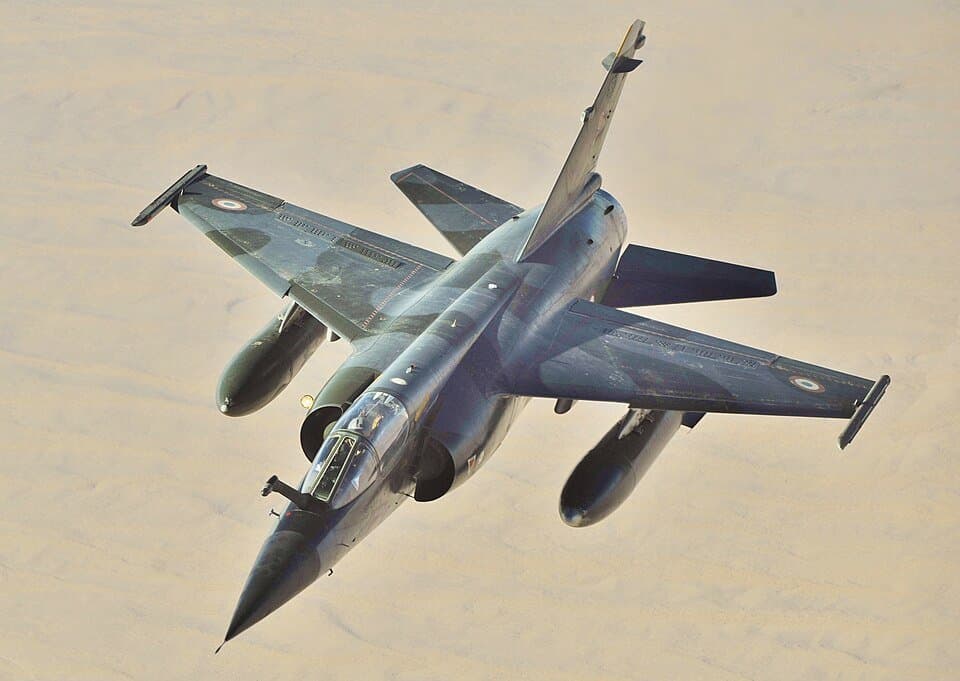

Credit
MSgt Eric Harris · Public domain · Resized · Public domain · Source ↗ · Modified


Preparing your view.

At a glance
True scale
Side by side. From every angle. A human reference for perspective.
3.28 MB · Loads when you open it| Model | Length | Width / span | Height |
|---|---|---|---|
| Dassault Mirage F1 | ≈ 15.3 m | ≈ 8.4 m (Wingspan) | ≈ 4.5 m |
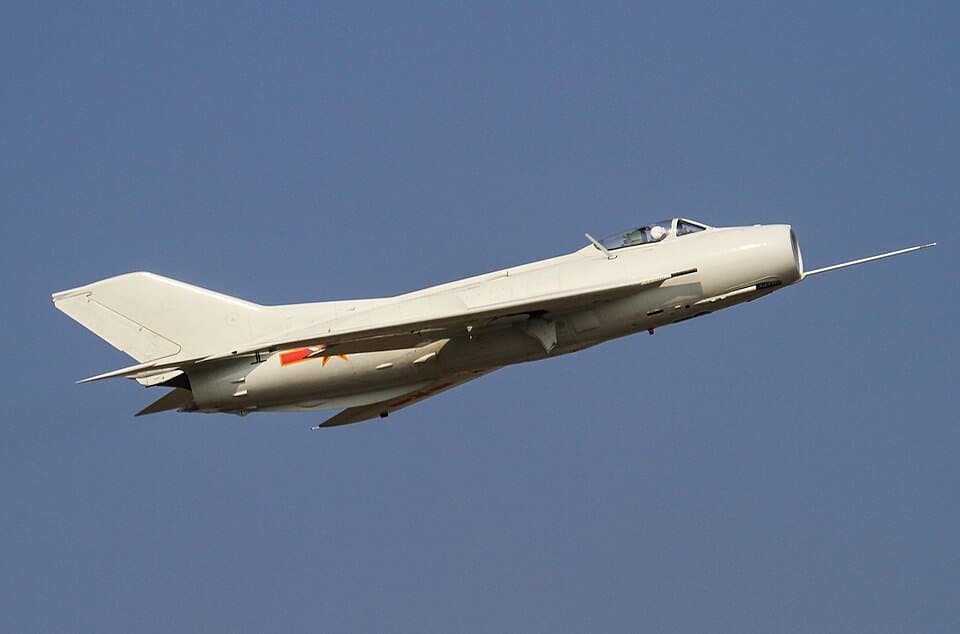
| Shenyang J-6 | ≈ 14.64 m | ≈ 9 m (Wingspan) | ≈ 3.88 m |
Scaled uniformly to the sourced length of 15.3 m. The shape was turned square to the axes; the height was fitted to the sourced 4.5 m; the width was fitted to the sourced 8.4 m wingspan. Not an official model or a measured survey.
ForceTally · All rights reserved
Scaled uniformly to the sourced length of 14.64 m. The height was fitted to the sourced 3.885 m; the width was fitted to the sourced 9 m wingspan. Not an official model or a measured survey.
ForceTally · All rights reserved
The human reference is a generic 1.75 m figure. Models describe external size, not combat performance.
Measured figures
Mirage F1 · Length
Single source15.3 m (50 ft 2 in)[source]
Configuration
| Specification | Dassault Mirage F1 | Shenyang J-6 |
|---|---|---|
| Type | Fighter aircraft[source] | Fighter aircraft[source] |
| National origin | France[source] | — |
| Manufacturer | Dassault Aviation[source] | Shenyang Aircraft Corporation[source] |
| Status | In limited service[source] | In service[source] |
| Primary users |
J-6 · variants with nose pitot probe
14.64 m (48 ft 0 in) (variants with nose pitot probe)[source]
Empty; Mirage F1 · Empty weight
Single sourceGross; Mirage F1 · clean take-off weight
Single sourceMaximum take-off; Mirage F1 · Max takeoff weight
Single source7,400 kg (16,314 lb)[source]
10,900 kg (24,030 lb) (clean take-off weight)[source]
16,200 kg (35,715 lb)[source]
Empty; J-6 · Empty weight
Single sourceMaximum take-off; J-6 · clean
Single sourceFerry; Mirage F1 · with maximum external fuel
Single source3,300 km (2,100 mi, 1,800 nmi) with maximum external fuel[source]
Mirage F1 · 1 × SNECMA Atar 9K-50 afterburning turbojet engine thrust dry
Single sourceMirage F1 · with afterburner
Single source1 × SNECMA Atar 9K-50 afterburning turbojet engine, 49.03 kN (11,020 lbf) thrust dry, 70.6 kN (15,900 lbf) with afterburner[source]
J-6 · 2 × Wopen WP-6A afterburning turbojet engines thrust each dry
Single sourceJ-6 · with afterburner
Single sourceBars compare reported quantities only. A larger figure does not make a system better; configurations and test conditions differ.
French Air Force (historical) Iraqi Air Force (historical) Hellenic Air Force (historical) Spanish Air Force (historical)[source] |
People's Liberation Army Air Force (historical) Pakistan Air Force (historical) Korean People's Air Force Bangladesh Air Force (historical)[source] |
| Number built | 726[source] | 4,500+ (including JJ-6 trainer)[source] |
|---|
| Manufactured | 1966–1992[source] | 1958 – 1986[source] |
|---|
| Introduction date | 1973 ( 1973 )[source] | 29 April 1962 (1964, practical type)[source] |
|---|
| First flight | 23 December 1966 ( 1966-12-23 )[source] | 30 September 1959[source] |
|---|
| Developed from | Dassault Mirage III[source] | Mikoyan-Gurevich MiG-19[source] |
|---|
| Guns | 2× 30 mm (1.18 in) DEFA 553 cannons with 150 rounds per gun[source] | — |
|---|
| Hardpoints | 1 centreline pylon, four underwing and two wingtip pylons with a capacity of 6,300 kg (13,900 lb) (practical maximum load 4,000 kg (8,800 lb)), with provisions to carry combinations of: Rockets: 8× Matra rocket pods with 18× SNEB 68 mm rockets each Bombs: various Other: reconnaissance pods or Drop tanks[source] | — |
|---|
| Thrust/weight | 0.66[source] | — |
|---|
| Rockets | 8× Matra rocket pods with 18× SNEB 68 mm rockets each[source] | — |
|---|
| Bombs | various[source] | — |
|---|
| Other | reconnaissance pods or Drop tanks[source] | — |
|---|
| Missiles | 2× AIM-9 Sidewinders OR Matra R550 Magics on wingtip pylons, 2× R.530 or Super 530 Fs underwing, 1× AM-39 Exocet anti-ship missile, 2× AS-30L laser-guided missiles[source] | — |
|---|
| Alternative designation | Mirage F1[source] | — |
|---|
| Retired | — | Late 1990s (China) Mid 2002 (Pakistan)[source] |
|---|
| Developed into | — | Nanchang Q-5[source] |
|---|
| Fuel capacity | — | 1,735–1,800 kg (3,825–3,968 lb) internal[source] |
|---|
| Take-off run | — | 900 m (3,000 ft) at full military power[source] |
|---|
| Landing run | — | 610 m (2,000 ft) with brake parachute[source] |
|---|
| Country of origin | — | People's Republic of China[source] People's Republic of China[source] |
|---|
2 × Wopen WP-6A afterburning turbojet engines, 25.5 kN (5,730 lbf) thrust each dry, 31.8 kN (7,160 lbf) with afterburner[source]