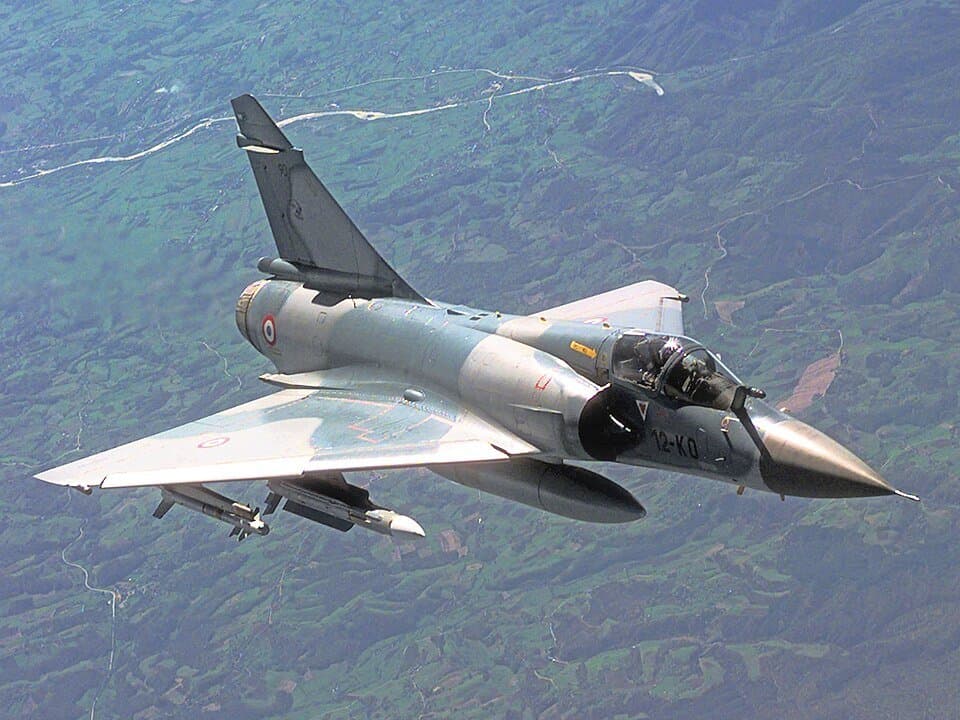

Credit
SRA GREG L. DAVIS, USAF · Public domain · Resized · Public domain · Source ↗ · Modified


Preparing your view.


At a glance
Measured figures
Mirage 2000 · Length
Single source14.36 m (47 ft 1 in)[source]
F-16 Block70/72 new-production configuration only · /15.027 m
Configuration
| Specification | Dassault Mirage 2000 | Lockheed Martin F-16V Viper |
|---|---|---|
| Type | Multirole fighter aircraft[source] | Multirole fighter[source] |
| National origin | France[source] | United States[source] |
| Manufacturer | Dassault Aviation[source] | Production plant of the Lockheed Martin in Greenville, South Carolina[source] |
| Status | In service[source] |
F-16V C/D Block 70/72 · /15.027 m
Single sourceMultirole 4th Generation Fighter / United States | 2017 / "The Lockheed Martin F-16V Viper is an active upgrade or new-build offering of the classic F-16 Fighting Falcon line." · Length
Single source49.3 ft/15.027 m[source]
49.2 ft (15.00 m)[source]Multirole 4th Generation Fighter / United States | 2017 / "The Lockheed Martin F-16V Viper is an active upgrade or new-build offering of the classic F-16 Fighting Falcon line."
49.3 ft/15.027 m[source]F-16 Block70/72 new-production configuration only · Length; not generic F-16 or retrofit Viper fleet
Multirole 4th Generation Fighter / United States | 2017 / "The Lockheed Martin F-16V Viper is an active upgrade or new-build offering of the classic F-16 Fighting Falcon line." · Width
Single source31.0 ft (9.45 m)[source]Multirole 4th Generation Fighter / United States | 2017 / "The Lockheed Martin F-16V Viper is an active upgrade or new-build offering of the classic F-16 Fighting Falcon line."
Mirage 2000 · Wingspan
Single source9.13 m (29 ft 11 in)[source]
Mirage 2000 · Height
Single source5.2 m (17 ft 1 in)[source]
F-16 Block70/72 new-production configuration only · /5.09 m
Single sourceF-16V C/D Block 70/72 · /5.090 m
Single sourceMultirole 4th Generation Fighter / United States | 2017 / "The Lockheed Martin F-16V Viper is an active upgrade or new-build offering of the classic F-16 Fighting Falcon line." · Height
Single source16.7 ft/5.090 m[source]
16.7 ft (5.10 m)[source]Multirole 4th Generation Fighter / United States | 2017 / "The Lockheed Martin F-16V Viper is an active upgrade or new-build offering of the classic F-16 Fighting Falcon line."
16.7 ft/5.09 m[source]F-16 Block70/72 new-production configuration only · Height; not generic F-16 or retrofit Viper fleet
Empty; Mirage 2000 · Empty weight
Single sourceGross; Mirage 2000 · Gross weight
Single sourceMaximum take-off; Mirage 2000 · Max takeoff weight
Single source7,500 kg (16,535 lb)[source]
13,800 kg (30,424 lb)[source]
17,000 kg (37,479 lb)[source]
Empty; F-16 Block70/72 new-production configuration only · /9,207 kg
Single sourceEmpty; F-16V C/D Block 70/72 · /9,207 kg
Single sourceMirage 2000 · Crew
Single sourceMultirole 4th Generation Fighter / United States | 2017 / "The Lockheed Martin F-16V Viper is an active upgrade or new-build offering of the classic F-16 Fighting Falcon line." · MANNED
Single source1 (F-16C) or 2 (F-16D)[source]
1 (MANNED)[source]Multirole 4th Generation Fighter / United States | 2017 / "The Lockheed Martin F-16V Viper is an active upgrade or new-build offering of the classic F-16 Fighting Falcon line."
Maximum; Mirage 2000 · / Mach 2.2 at high altitude
Single source2,336 km/h (1,452 mph, 1,261 kn) / Mach 2.2 at high altitude[source]
Maximum; F-16V C/D Block 70/72 · Mach 2+
Single sourceMaximum; Multirole 4th Generation Fighter / United States | 2017 / "The Lockheed Martin F-16V Viper is an active upgrade or new-build offering of the classic F-16 Fighting Falcon line." · Maximum speed
Single source1,500 mph (Mach 2+)[source]
917 mph (1,475 kph | 796 kts)[source]Multirole 4th Generation Fighter / United States | 2017 / "The Lockheed Martin F-16V Viper is an active upgrade or new-build offering of the classic F-16 Fighting Falcon line."
1,500 mph (Mach 2+)[source]F-16 Block70/72 new-production configuration only · Speed; not generic F-16 or retrofit Viper fleet
Ferry; Mirage 2000 · with auxiliary fuel
Single sourceMirage 2000 · Range
Single source1,550 km (960 mi, 840 nmi)[source]
3,335 km (2,072 mi, 1,801 nmi) with auxiliary fuel[source]
Operational; Multirole 4th Generation Fighter / United States | 2017 / "The Lockheed Martin F-16V Viper is an active upgrade or new-build offering of the classic F-16 Fighting Falcon line." · Operational range
Single source2,619 miles (4,215 km | 2,276 nm)[source]Multirole 4th Generation Fighter / United States | 2017 / "The Lockheed Martin F-16V Viper is an active upgrade or new-build offering of the classic F-16 Fighting Falcon line."
Mirage 2000 · 1 × SNECMA M53-P2 afterburning turbofan engine thrust dry
Single sourceMirage 2000 · with afterburner
Single source1 × SNECMA M53-P2 afterburning turbofan engine, 64.3 kN (14,500 lbf) thrust dry, 95.1 kN (21,400 lbf) with afterburner[source]
Mirage 2000 · Wing area
Single source41 m 2 (440 sq ft)[source]
Mirage 2000 · Service ceiling
Single source17,060 m (55,970 ft)[source]
Multirole 4th Generation Fighter / United States | 2017 / "The Lockheed Martin F-16V Viper is an active upgrade or new-build offering of the classic F-16 Fighting Falcon line." · Service ceiling
Single source49,213 ft (15,000 m | 9 miles)[source]Multirole 4th Generation Fighter / United States | 2017 / "The Lockheed Martin F-16V Viper is an active upgrade or new-build offering of the classic F-16 Fighting Falcon line."
Mirage 2000 · 56,100 ft/min
Single source285 m/s (56,100 ft/min)[source]
Bars compare reported quantities only. A larger figure does not make a system better; configurations and test conditions differ.
In service[source] |
| Primary users | French Air and Space Force United Arab Emirates Air Force Republic of China Air Force Indian Air Force[source] | — |
|---|
| Number built | 601[source] | — |
|---|
| Manufactured | 1978–2007[source] | 2019–present (serial production)[source] |
|---|
| Introduction date | July 1984[source] | — |
|---|
| First flight | 10 March 1978[source] | 2015[source] |
|---|
| Variant | Dassault Mirage 2000N/2000D[source] | — |
|---|
| Developed into | Dassault Mirage 4000[source] | — |
|---|
| Fuel capacity | 3,950 L internal / 8,000 L maximum[source] | — |
|---|
| Guns | 2× 30 mm (1.2 in) DEFA 554 revolver cannon , 125 rounds per gun[source] | 1 x M61A1 20 mm Vulcan Cannon[source] |
|---|
| Hardpoints | nine total (four under-wing and five under-fuselage) with a capacity of 6,300 kg (13,900 lb) external fuel and ordnance[source] | — |
|---|
| Wing loading | 337 kg/m 2 (69 lb/sq ft)[source] | — |
|---|
| Thrust/weight | 0.7[source] | — |
|---|
| Rockets | Matra 68 mm unguided rocket pods, 18 rockets per pod[source] | — |
|---|
| Missiles | Air-to-air missiles : 6 × MBDA MICA IR/RF (Mirage 2000-5, Mirage 2000-9, Mirage 2000 I ) 2 × Matra R550 Magic-II and 2× Matra Super 530 D (Mirage 2000 C, Mirage 2000 H ) Air-to-surface missiles : 2 × AM.39 Exocet (Mirage 2000 EG, Mirage 2000-5 Mk2) 1 × SCALP EG (Mirage 2000 D, Mirage 2000-5) Crystal Maze Crystal Maze II[source] | — |
|---|
| Air-to-air missiles | 6 × MBDA MICA IR/RF (Mirage 2000-5, Mirage 2000-9, Mirage 2000 I ) 2 × Matra R550 Magic-II and 2× Matra Super 530 D (Mirage 2000 C, Mirage 2000 H )[source] | — |
|---|
| Air-to-surface missiles | 2 × AM.39 Exocet (Mirage 2000 EG, Mirage 2000-5 Mk2) 1 × SCALP EG (Mirage 2000 D, Mirage 2000-5) Crystal Maze Crystal Maze II[source] | — |
|---|
| Bombs | Unguided : Mk.82 Guided : PGM 500 and PGM 2000 modular guided bombs (Mirage 2000-9) 2 × AS-30L laser-guided missile (Mirage 2000 D) 2 × GBU-12 laser-guided bombs (Mirage 2000 D, Mirage 2000 C & Mirage 2000 N with external laser designation) 1 × GBU-16 laser-guided bomb (Mirage 2000 D, Mirage 2000 C & Mirage 2000 N with external laser designation) 1 × GBU-24 laser-guided bomb (Mirage 2000 D, Mirage 2000 C & Mirage 2000 N with external laser designation) 2 × GBU-49 laser-guided bombs (Mirage 2000 D) 1 × ASMP-A tactical nuclear cruise missile (Mirage 2000 N) 1 × Spice 2000 (Mirage 2000 N) Smart Anti-Airfield Weapon AASM Hammer smart air-to-surface stand-off weapon[source] | — |
|---|
| Unguided | Mk.82[source] | — |
|---|
| Guided | PGM 500 and PGM 2000 modular guided bombs (Mirage 2000-9) 2 × AS-30L laser-guided missile (Mirage 2000 D) 2 × GBU-12 laser-guided bombs (Mirage 2000 D, Mirage 2000 C & Mirage 2000 N with external laser designation) 1 × GBU-16 laser-guided bomb (Mirage 2000 D, Mirage 2000 C & Mirage 2000 N with external laser designation) 1 × GBU-24 laser-guided bomb (Mirage 2000 D, Mirage 2000 C & Mirage 2000 N with external laser designation) 2 × GBU-49 laser-guided bombs (Mirage 2000 D) 1 × ASMP-A tactical nuclear cruise missile (Mirage 2000 N) 1 × Spice 2000 (Mirage 2000 N) Smart Anti-Airfield Weapon AASM Hammer smart air-to-surface stand-off weapon[source] | — |
|---|
| Role | multirole, single-engine, delta wing , fourth-generation jet fighter[source] | family of upgraded single-engine supersonic multirole fighter aircraft[source] |
|---|
| Source measurement | During the 65-minute flight, Coureau took the aircraft to Mach 1.02 without afterburner , before climbing to more than 12,000 meters and accelerating the aircraft to Mach 1.3.[source]Dassault Mirage 2000 · Development / Production; only the objects and conditions stated in this passage By the end of May, the aircraft had surpassed Mach 2 and an indicated airspeed of 1,200 kilometres per hour (650 kn).[source]Dassault Mirage 2000 · Development / Production; only the objects and conditions stated in this passage On the other end of the speed spectrum, the Mirage 2000 proved to be capable of low-speed flight, as demonstrated at the Farnborough Airshow in September 1978, during which Dassault pilot Guy Mitaux-Maurourd raised the aircraft's nose to 25° angle of attack (AoA) as the aircraft slowed to 190 km/h (100 kn).[source]Dassault Mirage 2000 · Development / Production; only the objects and conditions stated in this passage Later tests showed that the aircraft could attain 30° AoA while carrying fuel tanks and weapons.[source]Dassault Mirage 2000 · Development / Production; only the objects and conditions stated in this passage In September 1978, the second prototype, No. 02, made its 50-minute first flight with Maurourd again at the controls. This aircraft was to test some of the avionics systems and the carriage of weapons. Due to a flameout while on approach, the aircraft was lost in May 1984. No. 03 made its first flight in April 1979; equipped with a complete weapons system, it was used for radar and weapons trials. After 400 hours of flight, the prototypes were sent to Centre d'Essais en Vol , flight tests centre. Although three prototypes were ordered in December 1975, Dassault constructed an additional fourth single-seat demonstrator for its own purposes, which embodied lessons on the earlier aircraft, namely the reduction in fin height and an increased fin sweep, redesigned air inlets, and an FBW system. The only dual-seat Mirage 2000B of the test programme first flew on 11 October 1980.[source]Dassault Mirage 2000 · Development / Production; only the objects and conditions stated in this passage On 20 November 1982, the first production Mirage 2000C (C for chasseur , "fighter") made its first flight. Deliveries to the AdA began in 1983. The first 37 Mirage 2000Cs delivered were fitted with the Thomson-CSF Radar Doppler Multifunction (RDM), and were powered by the SNECMA M53-5 turbofan engine. The 38th Mirage 2000C had an upgraded SNECMA M53-P2 turbofan engine. The Radar Doppler à Impulsion (RDI) built for the Mirage 2000C entered service in 1987, which has a much improved range of about 150 km, and is linked to Matra Super 530D missiles, which are measurably improved compared to the older Super 530F. The aircraft's Look-down/shoot-down capabilities are much improved, as well, although this radar is not usually used for air-to-surface roles.[source]Dassault Mirage 2000 · Development / Production; only the objects and conditions stated in this passage The Mirage 2000N is a dedicated nuclear-strike variant, which was intended to carry the Air-Sol Moyenne Portée (ASMP) nuclear standoff missile. Flight tests of the first of two prototypes, Mirage 2000N 01 (eighth Mirage 2000) began on 3 February 1983. During the 65-minute flight, the aircraft reached a speed of Mach 1.5. The variant entered operational service in 1988, initially operating from Luxeuil Air Base with the 4 e Escadre de Chasse. Closely derived from the Mirage 2000N is a dedicated conventional attack variant designated Mirage 2000D. Initial flight of the Mirage 2000D prototype, a modified Mirage 2000N prototype, was on 19 February 1991. The first flight of a production aircraft occurred 31 March 1993, and service introduction followed in April 1995. Seventy-five Mirage 2000Ns and eighty-six Mirage 2000Ds were manufactured, respectively.[source]Dassault Mirage 2000 · Development / Strike derivatives; only the objects and conditions stated in this passage The aircraft's low-set, thin wing has a leading-edge sweep back of 58° and a trailing-edge forward sweep of 3.5°.[source]Dassault Mirage 2000 · Design / Overview; only the objects and conditions stated in this passage The wing on a Mirage 2000 has an area of 41 m 2 , giving it a wing loading of some 380 kg/m 2 (77 lb/ft 2 ) at a takeoff weight of 15,000 kg (33,000 lb), making it considerably more manoeuvrable than the F-15 and the similarly sized F-16, which has a wing loading of 540 kg/m 2 (110 lb/ft 2 ).[source]Dassault Mirage 2000 · Design / Overview; only the objects and conditions stated in this passage An airbrake is fitted above and below each wing in an arrangement very similar to that of the Mirage III. A noticeably taller tailfin allows the pilot to retain control at AoAs past 25°, assisted by the small strakes mounted along each air intake. The shape and size of these air intakes is sufficient to provide ample air flow even when the aircraft is being flown at high AoAs. Some composites have been used for elements of the aircraft, including the fins, rudder , elevons, and various access panels, resulting in an overall weight saving of roughly 100 kg. The Mirage 2000 has been noted for its superb handling, especially given its delta-wing design.[source]Dassault Mirage 2000 · Design / Overview; only the objects and conditions stated in this passage Dassault conducted flight tests of the M53-2 version using its Mirage F1E testbeds starting in December 1974; this version produced 84 kilonewtons (19,000 lb f ) in afterburner.[source]Dassault Mirage 2000 · Design / Engines; only the objects and conditions stated in this passage The Mirage 2000 itself was powered by two versions of the M53—the M53-5, which equipped initial operational aircraft, was rated at 88 kN (20,000 lb f ) of thrust with afterburner.[source]Dassault Mirage 2000 · Design / Engines; only the objects and conditions stated in this passage The definitive version of the engine, the M53-P2, which equipped the majority of the type, is rated at 65 kN (15,000 lb f ) in dry thrust and 95 kN (21,000 lb f ) in afterburner.[source]Dassault Mirage 2000 · Design / Engines; only the objects and conditions stated in this passage The Mirage 2000 is equipped with built-in twin DEFA 554 autocannon (now GIAT 30–550 F4) 30 mm revolver-type cannons with 125 rounds each. The cannons have selectable fire rates of 1,200 or 1,800 rounds per minute .[source]Dassault Mirage 2000 · Design / Payload and armaments; only the objects and conditions stated in this passage Capable of automatically locking onto multiple targets at first contact (creating a "shoot list), the radar can detect flying targets travelling as low as 60 m (200 ft).[source]Dassault Mirage 2000 · Design / Differences between variants; only the objects and conditions stated in this passage Improvements over the Mirage 2000C included the multimode RDY, which allows detection of up to 24 targets and the ability to simultaneously track eight threats while guiding four MICA missiles to different targets. Updates to defensive systems included the ICMS Mk2 countermeasures suite. ICMS Mk2 incorporates a receiver and associated signal processing system in the nose for detecting hostile missile-command data links, and can be interfaced to a new programmable mission-planning and postmission analysis ground system. Avionics were also updated, using a new night vision -compatible glass cockpit layout borrowed from the Dassault Rafale , a dual-linked wide-angle head-up display , and HOTAS controls. The Mirage 2000-5F can also carry the oversized drop tanks developed for the Mirage 2000N, greatly extending its range.[source]Dassault Mirage 2000 · Design / Differences between variants; only the objects and conditions stated in this passage The Indian government became aware of a high-performance prototype of the Mirage 2000 in the flight-testing phase while evaluating the Mirage F1 earlier.[source]Dassault Mirage 2000 · Operational history / India; only the objects and conditions stated in this passage While the agreement with France included the possibility of future manufacturing the aircraft in India, cost constraints and the Soviet offer of license production of MiG-27 in India meant that the Mirage 2000 aircraft was not produced in India.[source]Dassault Mirage 2000 · Operational history / India; only the objects and conditions stated in this passage The later single and two-seater aircraft powered by the M53-5P2, were named as "Mirage 2000H" and "Mirage 2000TH" respectively.[source]Dassault Mirage 2000 · Operational history / India; only the objects and conditions stated in this passage The order consisting of six Mirage 2000H single-seaters and three Mirage 2000TH two-seaters were delivered from 1987 to 1988.[source]Dassault Mirage 2000 · Operational history / India; only the objects and conditions stated in this passage India procured ATLIS II targeting pods and 60 Bombe Guidée Laser Arcole 1,000 kg laser-guided bombs to equip the Mirage aircraft.[source]Dassault Mirage 2000 · Operational history / India; only the objects and conditions stated in this passage The No. 1 Squadron flew 274 air defence and strike escort missions, and the No. 7 Squadron conducted 240 strike missions during which it dropped 55,000 kg (121,000 lb) of ordnance.[source]Dassault Mirage 2000 · Operational history / India; only the objects and conditions stated in this passage In December 1982, Peru placed an $800 million order for 14 single-seat Mirage 2000Ps and two two-seat Mirage 2000DP trainers, with an option for eight and two more aircraft, respectively. Although the contract was signed in 1985, the Peruvian government, due to the country's financial issues , renegotiated the number of aircraft to be reduced to 10 single-seaters and two two-seaters. Handover of the first aircraft occurred in June 1985, although the first deliveries to Peru were not made until December 1986, after the initial training of pilots in France had been completed. Peru's Mirage 2000s underwent an inspection and partial electronic modernisation programme following a $140 million deal in 2009 that involved Dassault, Snecma, and Thales. The aircraft were expected to be retired by 2025 but nine Mirage 2000Ps and two Mirage 2000DP trainers are still reported to be in service in 2026 until replacement aircraft are procured.[source]Dassault Mirage 2000 · Operational history / Peru; only the objects and conditions stated in this passage On 2 July 2019, during the 2019–20 Western Libya campaign , an airstrike hit the Tajoura Detention Center outside Tripoli, Libya , which was being used as a holding facility for migrants and refugees trying to reach Europe , was struck from the air. A storage hangar being used as a residential facility was destroyed by the attack, killing at least 53 people and wounding 130. The Libyan Government of National Accord (GNA) initially claimed that the airstrike was conducted by the Libyan National Army (LNA), but later attributed the attack to a UAE aircraft. A January 2020 report by the United Nations Support Mission in Libya (UNSMIL) and the Office of the United Nations High Commissioner for Human Rights (OHCHR) stated that the strike was likely to have been carried out with a guided bomb fired from a non-Libyan aircraft, again suggesting that a foreign Mirage 2000 had been used.[source]Dassault Mirage 2000 · Operational history / United Arab Emirates / In Libya; only the objects and conditions stated in this passage In August 2000, Greece placed a $1.1B order for a batch of 15 new Mirage 2000-5 Mk. 2 fighters, and had 10 existing Mirage 2000EGMs upgraded to Mirage 2000-5 Mk. 2 standard. The upgrade meant the addition of the RDY-2 radar and ICMS-3 DCS, and the ability to deploy SCALP cruise missiles and both versions of the MICA instead, an order for which was placed. Deliveries of the upgraded aircraft took place between 2004 and 2005. In December 2019, Greece signed contracts for a €260M further upgrade of its remaining Mirage 2000s, focused on their electronics and engines. All Greek machines (Mk 2s and EGMs) feature the TOTEM-3000 INS of the Mk2 instead of the Uliss-52 and have hose-and-drogue aerial refueling capability.[source]Dassault Mirage 2000 · Operational history / Greece; only the objects and conditions stated in this passage While the US opposed Taiwan's acquisition of the Mirage 2000 and instead pressured it to procure the F-16, the Republic of China Air Force became the first customer for the Mirage 2000-5 in November 1992.[source]Dassault Mirage 2000 · Operational history / Taiwan; only the objects and conditions stated in this passage Taiwanese Mirage 2000s were delivered from May 1997 to November 1998, and are based at Hsinchu AB. The RoCAF's Mirages have suffered from low operational readiness and high maintenance costs; the harsh environment and high operational tempo have caused higher than expected wear and tear. After cracks were detected in the blades of the aircraft's engines in 2009, Dassault worked with Taiwanese authorities to successfully rectify the issue and provided compensation for the engine damage. By the following year, normal training hours of 15 per month had resumed and the fleet's operational readiness had been restored, after having reportedly dropped to 6 hours per month because of the engine troubles. There were also considerations of mothballing the entire Mirage fleet because of its high maintenance costs. Although the aircraft's maintenance costs more than that of the AIDC F-CK-1 Ching-kuo and the Lockheed F-16 Fighting Falcon , the fleet was reportedly still being flown. Yet plans to upgrade the fleet have not been executed, since the upgrade is cost prohibitive.[source]Dassault Mirage 2000 · Operational history / Taiwan; only the objects and conditions stated in this passage The initial conversion standard for the French Air Force differs slightly from the Mirage 2000-5 baseline offered for export, most notably by omitting the two superheterodyne antennas on the tail fin retaining only the LAM (Liaison Missile-Avion) datalink antenna below the forward-facing jammer. The French standard self-protection suit comprising Serval, Sabre, and Spirale is retained with minor modifications. Armament is tailored for the air defense role, typically comprising four MICA missiles mounted on the fuselage pylons and two R.550 Magic II missiles on the outer stations. Once available, the IR-guided version of the MICA will replace the Magic missiles. Mounting weapons on the wing root pylons frees the inboard wing stations for two large RPL 541/542 fuel tanks. Combined with the standard RPL 522 centerline tank, this configuration increases endurance in the air defense role from 1.5 to 3 hours. The first squadron was scheduled to be declared operational in April 1999.[source]Dassault Mirage 2000 · Variants / Mirage 2000-5F; only the objects and conditions stated in this passage The Mirage 2000M is the version purchased by Egypt. Two-seat Mirage 2000BM trainers were also ordered.[source]Dassault Mirage 2000 · Variants / Mirage 2000E; only the objects and conditions stated in this passage Mirage 2000H, 2000TH[source]Dassault Mirage 2000 · Variants / Mirage 2000E; only the objects and conditions stated in this passage It is an Indian specific version single/twin-seater fighter for the Indian Air Force similar to Mirage 2000-5 Mk2 equipped with Indian French and Israeli avionics and weapon packages. Its contract was signed in 2011 and first upgraded aircraft was delivered in 2015. Dassault Aviation will upgrade initial few planes Mirage 2000H, 2000TH to 2000I, 2000TI later by Hindustan Aeronautics Limited .[source]Dassault Mirage 2000 · Variants / Mirage 2000E; only the objects and conditions stated in this passage Peru placed an order for 10 single-seat Mirage 2000Ps and 2 Mirage 2000DP trainers.[source]Dassault Mirage 2000 · Variants / Mirage 2000E; only the objects and conditions stated in this passage Length: 14.36 m (47 ft 1 in)[source]Dassault Mirage 2000 · Specifications (Mirage 2000); only the objects and conditions stated in this passage Wingspan: 9.13 m (29 ft 11 in)[source]Dassault Mirage 2000 · Specifications (Mirage 2000); only the objects and conditions stated in this passage Height: 5.2 m (17 ft 1 in)[source]Dassault Mirage 2000 · Specifications (Mirage 2000); only the objects and conditions stated in this passage Wing area: 41 m 2 (440 sq ft)[source]Dassault Mirage 2000 · Specifications (Mirage 2000); only the objects and conditions stated in this passage Empty weight: 7,500 kg (16,535 lb)[source]Dassault Mirage 2000 · Specifications (Mirage 2000); only the objects and conditions stated in this passage Gross weight: 13,800 kg (30,424 lb)[source]Dassault Mirage 2000 · Specifications (Mirage 2000); only the objects and conditions stated in this passage Max takeoff weight: 17,000 kg (37,479 lb)[source]Dassault Mirage 2000 · Specifications (Mirage 2000); only the objects and conditions stated in this passage Powerplant: 1 × SNECMA M53-P2 afterburning turbofan engine, 64.3 kN (14,500 lbf) thrust dry, 95.1 kN (21,400 lbf) with afterburner[source]Dassault Mirage 2000 · Specifications (Mirage 2000); only the objects and conditions stated in this passage Maximum speed: 2,336 km/h (1,452 mph, 1,261 kn) / Mach 2.2 at high altitude[source]Dassault Mirage 2000 · Specifications (Mirage 2000); only the objects and conditions stated in this passage 1,110 km/h (690 mph; 600 kn) at sea level[source]Dassault Mirage 2000 · Specifications (Mirage 2000); only the objects and conditions stated in this passage Range: 1,550 km (960 mi, 840 nmi)[source]Dassault Mirage 2000 · Specifications (Mirage 2000); only the objects and conditions stated in this passage Ferry range: 3,335 km (2,072 mi, 1,801 nmi) with auxiliary fuel[source]Dassault Mirage 2000 · Specifications (Mirage 2000); only the objects and conditions stated in this passage Service ceiling: 17,060 m (55,970 ft)[source]Dassault Mirage 2000 · Specifications (Mirage 2000); only the objects and conditions stated in this passage Rate of climb: 285 m/s (56,100 ft/min)[source]Dassault Mirage 2000 · Specifications (Mirage 2000); only the objects and conditions stated in this passage Guns: 2× 30 mm (1.2 in) DEFA 554 revolver cannon , 125 rounds per gun[source]Dassault Mirage 2000 · Specifications (Mirage 2000); only the objects and conditions stated in this passage Hardpoints: nine total (four under-wing and five under-fuselage) with a capacity of 6,300 kg (13,900 lb) external fuel and ordnance[source]Dassault Mirage 2000 · Specifications (Mirage 2000); only the objects and conditions stated in this passage Rockets: Matra 68 mm unguided rocket pods, 18 rockets per pod[source]Dassault Mirage 2000 · Specifications (Mirage 2000); only the objects and conditions stated in this passage Missiles: Air-to-air missiles : 6 × MBDA MICA IR/RF (Mirage 2000-5, Mirage 2000-9, Mirage 2000 I ) 2 × Matra R550 Magic-II and 2× Matra Super 530 D (Mirage 2000 C, Mirage 2000 H ) Air-to-surface missiles : 2 × AM.39 Exocet (Mirage 2000 EG, Mirage 2000-5 Mk2) 1 × SCALP EG (Mirage 2000 D, Mirage 2000-5) Crystal Maze Crystal Maze II[source]Dassault Mirage 2000 · Specifications (Mirage 2000); only the objects and conditions stated in this passage | Length: 49.3 ft/15.027 m[source]Lockheed Martin F-16V Viper · Specifications (F-16V C/D Block 70/72); only the objects and conditions stated in this passage Height: 16.7 ft/5.090 m[source]Lockheed Martin F-16V Viper · Specifications (F-16V C/D Block 70/72); only the objects and conditions stated in this passage Wingspan: 31.0 ft/9.449 m[source]Lockheed Martin F-16V Viper · Specifications (F-16V C/D Block 70/72); only the objects and conditions stated in this passage Empty Weight: 20,300 lb/9,207 kg[source]Lockheed Martin F-16V Viper · Specifications (F-16V C/D Block 70/72); only the objects and conditions stated in this passage Maximum TOGW: 48,000 lb/21,772 kg[source]Lockheed Martin F-16V Viper · Specifications (F-16V C/D Block 70/72); only the objects and conditions stated in this passage Optional Conformal Fuel Tanks (Right/Left) : 220 Gallon[source]Lockheed Martin F-16V Viper · Specifications (F-16V C/D Block 70/72); only the objects and conditions stated in this passage Speed: 1,500 mph (Mach 2+) |
|---|
| Designer | — | Lockheed Martin[source] |
|---|
| Primary user | — | See users[source] |
|---|
| In service | — | 2021–present[source] |
|---|
| Developed from | — | F-16 Fighting Falcon[source] |
|---|
| Maximum TOGW | — | 48,000 lb/21,772 kg[source] |
|---|
| Optional Conformal Fuel Tanks (Right/Left) | — | 220 Gallon[source] |
|---|
| Powerplant | — | 1 x GE F110-GE-129 engine for Block 70 aircraft (PW F100-PW-229 engine for Block 72 aircraft)[source] |
|---|
| Engine Thrust Class | — | 29,000 lb/13,000 kg[source] |
|---|
| Propulsion | — | 1 x General Electric GE F110-GE afterburning turbofan engine developing 32,500lb of thrust.[source]Multirole 4th Generation Fighter / United States | 2017 / "The Lockheed Martin F-16V Viper is an active upgrade or new-build offering of the classic F-16 Fighting Falcon line." |
|---|
Empty; Multirole 4th Generation Fighter / United States | 2017 / "The Lockheed Martin F-16V Viper is an active upgrade or new-build offering of the classic F-16 Fighting Falcon line." · Empty weight
Single sourceMaximum take-off; F-16 Block70/72 new-production configuration only · maximum take-off gross weight; not retrofit F-16V fleet · F-16 Block70/72 new-production configuration only · maximum take-off gross weight; not retrofit F-16V fleet · /21,772 kg
Single sourceMaximum take-off; Multirole 4th Generation Fighter / United States | 2017 / "The Lockheed Martin F-16V Viper is an active upgrade or new-build offering of the classic F-16 Fighting Falcon line." · Max takeoff weight
Single source20,300 lb/9,207 kg[source]
22,046 lb (10,000 kg)[source]Multirole 4th Generation Fighter / United States | 2017 / "The Lockheed Martin F-16V Viper is an active upgrade or new-build offering of the classic F-16 Fighting Falcon line."
48,006 lb (21,775 kg)[source]Multirole 4th Generation Fighter / United States | 2017 / "The Lockheed Martin F-16V Viper is an active upgrade or new-build offering of the classic F-16 Fighting Falcon line."
20,300 lb/9,207 kg[source]F-16 Block70/72 new-production configuration only · Empty weight; not generic F-16 or retrofit Viper fleet
48,000 lb/21,772 kg[source]F-16 Block70/72 new-production configuration only · maximum take-off gross weight; not retrofit F-16V fleet
Engine Thrust Class : 29,000 lb/13,000 kg[source]Lockheed Martin F-16V Viper · Specifications (F-16V C/D Block 70/72); only the objects and conditions stated in this passage
Guns: 1 x M61A1 20 mm Vulcan Cannon[source]Lockheed Martin F-16V Viper · Specifications (F-16V C/D Block 70/72); only the objects and conditions stated in this passage
Guided bombs : GBU-10 Paveway II 2000 lb GBU-12 Paveway II 500 lb GBU-16 Paveway II 1000 lb GBU-24 Paveway III 2000 lb GBU-31 (V) JDAM 2000 lb GBU-64 JDAM-ER 2000 lb GBU-73 Paragon GBU-49 Enhanced Paveway II 500 lb GBU-50 Enhanced Paveway II 2000 lb GBU-56 (V) Laser JDAM 2000 lb GBU-53 SDB II StormBreaker GBU-39 SDB I GBU-32 JDAM 1000 lb GBU-54 Laser JDAM 500 lb GBU-62 JDAM-ER 500 lb GBU-38 JDAM 500 lb[source]Lockheed Martin F-16V Viper · Specifications (F-16V C/D Block 70/72); only the objects and conditions stated in this passage