

Preparing your view.

At a glance
Measured figures
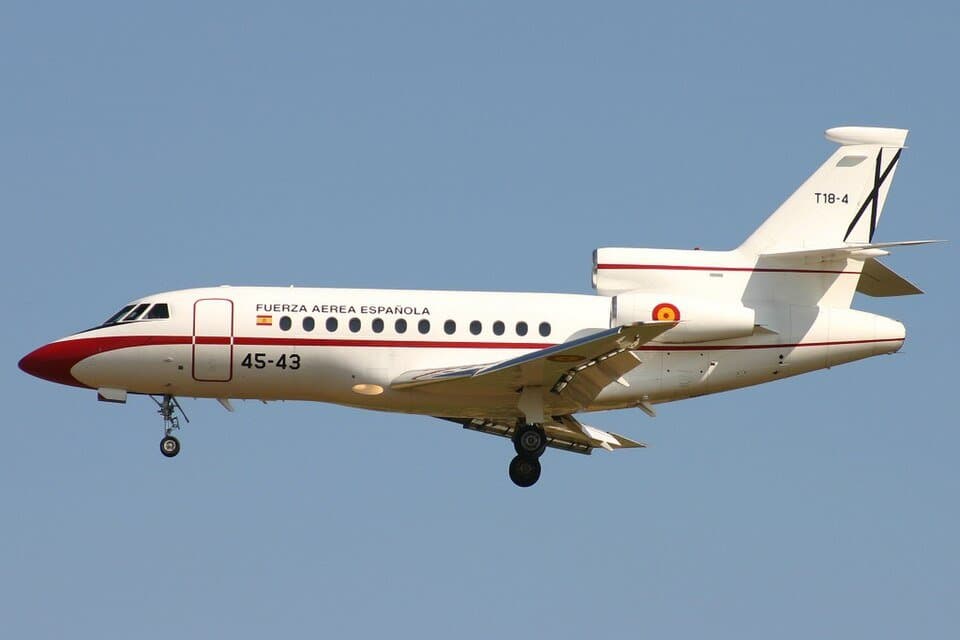
Falcon 900B · Length
Single source20.21 m (66 ft 4 in)[source]
Metro III · Length
Configuration
| Specification | Dassault Falcon 900 | Fairchild Swearingen Metroliner |
|---|---|---|
| Type | Business jet[source] | Regional airliner[source] |
| National origin | France[source] | — |
| Manufacturer | Dassault Aviation[source] | Fairchild[source] |
| Status | Active service, in production[source] | In service[source] |
59 ft 4 in (18.08 m)[source]
Metro III · Height
Single source16 ft 8 in (5.08 m)[source]
Empty; Falcon 900B · Empty weight
Single sourceMaximum take-off; Falcon 900B · Max takeoff weight
Single source10,255 kg (22,608 lb)[source]
20,640 kg (45,503 lb)[source]
Empty; Metro III · Empty weight
Single sourceMaximum take-off; Metro III · depending on model
Single sourceMetro III · 2 × Garrett AiResearch TPE-331 turboprop engines, 1,000 shp ( ) each or 1,100 shp (
Single sourceMetro III · ) each with alcohol-water injection
Single source2 × Garrett AiResearch TPE-331 turboprop engines, 1,000 shp (750 kW) each or 1,100 shp (820 kW) each with alcohol-water injection[source]
Falcon 900B · 3 × Honeywell TFE731 -5BR-1C turbofans thrust each
Single source3 × Honeywell TFE731 -5BR-1C turbofans , 21.13 kN (4,750 lbf) thrust each[source]
Bars compare reported quantities only. A larger figure does not make a system better; configurations and test conditions differ.
| Primary users | French Air and Space Force Japan Coast Guard Nigerian Air Force Royal Malaysian Air Force[source] | Ameriflight Perimeter Aviation Sharp Airlines Aeronaves TSM[source] |
|---|
| Number built | >500[source] | >600[source] |
|---|
| Manufactured | 1984–present[source] | 1968–2001[source] |
|---|
| First flight | 21 September 1984 ( 1984-09-21 )[source] | August 26, 1969[source] |
|---|
| Developed from | Dassault Falcon 50[source] | Swearingen Merlin[source] |
|---|
| Developed into | Dassault Falcon 2000 Dassault Falcon 7X[source] | — |
|---|
| Capacity | 19 passengers[source] | 19 passengers[source] |
|---|
| Fuel capacity | 8,690 kg (19,160 lb)[source] | — |
|---|
| Aspect ratio | 7.63:1[source] | — |
|---|
| Stall speed | 158 km/h (98 mph, 85 kn) (wheels and flaps down)[source] | — |
|---|
| Introduction date | — | 1972[source] |
|---|
| Variant | — | Fairchild C-26 Metroliner[source] |
|---|
| Airfoil | — | NACA 65A215[source] |
|---|
| Propellers | — | 4-bladed McCauley 4HFR34C652 or Dowty Rotol R.321/4-82-F/8[source] |
|---|
| Role | — | 19-seat, pressurized , twin- turboprop airliner first[source] |
|---|
| Source measurement | — | A new fuselage (but with a similar nose) and vertical fin were then developed, married to salvaged and rebuilt ( wet ) Queen Air wings and horizontal tails , and Twin Bonanza landing gear ; this became the SA26 Merlin , more or less a pressurized Excalibur. Through successive models (the SA26-T Merlin IIA and SA26-AT Merlin IIB ) the engines were changed to Pratt & Whitney Canada PT6 , then Garrett TPE331 turboprops. These were marketed as business aircraft seating eight to ten passengers.[source]Fairchild Swearingen Metroliner · Design; only the objects and conditions stated in this passage An all-new aircraft was built and named the SA226-T Merlin III with a new nose, wings, landing gear, cruciform horizontal tail and inverted inlet Garrett engines. Ultimately a stretch of the Merlin III was designed, sized to seat 22 passengers and called the SA226-TC Metro . Because FAA regulations limited an airliner to no more than 19 seats if no flight attendant was to be carried, the aircraft was optimized for that number of passengers, with 4 feet and 9 inches of headroom within the passenger cabin. The standard engines offered were two TPE331-3UW turboprops driving three-bladed propellers . A corporate version called the SA226-AT Merlin IVA was also marketed and initially sales of this version were roughly double that of the Metro.[source]Fairchild Swearingen Metroliner · Design; only the objects and conditions stated in this passage The Metro and Metro II were limited to a maximum weight of 12,500 pounds (5,700 kg) by the requirements of the Special Federal Regulation 23 that the aircraft had been certified against. The Metro II was re-certified as the Metro IIA in 1980 with a maximum weight of 13,100 pounds (5,900 kg) and the Metro II's TPE331-3 engines replaced by -10 engines of increased power.[source]Fairchild Swearingen Metroliner · Development; only the objects and conditions stated in this passage The SA227-AC Metro III followed, also initially certified in 1980 for up to 14,000 pounds (6,400 kg), increasing to 14,500 pounds (6,600 kg) as engines and structures were upgraded. An option for up to 16,000 pounds (7,300 kg) was offered. Among external improvements to the Metro III were a 10 ft (3.0 m) increase in wing span, four-bladed props, redesigned "quick-access" engine cowlings and numerous drag-reducing airframe modifications, including landing gear doors that closed after the gear was extended.[source]Fairchild Swearingen Metroliner · Development; only the objects and conditions stated in this passage At the 1987 Paris Air Show , Fairchild released details of proposed developments of the Metro designated the Metro V and Metro VI . These versions would have featured a longer fuselage with a taller "stand-up" cabin providing 69 in (180 cm) of interior height for passengers; a redesigned, longer wing; engines moved further out on the wing from the fuselage; a "T-tail" and various system improvements. A Merlin V corporate version of the Metro V was also planned. The Metro V was to be fitted with the same engines as the Metro 23 and the Metro VI was to be fitted with more powerful TPE331-14 engines. The Metro VI was shelved within months of being announced due to a lack of customer interest, but Fairchild did not proceed with the Metro V either.[source]Fairchild Swearingen Metroliner · Development / Further development; only the objects and conditions stated in this passage On June 12, 1980, a Metro II operating as Air Wisconsin Flight 965 suffered engine failure following massive water ingestion during a thunderstorm; the crew lost control and crashed near Valley , Nebraska . Both crew members and 11 passengers died; two passengers survived with serious injuries.[source]Fairchild Swearingen Metroliner · Accidents and incidents; only the objects and conditions stated in this passage On January 15, 1987, a Metro II operating as Skywest Airlines Flight 1834 collided with a single engine Mooney M-20 near Kearns, Utah. All eight people on the Metro II and both pilots on the Mooney were killed in the accident.[source]Fairchild Swearingen Metroliner · Accidents and incidents; only the objects and conditions stated in this passage On January 19, 1988, a Fairchild Metro III, operated by Trans-Colorado Airlines as Continental Express Flight 2286 , crashed near Bayfield, Colorado . Both crew members and seven of the 15 passengers died. Of the surviving passengers, only one was uninjured.[source]Fairchild Swearingen Metroliner · Accidents and incidents; only the objects and conditions stated in this passage On February 8, 1988, a Metro III operating as Nürnberger Flugdienst Flight 108 suffered a lightning strike, following which the electrical system failed. The right wing separated from the aircraft during an uncontrolled descent and the aircraft disintegrated and crashed near Kettwig , Germany . Both crew members and all 19 passengers died; the deadliest accident involving the Fairchild Metroliner.[source]Fairchild Swearingen Metroliner · Accidents and incidents; only the objects and conditions stated in this passage On February 19, 1988, a Fairchild Metro operating as AVAir Flight 3378 crashed one mile from the runway after takeoff from Raleigh-Durham International Airport , North Carolina killing both crew members and all 10 passengers. Pilot error was found to be the cause.[source]Fairchild Swearingen Metroliner · Accidents and incidents; only the objects and conditions stated in this passage On January 21, 1989, a Fairchild Metro II (OY-ARI) operating a charter flight attempted to make an emergency landing with one engine at Örnsköldsvik (OER) in IFR conditions but failed to feather the propeller making it hard to line up with the runway. The aircraft crashed in deep snow 30 m left of the runway injuring one passenger and destroying the aircraft.[source]Fairchild Swearingen Metroliner · Accidents and incidents; only the objects and conditions stated in this passage On September 26, 1989, Skylink Airlines Flight 070 , a Fairchild Metro III was on a scheduled flight from Vancouver (YVR) to Terrace (YXT), British Columbia with two pilots and five passengers on board. The aircraft crashed one quarter mile to the west of Terrace Airport while the crew was attempting to carry out a missed approach in IFR conditions. The aircraft was destroyed by the impact and a post-crash fire. All seven occupants were killed in the crash.[source]Fairchild Swearingen Metroliner · Accidents and incidents; only the objects and conditions stated in this passage On February 1, 1991, SkyWest Airlines Flight 5569 , operated with a Metro III, was waiting on a runway at Los Angeles International Airport when USAir Flight 1493 collided with it, resulting in the death of the ten passengers and two crew members on board the Metro.[source]Fairchild Swearingen Metroliner · Accidents and incidents; only the objects and conditions stated in this passage On August 25, 1992, a Lone Star Airlines Swearingen SA 227-AC Metro III on a test flight crashed after takeoff 1 km SE of Memorial Field Airport due to improper maintenance of all primary flight control cables. All three occupants were killed.[source]Fairchild Swearingen Metroliner · Accidents and incidents; only the objects and conditions stated in this passage On May 1, 1995, a Metro 23 operating as Bearskin Airlines Flight 362 (with a crew of two and one passenger on board) collided at 4,500 feet above sea level with an Air Sandy Piper PA-31 Navajo (with one pilot and four passengers on board) while on approach to Sioux Lookout Airport , destroying both aircraft and killing all persons on both aircraft.[source]Fairchild Swearingen Metroliner · Accidents and incidents; only the objects and conditions stated in this passage On October 10, 2001, a Merlin IVA operating as Flightline Flight 101 from Spain to Algeria crashed into the Mediterranean Sea off the Columbretes Islands in Valencia, Spain, killing all 10 people on board.[source]Fairchild Swearingen Metroliner · Accidents and incidents; only the objects and conditions stated in this passage On May 7, 2005, a Transair Metro 23 crashed near Lockhart River , north of Cooktown, Queensland in Australia. A total of 15 people died in what is, as of December 2009, the worst airline crash in Australia since the 1960s.[source]Fairchild Swearingen Metroliner · Accidents and incidents; only the objects and conditions stated in this passage On June 19, 2008, a Fairchild SA-226 Merlin, a coastguard airframe, was being used to conduct pilot flight-skills tests for the Trondheim-based operator Helitrans , the pilots lost control during a stall exercise, and just 37 seconds after the control loss, and with an eventual sink rate of 10,000 ft/min, the turboprop hit the sea in a near-horizontal attitude, 18 nm west of Bergen, killing all three on board.[source]Fairchild Swearingen Metroliner · Accidents and incidents; only the objects and conditions stated in this passage On February 10, 2011, Manx2 Flight 7100 , a Metro III owned by the Spanish airline Air Lada operating on behalf of Manx2 , was on a flight from Belfast , Northern Ireland to Cork , Ireland . The aircraft crashed on landing in fog, resulting in the death of six people.[source]Fairchild Swearingen Metroliner · Accidents and incidents; only the objects and conditions stated in this passage On September 6, 2011, Aerocon Flight 238 from El Trompillo Airport , Santa Cruz de la Sierra , Bolivia to Teniente Jorge Henrich Arauz Airport , Trinidad, Bolivia crashed on approach to Trinidad. The flight was operated by Swearingen SA-227 Metroliner CP-2548. Eight of the nine people on board were killed.[source]Fairchild Swearingen Metroliner · Accidents and incidents; only the objects and conditions stated in this passage On November 3, 2013, Aerocon Flight 25 , a SA227-BC Metro III, registration CP-2477, crashed when it was trying to land at Riberalta Airport (northern Bolivia) killing eight of the 18 people on board.[source]Fairchild Swearingen Metroliner · Accidents and incidents; only the objects and conditions stated in this passage On November 10, 2013, Bearskin Airlines Flight 311 , a Swearingen SA227-AC Metro III, crashed on final approach to its destination of Red Lake, Ontario, Canada en route from Sioux Lookout, Ontario. The aircraft experienced a near total failure of the left engine at 500 ft AGL which, combined with the aircraft being in the landing configuration, caused a loss of airspeed resulting in an unrecoverable situation. Safety systems to assist in the handling with one engine out did not activate since the engine did not completely shut down; the scenario gave conflicting information to the pilots who did not have time to identify the nature of the failure. Two crew members and three passengers were killed in the crash. Two passengers sustained injuries but survived.[source]Fairchild Swearingen Metroliner · Accidents and incidents; only the objects and conditions stated in this passage On December 2, 2013, a Metroliner property of IBC Airways , flying from Las Américas International Airport , Dominican Republic , crashed in the municipality of Arecibo, Puerto Rico . Two people were killed in the accident.[source]Fairchild Swearingen Metroliner · Accidents and incidents; only the objects and conditions stated in this passage On October 24, 2016, a CAE Aviation SA227-AT Merlin IVC crashed shortly after take-off from Malta International Airport . All five people on board were killed. The aircraft was taking part in a French-led surveillance operation to counter people-smuggling.[source]Fairchild Swearingen Metroliner · Accidents and incidents; only the objects and conditions stated in this passage On March 29, 2018, a flight operated by the former airline Amaszonas , also using a Fairchild Swearingen Metroliner, suffered an accident after colliding with birds and crashing near a highway. However, all occupants survived, with only one person sustaining an ankle injury.[source]Fairchild Swearingen Metroliner · Accidents and incidents; only the objects and conditions stated in this passage On November 15, 2022, an SA227-AT Expediter crashed on the Western Lakes Golf Club in Pewaukee , Wisconsin, 6 km short of Runway 10 at Waukesha County Airport . The plane was flying from New Orleans to Waukesha to deliver dogs to the Humane Animal Welfare Society of Waukesha. All three persons and all 53 dogs on the aircraft survived.[source]Fairchild Swearingen Metroliner · Accidents and incidents; only the objects and conditions stated in this passage Crew: 2 (captain & first officer), 1 in cargo-only configuration[source]Fairchild Swearingen Metroliner · Specifications (Metro III); only the objects and conditions stated in this passage Capacity: 19 passengers[source]Fairchild Swearingen Metroliner · Specifications (Metro III); only the objects and conditions stated in this passage Length: 59 ft 4 in (18.08 m)[source]Fairchild Swearingen Metroliner · Specifications (Metro III); only the objects and conditions stated in this passage Wingspan: 57 ft 0 in (17.37 m)[source]Fairchild Swearingen Metroliner · Specifications (Metro III); only the objects and conditions stated in this passage Height: 16 ft 8 in (5.08 m)[source]Fairchild Swearingen Metroliner · Specifications (Metro III); only the objects and conditions stated in this passage Wing area: 310 sq ft (29 m 2 )[source]Fairchild Swearingen Metroliner · Specifications (Metro III); only the objects and conditions stated in this passage Empty weight: 8,737 lb (3,963 kg)[source]Fairchild Swearingen Metroliner · Specifications (Metro III); only the objects and conditions stated in this passage Max takeoff weight: 14,500–16,000 lb (6,577–7,257 kg) depending on model[source]Fairchild Swearingen Metroliner · Specifications (Metro III); only the objects and conditions stated in this passage Powerplant: 2 × Garrett AiResearch TPE-331 turboprop engines, 1,000 shp (750 kW) each or 1,100 shp (820 kW) each with alcohol-water injection[source]Fairchild Swearingen Metroliner · Specifications (Metro III); only the objects and conditions stated in this passage Maximum speed: 311 kn (358 mph, 576 km/h)[source]Fairchild Swearingen Metroliner · Specifications (Metro III); only the objects and conditions stated in this passage Cruise speed: 278 kn (320 mph, 515 km/h)[source]Fairchild Swearingen Metroliner · Specifications (Metro III); only the objects and conditions stated in this passage Range: 594 nmi (684 mi, 1,100 km)[source]Fairchild Swearingen Metroliner · Specifications (Metro III); only the objects and conditions stated in this passage Service ceiling: 25,000 ft (7,600 m)[source]Fairchild Swearingen Metroliner · Specifications (Metro III); only the objects and conditions stated in this passage |
|---|
| Country of origin | — | United States[source]Inventory Origin column; table 1, row 6, cell 2; revision 1366057873; retrieved 2026-10-01 |
|---|