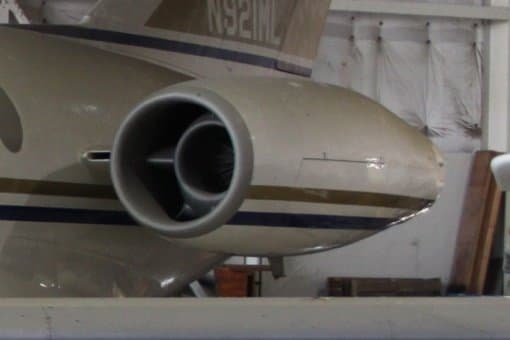

Credit
Aeroprints.com · CC BY-SA 3.0 · Resized · CC BY-SA 3.0 · Source ↗ · Modified


Preparing your view.

Measured figures
Falcon 20F · Length
Single source17.15 m (56 ft 3 in)[source]
Configuration
| Specification | Dassault Falcon 20 | Tupolev Tu-204 |
|---|---|---|
| Type | Business jet[source] | Narrow-body jet airliner[source] |
| Manufacturer | Dassault Aviation[source] | Tu-204: Aviastar SP Tu-214: Kazan Aircraft Production Association[source] |
| Status | Out of production, in active service[source] | In service, in production[source] |
| Primary users | Federal Express (formerly) French Navy United States Coast Guard |
Falcon 20F · Wingspan
Single source16.30 m (53 ft 6 in)[source]
Falcon 20F · Height
Single source5.32 m (17 ft 5 in)[source]
Falcon 20F · Crew
Single sourceCruise; Falcon 20F · at 12,200 m (40,000 ft) (econ. cruise)
Single sourceMaximum; Falcon 20F · at 7,620 m (25,000 ft) (max cruise)
Single source862 km/h (536 mph, 465 kn) at 7,620 m (25,000 ft) (max cruise)[source]
750 km/h (470 mph, 400 kn) at 12,200 m (40,000 ft) (econ. cruise)[source]
Falcon 20F · Range
Single source3,350 km (2,080 mi, 1,810 nmi)[source]
Falcon 20F · 2 × General Electric CF700 -2D-2 turbofans thrust each
Single source2 × General Electric CF700 -2D-2 turbofans , 20 kN (4,500 lbf) thrust each[source]
Falcon 20F · Wing area
Single source41.00 m 2 (441.3 sq ft)[source]
Falcon 20F · absolute ceiling
Single source12,800 m (42,000 ft) (absolute ceiling)[source]
Bars compare reported quantities only. A larger figure does not make a system better; configurations and test conditions differ.
Russian Air Force Red Wings Airlines Cubana de Aviación Air Koryo[source] |
| Number built | 512[source] | 89 as of December 2015[source] |
|---|
| Manufactured | 1965–1991[source] | 1990 –present[source] |
|---|
| Introduction date | 3 June 1965[source] | 23 February 1996 with Vnukovo Airlines[source] |
|---|
| First flight | 4 May 1963[source] | 2 January 1989 ( 1989-01-02 )[source] |
|---|
| Developed into | Dassault Falcon 10 Dassault Falcon 50[source] | Tupolev Tu-334[source] |
|---|
| Capacity | 8–14 passengers[source] | — |
|---|
| Aspect ratio | 6.4:1[source] | — |
|---|
| Fuel capacity | 5,200 L (1,100 imp gal; 1,400 US gal)[source] | — |
|---|
| Stall speed | 152 km/h (94 mph, 82 kn)[source] | — |
|---|
| Role | French business jet[source] | twin-engined medium- range narrow-body jet airliner capable of carrying 210 passengers,[source] |
|---|
| National origin | France[source] | Soviet Union / Russia[source] |
|---|
| Source measurement | During the 1950s and 1960s, the French government, which had taken a significant interest in the re-establishment and growth of its national aviation industries in the aftermath of the Second World War , developed a detailed request for a combined liaison / trainer aircraft, to be equipped with twin-turbofan engines. Among those companies that took interest in the government request was French aircraft manufacturer Dassault Aviation . In December 1961, French aircraft designer and head of Dassault Aviation, Marcel Dassault , gave the go-ahead to proceed with work towards the production of an eight- to 10-seat executive jet /military liaison aircraft, which was initially named as the Dassault-Breguet Mystère 20 . The emerging design was of a low-wing monoplane, which drew upon the aerodynamics of the transonic Dassault Mystère IV fighter-bomber , and was equipped with a pair of rear-mounted 14.68 kN (3,300 lbf) Pratt & Whitney JT12A-8 turbojet engines.[source]Dassault Falcon 20 · Development / Origins; only the objects and conditions stated in this passage Progress between Dassault and Pan Am was rapid, moving from engineering evaluations of the type to the formation of general agreements between the two companies. In response to feedback received from Pan American, the aircraft was re-engined with a pair of General Electric CF700 engines and several dimensions were increased. Accordingly, Pan American formed an agreement with Dassault to distribute the Mystère 20 in the western hemisphere; the firm placed an initial order for 40 aircraft along with options for a further 120. On 10 July 1964, the re-engined aircraft made its first flight. On 1 January 1965, the first production aircraft performed its maiden flight; in June 1965, both French and American type certifications were awarded. On 10 June 1965, French aviator Jacqueline Auriol achieved the women's world speed record using the first Mystère 20 prototype, having flown at an average recorded speed of 859 km/h over a distance of 1000 km.[source]Dassault Falcon 20 · Development / Origins; only the objects and conditions stated in this passage In 1973, FedEx's Falcons, designation FA-20-DC, cost $1.2 million each and were modified with a 55-by-74.5-inch forward cargo door with independent power supply, higher mtow, reinforced floor, plugged windows, and bigger brakes.[source]Dassault Falcon 20 · Development / Origins; only the objects and conditions stated in this passage An improved model of the aircraft, designated the Falcon 200 , was developed, which featured more advanced jet engines and other major improvements to increase range, capacity, and comfort. The Falcon 200, along with the Falcon 20G and HU-25 models, were powered by a pair of Garrett ATF3 engines. According to the magazine Flying , the Falcon 200 variant was more comparable to the newer Falcon 50 trijet than the original Falcon 20 model.[source]Dassault Falcon 20 · Development / Further development; only the objects and conditions stated in this passage During 2013, the FAA modified 14 CFR part 91 rules to prohibit the operation of jets weighing 75,000 pounds or less that were not Stage 3 noise compliant after 31 December 2015. The Falcon 20 was listed explicitly in Federal Register 78 FR 39576 . Any examples of the type that had not been modified, either by the installation of Stage 3 noise-compliant engines or have had hush kits installed upon noncompliant engines, were no longer permitted to fly anywhere in the contiguous 48 states after 31 December 2015. However, 14 CFR §91.883 Special flight authorizations for jet airplanes weighing 75,000 pounds or less – lists special flight authorizations that may be granted for operation after 31 December 2015.[source]Dassault Falcon 20 · Development / Further development; only the objects and conditions stated in this passage Prototype, one built. F-WLKB, initially powered by two 14.68 kN (3,300 lbf) Pratt & Whitney JT12A-8 turbojet engines. Now stored at Musée Air et Espace Aéroport Paris – Le Bourget.[source]Dassault Falcon 20 · Variants; only the objects and conditions stated in this passage Initial production version, with lengthened fuselage compared to first prototype and with 10–12 seats. Powered by 4,200 lbf (19 kN) CF700-2B engines.[source]Dassault Falcon 20 · Variants; only the objects and conditions stated in this passage Falcon 20CC (s/n 073)[source]Dassault Falcon 20 · Variants; only the objects and conditions stated in this passage Falcon 20G[source]Dassault Falcon 20 · Variants; only the objects and conditions stated in this passage Falcon 20H[source]Dassault Falcon 20 · Variants; only the objects and conditions stated in this passage Improved variant, powered by two 2360-kg (5,200-lb) Garrett ATF3-6A-4C turbofan engines and with more fuel. First flown on 30 April 1980.[source]Dassault Falcon 20 · Variants; only the objects and conditions stated in this passage United States Coast Guard version of the Falcon 20G. 41 built. Equipped with two Garrett AiResearch Garrett ATF3-6-2C turbofan engines.[source]Dassault Falcon 20 · Variants; only the objects and conditions stated in this passage Enlarged, 30-passenger commuter airliner derivative of Falcon 20, powered by two 27.0 kN (6,070 lbf) Lycoming ALF 502 D turbofans. One prototype built, first flying on 11 May 1973. No further production of Falcon 30 or proposed 40-passenger, shorter-range Mystére 40-100 .[source]Dassault Falcon 20 · Variants; only the objects and conditions stated in this passage Pakistan Air Force – 3 in service, including 2 DA-20s in EW , ECM , ESM roles[source]Dassault Falcon 20 · Operators / Current military operators; only the objects and conditions stated in this passage Royal Australian Air Force – Three in service from 1967 to 1989. No. 34 Squadron RAAF[source]Dassault Falcon 20 · Operators / Former military operators; only the objects and conditions stated in this passage Capacity: 8–14 passengers[source]Dassault Falcon 20 · Specifications (Falcon 20F); only the objects and conditions stated in this passage Length: 17.15 m (56 ft 3 in)[source]Dassault Falcon 20 · Specifications (Falcon 20F); only the objects and conditions stated in this passage Wingspan: 16.30 m (53 ft 6 in)[source]Dassault Falcon 20 · Specifications (Falcon 20F); only the objects and conditions stated in this passage Height: 5.32 m (17 ft 5 in)[source]Dassault Falcon 20 · Specifications (Falcon 20F); only the objects and conditions stated in this passage Wing area: 41.00 m 2 (441.3 sq ft)[source]Dassault Falcon 20 · Specifications (Falcon 20F); only the objects and conditions stated in this passage Empty weight: 7,530 kg (16,601 lb)[source]Dassault Falcon 20 · Specifications (Falcon 20F); only the objects and conditions stated in this passage Max takeoff weight: 13,000 kg (28,660 lb)[source]Dassault Falcon 20 · Specifications (Falcon 20F); only the objects and conditions stated in this passage Powerplant: 2 × General Electric CF700 -2D-2 turbofans , 20 kN (4,500 lbf) thrust each[source]Dassault Falcon 20 · Specifications (Falcon 20F); only the objects and conditions stated in this passage Maximum speed: 862 km/h (536 mph, 465 kn) at 7,620 m (25,000 ft) (max cruise)[source]Dassault Falcon 20 · Specifications (Falcon 20F); only the objects and conditions stated in this passage Cruise speed: 750 km/h (470 mph, 400 kn) at 12,200 m (40,000 ft) (econ. cruise)[source]Dassault Falcon 20 · Specifications (Falcon 20F); only the objects and conditions stated in this passage Stall speed: 152 km/h (94 mph, 82 kn)[source]Dassault Falcon 20 · Specifications (Falcon 20F); only the objects and conditions stated in this passage Range: 3,350 km (2,080 mi, 1,810 nmi)[source]Dassault Falcon 20 · Specifications (Falcon 20F); only the objects and conditions stated in this passage Service ceiling: 12,800 m (42,000 ft) (absolute ceiling)[source]Dassault Falcon 20 · Specifications (Falcon 20F); only the objects and conditions stated in this passage | The Tupolev Tu-204 ( Russian : Туполев Ту-204 ) is a twin-engined medium- range narrow-body jet airliner capable of carrying 210 passengers, designed by Tupolev and produced by Aviastar-SP and Kazan Aircraft Production Association . First introduced in 1995, it was intended to be broadly equivalent to the Boeing 757 , with slightly lower range and payload, and had competitive performance and fuel efficiency in its class.[source]Tupolev Tu-204 · Lead; only the objects and conditions stated in this passage The Tu-204 cabin was available in several layouts, including the baseline single-class layout seating for 210 passengers and a two- or three-class layout designed for 164–193 passengers. A cargo version of the Tu-204 is being successfully operated by several airlines in Europe and Egypt .[source]Tupolev Tu-204 · Design and development; only the objects and conditions stated in this passage Seating configuration is 3–3 in economy and 2–2 in Business class . The business class cabin has a seat pitch of 810 millimetres (31.9 in). The passenger cabin can be divided into compartments according to class with removable bulkheads and curtains. Compartments are illuminated by reflected light. Overhead bins for passenger baggage and coats are of the closed type. The volume of baggage per passenger is 0.052 cubic metres (1.8 cu ft).[source]Tupolev Tu-204 · Design and development; only the objects and conditions stated in this passage Certified in January 1995, this initial version is powered by Soloviev (now Aviadvigatel ) PS90 turbofans with 157 kN (35,300 lbf) of thrust, and uses Russian avionics in addition to its Russian engines. The Tu-204-200 is a heavier version with extra fuel for more range. Only one was built by Aviastar-SP in Ulyanovsk but has not yet been delivered (RA-64036). Now this version is only produced by KAPO in Kazan, marketed under the designation Tu-214 . The Tu-204-100C and Tu-204-200C are cargo versions of the −100 and −200 respectively, fitted with a forward main deck freight door. Currently, the Tu-204-100/200 is offered with the option of an up-rated Aviadvigatel PS90A2 turbofan, which promises 40% more service between overhauls. |
|---|
| Country of origin | France[source]Inventory Origin column; table 1, row 54, cell 4; revision 1377423821; retrieved 2026-10-02 | — |
|---|
| Designer | — | Tupolev[source] |
|---|
The Tu-204-100's maximum take-off weight (MTOW) is 103 tonnes, and its range with max payload is 4,400 kilometres (2,700 mi).[source]Tupolev Tu-204 · Tu-204 variants / Tu-204-100/200; only the objects and conditions stated in this passage
To broaden product appeal, the Tu-204-120/220 offers non-Russian avionics and engines. It is powered by two Rolls-Royce RB211-535 engines, each with thrust of 192 kN (43,100 lbf). Egypt's Cairo Aviation became the debut operator in November 1998 when it took delivery of a Tu-204-120 and its cargo version the Tu-204-120C . The Tu-204-220 and Tu-204-220C cargo version, are a higher gross weight variants of the basic Tu-204-120.[source]Tupolev Tu-204 · Tu-204 variants / Tu-204-120/220/120C/220C; only the objects and conditions stated in this passage
The Tu-204-120 has a maximum takeoff weight of 103 tonnes and a range with max payload of 4,500 kilometres (2,800 mi).[source]Tupolev Tu-204 · Tu-204 variants / Tu-204-120/220/120C/220C; only the objects and conditions stated in this passage
A shortened, longer-range and more efficient derivative of the Tu-204, the Tu-204-300 is also known as Tu-234. About six meters (20 ft) shorter than the basic Tu-204, this variant is available in two versions: the longer-ranged, heavier version, powered by Aviadvigatel PS-90A2 turbofans, has a maximum take-off weight of 107.5 metric tons and range (with 166 passengers) increased to 9,300 kilometres (5,000 nmi); and the lighter, shorter-ranged version, with a maximum take-off weight of 89 metric tons and range of 3,500 kilometres (1,900 nmi) with 166 passengers. The former Russian airline Vladivostok Air was the debut customer. This airline's aircraft are in a two-class seating configuration, with a 142-passenger capacity. Average numbers of flight hours during each 24-hour period is 9.35 hours, for year 2009. It is also operated by Air Koryo which currently operates one Tu-204-100B and one Tu-204-300. The Тu-204s operate on the Pyongyang-Beijing, Bangkok, Vladivostok, Shenyang and Kuala Lumpur routes.[source]Tupolev Tu-204 · Tu-204 variants / Tu-204-300; only the objects and conditions stated in this passage
The Tu-204SM, alternatively Tu-204CM, a medium-range airliner, is an upgraded version of the Tu-204-100/300. While the Tu-204SM will retain key design and aerodynamic features of the Tu-204-100/100E/100V series, there are numerous upgrades, largely aimed at meeting the current and near-future Russian and international standards, including those of ICAO and Eurocontrol .[source]Tupolev Tu-204 · Tu-204 variants / Tu-204SM; only the objects and conditions stated in this passage
The Tu-204SM will be powered by two PS-90 A2 engines. The latter is significantly improved over the original PS-90 A power plants. and features a unified twin-spool turbofan with a high bypass ratio. The PS-90 A2 is expected a life cycle cost saving of 35% over the original engine with a simultaneous increase in reliability in the 50 to 100% range. The PS-90 A2 is designed to meet the Russian AP-33 aviation standard, which is harmonized with the US FAR Part 33 and the European JAR33.[source]Tupolev Tu-204 · Tu-204 variants / Tu-204SM; only the objects and conditions stated in this passage
The updated passenger cabin accommodates a maximum of 210 passengers or 174 in a typical two-class layout. The upgrades include new larger storage bins, multicolored LED lighting , sound-absorbing structures and a modern in-flight entertainment system (IFE) .[source]Tupolev Tu-204 · Tu-204 variants / Tu-204SM; only the objects and conditions stated in this passage
The Tu-214 is also a variation of the Tu-204 first flown on 21 March 1996. It is technically a Tu-204-200, one of the differences being that it is built by a different factory. Planes designated Tu-204 are produced in Ulyanovsk by Aviastar-SP ; Tu-214 in Kazan by the Kazan Aircraft Production Association (KAPO). Both factories are independent from the Tupolev design bureau and have some control over the design of the variant they produce.[source]Tupolev Tu-204 · Tu-214 variants / Tu-214; only the objects and conditions stated in this passage
The Tu-214 is essentially a higher gross weight variant of the Tu-204, being fitted with extra fuel tanks and structural adjustments to deal with the heavier gross weight. For this reason, the Russian government prefers to use it as the platform upon which all further modifications for the 'Special Mission' variants will be based. Some of the special mission variants are claimed to be capable of a non-stop 10,000-kilometre flight range.[source]Tupolev Tu-204 · Tu-214 variants / Tu-214; only the objects and conditions stated in this passage
After Russia withdrew from the Treaty on Open Skies in 2021 in response to the United States's earlier withdrawal in 2020, the two Tu-214ON used for treaty observation missions have been used for military observation flights in Crimea .[source]Tupolev Tu-204 · Tu-214 variants / Tu-214 / Tu-214ON; only the objects and conditions stated in this passage
Special-purpose aircraft-control point equipped with a special onboard communication unit SBUS-214 intended for the Ministry of Defence of Russia . The aircraft is built with Russian-made components only, meeting the requirements of the state customers, and has a range of at least 7,200 km (4,500 mi). The main purpose of the aircraft is to provide additional communication capabilities to the user. The Russian MoD placed an order for two aircraft in November 2015. The first aircraft was delivered in March 2018, the second in June the same year.[source]Tupolev Tu-204 · Tu-214 variants / Tu-214 / Tu-214PU-SBUS; only the objects and conditions stated in this passage
It came to a stop 400 meters (1,300 feet) past the runway's end.[source]Tupolev Tu-204 · Accidents and incidents; only the objects and conditions stated in this passage
Apart from those, one person who was driving his car on the highway was seriously injured from the nose wheel that flew across the highway.[source]Tupolev Tu-204 · Accidents and incidents; only the objects and conditions stated in this passage
The fatal Vnukovo accident was the second runway overrun incident involving a Red Wings operated Tu-204 in nine days following a Moscow Vnukovo to Novosibirsk flight on 20 December 2012 that overran runway 25 at Tolmachevo Airport by 1,150 feet (350 meters) into an open field.[source]Tupolev Tu-204 · Accidents and incidents; only the objects and conditions stated in this passage