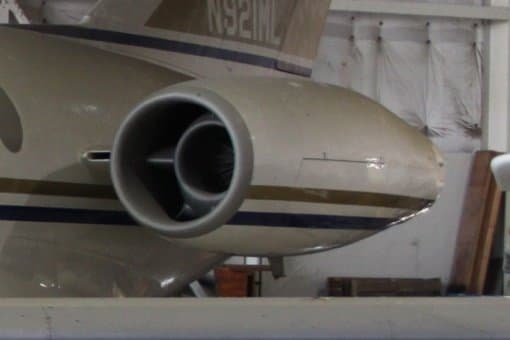

Credit
Aeroprints.com · CC BY-SA 3.0 · Resized · CC BY-SA 3.0 · Source ↗ · Modified


Preparing your view.

At a glance
Measured figures
Empty; Falcon 20F · Empty weight
Single sourceMaximum take-off; Falcon 20F · Max takeoff weight
Single source7,530 kg (16,601 lb)[source]
13,000 kg (28,660 lb)[source]
Empty; Il-76MD-90AE · Il-76TD-90
Single sourceMaximum take-off; Il-76MD-90AE · Il-76MD-90A
Single sourceCruise; Falcon 20F · at 12,200 m (40,000 ft) (econ. cruise)
Single sourceMaximum; Falcon 20F · at 7,620 m (25,000 ft) (max cruise)
Single source862 km/h (536 mph, 465 kn) at 7,620 m (25,000 ft) (max cruise)[source]
750 km/h (470 mph, 400 kn) at 12,200 m (40,000 ft) (econ. cruise)[source]
Cruise; Il-76MD-90AE · Cruise speed
Single source750–800 km/h (470–500 mph, 400–430 kn)[source]
Falcon 20F · Range
Single source3,350 km (2,080 mi, 1,810 nmi)[source]
Ferry; Il-76MD-90AE · Il-76MD-90A with no payload
Single sourceIl-76MD-90AE · Il-76MD-90A with 52 t (51 long tons; 57 short tons) payload
Single source5,000 km (3,100 mi, 2,700 nmi) Il-76MD-90A with 52 t (51 long tons; 57 short tons) payload.[source]
9,700 km (6,000 mi, 5,200 nmi) Il-76MD-90A with no payload.[source]
Falcon 20F · 2 × General Electric CF700 -2D-2 turbofans thrust each
Single source2 × General Electric CF700 -2D-2 turbofans , 20 kN (4,500 lbf) thrust each[source]
Il-76MD-90AE · 4 × Aviadvigatel PS-90 A-76 turbofans thrust each
Single source4 × Aviadvigatel PS-90 A-76 turbofans , 156.9 kN (35,300 lbf) thrust each[source]
Bars compare reported quantities only. A larger figure does not make a system better; configurations and test conditions differ.
Configuration
| Specification | Dassault Falcon 20 | Ilyushin Il-76 |
|---|---|---|
| Type | Business jet[source] | Strategic and tactical airlifter[source] |
| Manufacturer | Dassault Aviation[source] | Ilyushin, Tashkent Mechanical Plant, Aviastar-SP[source] |
| Status | Out of production, in active service[source] | In service[source] |
| Primary users | Federal Express (formerly) French Navy United States Coast Guard[source] | Soviet Air Forces (historical) Russian Aerospace Forces People's Liberation Army Air Force Indian Air Force[source] |
| Number built | 512[source] | 981[source] |
| Manufactured | 1965–1991[source] | 1971–present[source] |
| Introduction date | 3 June 1965[source] | June 1974 ( June 1974 )[source] |
| First flight | 4 May 1963[source] | 25 March 1971 ( 25 March 1971 )[source] |
| Developed into | Dassault Falcon 10 Dassault Falcon 50[source] | — |
| Capacity | 8–14 passengers[source] | Il-76M 42,000 kg (93,000 lb); Il-76MD 48,000 kg (106,000 lb); Il-76MD-90A 60,000 kg (130,000 lb)[source] |
| Aspect ratio | 6.4:1[source] | — |
| Fuel capacity | 5,200 L (1,100 imp gal; 1,400 US gal)[source] | — |
| Stall speed | 152 km/h (94 mph, 82 kn)[source] | — |
| Role | French business jet[source] | multi-purpose, fixed-wing, four-engine turbofan strategic airlifter[source] |
| National origin | France[source] | Soviet Union / Russia[source] |
| Source measurement | During the 1950s and 1960s, the French government, which had taken a significant interest in the re-establishment and growth of its national aviation industries in the aftermath of the Second World War , developed a detailed request for a combined liaison / trainer aircraft, to be equipped with twin-turbofan engines. Among those companies that took interest in the government request was French aircraft manufacturer Dassault Aviation . In December 1961, French aircraft designer and head of Dassault Aviation, Marcel Dassault , gave the go-ahead to proceed with work towards the production of an eight- to 10-seat executive jet /military liaison aircraft, which was initially named as the Dassault-Breguet Mystère 20 . The emerging design was of a low-wing monoplane, which drew upon the aerodynamics of the transonic Dassault Mystère IV fighter-bomber , and was equipped with a pair of rear-mounted 14.68 kN (3,300 lbf) Pratt & Whitney JT12A-8 turbojet engines.[source]Dassault Falcon 20 · Development / Origins; only the objects and conditions stated in this passage Progress between Dassault and Pan Am was rapid, moving from engineering evaluations of the type to the formation of general agreements between the two companies. In response to feedback received from Pan American, the aircraft was re-engined with a pair of General Electric CF700 engines and several dimensions were increased. Accordingly, Pan American formed an agreement with Dassault to distribute the Mystère 20 in the western hemisphere; the firm placed an initial order for 40 aircraft along with options for a further 120. On 10 July 1964, the re-engined aircraft made its first flight. On 1 January 1965, the first production aircraft performed its maiden flight; in June 1965, both French and American type certifications were awarded. On 10 June 1965, French aviator Jacqueline Auriol achieved the women's world speed record using the first Mystère 20 prototype, having flown at an average recorded speed of 859 km/h over a distance of 1000 km.[source]Dassault Falcon 20 · Development / Origins; only the objects and conditions stated in this passage In 1973, FedEx's Falcons, designation FA-20-DC, cost $1.2 million each and were modified with a 55-by-74.5-inch forward cargo door with independent power supply, higher mtow, reinforced floor, plugged windows, and bigger brakes.[source]Dassault Falcon 20 · Development / Origins; only the objects and conditions stated in this passage An improved model of the aircraft, designated the Falcon 200 , was developed, which featured more advanced jet engines and other major improvements to increase range, capacity, and comfort. The Falcon 200, along with the Falcon 20G and HU-25 models, were powered by a pair of Garrett ATF3 engines. According to the magazine Flying , the Falcon 200 variant was more comparable to the newer Falcon 50 trijet than the original Falcon 20 model.[source]Dassault Falcon 20 · Development / Further development; only the objects and conditions stated in this passage During 2013, the FAA modified 14 CFR part 91 rules to prohibit the operation of jets weighing 75,000 pounds or less that were not Stage 3 noise compliant after 31 December 2015. The Falcon 20 was listed explicitly in Federal Register 78 FR 39576 . Any examples of the type that had not been modified, either by the installation of Stage 3 noise-compliant engines or have had hush kits installed upon noncompliant engines, were no longer permitted to fly anywhere in the contiguous 48 states after 31 December 2015. However, 14 CFR §91.883 Special flight authorizations for jet airplanes weighing 75,000 pounds or less – lists special flight authorizations that may be granted for operation after 31 December 2015.[source]Dassault Falcon 20 · Development / Further development; only the objects and conditions stated in this passage Prototype, one built. F-WLKB, initially powered by two 14.68 kN (3,300 lbf) Pratt & Whitney JT12A-8 turbojet engines. Now stored at Musée Air et Espace Aéroport Paris – Le Bourget.[source]Dassault Falcon 20 · Variants; only the objects and conditions stated in this passage Initial production version, with lengthened fuselage compared to first prototype and with 10–12 seats. Powered by 4,200 lbf (19 kN) CF700-2B engines.[source]Dassault Falcon 20 · Variants; only the objects and conditions stated in this passage Falcon 20CC (s/n 073)[source]Dassault Falcon 20 · Variants; only the objects and conditions stated in this passage Falcon 20G[source]Dassault Falcon 20 · Variants; only the objects and conditions stated in this passage Falcon 20H[source]Dassault Falcon 20 · Variants; only the objects and conditions stated in this passage Improved variant, powered by two 2360-kg (5,200-lb) Garrett ATF3-6A-4C turbofan engines and with more fuel. First flown on 30 April 1980.[source]Dassault Falcon 20 · Variants; only the objects and conditions stated in this passage United States Coast Guard version of the Falcon 20G. 41 built. Equipped with two Garrett AiResearch Garrett ATF3-6-2C turbofan engines.[source]Dassault Falcon 20 · Variants; only the objects and conditions stated in this passage Enlarged, 30-passenger commuter airliner derivative of Falcon 20, powered by two 27.0 kN (6,070 lbf) Lycoming ALF 502 D turbofans. One prototype built, first flying on 11 May 1973. No further production of Falcon 30 or proposed 40-passenger, shorter-range Mystére 40-100 .[source]Dassault Falcon 20 · Variants; only the objects and conditions stated in this passage Pakistan Air Force – 3 in service, including 2 DA-20s in EW , ECM , ESM roles[source]Dassault Falcon 20 · Operators / Current military operators; only the objects and conditions stated in this passage Royal Australian Air Force – Three in service from 1967 to 1989. No. 34 Squadron RAAF[source]Dassault Falcon 20 · Operators / Former military operators; only the objects and conditions stated in this passage Capacity: 8–14 passengers[source]Dassault Falcon 20 · Specifications (Falcon 20F); only the objects and conditions stated in this passage Length: 17.15 m (56 ft 3 in)[source]Dassault Falcon 20 · Specifications (Falcon 20F); only the objects and conditions stated in this passage Wingspan: 16.30 m (53 ft 6 in)[source]Dassault Falcon 20 · Specifications (Falcon 20F); only the objects and conditions stated in this passage Height: 5.32 m (17 ft 5 in)[source]Dassault Falcon 20 · Specifications (Falcon 20F); only the objects and conditions stated in this passage Wing area: 41.00 m 2 (441.3 sq ft)[source]Dassault Falcon 20 · Specifications (Falcon 20F); only the objects and conditions stated in this passage Empty weight: 7,530 kg (16,601 lb)[source]Dassault Falcon 20 · Specifications (Falcon 20F); only the objects and conditions stated in this passage Max takeoff weight: 13,000 kg (28,660 lb)[source]Dassault Falcon 20 · Specifications (Falcon 20F); only the objects and conditions stated in this passage Powerplant: 2 × General Electric CF700 -2D-2 turbofans , 20 kN (4,500 lbf) thrust each[source]Dassault Falcon 20 · Specifications (Falcon 20F); only the objects and conditions stated in this passage Maximum speed: 862 km/h (536 mph, 465 kn) at 7,620 m (25,000 ft) (max cruise)[source]Dassault Falcon 20 · Specifications (Falcon 20F); only the objects and conditions stated in this passage Cruise speed: 750 km/h (470 mph, 400 kn) at 12,200 m (40,000 ft) (econ. cruise)[source]Dassault Falcon 20 · Specifications (Falcon 20F); only the objects and conditions stated in this passage Stall speed: 152 km/h (94 mph, 82 kn)[source]Dassault Falcon 20 · Specifications (Falcon 20F); only the objects and conditions stated in this passage Range: 3,350 km (2,080 mi, 1,810 nmi)[source]Dassault Falcon 20 · Specifications (Falcon 20F); only the objects and conditions stated in this passage Service ceiling: 12,800 m (42,000 ft) (absolute ceiling)[source]Dassault Falcon 20 · Specifications (Falcon 20F); only the objects and conditions stated in this passage | The aircraft was conceived by Ilyushin in 1967 to meet a requirement for a freighter able to carry a payload of 40 tonnes (88,000 lb) over a range of 5,000 kilometres (2,700 nmi; 3,100 mi) in less than six hours, able to operate from short (500 metres or less for a commercial airliner) and unprepared airstrips, and capable of coping with the harsh weather conditions likely to be experienced in Siberia and the Soviet Union's Arctic regions. It was intended to replace the Antonov An-12 . Another project design for a double-decked 250-passenger airliner was canceled. The Il-76 first flew in March 1971 ( 1971-03 ) .[source]Ilyushin Il-76 · Design and development / Origins; only the objects and conditions stated in this passage Production of Il-76s was allocated to the Tashkent Aviation Production Association in Tashkent , Uzbekistan , then a republic of the Soviet Union . Some 860 of the basic transport variants were manufactured. In the 1990s, modernized variants also equipped with Soloviev D-30 turbofan engines were developed (MF, TF), with a cargo compartment 20 m (66 ft) long by 3.4 m (11 ft) wide by 3.4 m (11 ft) tall; these larger variants were not produced in significant quantity due to the financial difficulties being experienced by the Russian Air Force, which was the primary operator of the type.[source]Ilyushin Il-76 · Design and development / Origins; only the objects and conditions stated in this passage As of late 2025, 27 aircraft are ordered to be delivered in the period up to 2028 and 27+ had been built, six in 2023, six in 2024, and seven in 2025.[source]Ilyushin Il-76 · Design and development / Il-76MD-90A; only the objects and conditions stated in this passage Between 1979 and 1991, Soviet Air Force Il-76s made 14,700 flights into Afghanistan, transporting 786,200 servicemen and 315,800 tons of freight. The Il-76 carried 89% of Soviet troops and 74% of the freight that was airlifted. As Afghan rebels were unable to shoot down high-flying Il-76s, their tactics were to try and damage it on takeoff or landing. Il-76s were often hit by shoulder-launched Stinger and Strela heat-seeking missiles and large-calibre machine gun fire, but because the strong airframes were able to take substantial damage and remain operational, the aircraft had a remarkably low attrition rate during this period of conflict. Building on that earlier experience, during 2006 the bulk of the Canadian Forces equipment airlifted into Afghanistan was flown in using rented civilian Il-76s. In 2006, the Russian Air Force had about 200 Il-76s. Civilian users in Russia have 108. |
| Country of origin | France[source]Inventory Origin column; table 1, row 54, cell 4; revision 1377423821; retrieved 2026-10-02 | — |
| Designer | — | Ilyushin[source] |
| Built by | — | Tashkent Aviation Production Association (formerly) Aviastar-SP[source] |
| Variants | — | Ilyushin Il-78 Beriev A-50 Beriev A-60 Beriev A-100 Shaanxi KJ-2000[source] |
| Thrust/weight | — | 0.32 at 200 t (200 long tons; 220 short tons) take-off weight and max. take-off thrust[source] |
| Minimum landing run | — | 450 m (1,480 ft) with thrust reversers[source] |
| Guns | — | 2 × 23 mm (0.906 in) cannon in radar-directed manned turret at base of tail[source] |
| Bombs | — | Some military models have four hardpoints under each outer wing capable of supporting 500 kg (1,100 lb) bombs.[source] |
| Hardpoints | — | Bombs: Some military models have four hardpoints under each outer wing capable of supporting 500 kg (1,100 lb) bombs.[source] |
| Origin reported by inventory | — | Soviet Union[source]Inventory Origin column; table 1, row 20, cell 2; revision 1377921935; retrieved 2026-10-02 USSR[source]Inventory Origin column; table 12, row 11, cell 3; revision 1367546664; retrieved 2026-10-02 |
Maritime search and rescue aircraft (alternative designation – Il-76PS – poiskovo-spasahtel'nyy ), not produced.[source]Ilyushin Il-76 · Variants / Prototypes and developmental variants / Special purpose/research variants; only the objects and conditions stated in this passage
Stretched military version with a 6.6 m (22 ft) longer fuselage, PS-90A-76 engines, maximum takeoff weight of 210 t (460,000 lb) and a lift capability of 60 t (130,000 lb). First flew in 1995. Two built and delivered to the Royal Jordanian Air Force , later sold to the Egyptian Air Force .[source]Ilyushin Il-76 · Variants / Military variants; only the objects and conditions stated in this passage
Ilyushin Il-78 /Il-78M/Il-78M(K)-90A[source]Ilyushin Il-76 · Variants / Military variants; only the objects and conditions stated in this passage
firefighting aircraft. The Il-76 waterbomber is a VAP-2 1.5-hour install/removal tanking kit conversion. The Il-76 can carry up to 49,000 litres (13,000 US gal) of water; 3.5 times the capacity of the C-130 Hercules . Since this kit can be installed on any Il-76, the designation Il-76TP, Il-76TDP are also used when those versions of the Il-76 are converted into waterbombers. The Il-76P was first unveiled in 1990.[source]Ilyushin Il-76 · Variants / Civil variants; only the objects and conditions stated in this passage
Iraqi development (with French assistance) with fibreglass -reinforced plastic radome over the antenna of the Thomson-CSF Tiger G surveillance radar with a maximum detection range of 350 km (190 nmi; 220 mi). One was destroyed on the ground during the 1991 Persian Gulf War ; two others were flown to Iran where they remained. At least one went into service with the IRIAF . One aircraft crashed following a midair collision with a HESA Saeqeh fighter, during the annual Iranian military parade in Tehran. It can be distinguished from the Beriev A-50 by having the Il-76 navigator windows in the nose, which the A-50 does not.[source]Ilyushin Il-76 · Variants / Foreign variants; only the objects and conditions stated in this passage
People's Liberation Army Air Force – 26 Il-76MD / Il-76TD, 3 Il-78M , and 4 KJ-2000 in service.[source]Ilyushin Il-76 · Operators / Military operators; only the objects and conditions stated in this passage
Russian Aerospace Forces – Approximately 130 Il-76, 19 Il-78 and 12 A-50 / A-100 in service. 7 Il-76MD-90A, 31 Il-78M-90A on order. More in reserve storage.[source]Ilyushin Il-76 · Operators / Military operators; only the objects and conditions stated in this passage
National Guard of Russia – 9 Il-76M / Il-76MD in service.[source]Ilyushin Il-76 · Operators / Military operators; only the objects and conditions stated in this passage
Border Service of the Federal Security Service of the Russian Federation - 3 in service.[source]Ilyushin Il-76 · Operators / Military operators; only the objects and conditions stated in this passage
Ukrainian Air Force - Unknown Il-76 in service[source]Ilyushin Il-76 · Operators / Military operators; only the objects and conditions stated in this passage
Jamahiria Air Transport operated five Il-76M and 12 Il-76TD.[source]Ilyushin Il-76 · Operators / Former civil operators; only the objects and conditions stated in this passage
Libyan Air Cargo , the cargo division of Libyan Arab Airlines , operates 21, including one Il-76M and 15 Il-76TD.[source]Ilyushin Il-76 · Operators / Former civil operators; only the objects and conditions stated in this passage
Airline Transport operated a number of Il-76 aircraft, losing three in accidents in 2004 and 2005.[source]Ilyushin Il-76 · Operators / Former civil operators; only the objects and conditions stated in this passage
Continental Airways has operated the Il-76 in the past, but does not do so currently.[source]Ilyushin Il-76 · Operators / Former civil operators; only the objects and conditions stated in this passage
Jet Air Cargo was one of the first civil operators of the Il-76 in Russia other than Aeroflot.[source]Ilyushin Il-76 · Operators / Former civil operators; only the objects and conditions stated in this passage
Christmas day crash . On 25 December 1979, a Soviet Air Force Il-76 crashed 36 km from Kabul, killing 48 onboard.[source]Ilyushin Il-76 · Accidents and incidents; only the objects and conditions stated in this passage
Soviet Air Force Ilyushin Il-76 crash . On 18 October 1989, a Soviet Air Force Il-76 (CCCP-76569) crashed in the Caspian Sea off Sumqayit, Azerbaijan following wing separation caused by an engine fire, killing all 57 in Azerbaijan's deadliest air accident. The cause of the engine fire was traced back to a design flaw.[source]Ilyushin Il-76 · Accidents and incidents; only the objects and conditions stated in this passage
On 1 February 1990, a Soviet Air Forces Il-76 registration СССР-86021 crashed 14 minutes after takeoff from Panevėžys Air Base , killing all 8 members of the crew.[source]Ilyushin Il-76 · Accidents and incidents / 1990s; only the objects and conditions stated in this passage
On 8 July 1993, a Russian Air Force Il-76M ( RA-86039 ) crashed near Pskov Airport due to loss of control following an unexplained in-flight fire, killing the 11 crew.[source]Ilyushin Il-76 · Accidents and incidents / 1990s; only the objects and conditions stated in this passage
1996 Abakan Ilyushin Il-76 crash . On 27 November 1996, a Russian Air Force Ilyushin Il-76MD, registration RA-78804 , flew into the side of a mountain, minutes after it departed Abakan Airport , and crashed 14 kilometres (8.7 mi) from the airport. All 21 occupants on board died in the accident.[source]Ilyushin Il-76 · Accidents and incidents / 1990s; only the objects and conditions stated in this passage
Rus Flight 9633 . On 14 July 2001 a cargo flight from Chkalovsky Airport crashed shortly after takeoff, killing 10 persons on board the aircraft.[source]Ilyushin Il-76 · Accidents and incidents / 2000s; only the objects and conditions stated in this passage
2003 Iran Ilyushin Il-76 crash . On 19 February 2003, an Ilyushin Il-76 crashed near Kerman , Iran under unspecified reasons (possibly weather-related). The crash killed 275 people, including hundreds of the Iranian Revolutionary Guard . The accident remains the deadliest involving the Il-76.[source]Ilyushin Il-76 · Accidents and incidents / 2000s; only the objects and conditions stated in this passage
2003 Ukrainian Cargo Airways Il-76 accident . On 8 May 2003, the rear loading ramp of an Il-76 leased by the Congolese government unexpectedly opened at 10,000 feet after taking off from the capital Kinshasa. Initial reports stated that over 120 policemen and their families had been sucked out in 45 minutes, but 14 people actually died.[source]Ilyushin Il-76 · Accidents and incidents / 2000s; only the objects and conditions stated in this passage
2007 Mogadishu TransAVIAexport Airlines Il-76 crash . On 23 March 2007, an Il-76 of TransAVIAexport Airlines registered EW-78849 was reportedly shot down (the official cause is undetermined) in the outskirts of Mogadishu, Somalia, killing all 11 people on board.[source]Ilyushin Il-76 · Accidents and incidents / 2000s; only the objects and conditions stated in this passage
2009 Aerolift Ilyushin Il-76 crash . On 9 March 2009, an Aerolift Il-76 (S9-SAB) crashed into Lake Victoria just after takeoff from Entebbe Airport , Uganda, killing all 11 people on board. Two of the engines had caught fire on takeoff. The aircraft was chartered by Dynacorp on behalf of AMISOM . The accident was investigated by Uganda's Ministry of Transport, which concluded that all four engines were time-expired and that Aerolift's claim that maintenance had been performed to extend their service lives and the certification of this work could not be substantiated.[source]Ilyushin Il-76 · Accidents and incidents / 2000s; only the objects and conditions stated in this passage
2009 Iranian Air Force Ilyushin Il-76 accident . On 22 September 2009, Islamic Republic of Iran Air Force Il-76MD Adnan 2 "5-8208" Simorgh crashed near Varamin killing all seven people on board. The crash was possibly the result of a mid-air collision with a Northrop F-5E Tiger II .[source]Ilyushin Il-76 · Accidents and incidents / 2000s; only the objects and conditions stated in this passage
2009 Yakutia Ilyushin Il-76 crash . On 1 November 2009, an Il-76 belonging to the Russian Ministry of the Interior crashed near the city of Mirny within 2 kilometers after taking off. Eleven people on board were confirmed as killed.[source]Ilyushin Il-76 · Accidents and incidents / 2000s; only the objects and conditions stated in this passage
Sun Way Flight 4412 . On 28 November 2010, Il-76 4L-GNI crashed in a populated area of Karachi , Pakistan, shortly after taking off from Jinnah International Airport . All eight people on board were killed, along with two people on the ground. The aircraft was reported to have been trying to return to Jinnah after suffering an uncontained engine failure and fire.[source]Ilyushin Il-76 · Accidents and incidents / 2010s; only the objects and conditions stated in this passage
Silk Way Airlines Flight 995 . On 6 July 2011, an Il-76, tail number 4K-AZ55, crashed into a mountain in Afghanistan, while on final to Bagram Air Force Base . Eight people on board were initially confirmed as killed, with one unaccounted.[source]Ilyushin Il-76 · Accidents and incidents / 2010s; only the objects and conditions stated in this passage
2012 Aéro-Service Ilyushin Il-76 crash . On 30 November 2012, an Aéro-Service Il-76T (also reported as being operated by Trans Air Congo in the days after the accident ) crashed 850 meters short of runway 5L of the Congo's Maya-Maya Airport in Brazzaville while landing during a violent storm, killing 32, including the 5 aircrew, another person on board and 26 people on the ground.[source]Ilyushin Il-76 · Accidents and incidents / 2010s; only the objects and conditions stated in this passage
2018 Algerian Air Force Ilyushin Il-76 crash . On 11 April 2018, Algerian Air Force Ilyushin Il-76 7T-WIV crashed shortly after take-off from Boufarik Airport , Boufarik , Algeria . All 257 people on board were killed, making the accident the deadliest air crash on Algerian soil.[source]Ilyushin Il-76 · Accidents and incidents / 2010s; only the objects and conditions stated in this passage
On the night of 19–20 October 2023, a Il-76MD military transport plane caught fire during take-off from a military airfield in Dushanbe , the capital of Tajikistan. A wheel exploded on the plane during acceleration, causing a fire to break out. The plane rolled out of the runway and burned down completely. It is known that there were eight people on board. The crew was not injured.[source]Ilyushin Il-76 · Accidents and incidents / 2020s; only the objects and conditions stated in this passage
2024 Ivanovo Ilyushin Il-76 crash . On 12 March 2024, an Il-76 crashed in Ivanovo oblast . According to RIA Novosti , the engine caught on fire after the take-off from the Ivanovo air base, and the aircraft crashed when attempting an emergency landing back at the air base. There were eight crew members and seven passengers. All eight crew and seven passengers were killed in the crash.[source]Ilyushin Il-76 · Accidents and incidents / 2020s; only the objects and conditions stated in this passage
CCCP-76511 (c/n 083414444) preserved in the Ukraine State Aviation Museum , Kyiv. The aircraft was originally painted as UR-UCI of Ukrainian Cargo Airways to commemorate the real aircraft that crashed in 1998, but was returned to its original Aeroflot livery as CCCP-76511 in 2016.[source]Ilyushin Il-76 · Aircraft on display; only the objects and conditions stated in this passage
An Ilyushin Il-76 in Umm Al Quwain , the United Arab Emirates sat abandoned by the side of a highway from 2000 to 2022, acting as an adveritising billboard for a local beach resort. It later became a tourist destination. It was then scrapped in May 2022.[source]Ilyushin Il-76 · Aircraft on display; only the objects and conditions stated in this passage
Capacity: Il-76M 42,000 kg (93,000 lb); Il-76MD 48,000 kg (106,000 lb); Il-76MD-90A 60,000 kg (130,000 lb)[source]Ilyushin Il-76 · Specifications (Il-76MD-90AE); only the objects and conditions stated in this passage
Length: 46.6 m (152 ft 11 in)[source]Ilyushin Il-76 · Specifications (Il-76MD-90AE); only the objects and conditions stated in this passage
Wingspan: 50.5 m (165 ft 8 in)[source]Ilyushin Il-76 · Specifications (Il-76MD-90AE); only the objects and conditions stated in this passage
Height: 14.42 m (47 ft 4 in)[source]Ilyushin Il-76 · Specifications (Il-76MD-90AE); only the objects and conditions stated in this passage
Wing area: 300 m 2 (3,200 sq ft)[source]Ilyushin Il-76 · Specifications (Il-76MD-90AE); only the objects and conditions stated in this passage
Empty weight: 92,500 kg (203,928 lb) Il-76TD-90[source]Ilyushin Il-76 · Specifications (Il-76MD-90AE); only the objects and conditions stated in this passage
Max takeoff weight: 210,000 kg (462,971 lb) Il-76MD-90A[source]Ilyushin Il-76 · Specifications (Il-76MD-90AE); only the objects and conditions stated in this passage
Powerplant: 4 × Aviadvigatel PS-90 A-76 turbofans , 156.9 kN (35,300 lbf) thrust each[source]Ilyushin Il-76 · Specifications (Il-76MD-90AE); only the objects and conditions stated in this passage
Cruise speed: 750–800 km/h (470–500 mph, 400–430 kn)[source]Ilyushin Il-76 · Specifications (Il-76MD-90AE); only the objects and conditions stated in this passage
Range: 5,000 km (3,100 mi, 2,700 nmi) Il-76MD-90A with 52 t (51 long tons; 57 short tons) payload.[source]Ilyushin Il-76 · Specifications (Il-76MD-90AE); only the objects and conditions stated in this passage
Ferry range: 9,700 km (6,000 mi, 5,200 nmi) Il-76MD-90A with no payload.[source]Ilyushin Il-76 · Specifications (Il-76MD-90AE); only the objects and conditions stated in this passage
Service ceiling: 12,200 m (40,000 ft)[source]Ilyushin Il-76 · Specifications (Il-76MD-90AE); only the objects and conditions stated in this passage
Thrust/weight : 0.32 at 200 t (200 long tons; 220 short tons) take-off weight and max. take-off thrust[source]Ilyushin Il-76 · Specifications (Il-76MD-90AE); only the objects and conditions stated in this passage
Minimum landing run : 450 m (1,480 ft) with thrust reversers[source]Ilyushin Il-76 · Specifications (Il-76MD-90AE); only the objects and conditions stated in this passage
Guns: 2 × 23 mm (0.906 in) cannon in radar-directed manned turret at base of tail[source]Ilyushin Il-76 · Specifications (Il-76MD-90AE); only the objects and conditions stated in this passage